

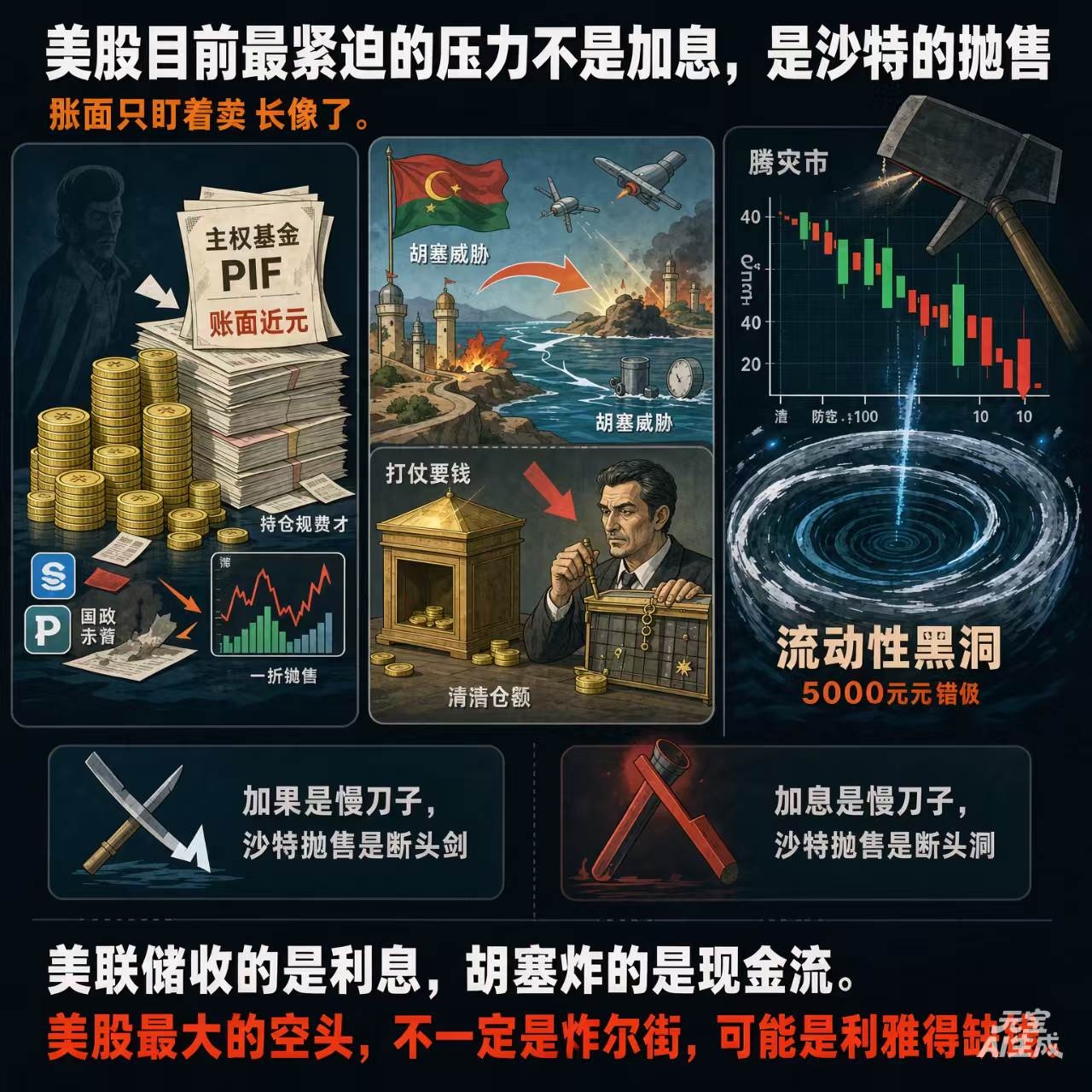
 Stop only focusing on the Federal Reserve.
The market has locked its attention entirely on interest rates and inflation, yet it overlooks a more realistic—and far more violent—variable: the paper wealth in Saudi Arabia’s hands is turning into the sword of Damocles hanging over the US stock market.
Many people’s impression of Saudi Arabia is still stuck at “there are rich people everywhere, and the petrodollars are never-ending.”
But the truth is: Saudi Arabia isn’t as rich as people imagine. It has always been a matter of earning what it spends.
Apart from that sovereign wealth fund PIF—an amount that can’t be quickly liquidated, with paper value of nearly a trillion—it really doesn’t have much in the way of actual cash in the treasury.
The problem lies in those two words: “on paper.”
The money Saudi Arabia has now is, in essence, paper wealth—positions held by various sovereign wealth funds.
When the market is good, you can brag about how much you earned in a year. But once a financial crisis hits, these positions could be worth only 10%—maybe even less.
It can only add icing on the cake. At critical moments, it simply can’t send timely help—because the position size is too large. If it really needs to sell, it would trigger a small-scale equity crash, leading to panic selling and causing massive asset write-downs.
More importantly: it’s not that nobody is forcing it to sell—someone is holding a gun to its head and telling it to sell.
The Houthi armed forces repeatedly threaten Saudi energy infrastructure and Red Sea shipping lanes. Airports in the south, oil fields, ports, and oil pipeline nodes are all within the risk radius.
Fighting costs money, air defense costs money, rebuilding costs money; after the Red Sea shipping lane was disrupted, insurance premiums and freight charges also have to be paid.
Oil price rising doesn’t mean Saudi cash flow is comfortable. When oil facilities are hit, exports are rerouted, Aramco dividends come under pressure, and the fiscal deficit expands—money becomes even tighter.
So why is Saudi Arabia, while calling for “long-term investment,” continuously liquidating Meta, PayPal, Arm options, industrial gases, and logistics real estate?
This isn’t simply rebalancing; it’s shifting overseas liquidity to domestic, safer areas—military spending, energy security, and the “2030 Vision” life-saving projects.
Right now, if Saudi Arabia dared to liquidate, it could directly trigger a market crash. Coming back with $500 billion is already pretty good. Its ability to withstand risk is extremely low.
Rate hikes are a slow knife; Saudi selloffs are a guillotine.
And the Houthis’ missiles are the hand that presses the button.
So the most urgent pressure on US stocks right now isn’t really whether rates are raised.
Instead, it’s these “paper rich” sovereign capitals: once they’re forced to sell due to war, air defense needs, fiscal deficits, and liquidity self-rescue—that’s when the real liquidity black hole appears.