



Many people will ask:
“Why is my content so good, yet nobody follows me?”
In many cases, it’s not that your content isn’t good enough.
Instead, after users watch/read it, they simply don’t know:
Who are you? What do you do? Why should I pay attention to you?
So, the first step to building a personal IP is never about rushing to post content.
Rather, it’s about figuring out two questions first:
What is your positioning? What is your persona?
① First, think through your own positioning
So-called positioning is really this: which group of people do you want to serve?
Are the users you serve brand-new crypto newbies, or seasoned veterans who’ve already been through a few bull and bear cycles?
Are you doing beginner teaching? Or macro analysis? Are you doing short-term trading? Or long-term investing?
Different users have completely different needs for content.
You can’t write one piece of content that makes beginners feel it’s simple and simultaneously makes experienced traders feel it’s deep enough.
So don’t start by thinking: “Everyone is my fan.”
It’s actually the opposite.
The clearer you are about who you serve, the easier it is for you to attract a precisely targeted audience.
② What is your persona?
Positioning answers: “Who do you provide value to?”
Your persona answers: “Why would users be willing to remember you?”
You can be: the Master of Always-Profiting? A professional trader? A beginner teacher? A market analyst? A fun-and-educational blogger?
It could even be simply: someone who stays with everyone every day to watch the market, chat, and study it.
There’s no such thing as the best positioning.
Only the positioning that’s best for you.
Whatever you’re good at, amplify it. Whatever strengths you have, reinforce them.
Don’t, just to imitate others, force yourself into a persona that doesn’t suit you. It’s awkward to be like everyone else—imitating blindly is cringe!
A persona isn’t something performed—it’s constantly amplifying the most valuable traits you have. Remember what I said—it's important!
③ Positioning also determines your business model
A lot of people actually haven’t figured this out.
What exactly do you want from creating this account?
Build influence through high-quality content, and then do subscription revenue?
So is it still through users using your invitation link to earn referral commission income?
Or, in the future, do monetization through methods like live streaming, commercial deals, courses, communities, and so on?
All of this is possible.
But you must figure this out in advance.
Because: different positioning corresponds to different business models.
For example, if your positioning is professional trading analysis, referral commissions might be a better fit.
Your perspectives, strategies, frameworks, and continued informational value.
If your strength is the exchange ecosystem and using tools, then users paying for subscriptions is more suitable for you—because it’s like a layer of paper: once you poke through, it’s gone.
If you’re especially good at teaching, then courses, training camps, paid subscriptions, and referral commissions all suit you.
④ Don’t start with “you want everything”
Many people, when they first start an account, want everything.
You want to do trading analysis, and you also want to make funny content.
You want to teach beginners, and you also want to do macro analysis.
You want subscriptions, and you also want referral commissions.
You also want to take commercial deals.
That’s right.
Once your size gets big enough, you truly have the capital to “want everything.”
The problem is: when you’re just starting out, you don’t have that capital.
You haven’t even explained clearly why users follow you, and yet you start thinking about how to monetize.
This easily leads to one result: there’s everything, but nothing stands out enough.
So in the early days of an account, I’d suggest: do subtraction first, then addition.
First find your core positioning and build one direction.
Once users get to know you and trust you, then expand slowly.
⑤ After building your homepage, first give users an “entry point”
After you’ve finished building your homepage, nickname, profile picture, and bio, the first thing I suggest you do is:
Understand and make good use of Binance’s chat room feature.
Why?
Because you need to give users a real place where they can find you.
Content brings users in, and chat rooms keep users there.
This is your private-domain entry point.
It’s actually quite simple to do this:
Go back to the top-right of the homepage → tap Messages → tap “+” → set your chat room ID → create the group.
You can set up different groups based on your own positioning.
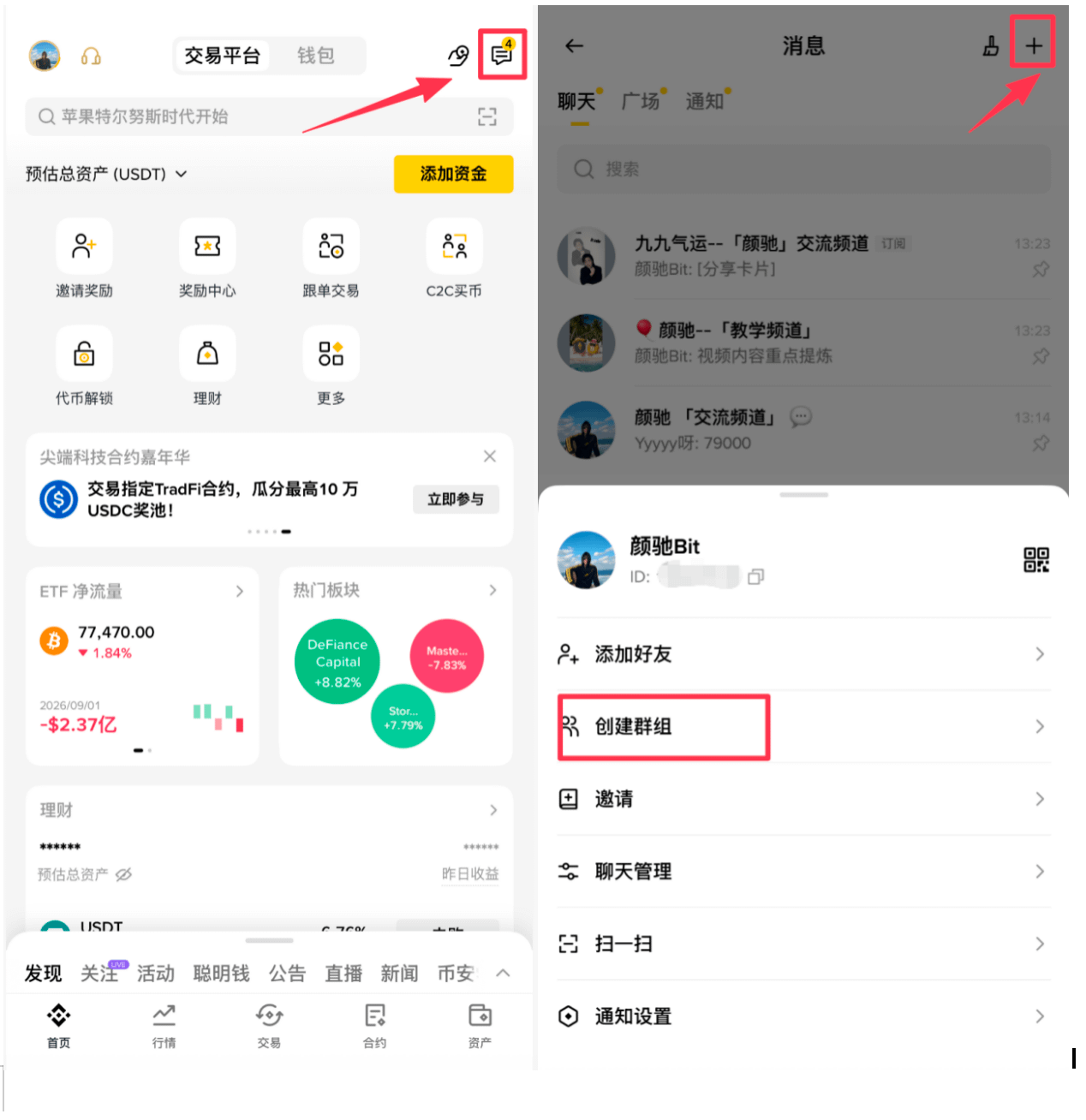
For example, I currently have three groups:
First: the subscription group.
This group has just been created, so for now there isn’t much content—mostly chat and交流/interaction.
Pay a subscription fee of 6.66U to enter and become an “unprivileged VIP.” 😄 Mainly to filter out bots 🤖—the ones begging for food!
Second: the teaching channel.
This channel mainly publishes market updates and strategy content. Usually it’s set to no chat (silenced) to prevent information from being buried by too much casual talk.
The teaching channel, as the name suggests, is where I interpret the key takeaways from my daily videos, and also the strategies I personally trade with.
Third: the communication channel.
This channel is mainly for users who use my invitation link—it's the place for further communication and interaction.
Different groups serve different functions.
That way, users also become clearer: why should I join your group? What will I get after joining?
⑥ Subscriptions and referral commissions aren’t that complicated either
A lot of people are embarrassed to talk about money.
I actually think: there’s no need to.
If you truly help users catch a decent run through your own analysis and judgment.
Users therefore gain returns.
At this point, you tell them: “If you recognize my content, you can consider using my invitation link.”
Or: “If you want to keep seeing my strategies, you can consider subscribing to my channel.”
What’s embarrassing about that? There’s absolutely nothing wrong with it.
As long as you don’t deceive users, don’t pressure users, don’t exaggerate returns, and don’t package commercial interests as selfless giving.
Earning income through your own abilities is, in itself, something very normal.
⑦ Don’t let so-called “face” block your income
Some people may think: “If I take the initiative to get others to subscribe, will that make me seem less valuable?”
“If I let others use my invitation link, will it make me look too self-interested?”
Let me say something quite direct:
Don’t let that little bit of worthless pride get in the way of the value you could have gained.
Making money has never been something to be ashamed of.
In this world, very few people do anything with zero expectations.
When Tang Sanzang went to the Western Heavens to obtain scriptures, did he really want nothing at all?
The secret scriptures are his wanting (seeking).
He wants to help everyone, and that is also a kind of “seeking.”
So: wanting something isn’t shameful.
What’s truly shameful is: you clearly have something you want, yet you pretend you want nothing.
⑧ When the market is right, be bold
If your positioning is trading analysis,
Then once you truly study the market seriously, make your judgment, and finally verify that logic.
At this point, it’s actually the best conversion moment—not to shout every day, “Come subscribe to me!”
But it’s when users truly feel your value that you naturally tell them:
“If you recognize my analysis, you can subscribe to my channel.”
Or: “If your friends around you haven’t used the Binance exchange yet, you can consider registering through my invitation link.”
This is what a fairly natural business conversion looks like.
Provide value first, then talk business—not: treat users as customers first, and only then think of how to provide value to them.
Both orders are completely different.
⑨ Sincerity is the prerequisite for all monetization
I’ve always believed that:
The two words “sincerity” shouldn’t just accompany your account journey—it should be with you as a whole person.
You can make money, and you can take ads.
You can do referral commissions. You can do subscriptions.
You can even turn your influence into tremendous commercial value.
None of this is a problem.
But you must not overpackage yourself.
Don’t package yourself as “the person who will never be wrong.”
Don’t describe one success as proof that you succeed every time.
Don’t package high-risk investments as if they’re always sure wins.
And don’t deliberately create anxiety just to drive conversions.
Because users will eventually discover the truth.
You can fool users once, but it’s hard to fool them for a lifetime.
⑩ When monetization starts producing positive feedback
When your subscription numbers grow.
As more and more users register through your invitation link.
Once you truly start earning income, you’ll find out something: you actually become even more hardworking.
Because in the past, you only had to be responsible for yourself.
Now you also have a whole group of people who believe in you.
You’ll start thinking: “I can’t let them down for their trust.” And then you’ll study the market even more seriously.
Work even harder to produce content, to review and reflect even more seriously, and to learn more diligently.
This is a very good positive feedback loop:
Provide value → earn trust → convert users → earn income → keep improving yourself → provide even better value.
The premise always comes down to two words: sincerity.
📌 Finally
So if right now you think:
“Why is my content clearly good, yet nobody follows me?”
Feel free to review your account again:
Who am I? Who do I serve? What am I good at? Why should users follow me? What will they get after following me?
In the end, how do I hope to monetize?
After thinking through these questions, you’ll realize: building a personal IP isn’t that complicated after all.
Positioning determines who you attract, and your persona determines who users remember.
Content determines why users stay.
Chat rooms determine where users settle and accumulate.
Your business model determines how your traffic generates value.
And finally, what truly determines whether you can go far is—
Still, the two words are: sincerity.
You can have ambition, make money, monetize, and pursue even bigger traffic.
But don’t ever forget: every single cent you earn today is backed by other people’s trust in you.
🎈Keep hold of this trust, and only then can you truly turn your personal IP into a business that can be built to last ten years—Yan Chi!