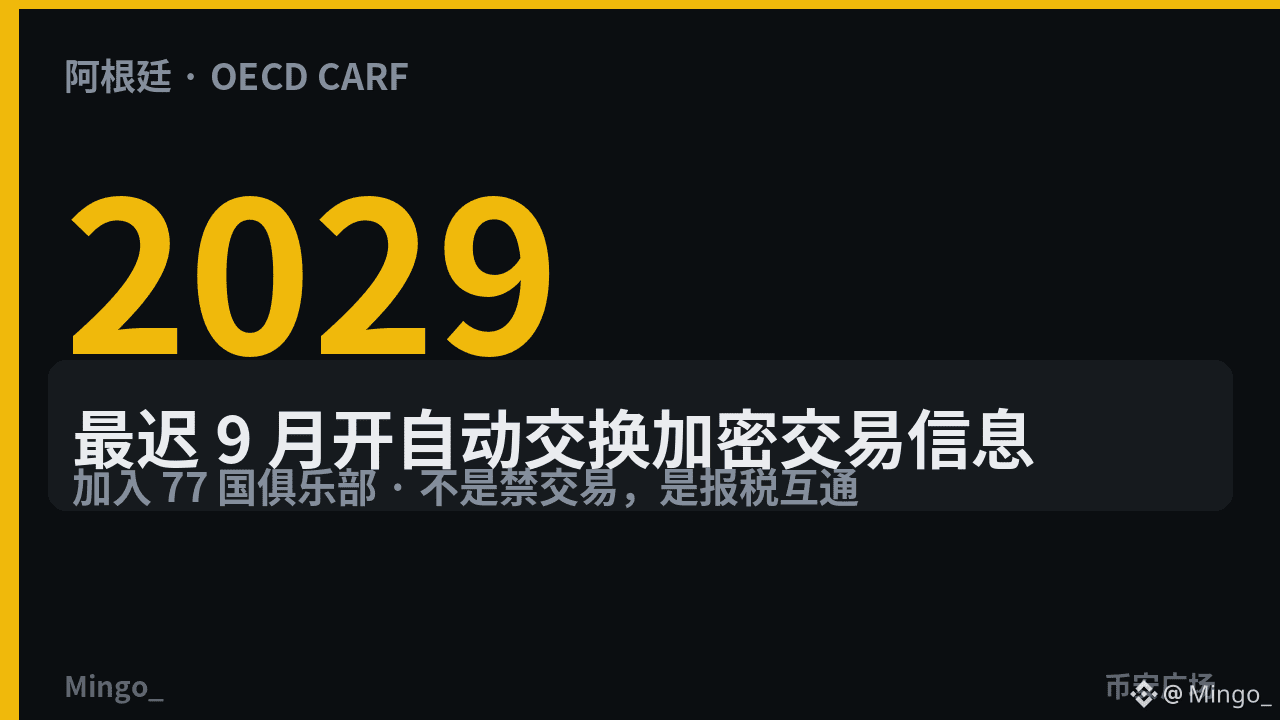
Argentina has joined the club too.
Over at the OECD, they’ve just logged it: it has committed to launching the automatic exchange of information on crypto-asset trading no later than September 2029. Right now, 77 jurisdictions worldwide have already signed on to this CARF framework, and it—along with places like the US and Mexico—lands in the 2029 group.
In plain terms: exchanges and intermediaries will need to collect users’ identities, tax residency, and trading transaction records so that tax authorities across countries can reconcile their books. This isn’t a ban on buying or selling—it’s that the tax-reporting pipeline has to line up.
On one side, Milei is still pushing a crypto-friendly stance; on the other, the “information sharing” timeline has already been nailed down. Embrace crypto if you want—but after this, it’ll be harder to hide the ledger.
#阿根廷承诺2029年采用OECD加密报告框架
Over at the OECD, they’ve just logged it: it has committed to launching the automatic exchange of information on crypto-asset trading no later than September 2029. Right now, 77 jurisdictions worldwide have already signed on to this CARF framework, and it—along with places like the US and Mexico—lands in the 2029 group.
In plain terms: exchanges and intermediaries will need to collect users’ identities, tax residency, and trading transaction records so that tax authorities across countries can reconcile their books. This isn’t a ban on buying or selling—it’s that the tax-reporting pipeline has to line up.
On one side, Milei is still pushing a crypto-friendly stance; on the other, the “information sharing” timeline has already been nailed down. Embrace crypto if you want—but after this, it’ll be harder to hide the ledger.
#阿根廷承诺2029年采用OECD加密报告框架