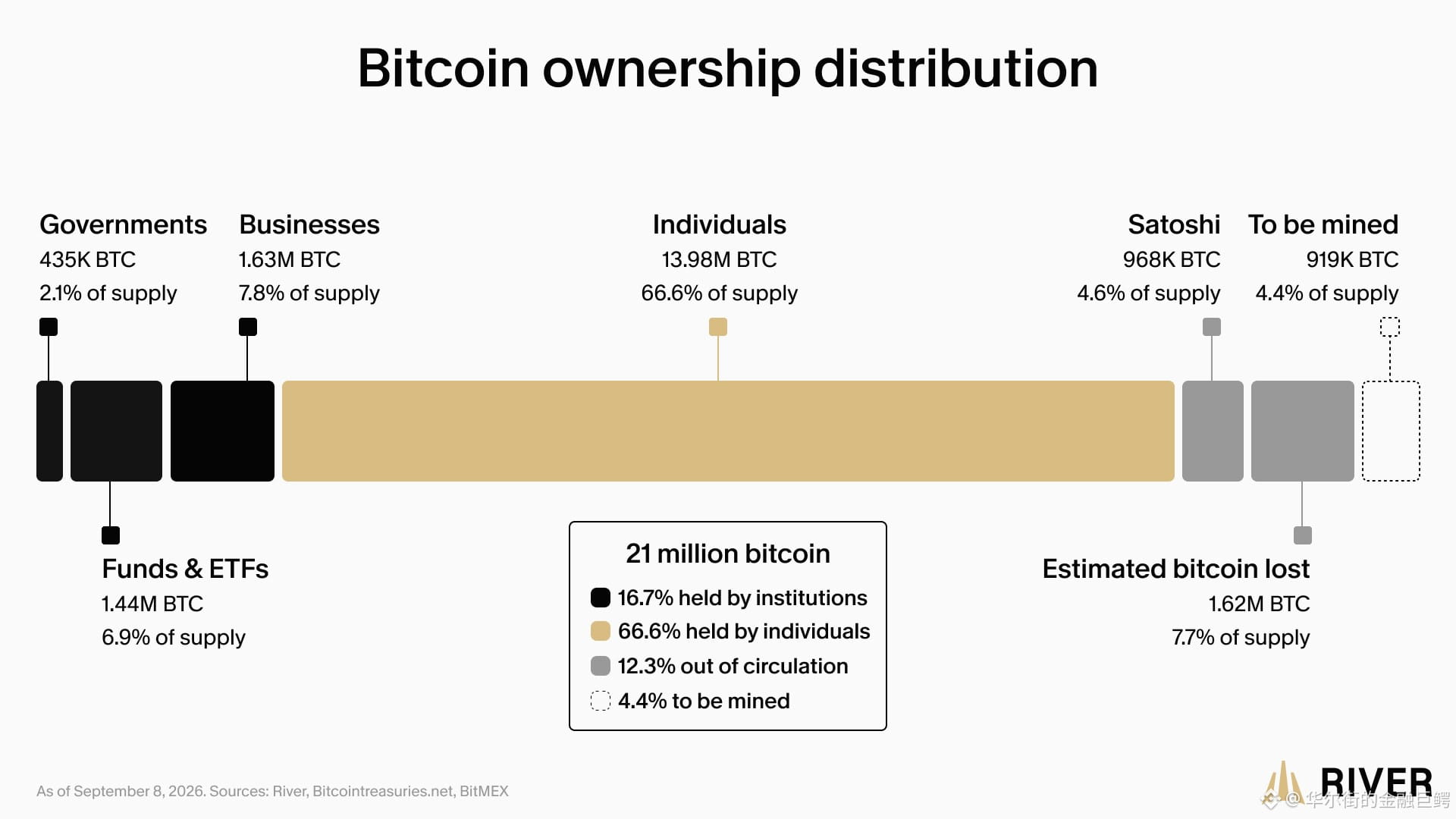
The amount of Bitcoin in the hands of institutions may not be as much as we think!
Based on data as of September 8, 2026, individuals hold 13.98 million BTC, accounting for 66.6% of the 21 million total supply cap.
Institutions (governments, companies, and funds/ETFs combined) hold 16.7%.
About 12.3% is out of circulation (Satoshi’s holdings plus an estimated number of lost coins).
Only 4.4% has not yet been mined.
The breakdown is as follows:
Individuals: 13.98 million BTC, 66.6%
Companies: 1.63 million BTC, 7.8%
Funds and ETFs: 1.44 million BTC, 6.9%
Governments: 435,000 BTC, 2.1%
Satoshi: 968,000 BTC, 4.6%
Estimated lost: 1.62 million BTC, 7.7%
Not yet mined: 919,000 BTC, 4.4%
ETFs changed who can buy Bitcoin, but not who truly owns Bitcoin.
Most Bitcoin is still in the hands of individuals.
The part that is truly “tight” in terms of liquidity is that 16.7% institutional holding, plus those coins that will never move.
That’s why ETF inflows of only a few tens of billions of dollars can still push the price to $77,000.
Bitcoin supply: 66.6% individuals, 16.7% institutions, 12.3% out of circulation, 4.4% not yet mined.
#比特币守稳77000美元上方
Simply put: the biggest share of Bitcoin is still held by ordinary people, and institutions aren’t that dominant.
Many people think that once ETFs are approved and companies buy aggressively, institutions have already taken all the coins.
But the reality is: nearly two-thirds (66.6%) is still in the hands of individuals.
All institutions combined are only 16.7%.
Satoshi’s nearly 1 million coins + the estimated 1.6+ million lost coins are basically “dead coins”—they won’t move.
The coins that can still circulate are actually quite scarce.
So even if ETFs bring in only a few tens of billions of dollars, they can still lift the price to $77,000—because there just aren’t many coins available to sell.
ETFs only make it easier to buy Bitcoin, but they haven’t changed the reality that individuals are still the largest holders.
Out of circulation, there’s only 4.4% that hasn’t been mined yet.
Based on data as of September 8, 2026, individuals hold 13.98 million BTC, accounting for 66.6% of the 21 million total supply cap.
Institutions (governments, companies, and funds/ETFs combined) hold 16.7%.
About 12.3% is out of circulation (Satoshi’s holdings plus an estimated number of lost coins).
Only 4.4% has not yet been mined.
The breakdown is as follows:
Individuals: 13.98 million BTC, 66.6%
Companies: 1.63 million BTC, 7.8%
Funds and ETFs: 1.44 million BTC, 6.9%
Governments: 435,000 BTC, 2.1%
Satoshi: 968,000 BTC, 4.6%
Estimated lost: 1.62 million BTC, 7.7%
Not yet mined: 919,000 BTC, 4.4%
ETFs changed who can buy Bitcoin, but not who truly owns Bitcoin.
Most Bitcoin is still in the hands of individuals.
The part that is truly “tight” in terms of liquidity is that 16.7% institutional holding, plus those coins that will never move.
That’s why ETF inflows of only a few tens of billions of dollars can still push the price to $77,000.
Bitcoin supply: 66.6% individuals, 16.7% institutions, 12.3% out of circulation, 4.4% not yet mined.
#比特币守稳77000美元上方
Simply put: the biggest share of Bitcoin is still held by ordinary people, and institutions aren’t that dominant.
Many people think that once ETFs are approved and companies buy aggressively, institutions have already taken all the coins.
But the reality is: nearly two-thirds (66.6%) is still in the hands of individuals.
All institutions combined are only 16.7%.
Satoshi’s nearly 1 million coins + the estimated 1.6+ million lost coins are basically “dead coins”—they won’t move.
The coins that can still circulate are actually quite scarce.
So even if ETFs bring in only a few tens of billions of dollars, they can still lift the price to $77,000—because there just aren’t many coins available to sell.
ETFs only make it easier to buy Bitcoin, but they haven’t changed the reality that individuals are still the largest holders.
Out of circulation, there’s only 4.4% that hasn’t been mined yet.