

Miscellaneous Essay Custom Workshop · September 5, 2026
In past years, the September script was fixed: Apple held a launch event at dawn, domestic brands stayed silent as a group, and after Cook finished speaking, they started copying overnight. Global tech media stayed up late writing articles, all using the same formula — "Apple has reinvented XX, domestic brands say the pressure is not too great, and they’ll copy it tomorrow."
This year's script has been torn up.
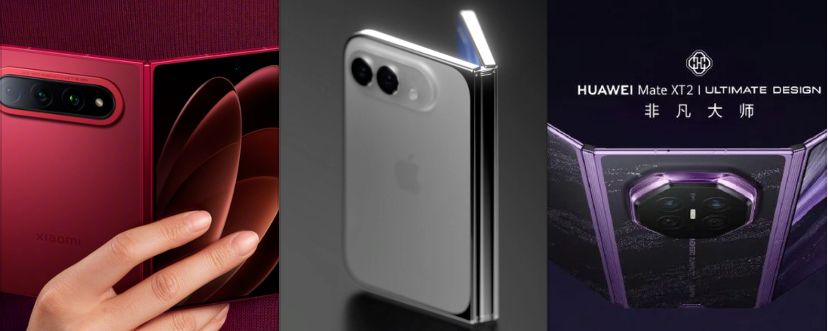
At 2:30 p.m. on September 7, Huawei held a launch event in Shenzhen; at 7:00 p.m. that same evening, Xiaomi held a launch event in Beijing; and at 1:00 a.m. on September 10, Apple finally began its event in California, unhurried as ever. Three days, three events, all foldables — the industry calls this "the most concentrated foldable-phone three-way showdown in the history of the smartphone world," and I call it this: the exam hasn’t even started, but two students have already finished their papers and turned them in; by the time proctor Apple got the papers, the whole class had already been dismissed.
Apple’s foldable phone is seven years late—everyone else finished their homework and left class, and the top student only then raises a hand to say they need the restroom.
On September 1 this year, Apple finally changed CEOs—Cook, after 15 years on the job, stepped back behind the scenes, and hardware engineer John Ternus took over. On just his 9th day in office, the new CEO had to hold his first-ever launch event, with the star still being the most expensive iPhone in history.
The shortest probation period in history: after handing over your previous job, at least you’d usually need to figure out where the break room is. But on day 9 after taking office, Ternus got hit straight in the face with a KPI: a foldable phone that’s seven years late. Call it what you want, but this isn’t probation anymore—this is a probationary dive, and the first jump is straight off the 10-meter platform.
September 7 belongs to Chinese manufacturers
Huawei at 2:30 p.m. in Shenzhen, starring the Mate XT2, the second-generation triple-fold. Unfolded, it’s 10.2 inches—bigger than an iPad mini. Also announced alongside it was HarmonyOS 7. One detail from the event was especially interesting: the top-spec version has 2TB of storage, a privacy screen, and a stylus, with the specs maxed out—but the color options? Just one: purple.
A 20,000-yuan business flagship, in one color only: purple. Huawei’s message is clear—buyers who can afford this version of the boss phone don’t care about color; what they care about is whether, the moment they pull out their phone, the neighboring boss pulls out the same model.
At 7 p.m., Xiaomi takes over in Beijing, four and a half hours apart, with the Lei Jun team running nonstop. The Xiaomi 18 Fold, a wide foldable, debuts with the in-house Xuanjie O3 chip, scoring over five million points. Tablet and phone together on stage—think that’s all? At the end of the event, Lei Jun slowly pulled out three extended-range SUVs.
Yes, you read that right: the final segment of the phone launch event is selling cars. The audience walks in expecting a phone event, and walks out with a car sitting in their shopping cart. You go into Xiaomi Home wanting to buy a power bank, and come out signing a car purchase contract, while the sales rep still asks warmly: Bro, maybe take a look at the phones too?
If Cook happened to see this launch event, his expression would probably be the same as at a parents’ meeting: someone else’s kid not only gets top marks, but also makes enough to pay university tuition on the side.
The early hours of September 10, Apple’s home turf
The launch theme was quite interesting: “Light Up a New Chapter, Shine Bright.” A new CEO’s debut, the first foldable—this was supposed to be Apple’s annual peak moment. But leaker Gurman gave it away early: the crease on Apple’s first foldable phone had “already come close to disappearing, but has not yet truly been conquered.”
“Almost disappearing”—think about those words. It’s like saying “I’m almost getting into Tsinghua,” or “I’m almost financially free,” or a courier tracking page saying “Out for delivery” — do you know how far away it is? No. But you know it’s almost here, and once it’s almost here, it’s forever on the way.
To make the body only 4.5 mm thick when unfolded, Apple made some trade-offs: no Face ID, side fingerprint unlock instead, telephoto lens removed, dual cameras. A phone starting at 14,000 yuan uses the same unlocking method as your 5,000 yuan Android phone, and it has one fewer camera than your 5,000 yuan phone.
The most expensive iPhone in history starts adding subtraction to its spec sheet while its price keeps adding up. Apple calls this “the price of ultimate thinness”; I call it: you spent 20,000 yuan to buy a crease, with a phone thrown in as a bonus.
Even more extreme is the inventory. Initial stock may be under one million units, and scalpers are already itching to move. The most likely scenario is this: you set your alarm for 1 a.m. to watch the launch, then at 7 a.m. check the official site—and it’s sold out. The markup channel, though, is wide open. This may be the first time Apple lets you spend 14,000 yuan just to experience trying to buy Moutai.
By the way, because storage chips are rising across the board, this wave of flagship phones is collectively getting 1,000 to 2,000 yuan more expensive. You usually don’t read news about storage price hikes, but the result of those hikes will ultimately land precisely in your shopping cart. The rate at which your wallet shrivels has finally caught up with the rate at which storage chips are getting more expensive—congratulations.
After three days, who had it worst
Three launch events in three days—the ones who suffer most aren’t the manufacturers, but the tech independent media.
On September 7 in Shenzhen during the day, Beijing at night, then staying up to watch the livestream in the early hours of September 10, writing until the morning of September 11, and the headline on the finished piece was the same every time: (The Year One of Foldables Has Arrived). The word “Year One” has been used for foldables for seven years—every year is Year One, the same logic as “I’ll start saving money next month.”
Consumers’ schedules were neatly arranged too: on September 7 they watched Huawei and got excited, in the evening they watched Xiaomi and got conflicted, and in the early hours of September 10 they watched Apple and found peace—it's not that Apple is bad, it’s just that a 14,000-yuan crease really can bring peace.
That said, these three overlapping launch events are actually a good thing. Domestic brands daring to hold their launches before Apple, daring to go head-to-head with Apple in the same week—seven years ago, nobody could even imagine that. Back then Apple was teaching class and everyone else was copying homework; now it’s three top students turning in their exams at the same time, each with their own tricks: Huawei with a triple-fold, Apple with a double-fold, and Xiaomi turning its launch into an auto show.
As for who wins in the end? Apple starts preorders on September 12, and the answer will come soon enough. Anyway, for consumers like me, the winning side is already certain—the fiercer the three-way battle, the safer I am. I’m just standing by cracking sunflower seeds: you compete, you compete; you’re folding phones, I’m protecting my wallet.
— Presented by the Custom Essay Workshop
You have ideas, I have a pen—who among serious people writes essays? But if I write one, I guarantee it’ll look better than a serious person’s.
If you can chew through snacks worth tens of thousands, what’s one more video record of your life? The custom video workshop is here for you: you talk, I cut the film. 40 seconds of footage gets turned into one video you’d never admit you shot yourself, 100 yuan each, delivered in 24 hours—cheaper than a foldable phone, and without the crease.