
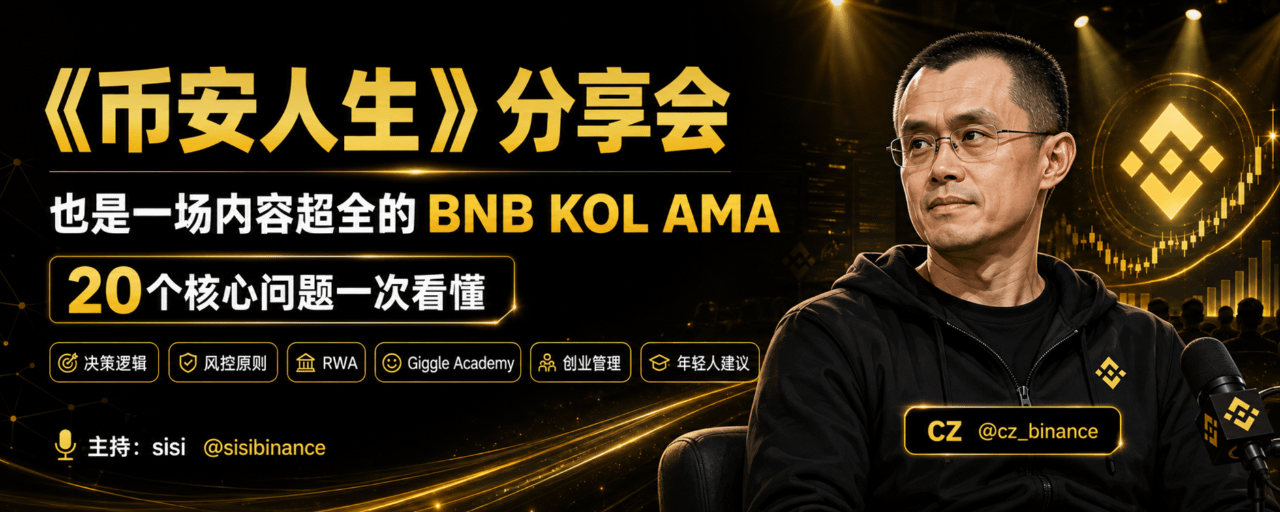


This BNB Life (Binance Life) sharing session is also an AMA with extremely comprehensive content.

The whole session is led by sisi
@sisibinance steered the discussion from start to finish; most of the questions that people in the crypto community are usually curious about and want to ask were covered, CZ @cz_binance
And each question was answered with concrete, practical guidance. I sincerely recommend everyone to watch it carefully.
1. How to make decisions: what to stick with and what to give up
The core judgment is in two steps: first determine whether it’s a big decision or a small one, then decide whether it’s reversible or irreversible.
In the market, 90% of decisions are small and reversible. They allow you to make quick calls, but you can’t go down one road forever. You should regularly review and adjust; if it doesn’t work, change it (for example, previously holding a wait-and-see stance on RWA projects—when the momentum picked up, then step in and support).
Irreversible big decisions must be made slowly and in fewer numbers. And there’s another type of “big but reversible” decisions—where switching costs are high—so you should also do as little as possible.
Every decision has a bottom line you don’t need to think about: don’t do anything that harms users. If you touch that line, veto it immediately—no need to纠结.
When trading, especially pay attention to risk control. Even if it’s a game with positive mathematical expectation, if you lose even once, you could end up going to zero entirely—so you absolutely must not play it that way.
Don’t just focus on returns for risk control—first check whether you can withstand the worst-case outcome.
2. The impact of crypto openness in different countries—which Southeast Asian countries have potential?
Big countries opening up will definitely bring huge benefits to the industry.
Many countries worry that crypto will undermine their sovereign currencies—but that’s a misconception. Issuing a domestically compliant stablecoin can actually make fiat currency circulate more widely globally. This understanding needs to be communicated and gradually corrected.
The original prediction was “rural areas encircle the cities”—take down small countries first, then influence big countries. Recently, the US attitude has turned more friendly, which is beyond expectations and directly drove the market upward.
A small country’s influence is limited, but combined together, the overall impact is very large.
Southeast Asia today: Thailand and the Philippines are leading. The Philippines already has licenses and banking channels connected, so users no longer need to go through C2C to deposit funds. Malaysia is moving a bit slower, but the overall regional development is still fast. Looking long-term, I’m bullish on the region.
3. “CZ Principles”—has there been an update to Article 73? (The book already has 72 articles.)
Later, there really was a reorganized and updated version, but when the book was published, it wasn’t included.
I think it’s not appropriate to put tutorial-type content and personal memoirs together. Originally, the book’s ending at “If you can, you must” would have had a better effect.
The original intention of these principles is for internal use—to help align the team with my decision logic. They don’t represent a standard answer. Use them as reference; if they give you inspiration, that’s enough. No need to copy everything wholesale.
4. Free education project Giggle Academy @GiggleAcademy: when will it reach 10 million users?
Growth data: last year in June, there were only a few tens of thousands of users. This year at the beginning, it reached 100,000. Now it’s already 1.5 million+.
Based on this trend, in 1–2 years it may reach 10 million, but I won’t make guarantees (it still feels like I’m being too low-key).
I care more about long-term user retention. The ideal scenario is that the child can use it continuously for 18 years. We’re still far from that.
Right now, I’ve only built content for ages 2 to 6. The 6 to 10 age-course hasn’t launched yet, and the content library isn’t rich enough. At the same time, we also need to control the child’s screen time.
Based on comprehensive estimates, in about 2–3 years it could reach the goal of 10 million users. The ultimate target is 100 million, even 1 billion.
5. Traditional enterprises enter Web3: how to avoid traps, and how to find opportunities.
Risk control is always number one. When you encounter a new project or a new product, don’t invest too much money at once. Start with a small position to test the waters and see if you can adapt. Only add more after you’re 100% sure it works. For major decisions, be cautious; for small decisions, stay flexible.
Binance is not just an exchange platform; many functions can be used by real businesses too:
For example, Binance Pay can do cross-border settlement at low cost—with high efficiency and low fees. There are also wealth-management features that can provide stable monthly income. Many hidden options even I don’t fully understand—so everyone can explore more!
6. Nine years of entrepreneurship—the most stressful moments.
There are very few feelings of “despair”; my personality is generally optimistic and I have strong pressure tolerance. There’s even a word that means this: being tough and long-lasting.
The two phases with the most pressure: when the platform just goes live and BNB drops below its issue price—early investors numbering in the tens of thousands were losing money. Those two weeks carried the heaviest psychological burden.
In the first couple of years, handling issues related to the US put more pressure on the personal level. But when I ask myself whether I did right by the users and the industry, my psychological pressure ends up being much less—though individuals still have to bear the consequences that follow.
7. Should people in the crypto industry proactively pursue influence?
There’s no standard answer. It depends on your personal style and what your project needs.
“The early bird gets the worm” is applicable everywhere—if you can quietly do things well and make money, that’s the best solution.
But influence itself is also a development path. Some projects can be hard to start if they get zero exposure. Having influence means you can get resources more easily. Both have pros and cons—just weigh and balance them yourself.
8. Will all future assets be put on-chain to achieve freedom of capital?
Yes, definitely. The evolution roadmap is clear: stocks go on-chain first—aimed at global investors, with higher valuations and better liquidity.
Then there’s money (stablecoins). Right now, 90% of stablecoins are pegged to the US dollar, which has already effectively expanded the dollar’s influence in the crypto world.
Next, put forex on-chain: traditional forex quotes aren’t transparent; on-chain you can trade 7×24 hours with prices completely公开.
Further down the line, art, cultural property rights, and real estate can also be tokenized and put on-chain. It’s just that this type of asset has poor liquidity, so the rollout will be slower.
9. How to adjust your mindset when you hit a fortune / a low point—advice for the post-00s generation.
Getting rich overnight sounds great, but “it comes fast and goes fast.” The risks are extremely high, and most people simply can’t hold on to it. Only long-term, steady accumulation is the safest and calmest approach.
Even if you’re lucky enough to make quick money, you absolutely can’t go all-in. Risk control is always the bottom line. Going all-in to bet on getting rich overnight might also mean going to zero in a single night.
I don’t recommend young people fixating on getting rich overnight. Young people’s biggest capital is time. Each month, set aside a small portion of idle money for systematic investing, and stick with it for ten years—returns will be very significant. There’s no need to rush success. There is no risk-free, guaranteed way to get rich overnight.
10. How should newcomers in blockchain participate in industry change?
In six months, who can predict which track will be hot? You don’t need to force a guess.
The entry barrier for blockchain is low, but there are many scammers too. Newcomers’ first priority is to pay attention to risk control.
When pitching projects, first look at the community. Projects without a real community probably won’t go far. Even with a community, you still have to distinguish whether it’s truly active users or fake hype created by sockpuppets.
11. The core factors that determine success or failure of blockchain projects.
In the end, it’s about the people, and it’s about the team.
There are plenty of teams that are strong technically and can build solid, qualified products. What’s hardest are three qualities: resilience (can they push forward under adversity?), a positive mindset (can they make stable long-term money?), and a sense of mission.
During a bull market, it’s a mixed bag and hard to tell. Recently, lots of people from the industry moved to the AI track—ironically, that filtered out a batch of those who were just trying to grab quick money. What’s left to deepen blockchain usually has a stronger sense of mission.
Compared with the AI industry: AI is highly centralized, and most of the windfall has basically been taken by top big companies; in the crypto industry, opportunities for ordinary people to make money are relatively more.
12. Do young people still need to go all-in on Bitcoin now? Will there be opportunities in the future?
I absolutely don’t recommend that anyone go all-in on any asset casually.
Before going all-in, ask yourself: if it goes to zero, will your life be affected? If the answer is “yes,” then don’t do it—and you definitely can’t invest borrowed money.
When I went all-in on Bitcoin back then, I was already over 35+. Even if it went to zero, I could still work and support my family—because I had enough of a safety cushion.
In the future, opportunities will only be more than in the past. Bitcoin could still rise several hundred times, but no one knows how long it will take. In the short term, it can still drop. Besides Bitcoin, there are many other tracks.
Allocation advice for young people: most of your position should be in mainstream blue-chip coins. Absolutely don’t sell your house or hollow out your entire savings to enter. You can take 10%-20% of your monthly income for high-risk investments, as long as it doesn’t affect your basic living needs.
13. In the AI era, what will education become? Has the初心 (original intention) of Giggle Academy changed?
Giggle Academy was already, from the very beginning, a project for the AI era. On day one, it was already planned to push AI capabilities to the extreme.
At present, pure AI can’t yet build a complete systematized education curriculum for ages 0 to 18 from scratch. It can only answer questions in a scattered way. The current stage is: human experts design the syllabus outlines, and AI is used to improve content production efficiency.
The ultimate future form: one AI mentor can accompany a child to complete the entire growth and education. If the day really comes and Giggle Academy has to stop, it doesn’t matter. It’s already a public-benefit project. The goal is simply to produce the best education product.
Traditional campus education is standardized on average—it trains standardized talent for factories;
Future global competition will be intense. The top 0.1% will earn far more than ordinary people. So education should preserve basic general knowledge, while digging deeper into each person’s strengths.
AI-driven one-on-one teaching will be the mainstream in the future, with costs far lower than hiring offline teachers.
14. When starting over again, what direction would you choose—and when would you go all-in?
Don’t just look at what’s hottest when starting a business. Combine these three things:
What you’re good at, what you’re interested in, and whether this has social value—the overlap of all three is what you should do.
Even if AI becomes even more popular, I won’t do it—because I don’t have technical accumulation, and entering wouldn’t give me an advantage. I’ll still choose something related to crypto. I’ve done it my whole life; I’m familiar with it.
Don’t blindly follow the trend. If someone makes money opening a Sichuan restaurant, you don’t necessarily need to open one too. NVIDIA spent decades focusing on graphics cards before waiting for the AI windfall. Apple has also gone through multiple cycles of ups and downs.
The premise of going all-in on entrepreneurship: once the product has been validated as a market fit, then you can go all-out.
15. What if you miss the trade and feel anxious?
As long as trading makes you feel noticeably anxious, the most direct solution is to reduce your position size.
If your position size is smaller, the impact of market volatility on you will naturally be smaller too. There’s no perfect solution for missing the trade anxiety.
16. The next phase of Binance’s ecosystem growth hotspots.
The centralized exchange business is currently run by the “sister”—He Yi, (何一).
@heyibinance
Responsible. Currently, RWA (real-world asset tokenization) is growing very fast and is the core main line.
Binance itself isn’t suitable to be an asset issuer. Its positioning is to build infrastructure. Working with the whole ecosystem—BNB Chain, PancakeSwap, and more—together with global securities firms, Binance pushes forward in coordination.
The future won’t force trends into existence. Whatever projects emerge in the community and gain momentum will cause the whole ecosystem to follow along and get supported.
17. If you achieve financial freedom, do you still have worries? What does happiness come from?
Having money doesn’t mean lasting happiness. The happiness brought by wealth fades extremely fast: doubling your salary makes you happy for two weeks; adding zeros to your assets makes you happy for a month—then you return to your original state.
My own daily spending isn’t high. I’m not interested in sports cars or luxury goods. Most of my happiness comes from outdoor activities like skiing, kitesurfing, and surfing.
Priority order for happiness:
Health: People with good health have a hundred kinds of worries; people who lose their health have only one.
Family: the support and warmth from your loved ones.
High-quality friends: friends are valuable not because there are many, but because they’re few and excellent.
Finally comes your career and making money. As long as you have enough to get by comfortably, more won’t make you any happier.
18. How can minimalism resolve complex regulatory crises?
When you face a complex crisis, simplify the issue and return it to the most core principles—then decision-making becomes easier.
For example, when facing overseas law-enforcement pressure and all kinds of complex options, I just go back to one bottom-line: does this decision protect users’ interests? Hold on to this yardstick, and even under huge pressure you’ll still know how to choose. Back then, the Nigeria incident was handled this way.
19. Why is crypto adoption in Hong Kong progressing slowly?
The more mature the financial system, the slower the policy iteration. Hong Kong’s traditional brokerage and banking systems are huge. Every new rule has to be assessed repeatedly for its impact on the existing industry, and institutions need plenty of transition time too. That’s why compliance updates are measured in “years,” not in the “days/hours” language used in the startup world.
Also, Hong Kong has to consider the policy spillover effects on the Mainland, and balance two real-world challenges:
The relationship between digital currency and the goal of internationalizing the RMB, and the challenges of cross-border circulation of crypto assets for foreign-exchange management—each of these issues has no simple answer, so the timeline is long.
But the regulatory authorities in Hong Kong have a strong subjective will—only, the difficulty of implementation is indeed very high.
20. Is university a good place for promoting crypto?
Yes. In history, most major changes began in campuses, which makes it very suitable for promoting emerging industries.
But crypto is a finance track, and campus promotion has a certain level of sensitivity. Previously, the lectures at the University of Hong Kong got a very good response, and Binance also provides the most comprehensive free blockchain education resources in the industry.
In the future, the whole industry can further increase the efforts of campus-based popular science.
That’s all the content for this sharing session!
Actually, throughout this whole conversation, CZ’s logic has stayed very clear: bottom-line principles won’t budge. Small matters can be reversed and tested quickly. Big matters that can’t be reversed require extreme caution. Risk control always comes before returns.
Whether you’re a newcomer just entering the industry, a trader playing the market, or a friend创业 building a project, you can all map yourselves to your own stage and use it as a reference.
If you think it’s useful, you can pass it along to friends around you in your circle. We’ll make money slowly and walk steadily!