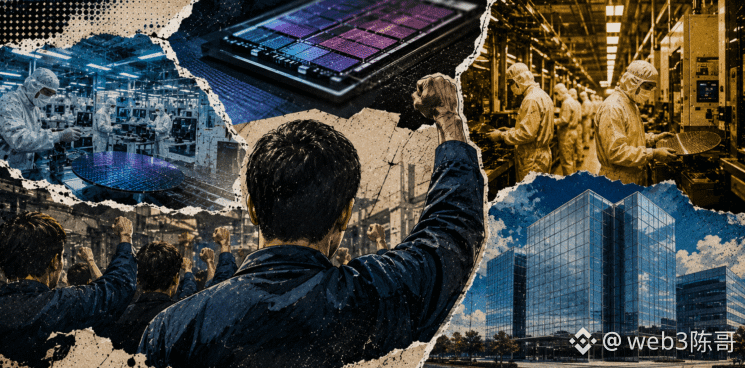
🔥 Micron is raking in huge profits, yet employees are preparing to put a “strike” on the table—this standoff may not be just about wages!
In Micron’s latest fiscal Q3, the gross margin hit 84.9%, a company record. But on the other side, Taiwan’s two major unions’ preliminary investigations show that the proportion of employees supporting a strike has already reached about 80%. The unions’ demands are also clear: the current performance-bonus allocation is too opaque, and they want to change IPP to a more reasonable profit-sharing mechanism.
Why is this worth the market’s attention?
Because Micron is right at the takeoff point of the AI storage super-cycle. In the previous quarter, revenue reached $23.86 billion, up 196% year over year. Micron’s three major product lines—HBM, high-capacity DIMMs, and server DRAM—together contributed about $10 billion, with scale already several times larger than a year earlier. HBM4 has entered mass production and is now part of Nvidia’s next-generation platform supply chain.
Put simply, AI companies around the world are buying compute at a frenzy, and behind that compute are not only GPUs, but also the need to consume huge amounts of memory and storage.
So, on the surface, Micron employees’ negotiation with the company is about “how bonuses are split,” but underneath it is a long industrial chain. If talks were to truly turn into a work stoppage, the first concern the market would have would not just be Micron’s stock price, but whether key component suppliers like HBM and DRAM could face disruptions.👀
That said, there are still several steps before a real strike can happen, and mediation hasn’t started yet. Winning a vote doesn’t necessarily mean a shutdown will follow.
But the interesting part is that this phenomenon is reminding the market of one thing: the AI arms race has already burned down to the bottom of the supply chain.
Previously, everyone watched the GPU story. Now people are starting to watch HBM; previously, reading Nvidia’s earnings was enough. Now you also have to see who supplies it with memory, who manufactures storage, who is expanding capacity, and whether there are bottlenecks in the supply chain.
This is the same for the crypto market.
When an AI narrative truly spreads, capital won’t forever chase only a few AI flagship names. Directions that “sell shovels,” like chips, storage, electricity, and optical communications, could also become places where funds look for new opportunities.
The more intense AI gets, the more precious the underlying resources become. What’s really worth watching is often not the person best at telling stories, but the one holding scarce capacity. 🚀$ETH $MU $SNDK #波场主网激活TVM布拉格大阪兼容
In Micron’s latest fiscal Q3, the gross margin hit 84.9%, a company record. But on the other side, Taiwan’s two major unions’ preliminary investigations show that the proportion of employees supporting a strike has already reached about 80%. The unions’ demands are also clear: the current performance-bonus allocation is too opaque, and they want to change IPP to a more reasonable profit-sharing mechanism.
Why is this worth the market’s attention?
Because Micron is right at the takeoff point of the AI storage super-cycle. In the previous quarter, revenue reached $23.86 billion, up 196% year over year. Micron’s three major product lines—HBM, high-capacity DIMMs, and server DRAM—together contributed about $10 billion, with scale already several times larger than a year earlier. HBM4 has entered mass production and is now part of Nvidia’s next-generation platform supply chain.
Put simply, AI companies around the world are buying compute at a frenzy, and behind that compute are not only GPUs, but also the need to consume huge amounts of memory and storage.
So, on the surface, Micron employees’ negotiation with the company is about “how bonuses are split,” but underneath it is a long industrial chain. If talks were to truly turn into a work stoppage, the first concern the market would have would not just be Micron’s stock price, but whether key component suppliers like HBM and DRAM could face disruptions.👀
That said, there are still several steps before a real strike can happen, and mediation hasn’t started yet. Winning a vote doesn’t necessarily mean a shutdown will follow.
But the interesting part is that this phenomenon is reminding the market of one thing: the AI arms race has already burned down to the bottom of the supply chain.
Previously, everyone watched the GPU story. Now people are starting to watch HBM; previously, reading Nvidia’s earnings was enough. Now you also have to see who supplies it with memory, who manufactures storage, who is expanding capacity, and whether there are bottlenecks in the supply chain.
This is the same for the crypto market.
When an AI narrative truly spreads, capital won’t forever chase only a few AI flagship names. Directions that “sell shovels,” like chips, storage, electricity, and optical communications, could also become places where funds look for new opportunities.
The more intense AI gets, the more precious the underlying resources become. What’s really worth watching is often not the person best at telling stories, but the one holding scarce capacity. 🚀$ETH $MU $SNDK #波场主网激活TVM布拉格大阪兼容