


When I first looked at Rayls, “private settlement” sounded like a broad privacy claim.
The interesting part is what happens underneath.
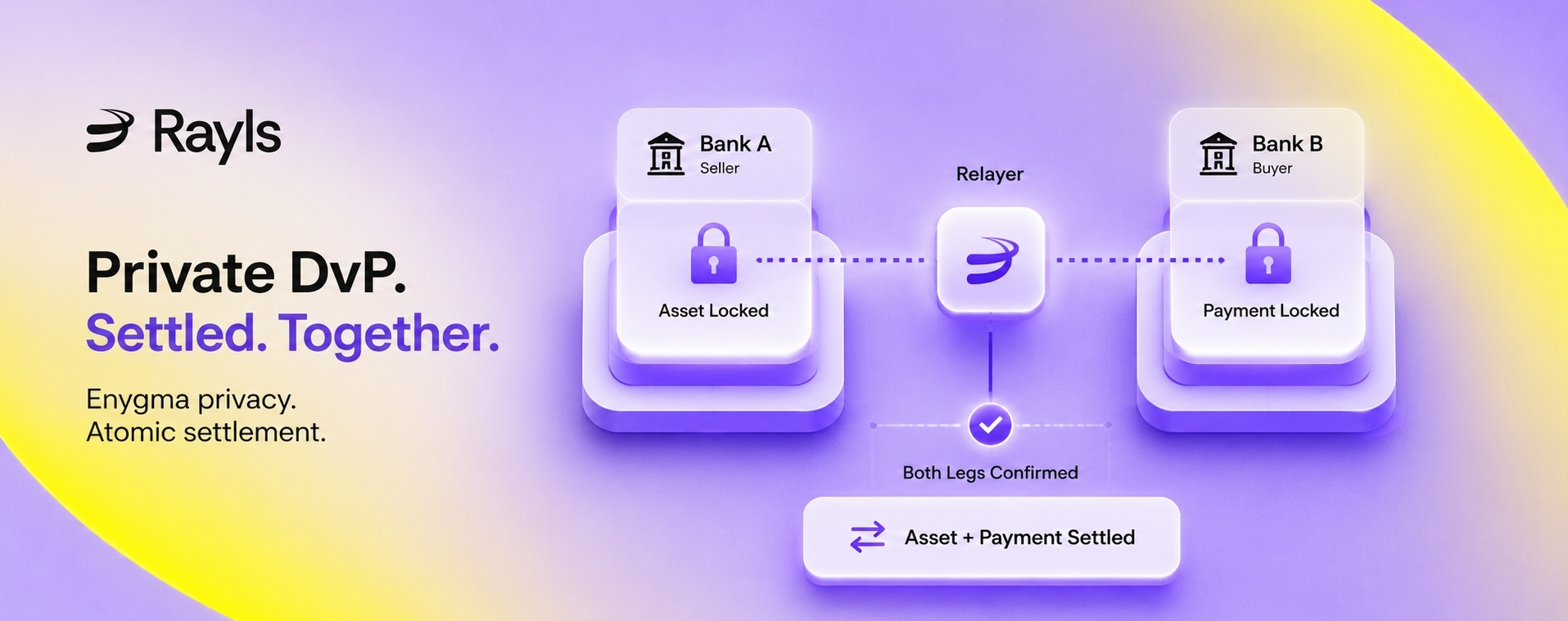
Rayls Enygma can be used for Delivery-versus-Payment (DvP), where an asset and its payment are exchanged together instead of relying on one side to trust the other to complete their leg later.
Here is the part I think is worth understanding.
1. The asset and payment start on different Privacy Nodes
Imagine Bank A wants to sell a tokenised asset to Bank B.
Bank A's asset sits on its Rayls Privacy Node.
Bank B's payment sits on its own Privacy Node.
This is important because Rayls does not require both institutions to give up control of their own environments. A Privacy Node is a sovereign EVM-compatible chain operated by the institution itself.
2. Bank A locks the asset
The seller first deposits the asset into the DvP handler on its Privacy Node.
The asset is now locked for the swap.
It cannot simply be transferred somewhere else while the DvP is waiting.
At this point, Bank A has committed the asset without handing control of its whole private ledger to Bank B.
3. The payment leg is coordinated privately
Bank A initiates the cross-chain DvP request, specifying the asset, the amount of Enygma payment required, the destination Privacy Node and an expiry time.
The Rayls relayer carries the settlement message to Bank B's Privacy Node.
If Bank B has enough Enygma payment, its payment leg is locked there.
This is where the architecture gets interesting: the two sides are on separate institutional chains, but the settlement is coordinated as one transaction flow.
4. Both sides succeed, or the trade can be cancelled
If both legs are ready, the relayer completes the DvP.
The seller's locked asset is removed from its side and represented on the buyer's Privacy Node.
At the same time, the Enygma payment is released to the seller.
If the swap expires or the counterparty does not respond, the process can be cancelled and the locked funds can be recovered.
That failure path matters.
A settlement mechanism is not only about the successful transaction. You also need to know what happens when the other side never completes its part.
Where does the privacy come in?
The DvP mechanism handles the atomic exchange.
Enygma handles the confidentiality around the transaction.
Rayls documents Enygma using cryptographic components including Pedersen commitments and zero-knowledge proofs. The network can verify that the transaction is valid without exposing the sensitive transaction data to everyone else.
There is another detail I find more interesting than simply saying “the transaction is private.”
Rayls separates spending authority from viewing authority.
An authorised auditor can receive a view-only key that allows them to decrypt specific transactions they are permitted to inspect. That means audit access does not automatically give the auditor the ability to move the assets.
So the model becomes:
* Private to unauthorised observers.
* Verifiable to the network.
* Inspectable by authorised auditors.
That is a much more useful way to think about institutional privacy than simply hiding transactions.
Why DvP matters
Consider a tokenised bond, fund share, or another financial asset.
The institution does not only need to put the asset onchain.
It needs the asset transfer and payment to happen under defined conditions, while keeping commercially sensitive information private and maintaining an audit trail.
Rayls' DvP architecture is designed around that exact problem.
And this is not just a diagram in the docs. Rayls says multiple Privacy Node clients are already using Enygma for private DvP with programmable compliance.
For me, this is one of the more important ideas in Rayls:
The value of privacy is not simply hiding a transaction. It is making a transaction private while still giving the system a way to prove that the settlement rules were followed.
That is the part worth watching as more institutional assets move onchain.