

Source: Global Times
On August 21, YinoLink (YinoLink 易诺) jointly with Meta official, Shoplazza (店匠Shoplazza), and WINIT WanyiTong (WINIT万邑通) held a practical salon in Shenzhen titled “Under the New Environment for Global Trade, How Overseas Brands Can Build an End-to-End Growth System.” The event invited three senior experts deeply engaged on the front line to connect the three key growth stages—customer acquisition, conversion, and fulfillment—through in-depth discussion. With real cases and post-event review data, they helped cross-border sellers conduct an early check of their growth funnel before the peak season in the second half of the year.
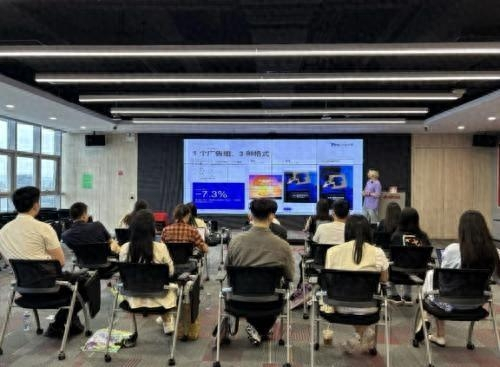
1. Meta Ads for Customer Acquisition: A Growth Progression from Data Signals to Intelligent Creative
YinoLink’s Senior Customer Success Manager, Chen Zhihan, shared (Insights on Meta product change trends and adapting best practices for ad-driven growth). Centering on the changes in Meta ad products and ad delivery methods, she outlined a growth path from data signals to content creative and then to intelligent optimization.
Combine CAPI + Pixel to complete conversion signals
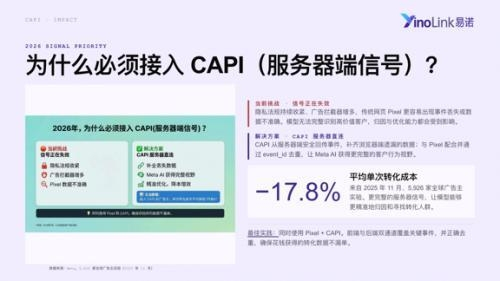
To find people who are more likely to buy, an ad system first needs clear and complete conversion signals. Chen Zhihan emphasized at the beginning that, in an environment where privacy policies are tightening and browser restrictions are increasing, Pixel alone can’t fully record user behavior. Sellers can complement Pixel by sending data from servers via CAPI, completing the conversion path and improving signal quality. Meta-related experiments also show that more complete server-side signals can reduce average CPA by 17.8%.
Leverage Reels’ native scenarios and the advantages of diverse creative formats
With more accurate signals, you also need the right content to reach users in scenarios where they are truly paying attention. According to Meta data, more than half of Instagram users’ time is spent using Reels. Compared with static images, native Reels assets in a 9:16 vertical format with audio and safe-area requirements can lower average CPA by 34.5%.
However, placement only determines where the ad appears, while the creative determines whether users are willing to stop and stay. For different purchase motivations, ads must also differ in asset format, core selling points, and visual style. Based on this idea, Chen Zhihan shared the “golden creative three-piece set” on site: configure images, standard videos, and 9:16 sound-on vertical video in the same ad set, which can further reduce average conversion costs by 7.3%. (Data source: Meta, causal inference modeling based on 2 million+ performance ad sets worldwide, Apr–May 2024)

Make the most of Advantage+ and unlock smart optimization potential
Once the system has stable conversion signals and sufficient multi-element creative assets, advertisers can reduce manual constraints and let Advantage+ (Meta advanced enablement product) optimize audiences, placements, and budgets in real time. Meta-related tests show that for advanced enablement sales ad series, ROAS can increase by 32%. [Data source: Meta internal research (31 advertisers/publishers, Jul–Sep 2022); meta-analysis of 21 A/B test studies]
This is not about handing ad spend fully to AI, but shifting the team’s workload toward more critical inputs: clarify business objectives, provide high-quality first-party data and diverse creative assets, leaving the algorithm with more room for combinations and optimization.
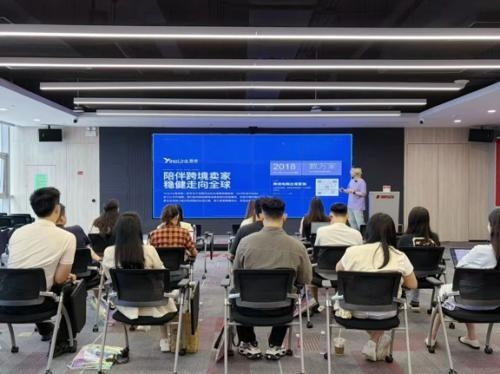
With the evolution of platform algorithms, higher demands are placed on the team’s judgment and execution ability. Since 2018, YinoLink has been recognized as an official Meta partner agency, supporting tens of thousands of cross-border sellers through different stages—from initial market entry to mature operations. From account setup to marketing strategies and ad optimization, it helps advertisers turn platform capabilities into concrete competitive business advantages.
Second, standalone site conversion: don’t only look at the final conversion rate—find exactly where the orders leak
Don’t only look at the final conversion rate—find which step of the order journey is leaking
With the same 10,000 visitors, why does one store close 180 orders while another only closes 150? The 1.8% vs. 1.5% sitewide conversion rates only tell you that the outcomes differ—they don’t explain how the gap was created.
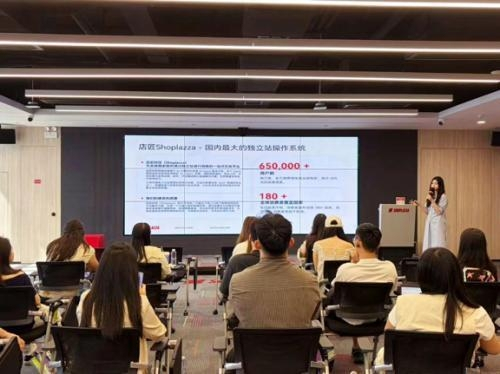
Shoplazza’s independent store customer solutions manager Zeng Yushan said in her sharing that standalone sites’ conversion issues are often not caused by a single page, but by an abnormal leak at some step in the purchase journey. With one-click diagnosis via Athena, sellers can locate problems layer by layer along the core funnel of “visitor → add to cart → reach checkout → payment success”:
Sitewide conversion rate: measures overall traffic monetization capability;
Add-to-cart rate: if the add-to-cart rate is low, the problem is usually concentrated in how well traffic matches products, price competitiveness, product selling points, page experience, and trust-building;
Checkout initiation rate: If add-to-cart is normal but the checkout rate is low, focus on whether shipping taxes/fees appear too late, whether the entry point for promo codes causes hesitation, whether cart operations are too complex, and whether strong account registration is required before checkout.
Payment success rate: If many users reach the checkout page but don’t complete payment, check payment method coverage, channel success rates, 3DS verification, risk-control blocks, currency compatibility, and the mobile payment experience.
AOV and attachment rate: measure the value of each individual order;
Repeat purchase rate and LTV: evaluate long-term customer value.
When diagnosing, also pay attention to further breakdown by dimensions: product, channel, country/region, device type, and whether visitors are new or returning. The same decrease in payment success rate may be related to local payment method coverage if it happens only in one country; if it occurs only on mobile, it is more likely due to page compatibility or payment redirect issues.
The metric itself won’t directly reveal the cause, but you can narrow down the vague “low conversion rate” into an abnormality at a specific stage, for a certain type of traffic, or for a specific payment channel. First quantify where orders are leaking, then optimize the specific bottleneck; only then does every adjustment for a standalone site have real evidence.
Third, global fulfillment: the supply chain is not just the wrap-up after order completion—it’s the beginning of profit management.
After an order’s payment is completed, inventory turnover, warehouse network layout, and fulfillment costs will continue to affect final profit.
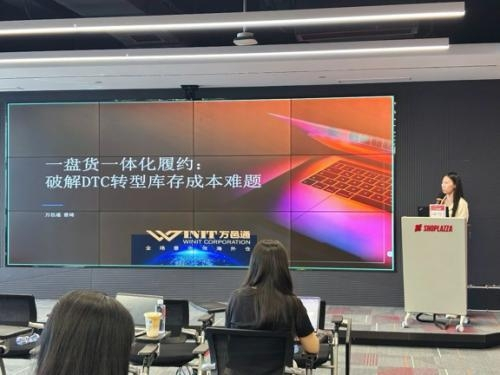
WINIT (万邑通) Shenzhen regional key account manager Zeng Qi emphasized that cross-border supply chains can’t only compare one segment of shipping costs, and can’t only chase “fast shipping.” They must also consider sales volume, capital usage efficiency, and end-to-end total costs. This forms the “golden triangle” of supply chain management.
In real operations, many sellers fall into the misconception of “keeping stock separately for each channel,” which can easily lead to both stockouts in one channel and slow-moving inventory in another. To address this, Zeng Qi shared an “all-in-one inventory” global inventory management strategy:
Shared inventory pooling: bring inventory scattered across different channels back into a unified inventory pool, enabling both B2B wholesale and B2C retail scenarios, and supporting dynamic allocation across channels;
Standardize processes in advance: connect packaging, labeling, scheduled handover, and shortage-handling rules early to reduce repeated loss from intermediate steps and temporary handling costs.
When inventory is visible and adjustable, sellers can find a more reasonable balance among sales, replenishment, and costs—reducing duplicate restocking and stock buildup, and getting capital back into the next product and marketing investment cycle faster.
Fourth, conclusion
In fact, across the full funnel—from acquiring customers through ads, to standalone site conversion, to inventory fulfillment—end-to-end growth doesn’t require every step to be executed to perfection on its own. It’s about ensuring that the value delivered by the previous step can be efficiently taken up by the next step, forming a complete system that can operate continuously.
Thanks again to everyone who participated in this event—new and returning friends alike. We spent a pleasant afternoon together, full of good insights and practical takeaways. In the future, YinoLink (易诺) will continue to rely on official platform resources, long-term hands-on ad operation experience, and the technical enablement from YinoCloud (易诺云) to help more Chinese brands turn complex global marketing challenges into clear, actionable growth paths.