


I usually just glance at regulatory news and move on, because most of it has little to do with ordinary holders. But after reading these UK rules, I changed my mind, because there’s a rather unobvious mechanism that will genuinely affect which chain institutions choose in the future.
First, lay out the timeline clearly, because that determines how urgent it is.
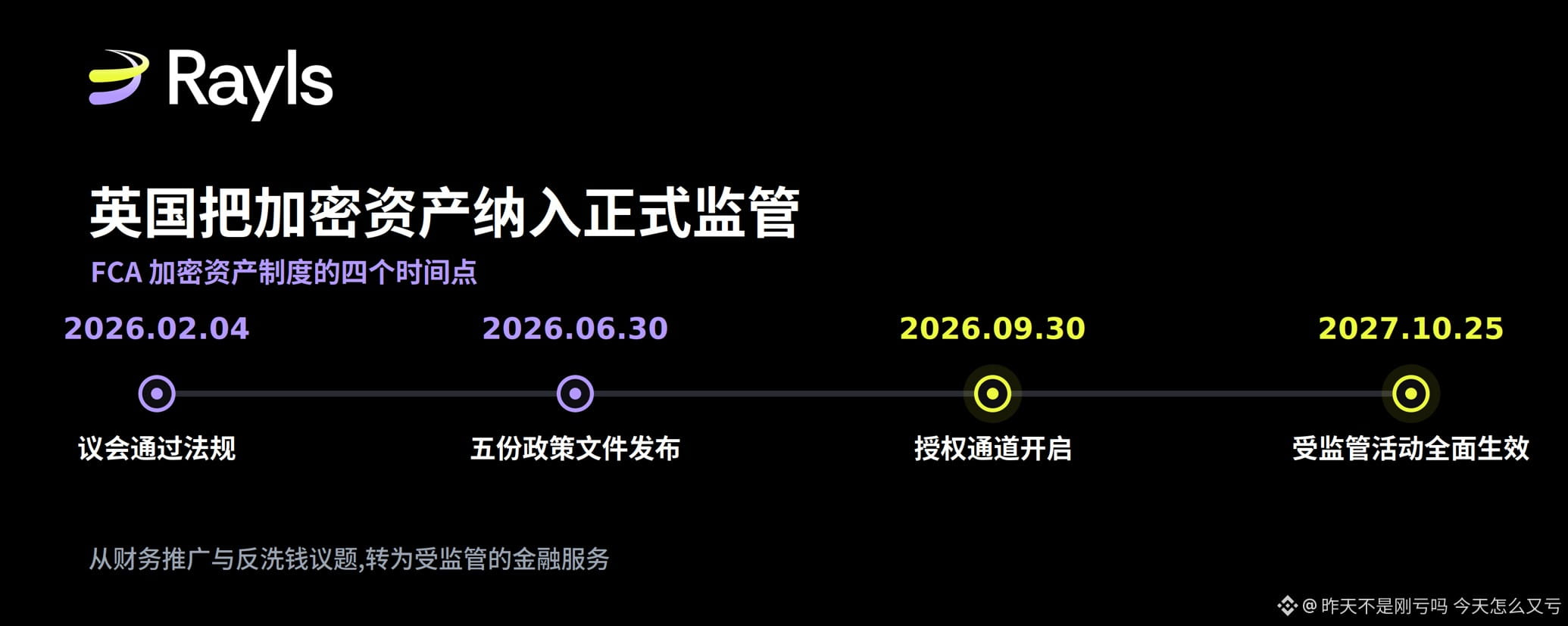
On February 4, 2026, the UK Parliament passed the relevant regulations. On June 30, the FCA published the core details of the制度, with a total of five policy documents. The authorized gateway opened on September 30, while the complete scope of regulated activities will not fully take effect until October 25, 2027.
From now, the authorized channel will open a little over a month later, and full implementation is about fourteen months after that. For institutions that need to rebuild their compliance architecture, this window is not very spacious.
The real change in these rules is qualitative. In the past, the UK mainly treated cryptoassets as issues related to financial promotion and anti–money laundering. Now it treats them as regulated financial services. Consumer responsibilities, senior executive accountability, operational resilience, custody of client assets, and an entire dedicated prudential framework are all brought along with it.
The most worth noting one, tucked inside “operational resilience”
There’s a lot of content across the five documents, but I believe the one that will have the biggest impact on the blockchain industry is operational resilience.
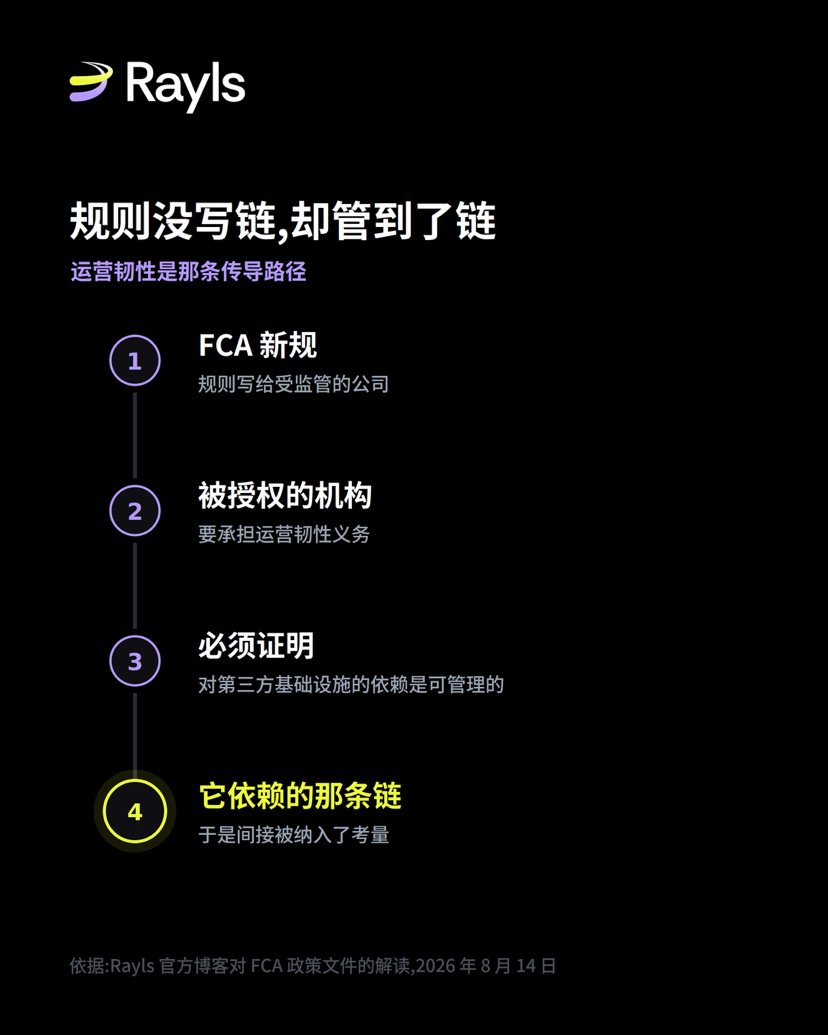
The rules themselves do not impose any requirements on the blockchain. They don’t name validators, and they don’t prescribe how a public chain should run consensus.
But it requires authorized institutions to manage and demonstrate their control over the infrastructure they rely on, including third-party risk and technical risk. This line looks plain, but in practice it is a transmission path: the rules govern institutions, and institutions must be responsible for the chain they use—so the chain itself is indirectly brought into consideration.
Add another feature: this regime concentrates obligations on recognizable and accountable parties. Even for decentralized finance, the entry point is whether there is a recognizable controlling party. Put the two together and the direction becomes pretty clear: regulated business will tend to flow toward networks whose operators are identifiable and whose compliance controls can be supervised.
Staking has been formally brought under regulation
This point connects perfectly with the two articles I wrote earlier about staking.
Under the new rules, staking becomes a regulated activity, with obligations for information disclosure, customer consent, and record-keeping, while leaving reasonable room for automated staking. On custody: client cryptoassets are subject to the new CASS 17 custody rules, taking a technically neutral stance on private key management; tokenized securities custody still follows the existing CASS 6 rules.
Another detail worth noting for staking participants: institutions need to set aside capital for staking losses (for example, penalties and forfeitures). Forfeiture is the risk I discussed in my previous piece—the validator misbehaves or goes offline for a long time and a portion of the staked coins gets deducted. Now regulators treat it as a real risk that must be covered by capital.
Stablecoins have been granted the status of settlement assets
This is, in my view, the most practical piece of good news for the industry.
After the digital securities sandbox guidance was updated, eligible stablecoins can be used as settlement assets. At the same time, the prudential treatment for stablecoin issuance has been relaxed, with the relevant capital coefficient reduced from 2% to 1%.
Industry reactions to this point have been clearly positive. The Payments Association calls halving the capital coefficient a victory on the proportionality principle, and believes the entire adjustment replaces rigid and complex requirements with rules that are commercially workable.
The parts that aren’t decided yet need to be clarified
I don’t want to write this as one-way good news, so this section may be more important than the ones above.
FCA has listed for itself the parts that are not yet completed: decentralized finance, distributed ledger technology, cryptoasset derivatives, future stablecoin policy, audit requirements, and transitional provisions—all of these will be handled in subsequent policy-making and consultations.
Specifically, there are a few key points. The details on prudential aspects are still being consulted, with the feedback deadline set for July 30, 2026, so institutions cannot yet accurately measure their capital usage with certainty. Decentralized finance has been pushed back. The criterion of recognizable controlling parties provides an anchor point for the boundaries, but the objective indicators for assessing decentralization will require separate consultations—meaning the most controversial boundary line in the entire regime is暂時 left hanging for now. The scope of stablecoins is also still in flux. A draft regulation from April proposes removing eligible stablecoins issued in the UK from certain activity categories and bringing them into the future payment regime. The government also proposes folding the payment systems regulator into the FCA.
Also, compliance costs are real. Under stress scenarios, proving redemption at par value, setting aside capital for staking losses, and providing operational resilience evidence when relying on third-party infrastructure—none of these are cheap. Whether the rules are reasonable is one question; whether regulators apply the proportionality principle when enforcing them is another.
What it means for Rayls, and what needs to be kept in check
Rayls’ official interpretation is that the direction of this regime is consistent with its design goals: public chains use a recognizable set of licensed verification validators rather than anonymous open ones; compliance is built into the network and token standards layer rather than added as after-the-fact checks; Enygma preserves auditability while providing transaction privacy; and after stablecoins are allowed to be settlement assets, supporting institutions-level L1 for regulated settlement tools aligns even more with that direction.
But there’s a degree of restraint here that I think must be kept exactly as is, because it is precisely the most trustworthy part of this official blog. The blog states clearly that the FCA does not require licensed regime verification validators, and it also doesn’t spell out any rule that favors a particular network architecture. It merely sets recognizability, accountability, and operational resilience as thresholds for carrying on regulated business.
The difference between these two sentences is huge. The former is “regulation standing on my side,” while the latter is “the regulatory threshold and my design happen to align.” The official chose the latter, and that restraint actually makes the argument hold up better.
My view
This set of rules has little direct impact on ordinary holders, but it may change the logic by which institutions make choices.
Before this, institutions choosing a chain mainly considered performance, cost, and ecosystem. Going forward, if they must demonstrate to regulators that their reliance on infrastructure is manageable, then who operates “this chain,” who to look for if something goes wrong, and whether it can be supervised will become a hard question. It’s difficult for an anonymous set of validators to provide an answer to that.
What’s worth paying attention to is the upcoming series of consultations—especially the criteria for determining decentralized finance and the guidance on the operational resilience of distributed ledger technology. Those are the parts that truly affect infrastructure selection.
Reference source: Rayls official blog (The FCA cryptoasset regime is here: what it means for institutional blockchains) (Peter Bidewell, August 14, 2026); the link to an overview of FCA policy documents cited in the article, as well as industry reactions, is in the original text