A customs clearance I was tracking in Karachi port sat in "under review" for three days before jumping straight to "cleared" with no stages in between shown on the portal. I expected Dusk block finality to work the same way, pending then final, one jump. That's not how rolling finality operates at all.
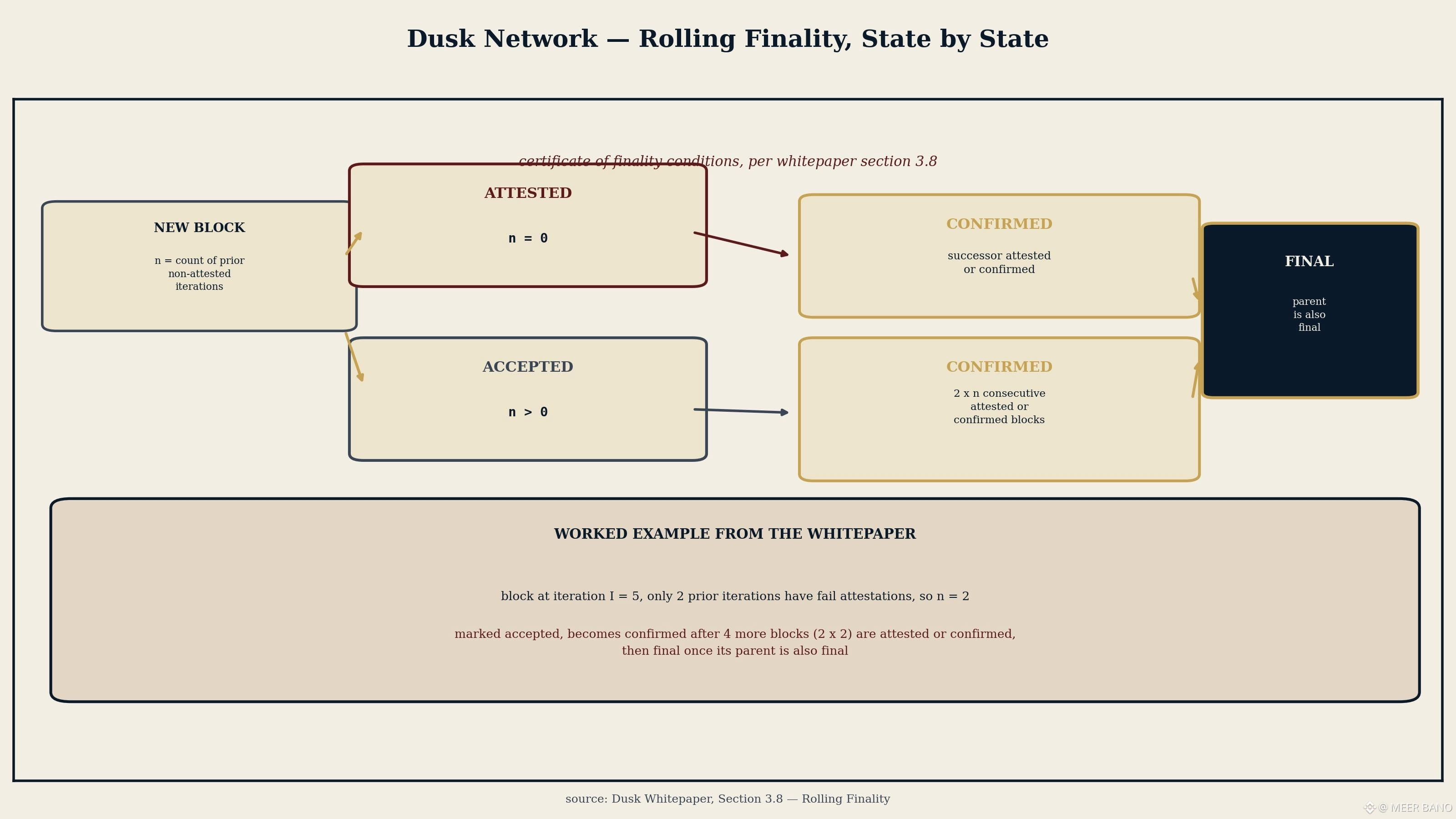
There are four distinct states a block moves through, and the jump between them depends entirely on what happened in the iterations before it. A block starts as attested if zero prior iterations in that round failed, meaning no other candidate could have possibly beaten it to consensus. If any prior iterations did fail without a fail attestation, it starts as accepted instead, meaning a lower iteration block could still theoretically replace it.
The part that actually reshaped my thinking is how confirmed and final aren't really about the block itself. An attested block becomes confirmed once a single successor is attested or confirmed. But an accepted block needs 2 times n consecutive attested or confirmed blocks stacked on top of it, where n is the count of non attested prior iterations. So two similarly aged blocks can take completely different amounts of time to reach the same confidence level, depending purely on how clean their iteration history was.
What the whitepaper doesn't give me is a real average timeframe, in seconds or blocks, for something to go from accepted to final on live Dusk infrastructure. I can't manufacture that number.
The real test for DUSK is whether this variable path to finality still feels fast enough for everyday users moving funds.
Has anyone tracked how long a real transaction took to hit final status on Dusk?
#dusk $DUSK @Dusk
There are four distinct states a block moves through, and the jump between them depends entirely on what happened in the iterations before it. A block starts as attested if zero prior iterations in that round failed, meaning no other candidate could have possibly beaten it to consensus. If any prior iterations did fail without a fail attestation, it starts as accepted instead, meaning a lower iteration block could still theoretically replace it.
The part that actually reshaped my thinking is how confirmed and final aren't really about the block itself. An attested block becomes confirmed once a single successor is attested or confirmed. But an accepted block needs 2 times n consecutive attested or confirmed blocks stacked on top of it, where n is the count of non attested prior iterations. So two similarly aged blocks can take completely different amounts of time to reach the same confidence level, depending purely on how clean their iteration history was.
What the whitepaper doesn't give me is a real average timeframe, in seconds or blocks, for something to go from accepted to final on live Dusk infrastructure. I can't manufacture that number.
The real test for DUSK is whether this variable path to finality still feels fast enough for everyday users moving funds.
Has anyone tracked how long a real transaction took to hit final status on Dusk?
#dusk $DUSK @Dusk