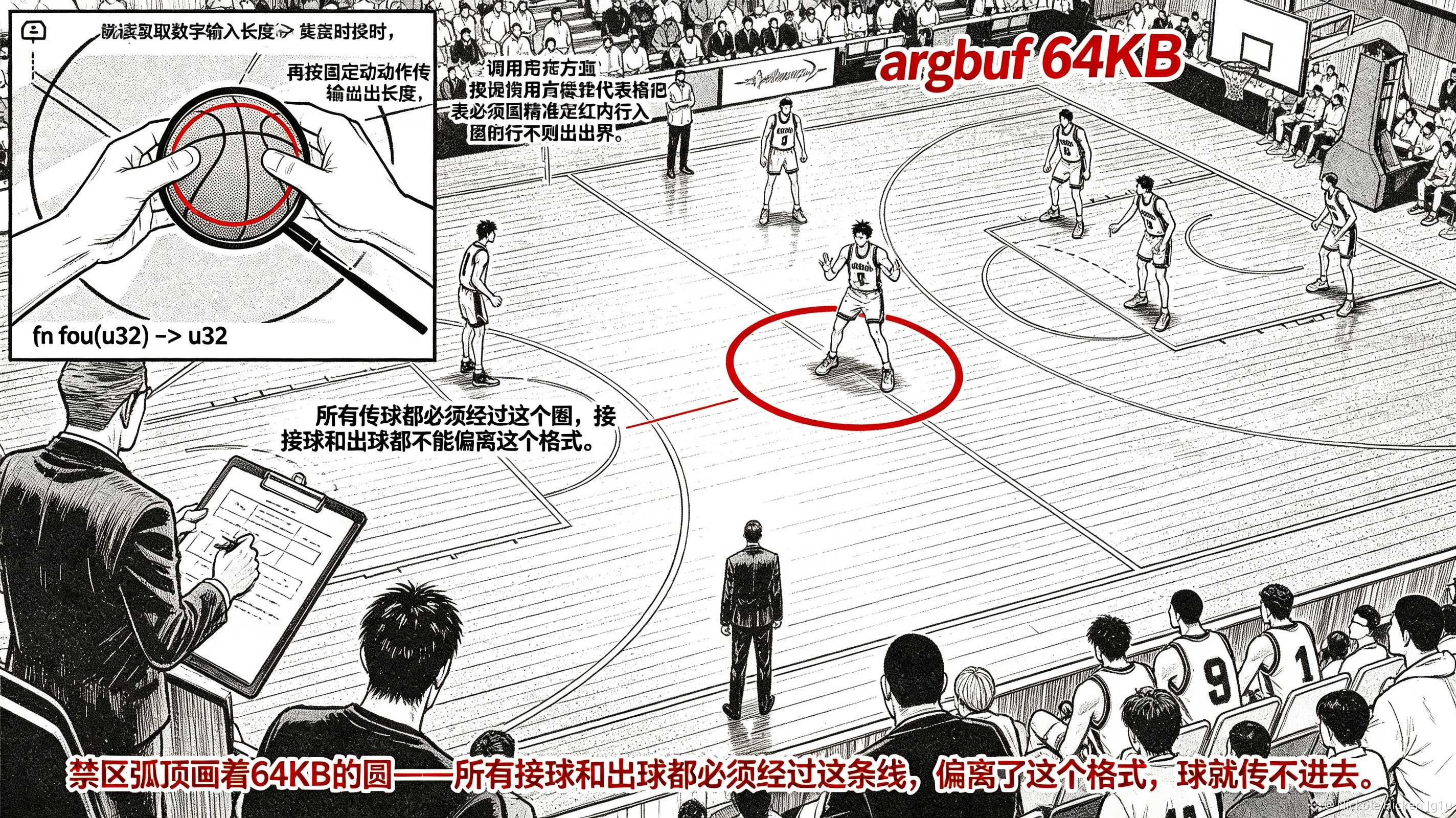
I originally thought whether a contract could run in DuskVM mainly depended on whether the Rust code compiled successfully, but after reading the DuskVM documentation by @Dusk I realized that the spots that are really easy to get stuck are closer to the call boundary: the contract must expose a 64KB argbuf, and the entry function also has to receive the input length in the format fn foo(u32) -> u32, process the data, and then return the output length. Even if the code logic is correct, it doesn’t mean that external calls can feed it correctly. This design made me rethink development cost: DuskVM doesn’t require developers to define business logic for them, but it hands the input/output memory boundaries over to the contract itself. What the caller passes in is not a list of “parameters you can read however you like,” but data that has already been placed into a buffer and whose read range is determined by the length. If serialization, length checks, or output write-back is off by even one spot, the problem may not show up as an obvious business error— the frontend will only receive a failed contract call once. The pressure scenario is actually very specific: in local testing, an asset app that passes only a simple number works fine. After going live, when it switches to longer credential, order, or permission data, the contract still gets called but reads incompletely or returns a truncated result. What users see is that the status doesn’t update. Developers then need to go back and troubleshoot the ABI, the buffer, and the data driver. The cost isn’t an abstract virtual machine—it’s the users waiting for results and the team maintaining the integration. So when I look at the DuskVM by $DUSK , I won’t just ask whether it can execute Rust or WASM; I’ll first check whether the contract tests cover parameter length, output length, and boundary inputs. @Dusk lays out the calling convention very clearly, and behind the performance and controllability there’s also a responsibility for memory. For Dusk developers, what’s truly worth validating is whether, after complex business data enters the contract, the boundaries remain predictable. #dusk


Post

--Bullish


Disclaimer: Includes third-party opinions. No advice. Binance AI may be used without guarantee. See T&Cs.