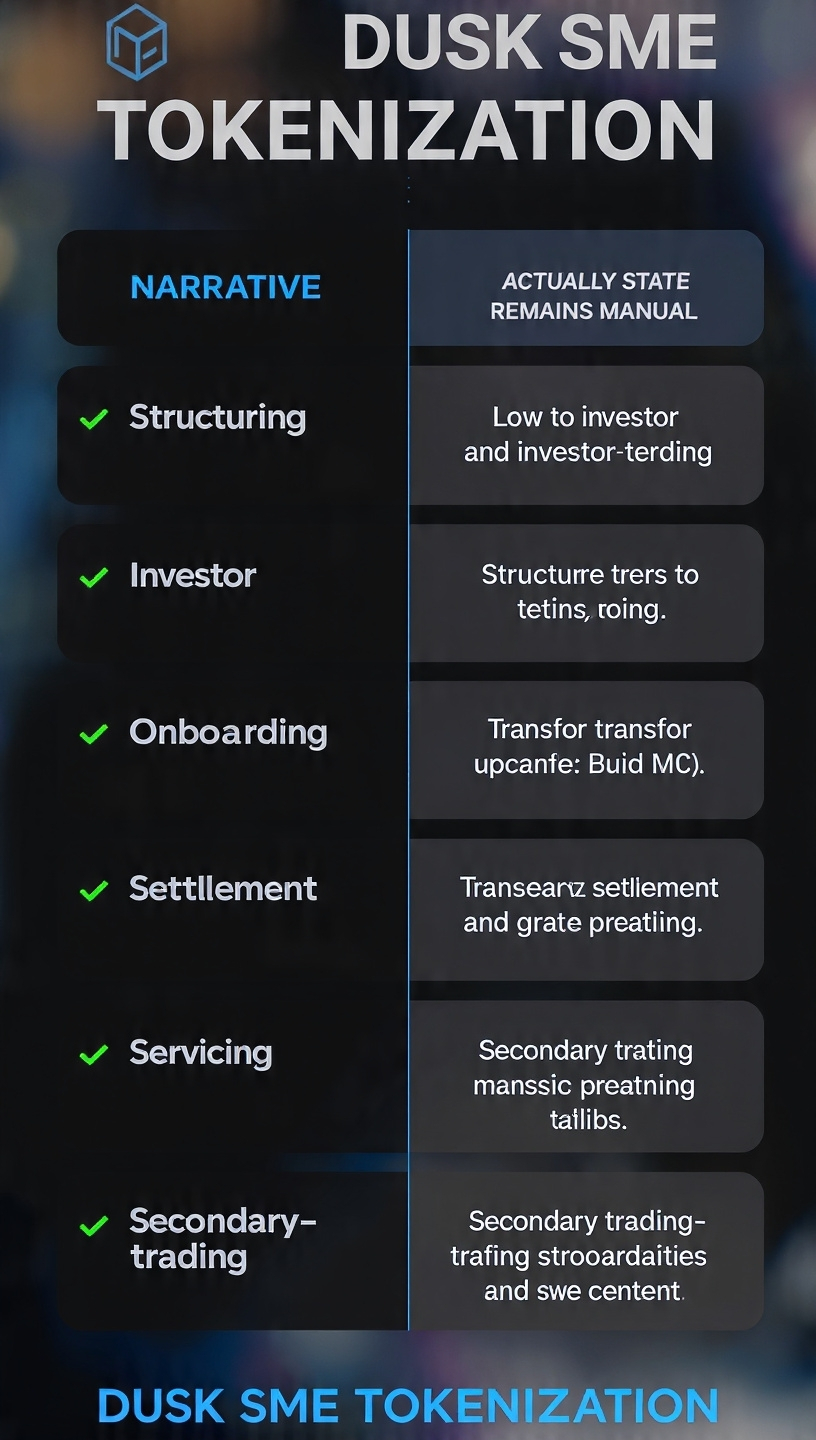
#dusk $DUSK @Dusk I examined a question that initially appears deceptively simple:
If RWAs are intended to bring traditional finance on-chain, why would institutions want every financial action to be publicly visible?
This is where the narrative begins to break down.
The common cryto narrative is:
“Put the asset on a public chain → enable full transparency → simplify settlement.”
However, traditinal financial markets do not operate like an open ledger.
A company may need to demonstrate investor eligibility without disclosing its full financial position.
An investor may need to execute a trade without revealing their broader portfolio strategy to competitors.
A fund may require regulatory oversight without exposing all balances and transaction history to the public.
This is the underlying tension.
Transparency and privacy are not inherently opposing forces.
In RWA markets, a more relevant question may be:
Who needs access to what information — and for what purpose?
This is where @Dusk becomes particularly relevant.
Rather than framing privacy as the complete concealment of data, Dusk focuses on selective disclosure: sensitive information remains protected while authorized parties can still verify what is necessary.
This approach more closely reflects how traditional finance already functions.
Most RWA narratives emphasize asset tokenization and on-chain representation.@Dusk
However, the more complex challenge may be determining what should be on-chain, what should remain private, and what must be verifiable without being publicly exposed.
If institutions cannot safeguard commercially sensitive information, it raises the question of whether “tokenizing everything” truly addresses the barriers to adoption.
Conversely, if privacy can be aligned with compliance requirements, it may represent a critical missing component in institutional RWA adoption.
#dusk $DUSK $BTC #bitcoin
If RWAs are intended to bring traditional finance on-chain, why would institutions want every financial action to be publicly visible?
This is where the narrative begins to break down.
The common cryto narrative is:
“Put the asset on a public chain → enable full transparency → simplify settlement.”
However, traditinal financial markets do not operate like an open ledger.
A company may need to demonstrate investor eligibility without disclosing its full financial position.
An investor may need to execute a trade without revealing their broader portfolio strategy to competitors.
A fund may require regulatory oversight without exposing all balances and transaction history to the public.
This is the underlying tension.
Transparency and privacy are not inherently opposing forces.
In RWA markets, a more relevant question may be:
Who needs access to what information — and for what purpose?
This is where @Dusk becomes particularly relevant.
Rather than framing privacy as the complete concealment of data, Dusk focuses on selective disclosure: sensitive information remains protected while authorized parties can still verify what is necessary.
This approach more closely reflects how traditional finance already functions.
Most RWA narratives emphasize asset tokenization and on-chain representation.@Dusk
However, the more complex challenge may be determining what should be on-chain, what should remain private, and what must be verifiable without being publicly exposed.
If institutions cannot safeguard commercially sensitive information, it raises the question of whether “tokenizing everything” truly addresses the barriers to adoption.
Conversely, if privacy can be aligned with compliance requirements, it may represent a critical missing component in institutional RWA adoption.
#dusk $DUSK $BTC #bitcoin