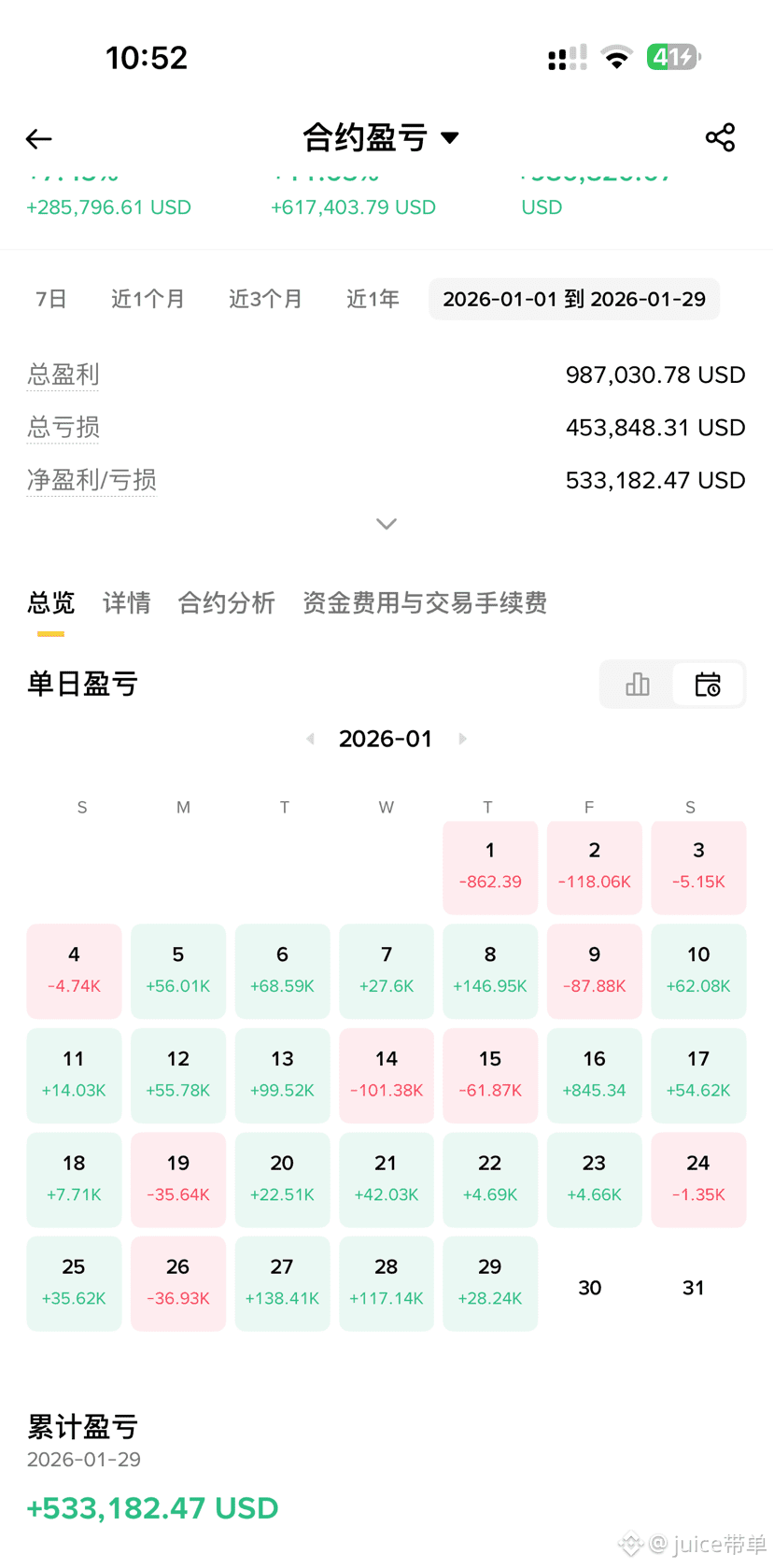
Below 3000U is the most dangerous area for making money.
Those with less money tend to invest more heavily. This is the deepest paradox in the cryptocurrency world—smaller principal leads to bigger risks, and faster losses.
I have seen too many cases of entering at 2000U and going to zero in three weeks, and I have personally guided students who turned 1800U into 50,000U. The difference lies not in the funds but in whether one admits to being a "weakling."
Admitting weakness can actually help one survive.
Last year, a student was laid off shortly after starting, with only 1800U in his pocket. He didn’t rush to prove himself; instead, he saw himself as a "disabled person on the battlefield"—if you can’t run fast, you have to be smarter. Ten months later, his account stood at 52000U. There was no luck from above, only three rules of "survival."
Divide the money into three piles, even if it's just three grains of rice.
Cut 1800U into three parts:
- 600U for day trading: only bite into the certainty of BTC/ETH fluctuations, withdraw at 1-3%, do not chase the last penny;
- 600U for swing trading: only act when the trend is in your favor, hold for 3-5 days;
- 600U locked: do not move even if the sky falls, this is the opportunity cost for your next comeback.
Going all in is a privilege of the strong, while the weak must learn to exchange space for time.
80% of the time, you should be a waste.
The market oscillates most of the time, specifically hunting those who are itchy to trade. No structure, no volume, no direction—then it’s none of your business.
Before a signal appears, it’s as quiet as a stone. Once a signal appears, hold on tight and don’t let go. Take out your capital after a 15% profit, let the profits fly in the sky, and stay calm.
Doing nothing is the only moat for small caps.
Lock down decision-making mechanically.
- Stop loss: 1% per trade, exit immediately when triggered, no negotiation;
- Take profit: cut the position in half at a 3% profit, leave the rest on a trailing stop;
- Iron rule: never add to a losing position, averaging down is an elevator to hell.
Emotions are poison for retail investors; rules are the antidote. You don’t need to predict accurately, you just need to cut hard.
A small capital is not a curse; the obsession with "having to double quickly" is.
Turning 1800U into 50,000U relies not on huge profits, but on refusing to incur huge losses. I have walked this road, and I have stepped on all the pits for you. The light is here; whether to follow or not is up to you. @juice带单