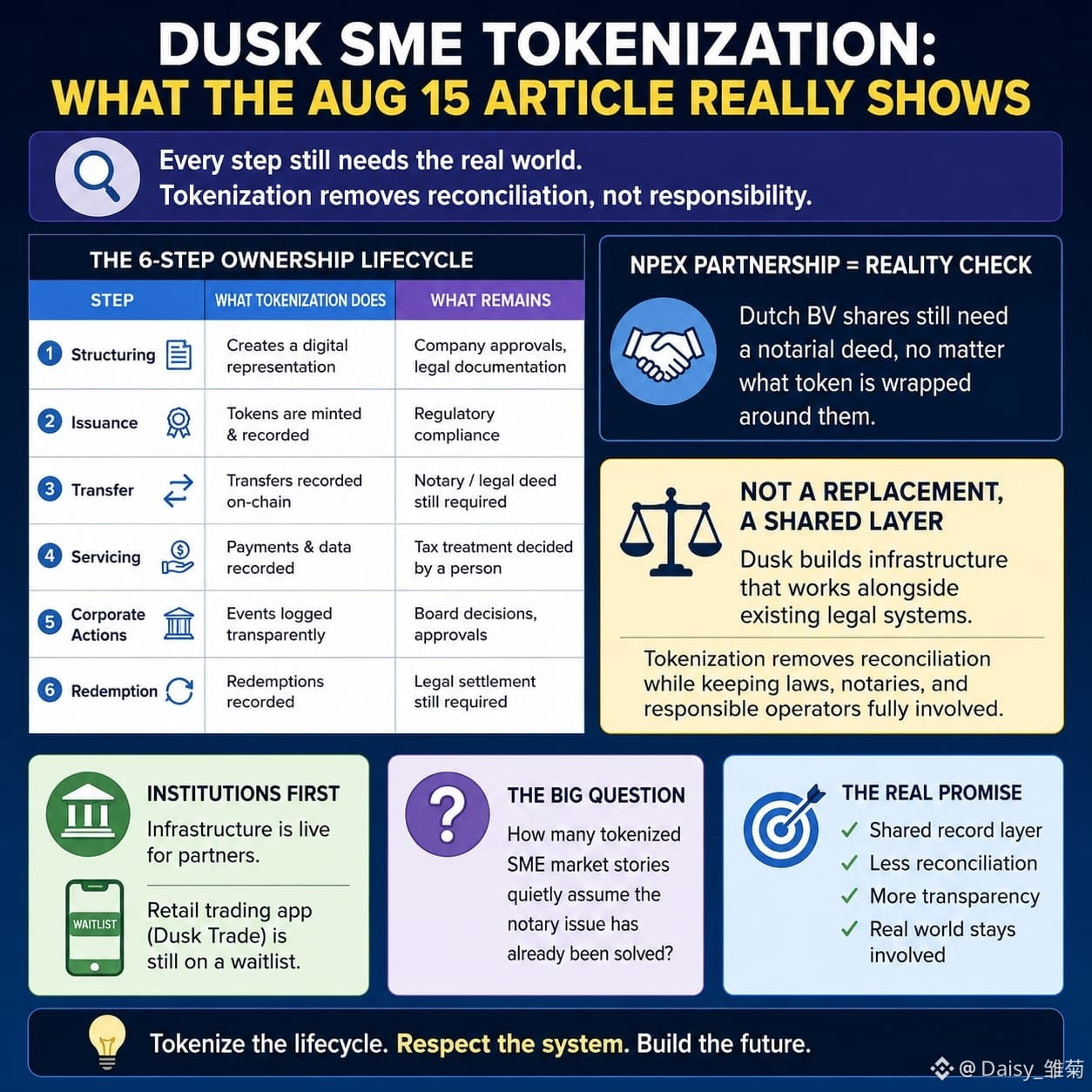
@Dusk was halfway through studying dusk Aug 15 article on SME tokenization when I nearly skipped over the six-step lifecycle table… then I noticed something: every single row includes a what remains section.
Structuring still requires company approvals. Transfer still needs a notary. Servicing still depends on a person deciding the tax treatment.
That detail really caught my attention. The marketing message is to tokenize the ownership lifecycle, but when you read the document carefully, Dusk is actually building a shared record layer that works beside existing legal systems, not replacing them.
The NPEX partnership makes this very clear: Dutch BV shares still need a notarial deed, no matter what token is placed around them.
Wait...that is almost the reverse of what many L1 discussions suggest when they talk about RWA settlement. The usual assumption is that tokenization removes friction.
But the document shows something different: tokenization removes reconciliation while keeping laws, notaries, and responsible operators fully involved.
Institutions receive the infrastructure first. Retail users are promised the trading app later. Dusk Trade is still on a waitlist…
Now I amm wondering: how many tokenized SME market stories quietly assume the notary issue has already been solved?
@Dusk #dusk $DUSK
Structuring still requires company approvals. Transfer still needs a notary. Servicing still depends on a person deciding the tax treatment.
That detail really caught my attention. The marketing message is to tokenize the ownership lifecycle, but when you read the document carefully, Dusk is actually building a shared record layer that works beside existing legal systems, not replacing them.
The NPEX partnership makes this very clear: Dutch BV shares still need a notarial deed, no matter what token is placed around them.
Wait...that is almost the reverse of what many L1 discussions suggest when they talk about RWA settlement. The usual assumption is that tokenization removes friction.
But the document shows something different: tokenization removes reconciliation while keeping laws, notaries, and responsible operators fully involved.
Institutions receive the infrastructure first. Retail users are promised the trading app later. Dusk Trade is still on a waitlist…
Now I amm wondering: how many tokenized SME market stories quietly assume the notary issue has already been solved?
@Dusk #dusk $DUSK