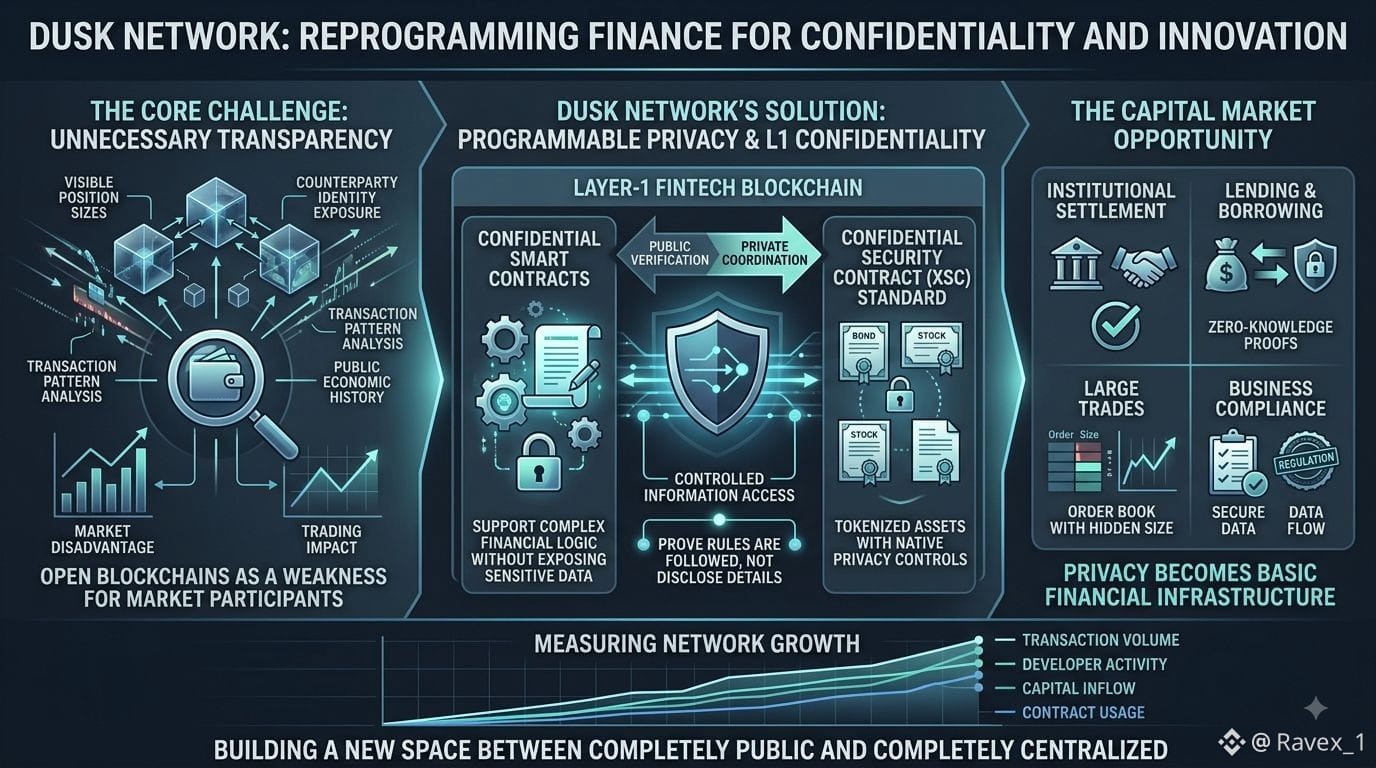
Dusk Network is interesting to me because it starts with a problem crypto still handles badly: financial activity is often far more visible than it needs to be. I’ve watched traders celebrate transparent blockchains as if visibility were automatically a strength, but markets eventually expose the cost. When positions, counterparties, balances, and transaction patterns can be studied in real time, transparency can become an advantage for observers and a weakness for participants.
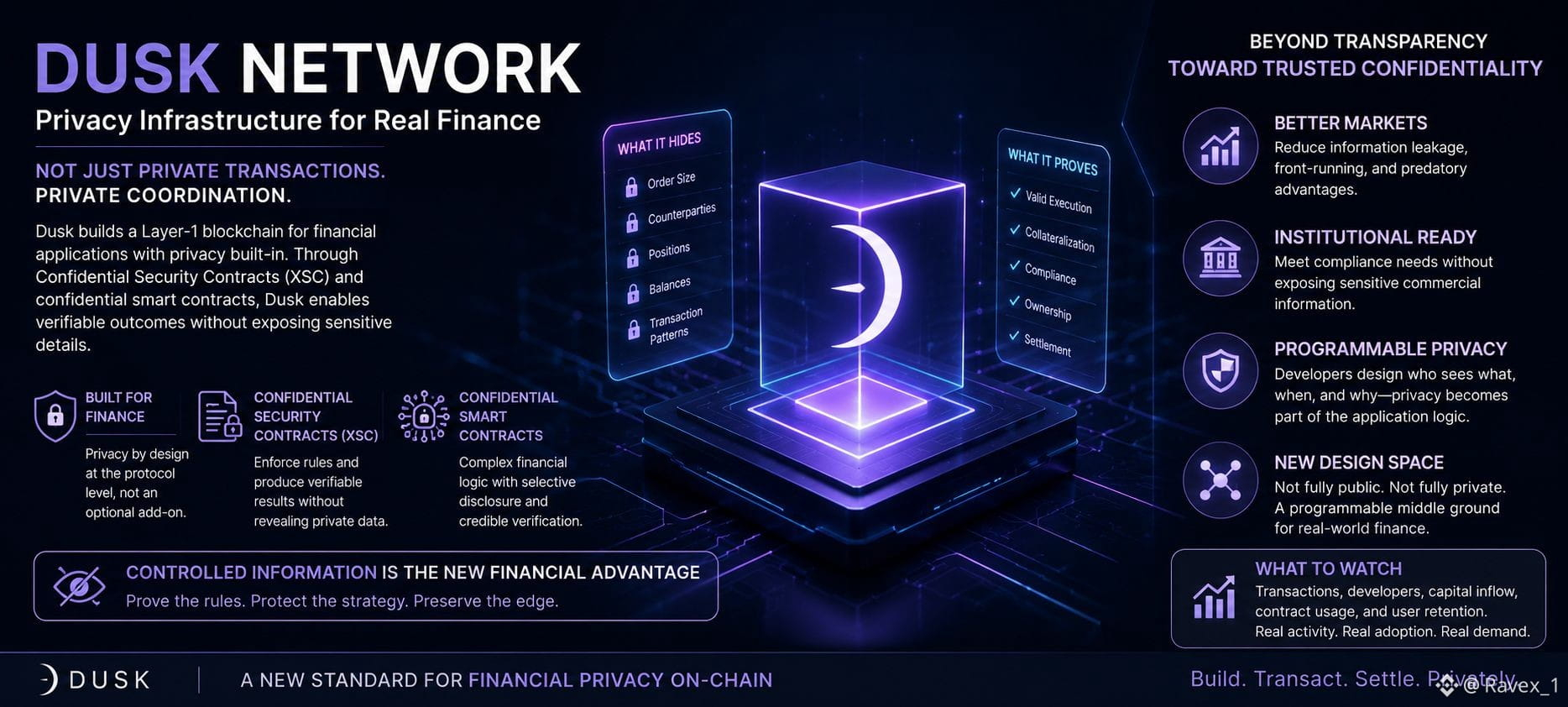
What catches my attention about Dusk is its attempt to build privacy directly into a Layer-1 designed around financial applications rather than treating privacy as an afterthought. Its Confidential Security Contract standard and confidential smart contracts point toward a different model: applications can preserve useful rules and verifiable outcomes without exposing every sensitive detail to everyone watching the chain.
I think this distinction matters enormously for capital markets. A large trader does not necessarily want the market to know the size of an order before execution. A business may want settlement to be verifiable without publishing commercially sensitive information. A financial institution may need compliance controls without turning its entire economic history into public data. Privacy therefore becomes less about hiding and more about controlling what information different participants are allowed to see.
I’ve also started thinking about privacy through the lens of on-chain analytics. Analysts have become extremely good at tracking wallets, clustering addresses, identifying flows, and interpreting behavior. That has created an unusual situation: blockchain transparency can sometimes make sophisticated participants easier to model than users realize. Dusk’s approach challenges that assumption by asking whether financial networks should reveal everything by default.
The deeper opportunity is not simply private transactions. It is private coordination. Imagine conditions without exposing every underly
@Dusk #dusk $DUSK
What catches my attention about Dusk is its attempt to build privacy directly into a Layer-1 designed around financial applications rather than treating privacy as an afterthought. Its Confidential Security Contract standard and confidential smart contracts point toward a different model: applications can preserve useful rules and verifiable outcomes without exposing every sensitive detail to everyone watching the chain.
I think this distinction matters enormously for capital markets. A large trader does not necessarily want the market to know the size of an order before execution. A business may want settlement to be verifiable without publishing commercially sensitive information. A financial institution may need compliance controls without turning its entire economic history into public data. Privacy therefore becomes less about hiding and more about controlling what information different participants are allowed to see.
I’ve also started thinking about privacy through the lens of on-chain analytics. Analysts have become extremely good at tracking wallets, clustering addresses, identifying flows, and interpreting behavior. That has created an unusual situation: blockchain transparency can sometimes make sophisticated participants easier to model than users realize. Dusk’s approach challenges that assumption by asking whether financial networks should reveal everything by default.
The deeper opportunity is not simply private transactions. It is private coordination. Imagine conditions without exposing every underly
@Dusk #dusk $DUSK