#dusk $DUSK @Dusk
I assumed staking on Dusk Network belonged only to wallets and node operators.
Stake Abstraction changes the owner of the position.
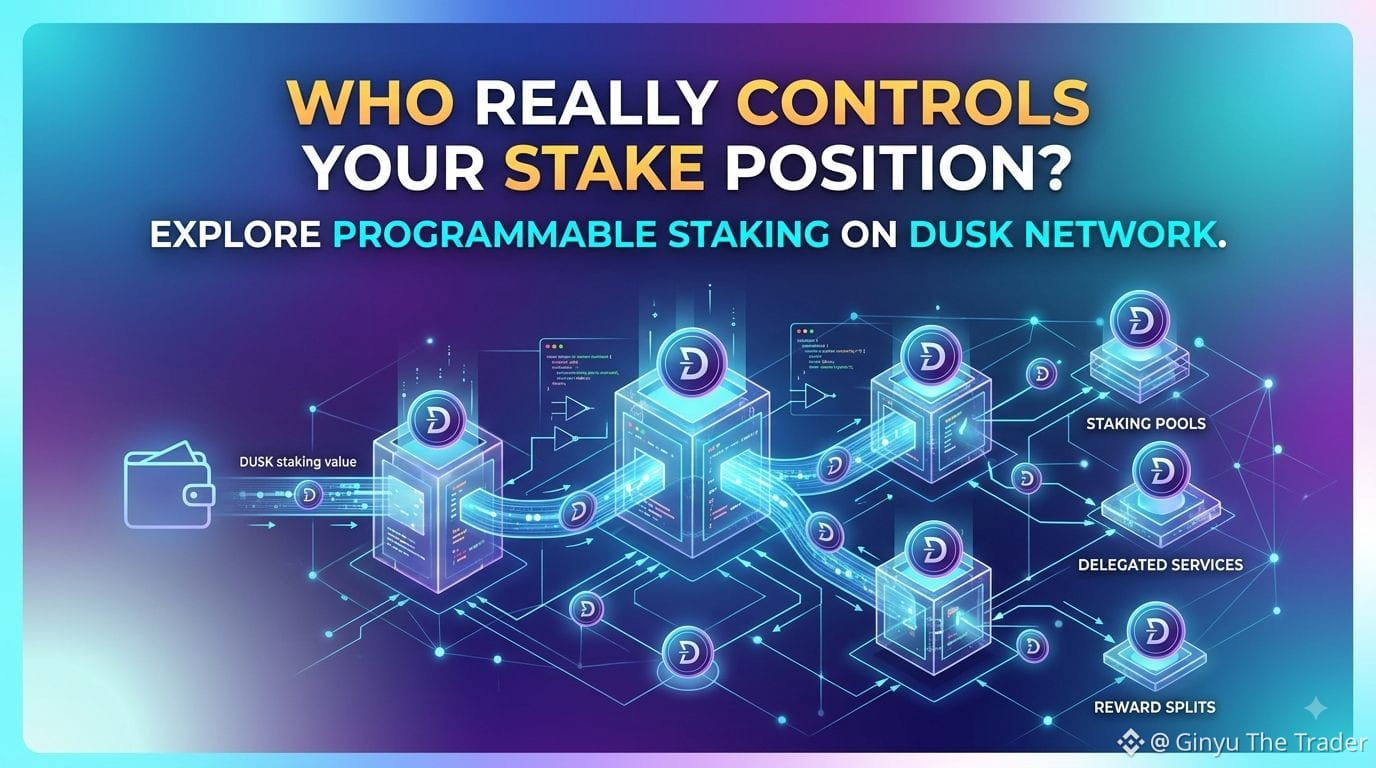
A Dusk smart contract can accept deposits, create stake, receive rewards, and distribute or reinvest them under its own rules. That enables staking pools, delegated services, reward splits, and derivatives without keeping every decision in an offchain operator account.
The stake becomes programmable. So does the risk.
Users are no longer evaluating only a provisioner's consensus performance. They also depend on the contract's accounting, withdrawal logic, reward allocation, upgrade controls, and recovery path. A perfectly performing validator cannot protect a depositor from a pool contract that calculates shares incorrectly.
Dusk keeps some protocol boundaries explicit. Contracts still face the 1,000 DUSK minimum stake. Activation occurs at an epoch boundary after the next one, usually between 1 and 2 epochs after submission. A contract cannot call the staking function as if it were a wallet. Funds move through the Transfer Contract and trigger the Stake Contract through a contract-to-contract transfer.
That last detail matters to me. It binds the staking action to actual value movement rather than letting contract logic announce a stake without the corresponding funds.
I would watch how applications expose the delay between deposit and active stake. A pool token issued immediately can look productive while the underlying DUSK is still waiting for activation. Reward claims and unstaking callbacks also need to remain synchronized with user balances.
Stake Abstraction expands DUSK utility beyond direct staking. It could also concentrate deposits inside a small number of contracts if convenience wins over diversification.
Dusk has made the consensus position composable. The next proof is that pool contracts preserve solvency, clear ownership, and fair exits across every staking state.
Programmability can remove manual distribution. It cannot remove the need to audit who controls the program.
I assumed staking on Dusk Network belonged only to wallets and node operators.
Stake Abstraction changes the owner of the position.
A Dusk smart contract can accept deposits, create stake, receive rewards, and distribute or reinvest them under its own rules. That enables staking pools, delegated services, reward splits, and derivatives without keeping every decision in an offchain operator account.
The stake becomes programmable. So does the risk.
Users are no longer evaluating only a provisioner's consensus performance. They also depend on the contract's accounting, withdrawal logic, reward allocation, upgrade controls, and recovery path. A perfectly performing validator cannot protect a depositor from a pool contract that calculates shares incorrectly.
Dusk keeps some protocol boundaries explicit. Contracts still face the 1,000 DUSK minimum stake. Activation occurs at an epoch boundary after the next one, usually between 1 and 2 epochs after submission. A contract cannot call the staking function as if it were a wallet. Funds move through the Transfer Contract and trigger the Stake Contract through a contract-to-contract transfer.
That last detail matters to me. It binds the staking action to actual value movement rather than letting contract logic announce a stake without the corresponding funds.
I would watch how applications expose the delay between deposit and active stake. A pool token issued immediately can look productive while the underlying DUSK is still waiting for activation. Reward claims and unstaking callbacks also need to remain synchronized with user balances.
Stake Abstraction expands DUSK utility beyond direct staking. It could also concentrate deposits inside a small number of contracts if convenience wins over diversification.
Dusk has made the consensus position composable. The next proof is that pool contracts preserve solvency, clear ownership, and fair exits across every staking state.
Programmability can remove manual distribution. It cannot remove the need to audit who controls the program.