
Caixin News, August 14 (Reporter Wang Chen): Sell-side research resources are moving back toward pharmaceuticals.
For a long time, the most crowded discussions in China’s A-share market have undoubtedly remained in the technology sector. Topics such as AI computing power, domestic computing power, optical communication, PCBs, and semiconductor equipment continue to feature on roadshow agendas and also form the densest information chain in institutional exchanges.
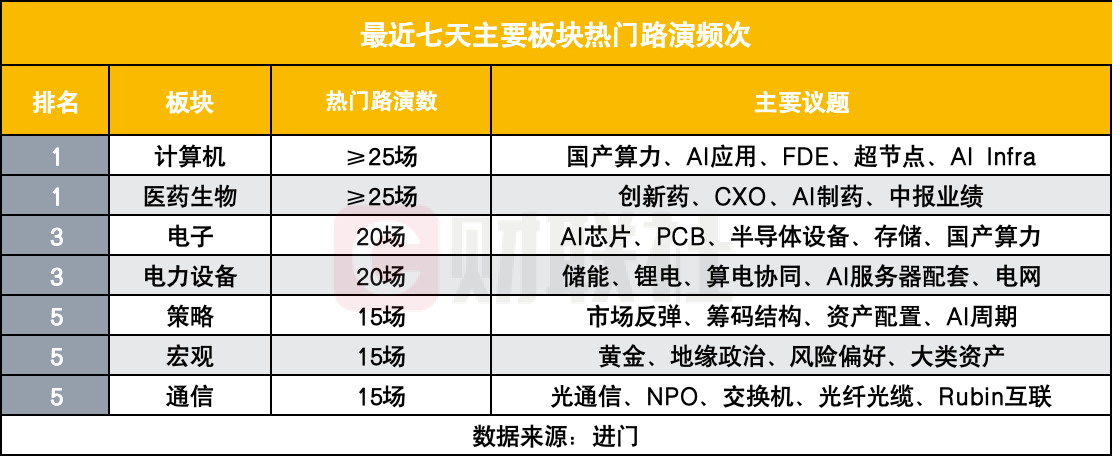
But a change is emerging: sell-side attention toward the pharmaceuticals and biotech sector is rising rapidly. According to Jiumen Finance data, over the past week, the number of popular roadshows in the computer and pharmaceuticals/biotech sectors both exceeded 25, ranking them among the top in all industries. By comparison, electronics and electrical equipment had 20 roadshows each, while directions such as communications, strategy, and macro had around 15. In other words, after being relatively quiet for a period, the pharmaceuticals sector has returned to the sell-side’s high-frequency roadshow desks.
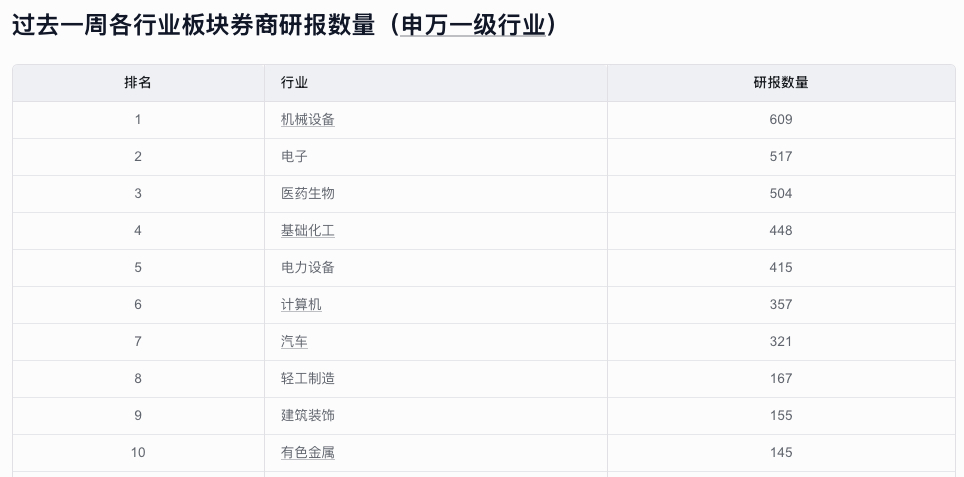
The number of research reports also provides a similar signal. In the past week, according to Wind data, as of August 13, among Shenwan Level-1 industries, machinery and equipment had 609 research reports, electronics had 517, and pharma & biomed had 504. Pharma & biomed ranked third, clearly higher than computer’s 357. Roadshow heat and research-report supply are increasing in sync, suggesting that sell-side attention to pharma is not merely a disturbance from a single conference.
The core of this pharma re-acceleration in sentiment has switched from traditional defensive characteristics to a growth narrative and repricing. Innovative drugs, CXO, AI drug discovery, and interim-report performance verification are turning pharma into a direction that requires continuous tracking, repeated validation, and revaluation.
Roadshow heat catches up with computers; pharma ranks first in the sell-side communication “top tier”
According to the data from Jingu or “Entering the Gate” finance platform, in the roadshow structure of the past week, technology remained the most densely covered main line. Computer, electronics, communications, and some power equipment roadshows are actually centered on the same AI infrastructure industry chain. From domestic computing power, AI chips, and PCBs to optical modules and compute-electricity coordination, the technology sector remains the most intensive communication direction right now.
Meanwhile, the number of hot roadshows for both computers and pharma & biomed each exceeded 25. Pharma & biomed being able to stand alongside computers is exactly the highlight of this change in heat. Popular pharma roadshows mainly cluster into three categories: performance exchanges from companies such as BeiGene, ZaiDing? (再鼎医药), WuXi AppTec, and Wuxi? (药石科技); discussions on industry trends in innovative drugs and CXO; and cross-over topics such as AI drug discovery and AI4S.
Pharma roadshows have not been evenly distributed across all sub-industries; they are more concentrated on the innovative-drug industry chain. The focus of sell-side and institutions is on: which companies’ interim reports can deliver; which innovative drug pipelines enter key windows for clinical trials or commercialization; which CXO order repairs are likely to be sustainable; and whether AI drug discovery can move from algorithm stories to clinical progress, cooperation orders, and “wet lab” demand.
From the perspective of the functions of roadshows, high-frequency meetings usually correspond to two states: fast changes in industry information and large differences in market expectations. Pharma currently has both. After the market has just repaired from long-term weakness, institutions need to determine whether this is merely a short-term rebound or whether the innovative-drug industry chain has entered a new round of fundamental validation.
With the number of research reports ranking among the top three, research resources are clearly flowing back
Roadshows reflect the need for immediate communication between sellers and buyers, while the number of research reports allows for a clearer observation of how research resources are allocated.
In the past week, the number of pharma & biomed research reports reached 504, approaching the electronics industry’s 517 and clearly above computers’ 357. The top five industries by number of research reports were machinery and equipment, electronics, pharma & biomed, basic chemicals, and power equipment, showing that research resources are still concentrated on manufacturing and tech-growth directions. Pharma has once again squeezed into the most crowded research-track.
This contrasts with the market conditions the pharmaceutical sector faced in the past. Affected by factors such as centralized procurement (volume-based bidding), anti-corruption in healthcare, the financing cycle for innovative drugs, and CXO order volatility, pharmaceuticals once fell into a combination of undervaluation, low positioning, and low attention. Research coverage did not disappear, but buyers’ attention and trading elasticity were clearly weakened.
Now that the number of research reports has rebounded, behind it is a stronger need for fundamental validation. The interim-report disclosure season is approaching. Commercialization execution by innovative-drug companies, the cadence of authorization transactions, and overseas clinical progress; as well as CXO companies’ orders and revenue guidance—will all affect investors’ judgments about the sector’s sustainability. What sell-side research needs to answer again is whether the rebound can be supported by earnings, orders, and pipeline data.
Why is it happening now? Interim reports, going global, CXO, and AI drug discovery all catalyze at the same time
Rising attention on pharmaceuticals has both market factors and industry factors.
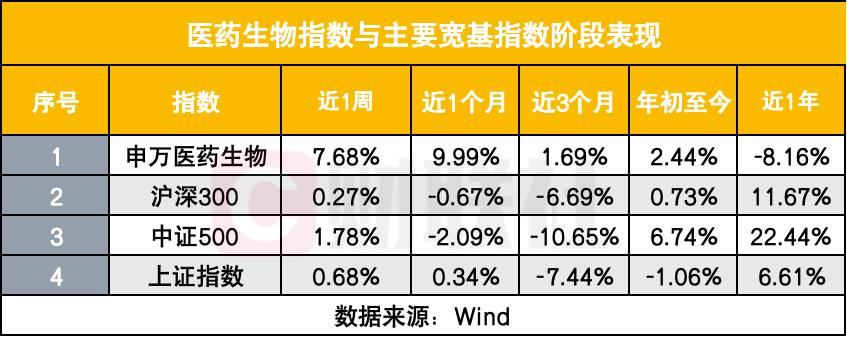
In terms of market performance, as of the close on August 13, 2026, the Shenwan Pharma & Biomed Index rose 7.68% over the past week and 9.99% over the past month, outperforming the CSI 300 by about 7.41 percentage points and 10.66 percentage points respectively. Wind data shows that on August 13, the trading value of the Shenwan Pharma & Biomed Index was about RMB 210.746 billion (2107.46 billion), and the turnover rate was about 4.01%. Pharma is no longer a peripheral sector with low trading and low attention.
From a breakdown by sub-sector, innovative drugs and CXO are the strongest main lines. The CSI Innovation Drug Industry Index rose 9.11% over the past week and 9.56% over the past month, and is up 10.58% year-to-date, clearly outperforming the overall Shenwan pharma sector. Hong Kong-listed pharma also shows 同步释放的 elasticity: the Hang Seng Healthcare Index and the CSMAR / Hang Seng China HK Stock Connect Pharma & Healthcare Composite Index have both seen roughly 10% gains over the past month.
Brokerage views are also changing. Recently, multiple brokerages have moved the pharma sector’s key矛盾 (core contradiction) from valuation repair toward interim-report performance, innovative-drug globalization, and CXO order verification. Citic Strategy mentioned that China’s innovative-drug industry may have opportunities for pipeline potential validation and value enhancement around nodes such as international academic conference data; institutions including CICC and Jiao? (交银国际) also focus on re-rating opportunities driven by innovative drug going global, License-out, and CXO prosperity repair.
From an industry-chain perspective, CXO is being re-focused, driven by improving innovation-drug financing/investment activity and a rebound in global R&D demand. A recent research note by Huafu Securities said that global CXO and upstream sectors show favorable earnings trends, and financing/investment continues to improve; Zhejiang Securities also emphasized that after years of clearing on the supply side, the CXO sector is now seeing positive resonance between demand and earnings.
AI drug discovery brings a new technology label to pharma. In the hot pharma roadshow samples from the past week, at least seven sessions directly discussed AI drug discovery or AI4S. Compared with the earlier, more concept-driven AI healthcare narrative, the market now focuses on whether AI drug discovery can deliver concrete clinical progress, cooperation orders, and improvements in R&D efficiency—making the boundary between pharma and the technology main theme increasingly blurred.
Besides the rise in market heat, funding signals still differ
The warming up of pharma is already quite obvious, but that doesn’t mean a broad-based rally across the entire industry. Judging from gains, trading, roadshows, research reports, and survey activity, pharma’s attention is increasing. Recently, the pharma & biomed sector received 104 institutional public-fund surveys over one week—more than electronics—and ranked first among all Shenwan Level-1 industries. Companies such as BeiGene, ZaiRui Pharmaceutical, and Nine Health? (JiuZhou?) have entered the top ranks by number of public-fund survey visits.
However, ETF flows have not shown one-way inflows. According to statistics, from August 6 to August 12, 57 pharma-related ETFs had an effective size of about RMB 100.994 billion, and the effective net outflow over the period was about RMB 1.545 billion. This suggests that while sector heat is rising, there is also a state of profit-taking from earlier low-level positioning and tentative moves by new capital.
Therefore, at present, pharma looks more like “accelerated turnover under high attention,” not a one-way trend after chips are completely locked. The rapid increase in sell-side roadshows and research reports reflects that institutions are补信息, 补模型, 补判断 (filling information, updating models, refining judgments). Differences on the capital side mean the market still needs continued validation from interim reports, orders, clinical progress, and authorized transactions.
From defense to growth—can pharma absorb the spillover capital from technology?
Another important backdrop for this renewed sell-side focus on pharmaceuticals is that after technology trades became crowded, capital needs to find new growth segments.
When the market talks about pharma in the past, it usually emphasized defense, undervaluation, and policy considerations. Now, the pharmaceutical directions being discussed at high frequency carry more growth and technology attributes. For innovative drugs: focus on globalization and pipeline value; for CXO: order repair and outsourced R&D demand; for AI drug discovery: shifts in the R&D paradigm; for life sciences upstream: domestic substitution and a rebound in R&D investment.
This is also why pharmaceutical roadshow popularity can stand alongside technology. The focus of institutional discussions has shifted from traditional pharmaceutical defensive positioning to looking for “technology-driven growth beyond technology.” Once the AI theme spreads across computing power, chips, optical communications, and power equipment, AI drug discovery within pharma, innovative drug globalization, and CXO order repair have also become new variables that sell-side institutions need to track continuously.
However, differences within the pharmaceutical sector are also very clear. Innovative drugs, CXO, life sciences upstream, and companies with commercialized execution capabilities are hotter, while traditional Chinese medicine, pharmacies, pharmaceutical distribution, and some medical device segments are relatively weaker. Whether subsequent market performance can continue depends mainly on whether interim report results, innovative drug global expansion, and CXO order fulfillment can keep coming through.
For sell-side participants, pharma getting hot again means research resources are shifting from simply chasing the strongest technology main line to finding the next growth chain that has fundamental validation. For the market, whether pharma can move from “short-term repair” to “main-line re-rating” depends on whether industry data can continue to provide answers.