


Original title: (DeepSeek Partners With Unitree: When Intelligence Becomes Cheap Enough to Be Wasted)
Original author: Insight Beating
When technology truly starts changing the world, it often happens when it becomes cheap enough to be wasted.
Recently, even foreign media have started learning a very China-internet-style term: the kill line.
On July 31, DeepSeek V4 Flash was updated. In the coordinate chart on Artificial Analysis that compares model intelligence levels and usage costs, the higher the vertical axis goes, the smarter the model is; the farther to the right the horizontal axis goes, the higher the calling cost. With an intelligence index of 50, V4 Flash is already right up against the global top-tier; yet the average cost per round of testing is only 3 cents. That point is almost pushed to the upper-left corner of the coordinate system. Models that are cheaper than it are mostly inferior in capability; models that are smarter than it are generally more expensive by a large margin.
Now, if a model can’t explain why it’s tens of times more expensive by being far superior to DeepSeek, it’s becoming increasingly hard to justify its premium. The Chinese internet calls this boundary line the “killing line.” A few days later, when Bloomberg discussed Chinese models’ price pressure on US AI companies, its headline also directly used “Death Zone.”
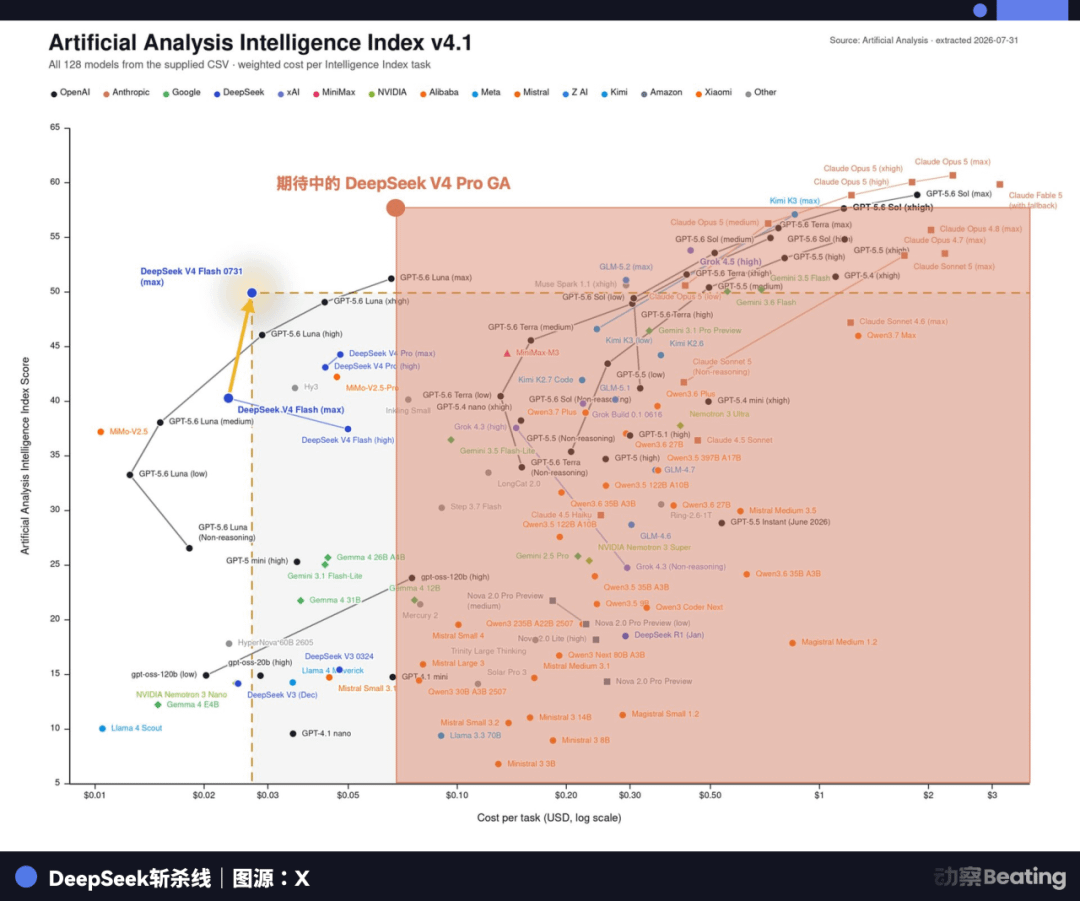
Since V2 in 2024, DeepSeek has been constantly pushing down the amount of money spent on making a machine “think once.” The tasks the model can handle keep getting more complex, yet the price never climbs alongside capability. Over the past two years, the large-model industry has tended to describe progress with larger parameter counts, longer context windows, and higher benchmarks. DeepSeek has been pursuing a different standard: with the same intelligence, can it achieve the same results while spending less money?
On the other side of Hangzhou, Wang Xingxing had been doing another similar thing for more than a decade.
When he was a graduate student doing XDog, there wasn’t money to burn from the start. He couldn’t afford the expensive hydraulic system, so he studied low-cost motors. He couldn’t buy mature solutions, so he drew his own drive boards, wrote programs, and built the control system. Many of today’s Unitree product-standard technical choices originally came with a very plain engineering habit: don’t ask how the industry usually does it—first see if there’s a cheaper way.
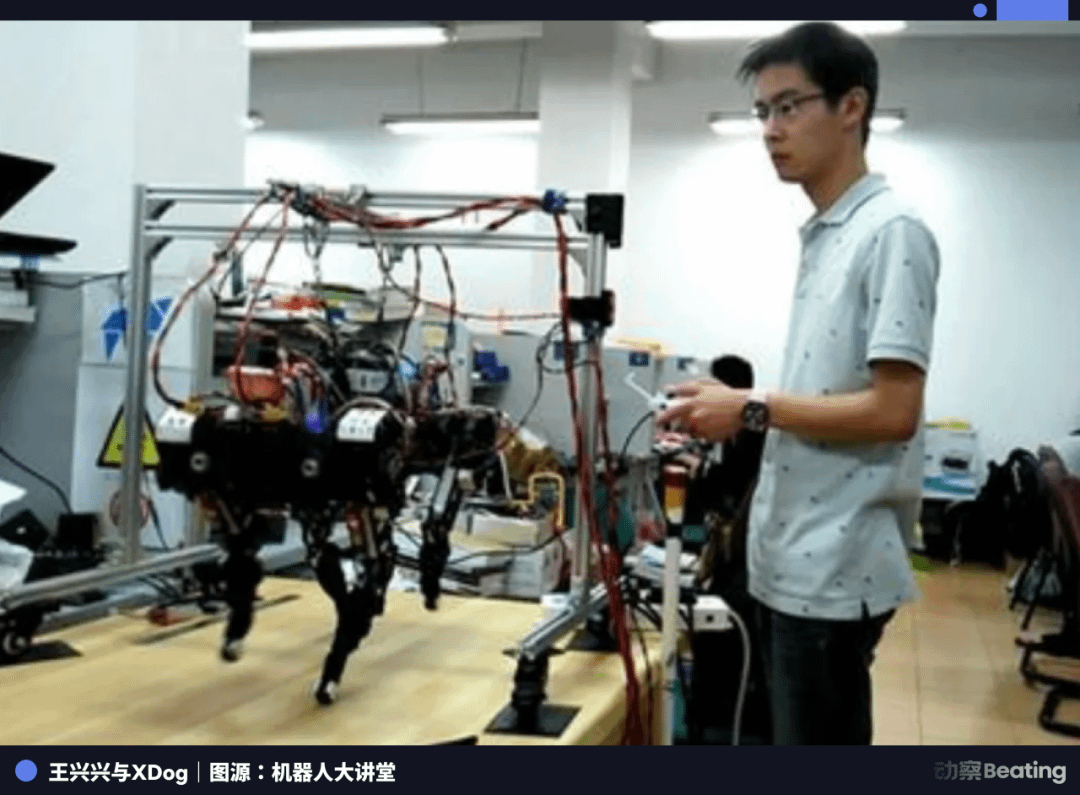
Later, Wang Xingxing recalled that when they built biped robots in 2010, the mechanical parts alone cost just 200 yuan. Years later, someone asked whether Unitree could keep reducing costs further. He replied: “Don’t compare with us in cost reduction. We can still reduce a lot.”
One company is lowering the price of thinking; one company is lowering the price of acting. For a long time, even though they’re both in Hangzhou, they’ve still been taking their own separate paths.
Until August 6.
Unitree Technology disclosed the results of its strategic allocation for its STAR Market IPO, and DeepSeek put up 140.8 million yuan to subscribe to Unitree’s new shares. The cooperation arrangements both sides disclosed are also quite direct: when Unitree needs model training services and technical solutions, it will prioritize DeepSeek; when DeepSeek needs robots and wants to explore embodied-intelligence applications, it will prioritize Unitree.
Putting this money into today’s AI industry isn’t that surprising. What’s really interesting is that two people who have spent more than a dozen years trying to bring expensive technology down to “bargain” levels have, for the first time, connected their cost curves. Then a question worth asking more than “large models finally give robots a body” came up:
If the cost of making machines think and the cost of making machines act keep falling at the same time, what would AI eventually become?
The answer might not be just “more people can afford it.”
The bigger change is that we start to value it less and less.
Two price killers
What’s most similar about Liang Wenfeng and Wang Xingxing is that they both don’t really believe in “cheapness” bought through subsidies. The price list can be changed overnight, sure—but the wool comes from the sheep. This kind of low price usually can’t last long. If a product truly wants to be sold cheaply long-term, it ultimately has to go back to engineering: break down those costs that previously seemed to exist for granted, layer by layer.
DeepSeek-V2 is the most typical example. After the model was released in 2024, China’s large-model industry was quickly dragged into a price war. The easiest thing for outsiders to see is API pricing, but what actually supports the price cuts is hidden in the model architecture. V2 has a total of 236 billion parameters, but for each token processed it only activates 21 billion. Compared with the previous generation, training cost was reduced by 42.5%, KV cache was reduced by 93.3%, and maximum generation throughput increased to 5.76x.
By V3, the idea pushes forward again. The model becomes bigger. Official training used 2,788,000 H800 GPU hours. DeepSeek then optimized efficiency further through mixture-of-experts, low-precision training, and communication optimizations.
Later, this view of cost even started to define products in reverse.
This May, DeepSeek turned the original 75% promotional discount for V4-Pro directly into a permanent price, and the flagship tier also continued to be pushed down. Liang Wenfeng previously explained their pricing principles: pricing based on real costs, not losing money long-term, and not chasing excessive profit margins.
Wang Xingxing’s understanding of robots is almost the same.
When asked in a 2025 interview with (LatePost), about the fact that H1 was initially sold at 90,000 US dollars and later the more flexible G1 low-end version’s starting price was only 99,000 yuan RMB—would it still be profitable like that?
Wang Xingxing answered: “Business must certainly have reasonable commercial profit. Costs are always our KPI for everything we do. The core is to make money.”
What he then talked about was also very little about the most common line, “once the scale kicks in, suppliers naturally lower prices.” What really determines a robot’s price floor is how the motors are selected, how the reducers are built, how many parts a single joint needs, whether the whole unit can still be made lighter, and which components must be tightly held in-house.
This cost-reduction approach has a strong industrial-era feel, like splitting a penny into two halves to spend.
A few centimeters shaved off a circuit board, two fewer parts on a joint, a cable harness that allows a different route—none of these, taken alone, counts as a great breakthrough. But when dozens of such changes stack up, they directly end up affecting the selling price.
This is exactly what happened with Unitree’s pricing over the past few years. In 2023, the first full-size humanoid robot H1 launched, selling only 5 units that year, with an average selling price of 593,400 yuan; in 2024, the smaller G1 entered the market, with sales rising to 410 units and the average price dropping to 260,700 yuan; by the first nine months of 2025, humanoid robot sales reached 3,551 units, and the average price fell again to 167,600 yuan.

With each step down in price, robot buyers get a new batch of newcomers. A 500,000–600,000 yuan device requires a lab project approval, a budget submission, and explanations of what research it will be doing after purchase; 100,000+ yuan equipment can instead enter more universities, development teams, and enterprises.
Many technologies truly cross their adoption tipping point because the change is completed in moments like this. From special-purpose budgets to departmental budgets, and then from departmental budgets to normal procurement. Finally, one day, people get too lazy to算账 again for every use.
Expensive technology is naturally only meant to solve expensive problems. When prices drop, those small matters that previously weren’t even worth bringing technology into its world begin to enter it.
Two cost curves finally intersect
Since Unitree is already building world models and VLA, DeepSeek’s value isn’t just “giving a robot a brain.” What can truly lock the two companies together is the most expensive training loop that embodied intelligence has at the moment.
Half of this cycle happens in the real world. When robots really reach out, walk, and pick things up, humans or other systems repeatedly demonstrate for them—producing trajectories of both success and failure.
The other half happens in computation. Data is cleaned and labeled, then sent into the model training for a new strategy. After that, the model is redeployed back to the robot after inference and verification. The robot goes out to keep trying, brings back new data, and the model learns again. The faster this loop runs, the more of the world the robot gets to encounter.

The problem is that it’s expensive on both ends. Real machines are expensive, so it’s hard to keep hundreds of robots in the lab crashing into things all day. Training and inference are expensive, and the data you collect that isn’t clearly valuable at first sight is also hard to repeatedly train and validate.
So in the past, doing robot experiments was always so precious. There were only a few machines—you had to think in advance what data to collect today. There was only so much compute—whether a batch of trajectories was worth running again had to be worked out with your fingers. When resources are expensive, researchers are more inclined to choose questions that look most valuable and have the highest chances of success.
But reality is not like that.
What’s the difference between putting a cup 3 centimeters from the edge of a table and 5 centimeters away, where to grab after a towel is halfway wet, whether to keep pushing forward when a drawer sticks or back off a bit first, how to adjust your arm when putting one apple and three apples into a plastic bag—none of these things, taken individually, is worth holding a press conference for, and it’s even hard to justify launching a dedicated experiment in a lab. But once a robot enters homes, restaurants, warehouses, and offices, the world it faces every day is exactly made of these trivial, irritating issues.
When you look at the cooperation between DeepSeek and Unitree at this point, the logic becomes much clearer.
Unitree drives down the cost in the first half, so more real robots can go into labs, development teams, and real scenarios. DeepSeek, in the long run, solves the problems in the second half, making model training, inference, and verification progressively cheaper.
Most trajectories never make it into the product, and most experiments never become news. Some robots might repeatedly grab the wrong cup for a hundred times, and a batch of costly data runs might only prove that the original idea was fundamentally wrong.
When resources are expensive, these are called “throwing money down the drain”; when costs are low enough, they earn the right to be called “experience.”
If phones got a little cheaper, it would mean more people can buy them. And if robots got a little cheaper, it would also mean they can own more time that would otherwise have produced nothing—practicing in a lab for an afternoon, doing some actions that finally aren’t even useful, entering more strange environments, and encountering more situations that more engineers didn’t think about in advance.
When both bodies and intelligence become cheaper at the same time, embodied intelligence gets first what it needs most: more permission to make mistakes.
How did humans learn to waste technology?
This has happened many times in human technological history.
In 1865, when British economist William Stanley Jevons studied steam engines and coal, he found an unintuitive thing: as steam engine efficiency increases—less coal is burned to complete each task—Britain’s coal consumption doesn’t fall; it actually rises. Because once steam power becomes cheap, people start using it for things they previously couldn’t bear to do. The coal saved by efficiency is quickly eaten up by more new demand.
Later people called this phenomenon the “Jevons paradox.”
In the past two years, people using AI have already, to some extent, experienced the opposite stage. When models were still expensive, we first learned how to save intelligence. Startup teams talked about user experience on the surface, but product managers still had to keep in mind a token price list: a function that’s technically doable might end up being cut because “it’s too expensive for each user to run the model five more times.”
But for technology to truly enter everyday life, it often has to cross another hurdle: once it’s cheap enough for us to start using it to do things that aren’t that important.
Today nobody calculates how much economic value a single hour of lighting creation has before turning on the lights in the living room. And nobody thinks they’re wasting the great internet infrastructure just because their phone sends a few extra network requests in the background.
Electricity and networks both have costs. It’s just that the cost has already dropped to the point where it’s no longer worth making a decision for every single use. People have long become extravagant about these things—and without any guilt.
If intelligence ever arrives here, our relationship with AI will change too. After the meeting ends, you casually ask the model to organize things. Once the article is finished, a few models independently find faults. If an Agent doesn’t succeed, you try a few more paths and keep going. Whether there are dates or not, you still take three shots at the target first. The robot tidies up the table: first it knocks the cup over, second its hand goes off to one side, third the motion is too slow—then it comes back for a fourth time.
Once a technology truly becomes widespread, people won’t keep calculating how efficiently it’s being used. People may even forget they’re using it.
By the time we don’t have to keep tallying that cost anymore
In 1911, British mathematician and philosopher Alfred North Whitehead wrote a line in Principles of Mathematics:
“Civilizational progress lies in continuously expanding those important operations we can perform without thinking.”
Today’s AI obviously hasn’t gotten here yet. We’re still debating which tasks deserve to use the most expensive models. Developers will still switch suppliers by a few yuan per million tokens. Robot companies still have to find the scenario in which the ledgers are easiest to calculate—between showrooms, labs, and factories. The industry still has a very heavy “life’s necessities” kind of feel.
And the reason this 140.8 million yuan investment is truly linking them together is a bill that has rarely appeared in industry discussions. When a machine makes a mistake—how much is it really worth?
This answer isn’t cheap enough yet, so every piece of real-world data must be collected carefully. Each training cycle must be curated and filtered. And each robot should ideally find a job that can produce outputs as soon as possible.
By the time intelligence truly becomes widespread, there may not be a single press conference announcing the arrival of a new era. We’ll just slowly realize that in a warehouse corner, a robot practicing grabbing boxes for an afternoon—failing three hundred times—no one is especially interested in anymore. An Agent trying dozens of paths to find an answer won’t have anyone watching a token bill while feeling pained. In the lab, adding a few more robots won’t require writing a separate procurement justification for each one.
So the truly important price for AI’s future might not be how much a million tokens cost, nor how much a humanoid robot costs, but when we finally become too lazy to keep calculating these numbers.
When it’s no longer worth anyone’s heartache—when the machine has thought a few more times, walked a few more steps, and made mistakes a few more times—then intelligence is truly transformed from an expensive capability into infrastructure.
When technology truly starts to change the world, it often happens when it becomes cheap enough to be wasted.
DeepSeek is bringing the cost of thinking close to this price, while Unitree is bringing the cost of the body close to this price. The remaining thing is to give machines an entire life that’s cheap enough.
Cheap enough to try again and again, cheap enough to keep making mistakes, cheap enough that failures that look meaningless today finally become so numerous that they add up to intelligence.
Original text link