

1. Introduction: The leap from “holding” to “putting it to use”
Since bStocks went live, tokenized stock assets have grown from the original 5 to 25. The on-chain market capitalization is close to $300 million. Currently, there are 190,417 users in total: 41.5% trade bStocks only, while 58.5% participate in both perpetual contracts or stock products. More than half of the users no longer treat bStocks as merely something to “hold”; instead, they’ve begun exploring operational opportunities across assets.
But “participating in perpetual contracts” is only the tip of the iceberg of cross-asset strategies. Deployed as BEP-20 tokens on BNB Smart Chain, bStocks have composability that is entirely different from traditional stocks. While holding bStocks, you can obtain liquidity via collateralized lending without selling your position, earn additional returns through DeFi protocols, and hedge risk or amplify exposure through the derivatives market. The same underlying asset can be “used” in multiple ways—that’s the core value that sets bStocks apart from traditional stocks.
From a practical standpoint, this article systematically organizes bStocks’ cross-asset strategy framework, covering five directions: cross-market arbitrage, leveraged collateralization, DeFi yield enhancement, derivatives portfolio, and automated DCA.
II. Strategy One: Cross-Market Arbitrage
2.1 The Basic Logic of Arbitrage
There is a difference in pricing between bStocks and traditional stocks despite sharing the same underlying assets across two different markets. When the price of bStocks deviates from its anchored traditional stock price, arbitrageurs can capture the spread by buying in one market and selling in the other—or vice versa.
Binance Research data shows that 2,806 users participated in cross-market arbitrage between bStocks and traditional stocks. Of these, 2,600 users were one-time participants who appeared only once in the dataset, indicating that arbitrage opportunities are not limited to professional traders—ordinary users can participate as well. These occasional participants contributed $6.46 million in rapid-matching trading volume; trades typically completed within the same hour, with a median time interval of less than one minute.
206 systematic arbitrage users contributed $198.2 million in rapid-matching trading volume, accounting for 96.5% of the related trading volume, earning approximately $636,000 in spread profits before deducting trading costs.
2.2 Operational Framework
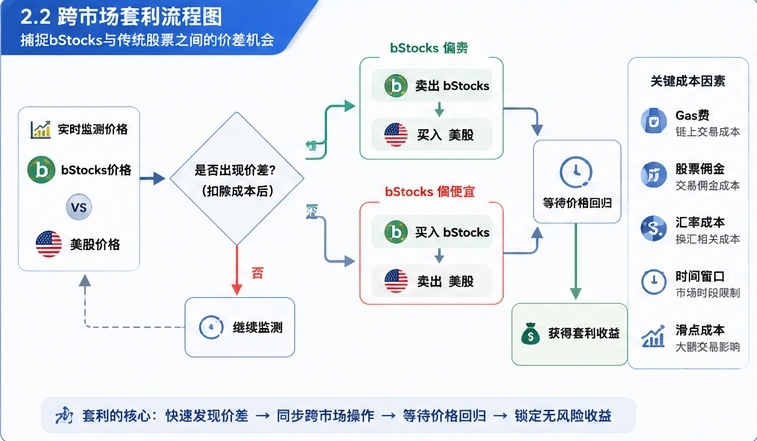
The core operation of cross-market arbitrage is: buy a certain stock in the traditional stock market while selling the corresponding tokenized version in the bStocks market; or the reverse—buy in the bStocks market and sell in the traditional stock market.
In practice, there are several key points to note. The time window is the first threshold for arbitrage. Traditional U.S. stock markets have clearly defined trading session restrictions, while bStocks supports trading 24/7. During U.S. stock market closed hours, bStocks’ share of trading volume reaches 58%, higher than the 42% for stock spot. The price spread during non-trading hours may be larger, but this also means you cannot lock in profits via traditional stock-market synchronized reverse trades. Arbitrageurs need to judge the timing rhythm of when prices revert.
Trading costs are the second key variable. bStocks’ on-chain trading and conversion have inherent cost advantages: users can convert directly held stocks to bStocks at a 1:1 ratio with zero conversion fee. However, arbitrage involves cross-market operations. Trading commissions in traditional stock markets, exchange-rate costs, and bStocks on-chain trading Gas fees all need to be included in the arbitrage cost model.
Spread monitoring requires tooling support. Successful arbitrage depends on the ability to capture spread opportunities in time. Since the bStocks price is determined by market supply and demand, while traditional stock prices are discovered through exchange order matching, their price discovery mechanisms differ and the spread will keep fluctuating. Systematic arbitrage users typically rely on algorithmic strategies for monitoring and execution, while ordinary users can participate by manual observation or by using third-party price comparison tools.
2.3 The Market Significance of Arbitrage
Arbitrage behavior itself has positive value for the bStocks market. The presence of arbitrageurs helps bStocks’ price track traditional stock prices more closely, forming a “self-correcting” market structure. The more arbitrage users there are, the higher the pricing efficiency of bStocks becomes—this protects all bStocks holders.
III. Strategy Two: Leverage and Collateral
3.1 bStocks as Collateral Assets
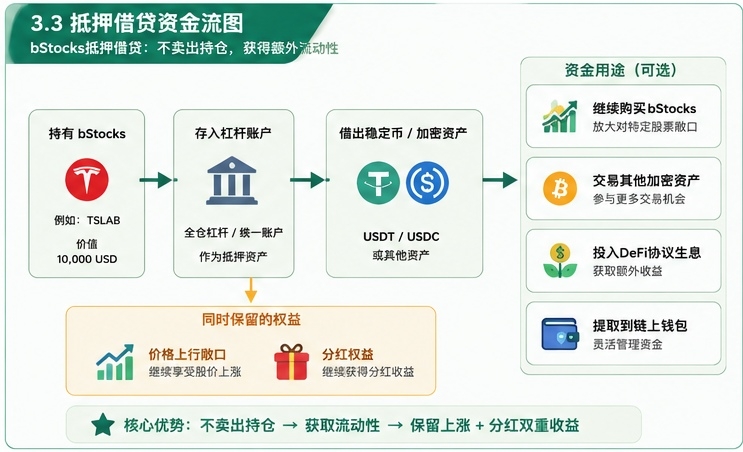
The most direct advanced use case for bStocks is to use them as collateral to obtain additional liquidity, without needing to sell your holdings.
The Binance-safe vault leverage, unified account mode, and unified account Pro Edition have already supported multiple batches of bStocks tokens as eligible collateral assets. By mid-July 2026, more than 25 bStocks underlying assets had been included within the scope of collateral assets. Users can deposit their bStocks into the leverage account as margin and borrow stablecoins such as USDT and USDC, or other crypto assets.
This feature is only available to VIP 3 users and above in approved jurisdictions. Parameters such as the collateralization ratio can be adjusted at any time based on market conditions.
3.2 Portfolio-Wide Leverage vs Unified Account
As collateral, bStocks currently supports three account modes: portfolio-wide leverage, unified account mode, and unified account Pro Edition.
In portfolio-wide leverage mode, bStocks collateral and other collateral assets in the account share a common margin pool, enabling larger-scale leveraged trades. However, portfolio-wide leverage also implies higher risk: losses in one position can trigger liquidation of the entire account.
Unified account mode allows users to manage multiple types of positions—spot, leverage, contracts, and more—within a single account. With bStocks as collateral, the account can simultaneously support trading needs across multiple product lines. Unified account Pro Edition provides more fine-grained risk management tools on top of that.
No matter which mode you choose, when using bStocks as collateral you must adopt strict risk management strategies and regularly monitor the margin level.
3.3 Operational Example
Assume a user holds $10,000 worth of TSLAB (Tesla tokenized stock). In a portfolio-wide leverage account, they use it as collateral; based on the prevailing collateralization ratio, they can borrow a certain proportion of stablecoins. The borrowed stablecoins can be used for:
Buy more bStocks to amplify exposure to specific stocks; trade other crypto assets; withdraw to an on-chain wallet and deposit into a DeFi protocol to earn yield.
The key point is: the user always retains the upside exposure and dividend rights of TSLAB. The position is not sold; it’s merely “pledged.”
IV. Strategy Three: DeFi Yield Enhancement
4.1 Maturity of On-Chain Yield Scenarios
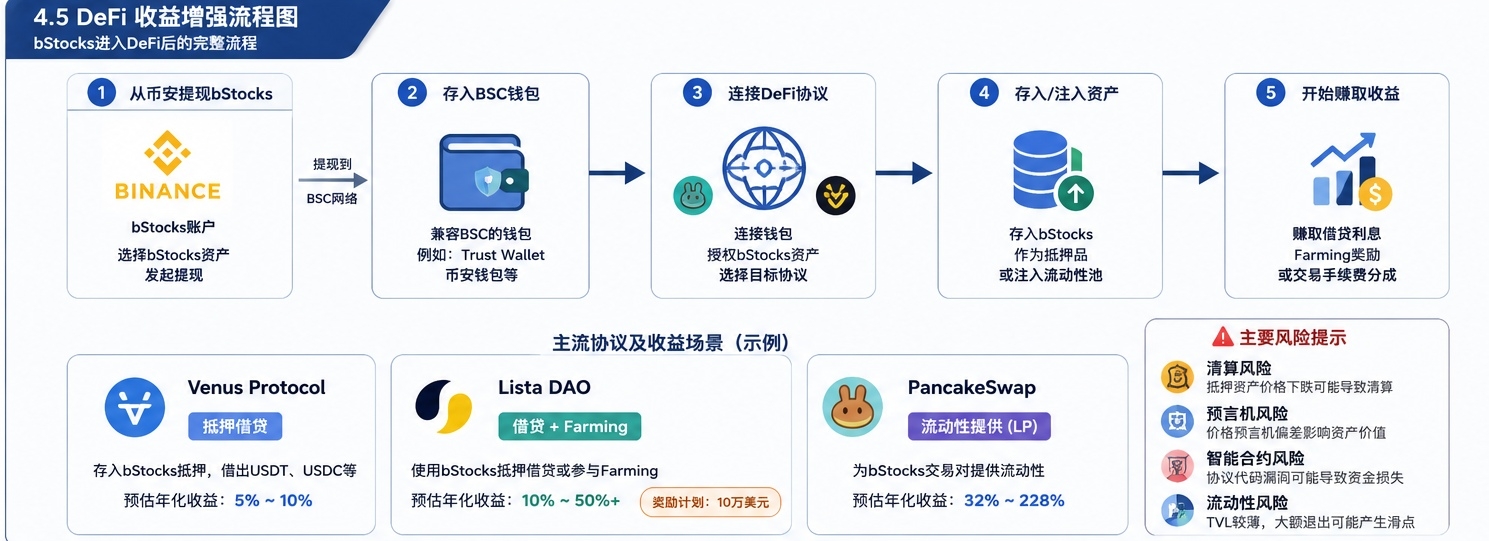
After bStocks is removed from the Binance platform, it can truly be “put to use” in DeFi protocols on BNB Chain. Currently, liquidity pools related to bStocks have appeared on multiple DEXs and lending platforms. PancakeSwap’s LP pool APY range is 32% to 228%, and the native credit pool yield is 5% to 10%. The currently visible total TVL is about $1.15 million.
These APY figures reflect early-market liquidity incentives rather than stable normal conditions. APY is high because liquidity is thin and incentives are concentrated. As more liquidity enters, APY will gradually return to a reasonable range.
4.2 Venus Protocol: Collateralized Lending
On June 20, 2026, Venus Protocol officially launched tokenized stock collateralized lending on BNB Chain. Users can deposit TSLAB (Tesla), NVDAB (NVIDIA) and SPCXB (SpaceX) into the Venus Core Pool as collateral, and borrow assets such as USDT and USDC while maintaining stock price exposure.
This is Venus’s first support for tokenized stocks as collateral assets. bStocks are positioned alongside BTC, ETH, BNB and stablecoins as part of the Venus liquidity market. This integration moves bStocks from “trading assets” into the “yield-bearing assets” category.
4.3 Lista DAO: Borrowing and Yield Farming
Lista DAO is the first lending protocol to support bStocks. It allows holders to use tokenized U.S. stocks as collateral to borrow or participate in yield farming. Lista DAO also launched a $100,000 rewards program, with the first phase focused on SPCXB (SpaceX).
Lista DAO itself is one of the core protocols in the BNB Chain ecosystem for handling liquid staking. By integrating bStocks into Lista DAO, tokenized stocks and BNB staking derivatives enter the same liquidity pool.
4.4 PancakeSwap: Liquidity Provision
PancakeSwap has already listed more than 35 bStocks assets, including NVIDIA, Tesla, Circle, Microsoft and Meta, among others. Users can provide liquidity to bStocks-related trading pairs and earn trading fees and incentive tokens. The SPCXB-USDT pool is one typical example: it allows users to stack rewards while holding a tokenized SpaceX exposure.
4.5 Operational Framework and Points to Note
The basic process for deploying bStocks to a DeFi protocol is:
1. Withdraw bStocks from the Binance platform to a self-custody wallet compatible with BSC (e.g., Trust Wallet, Binance Wallet);
2. Connect the wallet to the target DeFi protocol (Venus, Lista DAO, PancakeSwap, etc.);
3. Deposit bStocks as collateral or inject them into a liquidity pool;
4. Start earning loan interest, farming rewards, or a share of trading fees.
Risks to note include: liquidation risk—collateral asset price declines may lead to liquidation of the position; oracle risk—price oracles relied on by DeFi protocols may deviate; smart contract risk—the protocol itself may contain code vulnerabilities; liquidity risk—current TVL is relatively thin, and large withdrawals may cause significant slippage.
V. Strategy Four: Derivatives Portfolio
5.1 bStocks as Margin for Perpetual Contracts
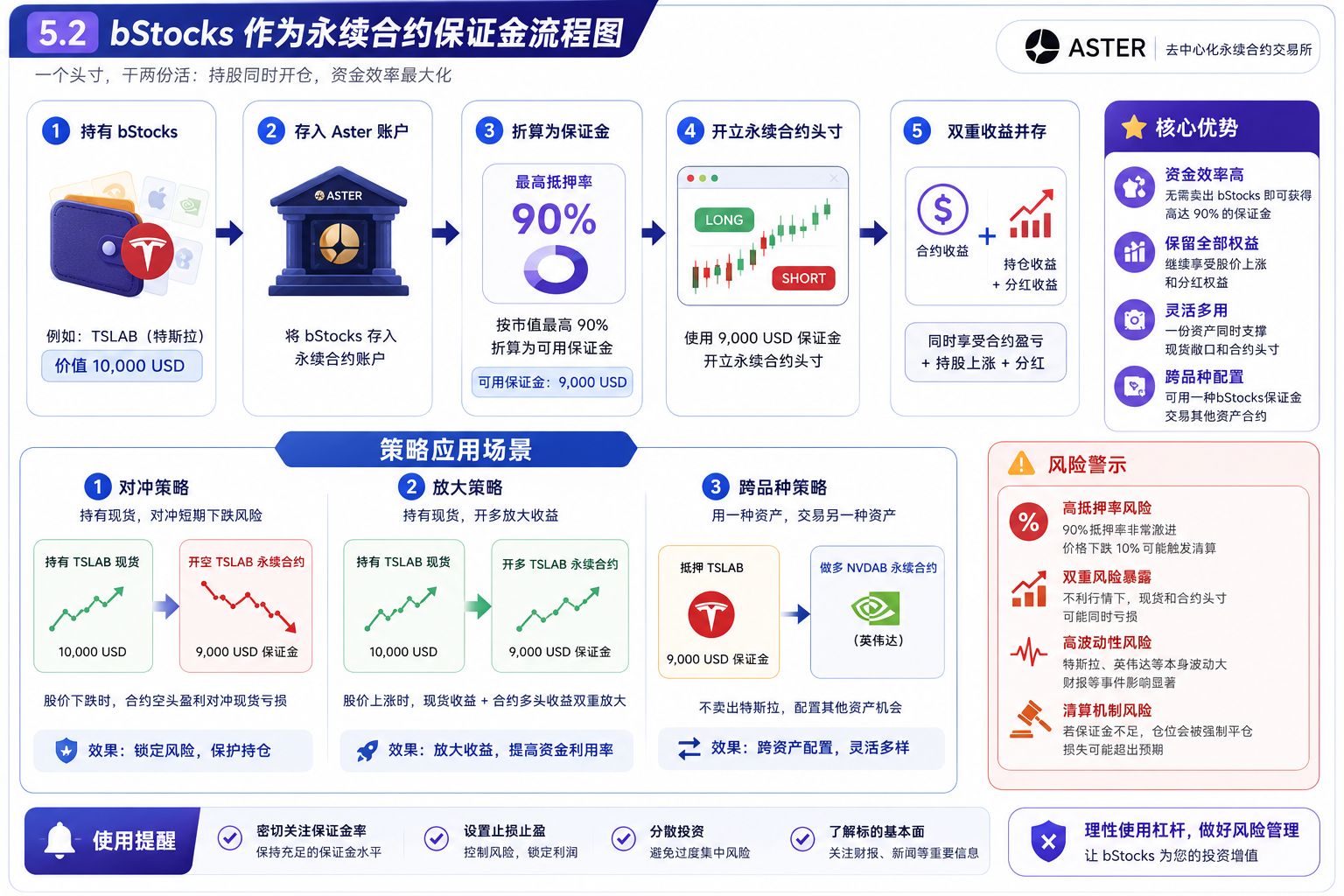
On June 15, 2026, Aster, a decentralized perpetual futures exchange on BNB Chain, launched a new feature: users can deposit bStocks into a perpetual contract account as margin, with up to 90% of the asset value counted toward margin.
This means that users holding $10,000 worth of TSLAB can use $9,000 directly as margin for perpetual contracts, while still enjoying all the rights to Tesla’s upside price movements and dividends. The first supported assets include TSLAB (Tesla), NVDAB (NVIDIA), CRCLB (Circle), and SNDKB (SanDisk).
Aster calls this mode “one position, two jobs,” where you open a position while holding.
5.2 Operational Framework
Specific steps for using bStocks as margin for perpetual contracts on Aster:
1. Enable multi-asset mode on the Aster platform;
2. Deposit bStocks into the perpetual contract account;
The system converts up to 90% of the market value into collateral assets;
4. Open a perpetual contract position using the converted margin.
The core advantage of this mechanism lies in capital efficiency. Users don’t need to sell bStocks to obtain margin for contract trading. The same asset supports both spot exposure and derivatives positions at the same time.
5.3 Strategy Applications
Hedging strategy: if a user holds a large amount of TSLAB spot but worries about short-term pullbacks, they can open a TSLAB perpetual contract short position on Aster, using TSLAB itself as margin. This provides protection without selling the position, and it can benefit from price declines.
Strategy amplification: If users expect upside from a particular stock, they can hold bStocks spot and use it as margin to open a directional long perpetual contract, amplifying upside returns.
Cross-asset strategy: users can use Tesla bStocks as collateral to open perpetual contract positions for NVIDIA or other assets, achieving cross-asset capital allocation.
5.4 Risk Warning
A 90% collateralization ratio is very aggressive. If the underlying bStock drops by 10%, the collateral value may reach the liquidation line. bStocks tied to Tesla, NVIDIA and other assets are inherently high-volatility. A poor earnings report could simultaneously destroy both the stock position and the perpetual contract position—this “double blow” scenario is prevented by strict risk-control rules in traditional finance, but in the DeFi environment users need to evaluate and assume the risk themselves.
VI. Strategy Five: Automated DCA
6.1 Bringing the DCA Strategy to Life
Binance Flexible Earn (Binance Flash Exchange) has already supported the bStocks DCA feature. Users can automatically buy supported bStocks starting from a minimum equivalent value such as 0.01 USDC. Users can set their preferred recurring purchase interval and amount, and the system will execute automatically.
Dollar-Cost Averaging (DCA) is a long-term strategy that smooths market volatility by continuously buying at a fixed amount over fixed intervals. bStocks’ DCA feature brings this traditional investment strategy into the tokenized securities space.
6.2 Applicable Scenarios
DCA is especially suitable for the following scenarios:
You hope to gain U.S. stock exposure through long-term accumulation, but you don’t want to take the timing risk of a one-time large buy; you have a fixed cash flow each month for investing and want automated allocation; you are bullish on a specific stock long-term, but short-term price fluctuations are high.
The minimum entry threshold for bStocks DCA is extremely low (0.01 USDC), making fractional-share investing possible.
VII. A Unified Framework for Risk Management
The diversity of cross-asset strategies creates opportunities for returns, but it also brings compounded risks. The risks below need to be assessed before executing any strategy.
Legal-structure risk: bStocks are tokenized securities instruments, not direct ownership of the underlying stock. Holding bStocks does not mean directly owning shares of the underlying publicly listed company.
Collateral risk: when bStocks are used as collateral, parameters such as the collateralization ratio will be adjusted at any time based on market conditions. Parameter changes may reduce the collateral value conversion ratio, which can then trigger additional margin calls or forced liquidation.
Cross-market risk: bStocks has a higher share of成交量 during non-trading hours, but liquidity may be thinner and price discovery efficiency may be lower. Performing large operations during non-trading hours requires special attention to slippage and depth.
Compounded risk: when multiple strategies are stacked together (e.g., after borrowing by pledging bStocks, the borrowed stablecoins are then put into a DeFi protocol to earn yield), the risks compound. Failure in one step can trigger a chain reaction.
VIII. Conclusion
The cross-asset strategy system for bStocks essentially fuses the investment logic of traditional stocks with the financial engineering capabilities of crypto assets. A single bStocks asset can be used as collateral on the Binance platform to leverage within the exchange ecosystem; it can be lent and earn interest on-chain through DeFi protocols; it can serve as margin for derivatives positions in perpetual contracts; and it can also support long-term accumulation via DCA strategies.
This “one position, multiple uses” trait is the core difference that sets bStocks apart from traditional stocks and ordinary crypto assets. However, the complexity of cross-asset strategies also means higher cognitive requirements and risk exposure. Every strategy has its own applicable scenarios and associated risks, and users need to choose based on their risk tolerance, capital size, and operational experience.
bStocks launched less than one month ago, and its on-chain market value is already approaching $300 million. With the continuous expansion of asset types and ongoing integration into the DeFi ecosystem, the cross-asset strategy toolbox will further grow.