
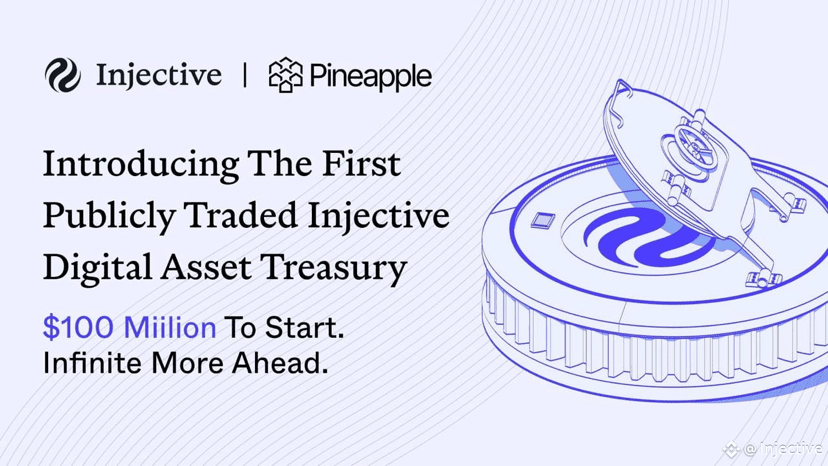
Recently, there has been a significant announcement in the crypto space: Pineapple Financial, a publicly listed company on the New York Stock Exchange (NYSE), has raised $100 million in digital asset treasury specifically for Injective (token INJ), and has already begun to aggressively buy INJ on the open market with this money. More importantly, Injective's ETF (exchange-traded fund) is set to launch in the United States soon, allowing both large institutions and regular investors to invest in INJ through legitimate channels on Wall Street!
First, understand two core professional terms, then we can talk about how important this matter is:
• Digital Asset Treasury: Simply put, this is the 'cryptocurrency special fund pool' established specifically by Pineapple Financial. $100 million is no small amount; it is equivalent to creating a 'safety fund' tailored for INJ. Moreover, it is led by a publicly listed company and backed by NYSE's compliance endorsement, which is not just small-scale financial speculation.
• ETF (Exchange-Traded Fund): We can understand it as an 'investment tool for the stock-like investment of cryptocurrencies'—there's no need to download a cryptocurrency exchange app or remember complex wallet addresses. Just like buying Moutai or Apple stocks, you can search for the code in your US stock account to buy it, and it is subject to US financial regulation, maximizing safety and convenience.
First, let's talk about the worth of the $100 million treasury: Pineapple Financial is a legitimate NYSE-listed company, not an unknown entity. By putting up $100 million to build an 'INJ exclusive fund pool', it essentially votes for INJ with 'real money' from traditional finance. This is not retail investors following trends, but a long-term arrangement made by professional institutions after research—equivalent to telling the market, 'We are optimistic about the ecological value of INJ and are willing to invest money for the long term.'
The role of this money is also very practical: continuous purchases of INJ in the open market will directly reduce the circulating supply, while providing stable buying support for INJ, like adding a 'safety cushion' to the price of INJ. More importantly, the participation of publicly listed companies will attract more traditional financial institutions to pay attention to INJ, effectively opening a cooperative channel between 'crypto assets + traditional listed companies', elevating the compliance and recognition of INJ to a new level.
Now, regarding the launch of ETFs in the US, this is 'great news' for both ordinary people and institutions:
For institutions, in the past, if they wanted to invest in INJ, they had to go through cryptocurrency exchanges or over-the-counter trading, which was cumbersome and could face compliance risks. Now, with ETFs, Wall Street's fund companies, banks, and pension funds—these 'big investors'—can openly allocate INJ through compliant channels, allowing massive funds to naturally flow in, resulting in explosive growth in INJ's liquidity and market scale.
For us ordinary people, the threshold has dropped to 'zero': there's no need to learn complex cryptocurrency knowledge, nor worry about the risks of losing milestones or private keys. As long as you have a US stock account, you can participate in investing in INJ with a few hundred dollars, effectively transforming INJ from a 'niche crypto asset' into a 'widely available investment product for everyone.'
When looking at these two matters together, INJ is actually completing a key step in 'moving from the crypto circle to mainstream finance': First, it relies on the $100 million treasury from a publicly listed company to solidify its value foundation, and then uses ETFs to open up funding channels on Wall Street. On one side is compliance endorsement, and on the other is funding entry, working together to help INJ completely shed the label of 'niche speculation' and become an asset recognized by the traditional financial market. ##injective @Injective $INJ
