

Written by: White55, Mars Finance
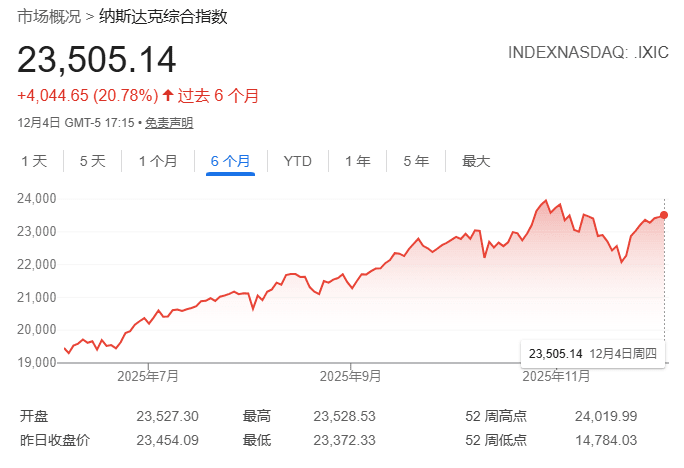
After a month of market fluctuations, the U.S. stock market has gradually rebounded and is approaching historical highs. However, concerns about persistent inflation and weakening consumer confidence data still keep investors cautious on the eve of the Federal Reserve's final policy meeting of the year.
In this context, the Personal Consumption Expenditures Price Index (PCE) for September, to be released on Friday—an inflation indicator that the Federal Reserve is particularly focused on—will be especially critical for the market. This report, although collected during an earlier data gathering period, is expected to provide a 'hard data'-based reality check to help determine whether the current sluggish economic sentiment is reasonable or further confirm its deviation from the actual situation.
Mark Hackett, Chief Market Strategist at Nationwide, pointed out: 'The reason Friday's PCE data is receiving closer attention is due to questions about the accuracy of some recent 'soft data' (such as survey responses).' He further explained: 'Currently, the data we have is incomplete or lagging, so the PCE report helps fill the information gap.
At a time when the market needs clear guidance, overly relying on some unstable soft data indicators poses a challenge for investors." Currently, investors are struggling to interpret a series of conflicting signals regarding the health of the U.S. economy.
On one hand, labor market data such as the ADP private sector employment report and consumer confidence surveys suggest that the risk of recession cannot be ignored, showing signs of a slowdown in hiring and an increase in job seekers.
On the other hand, from the latest financial reports of companies like Dollar General and Macy's, consumer spending continues to show resilience.
Additionally, the phenomenon of physical and online shopping reaching billions of dollars during 'Black Friday' challenges the view that current price pressures and a weak labor market will immediately suppress consumption—at least at this stage.
Hackett believes that the divergence of these economic signals makes the PCE report, along with personal spending and income data, 'extraordinarily important' for investors, especially in a market where bears are vigorously promoting the narrative of consumer weakness. He added that any evidence showing consumption remains strong could provide momentum for a year-end rebound in the stock market.
According to economists surveyed by The Wall Street Journal, the overall PCE is expected to rise by 0.3% month-on-month in September, while the more critical core PCE is expected to increase by 0.2% month-on-month. The year-on-year overall PCE for September is expected to remain at 2.9%, while the core PCE year-on-year rate may slightly decline to 2.8%.
Despite concerns among Federal Reserve officials that inflation may remain above the 2% target, the public still expects them to decide to cut interest rates at next week's meeting to support the somewhat weak labor market. According to the CME FedWatch Tool, futures market traders currently believe there is a high likelihood that the Federal Reserve will cut rates by 25 basis points next Wednesday.
Jack Janacewitz, chief portfolio strategist at Natixis Investment Managers Solutions, stated that policymakers are more likely to 'look to the future' rather than overly rely on lagging inflation data, as waiting for all data to clarify may lead to actions being taken too late. He further analyzed that the current economic slowdown—especially if unemployment rises rapidly—is a more concerning risk compared to accelerating inflation.
Janacewitz pointed out: 'As the labor market cools, the demand-side pressures behind inflation have eased, and some demand momentum is weakening. We hold a relatively optimistic view on inflation continuing to slow, as the current inflation risks are more about its stickiness rather than accelerating upward.'