Are you always troubled—why is it that when I buy more, it drops, and when I sell, it rises? Just after closing a position, the market takes off, and holding it for just a couple of days leads to deep losses; it's as if the market has eyes, specifically targeting your actions to 'reverse play'?
Let me tell you a heart-wrenching fact today: there is no 'profit without holding positions' in trading. All realizable gains are essentially 'patience in holding positions with a safety net'—and those who think 'buying means it will rise, selling means it will profit' are not trading; they are gambling.
Why do you say that? Think about it: the market never moves in a straight line according to anyone's 'expectations'—when good news lands, there will be a sentiment pullback of 'good news is all out', and the fundamentals will take time to run through the ecosystem and data. Even institutions accumulate positions in batches, enduring fluctuations; no one can accurately hit every rise and fall turning point.
What you refer to as 'falling when too many are in,' is likely buying at the peak of short-term emotional highs; 'rising when too many are out,' is selling at the reasonable low during value correction—essentially, you treated 'short-term volatility' as a 'trend reversal,' and with a 'heavy bet' mentality, you couldn't withstand the normal fluctuations, resulting in you cutting losses just as the market returned to its rightful value direction.
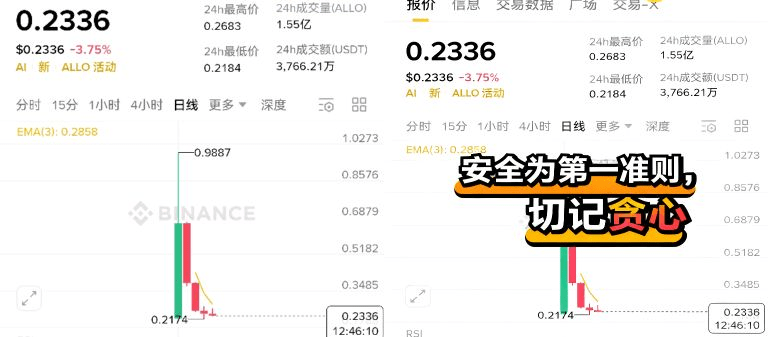
Today, we will take ALLO/USDT as an example, clarifying 'how to withstand it, why to withstand it' following this logic.
First, give a base to ALLO's 'resistance to single orders': it is not a random hype coin—it's the DeAI infrastructure transformed from the original NFT valuation platform Upshot, having received $35 million in investments from top institutions like Polychain and Coinbase Ventures. After its mainnet launch, it has already conducted 692 million AI inferences and has 288,000 active nodes. Recently, it has also done dynamic margin integration with leading DeFi protocols like GMX V3. In simple terms: it has institutional backing, a tangible ecosystem, and is a project that can run long-term, not just a speculation that 'drops to zero after a rise.'
Now, let's look at the current position of 0.2336:
It is below the initial opening price of 0.35, and it is far from the reasonable range supported by the project's fundamentals; the 24h volatility is between 0.2184-0.2683, which looks quite volatile, but this is the normal fluctuation of 'emotional digestion + value return' for a new coin after launch—since the institutional holdings of the project have not decreased and the ecological data has not collapsed, this fluctuation is not 'risk,' but rather a window for positioning.
But the premise of 'layout' is to weld 'safety' into the operations:
1. Positions should be 'light enough to sleep soundly.'
Keep the funds for this layout within 5% of your total capital—don't think 5% is too little; 'surviving' in trading is more important than 'making a profit once': even if it drops another 30%, a 5% position won't severely hurt you, while those heavily invested have long been forced out by volatility.
2. Ensure 'enough buffer with 3 times margin.'
If it's a contract layout, ensure at least 3 times the redundancy in margin (for example, if you open a position with 100 USDT, you should have at least 300 USDT as margin)—this way, even if the price drops to 0.18, you can hold steady and won't be kicked out due to volatility.
3. Build positions in batches; never go all in.
First, enter with 2% of your base position. If the price retraces below 0.2, add 2%; if it reaches 0.18, add another 1%—this way, you won't miss the low point, and you won't panic because of 'buying halfway up the mountain.'
Finally, here's a key point: greed and quick profits are the fastest 'exit tickets' in trading—don't think that buying ALLO will double in a few days; its value is gradually realized: the amount of inference increases, ecological cooperation becomes denser, and institutional holdings stabilize—these all take time.
What we are doing now is not 'betting on short-term fluctuations,' but 'waiting for long-term value to materialize in a safe manner'—after all, in trading, only those who stay can reap the final rewards.