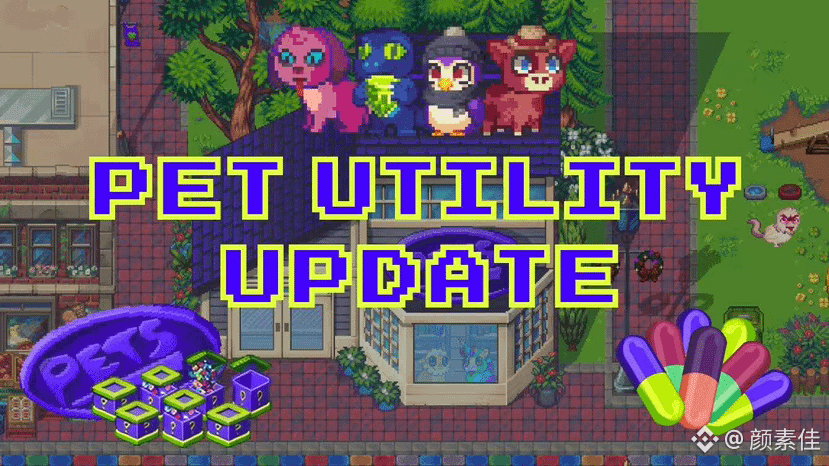
To be honest, looking back at the collapse of BERRY in Pixels, the logic behind it is not mysterious at all. To put it simply: everyone was busy taking money out of their pockets, and no one was putting money in. The players back then logged in every day like they were getting a salary, took their assets, and ran straight to the secondary market to exchange them for real cash. You think about it, if everyone is selling, who is buying? Those who didn't run could only watch helplessly as the little they had turned into ghost money, and eventually, the whole market crashed together; that was the inevitable result. Later, the project switched to $PIXEL , and they indeed played this trick quite well. It wasn't just a simple name change; they moved the 'faucet' that was crazily inflating the supply. Before, you could sell as soon as you mined, but now? The high-frequency output is all locked in the game as materials. If you want the things in your hands to be valuable? Sure, you first have to upgrade your land, engage in high-end production, and even spend on pets. In short, it’s no longer about how much you want to produce determines its value, but whether you, as a player, are loyal enough to reinvest the money you earn back into this ecosystem. Regarding inflation, we need to clarify: The current PIXEL does look much more stable, but that absolutely doesn't mean inflation has disappeared. The essence: inflation has just been 'timelapse photography.' The truth: output is still there, just split into various trivial tasks and materials, making it hard for you to create market selling pressure at the first moment. The feeling: the market looks quite smooth, but this pressure has actually been building up in the background. Chapter 3: The 'yangmou' hidden behind it You see the new tricks that Chapter 3 has come up with recently, like high-end production assembly lines, land efficiency optimization, and that resource-hungry pet system. This is not making a game at all; it’s clearly handing players a 'tightening curse.' The project team's logic is very hardcore: as long as you stop investing, your efficiency will drop exponentially. This design is actually a precise screening of players. 1. Upper-level players: Continuous compound interest, reinvest output, and maintain their position. 2. Gold-hungry locusts: Just want to linear freeload, but find the threshold increasingly high, and eventually can only be slowly squeezed out of the circle. @Pixels $BTC #pixel $PIXEL


Post

--



Disclaimer: Includes third-party opinions. No advice. Binance AI may be used without guarantee. See T&Cs.