

1. Core principles (applicable to all leverage multiples)
Single trade risk control: Each trade's risk should not exceed 1-2% of total capital (up to 3% for aggressive traders, and extremely conservative at 0.5%). This is the most important rule, almost all professional traders adhere to it.
The stop loss must be far from the liquidation price: Under low leverage, the liquidation price is far away, but don't set the stop loss too far (otherwise it’s like not setting it at all); under high leverage, the liquidation price is close, and the stop loss must be strictly nearby.
Set a stop loss as soon as you open a position: Never go 'naked', don’t wait for unrealized losses to set it (human nature tends to procrastinate).
Risk-reward ratio (R:R) of at least 1:2 or 1:3: The profit target should be at least 2-3 times the stop loss distance, otherwise the long-term mathematical expectation will be negative.
2. Comparison of common stop-loss setting methods
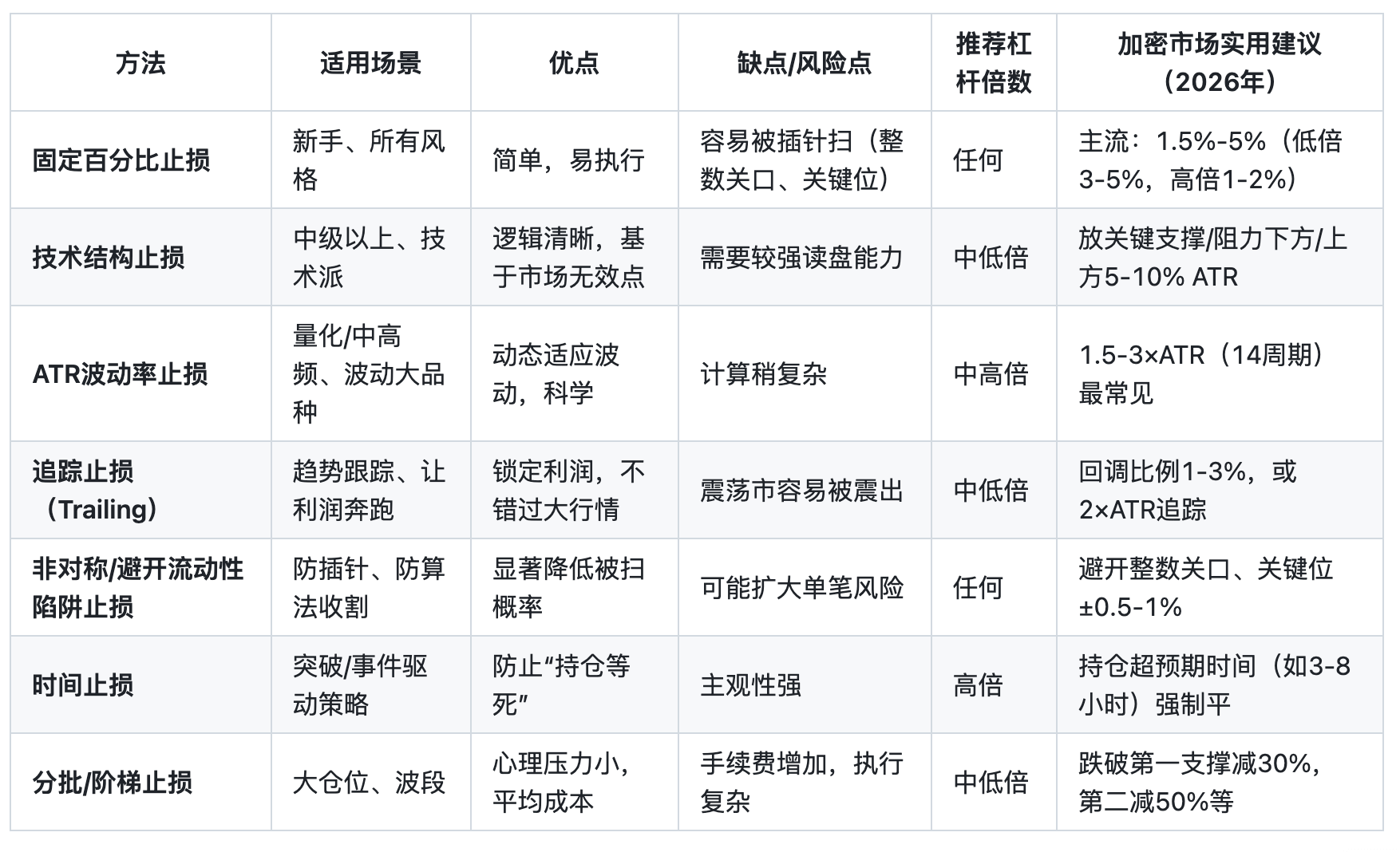
3. Practical strategies specifically for low leverage (1-5x) (addressing the previously mentioned pain point of 'low leverage being more dangerous')
The easiest mistake with low leverage is: thinking you are safe → not setting/setting a very loose stop-loss → holding a position → a significant pullback directly leads to being deeply trapped or close to liquidation.
Recommended combination (the safest combination):
Basic level: fixed capital risk method → maximum loss per trade is 1-2% of the account.
Example: account 100,000 USDT, risk 1% = maximum loss 1,000 USDT.
Assuming 3x leverage to long BTC, entry price 100,000, set stop-loss at the maximum loss price you can accept.
Calculation formula: stop-loss distance = (risk amount ÷ position value) × entry price
Technical level: place stop-loss at the position where 'trading premise is invalidated'.
Example: long when breaking through the 32,000-33,000 range → place stop-loss at the lower edge of the range -1% ATR (approximately 31,500-31,800 range).
Anti-spike layer: do not set at round numbers.
BTC 100,000 integer barrier → do not set stop-loss exactly at 99,999 or 100,001, set it at 99,800 or 100,200.
Dynamic layer: use trailing stop-loss or manually adjust upwards in steps.
After reaching a profit of 1:1, move the stop-loss to the entry price (break-even).
After reaching a profit of 1:2, move to the 1:1 position and let the rest run.
4. Iron rules for stop-loss in high leverage (10x+)
The stop-loss distance is very tight (0.3%-1.5%), otherwise, you won't withstand the volatility.
Must use trailing stop-loss or OCO (One Cancels Other).
Many experts use 'psychological stop-loss + very small position': better to incur frequent small losses than one large loss.
5. Additional reminders for the crypto market in 2026 (based on recent environment)
Flash crashes/spikes are still frequent → prioritize asymmetry + avoid key levels.
Liquidity vacuum periods are increasing (Asia/Europe switch, news black swan) → even with low leverage, do not hold heavy overnight positions.
Platform tools upgraded → almost all mainstream exchanges (Binance, Bybit, OKX, MEXC, etc.) support trailing stop-loss, conditional orders, OCO, strongly recommended to use.
AI/quantitative stop-loss is becoming more popular → if you can't maintain strict discipline, consider partially following orders or using a bot for execution.
In summary:
Good strategy = reasonable entry premise + strict 1-2% risk control + stop-loss position based on technical/volatility logic + trailing/dynamic adjustment + never unhedged.
Low leverage is not a 'safe mode', but a 'delayed death mode' — unless you treat stop-loss as a belief, the outcome is no different from that of a 100x gambler. Wishing you smooth trading, and may your stop-loss always come before liquidation.