



Contents
Introduction
What is planned investment?
Why use scheduled investment?
Examples of planned investment
Scheduled Investment Calculator
The disadvantages of planned investment
To conclude
Introduction
Active trading can be stressful, time-consuming, and consistently produces poor results. However, there are other options. Like many investors, you are looking for a less demanding and time-consuming investment strategy. Or simply a more passive style of investing. You have many investment options within the Binance ecosystem, including staking, lending your assets on Binance Savings, or mining on Binance Pool, and more.
But what if you want to invest in the markets but don't really know how to get started? More specifically, what would be the best way to build a longer-term position? In this article, we will discuss an investment strategy known as DCA (dollar cost averaging), or scheduled investing, which makes it easy to mitigate some of the risks associated with taking a position.
What is planned investment?
Scheduled investing is a strategy aimed at reducing the impact of volatility on the purchase of assets. It involves purchasing equal quantities of the asset at regular intervals.
The idea is that by entering the market in this way, the investment may not be as subject to volatility as if it were a lump sum (i.e. a one-off payment ). How so ? By purchasing at regular intervals, you can smooth out the average price. In the long run, such a strategy reduces the negative impact that a bad entry can have on your investment. Let's take a look at how scheduled investing works and why you might consider using it.
Why use scheduled investment?
The main advantage of dollar cost averaging is that it reduces the risk of betting at the wrong time. Managing the timing of your investments is the most difficult thing to control when it comes to trading or investing. Often, even if the direction of a trade idea is correct, the timing can be wrong, making the entire trade incorrect. Scheduled investment helps minimize this risk.
If you break your investment into smaller chunks, you'll likely get better results than if you invested the same amount of money all at once. Making a purchase at the wrong time is surprisingly easy, and it can lead to very bad results. Additionally, you can eliminate some bias from your decision-making. Once you commit to recurring dollar-cost purchases, the strategy will make the decisions for you.
Of course, planned investment does not completely mitigate risks. The idea is only to smooth entry into the market in order to minimize the risk of bad timing. Planned investment absolutely does not guarantee the success of an investment. Other factors must also be taken into consideration.
As we have seen, it is extremely difficult to predict what the market will do. Even the greatest trading veterans sometimes struggle to read the market accurately. Therefore, if you have adopted a planned investment position, you also need to think about your exit plan. That is, a trading strategy to exit the position.
If you have determined a target price (or price range), this can be quite simple. Again, you divide your investment into equal tranches and start selling them when the market gets closer to the target. This way you can mitigate the risk of not going out at the right time. However, this all depends entirely on your personal trading system.
Some people adopt a "buy and hold" strategy, where the goal is to never sell, because the assets purchased are expected to continually appreciate over time. Watch how the Dow Jones Index has performed over the last century below.

Performance of the Dow Jones Industrial Average (DJIA) since 1915.
Although there are periods of short-term recession, the Dow has been in a continuous upward trend. The goal of a buy-and-hold strategy is to enter the market and stay in the position long enough that timing doesn't matter.
However, it should be kept in mind that this type of strategy is generally focused on the stock market and may not apply to cryptocurrency markets. Remember that the performance of the Dow Jones is linked to the real economy. Other asset classes will be very different.
Examples of planned investment
Let’s look at this strategy through an example. Suppose we have a fixed amount of $10,000, and we think it is reasonable to invest in Bitcoin. We believe that the price is likely to fluctuate in the current area and that this is a favorable place to accumulate and build a position using a timed investment strategy.
We could divide the $10,000 into 100 pieces of $100. Every day we will buy $100 worth of bitcoins, regardless of the price. In this way, we will spread our entry over a period of approximately three months.
Now, let's demonstrate the flexibility of dollar-cost averaging with a different game plan. Let's say that Bitcoin has just entered a bear market, and we don't expect a prolonged uptrend for at least two years. However, we expect an upward trend in the long term, and we would like to prepare in advance.
Should we use the same strategy? Probably not. This investment portfolio has a much broader horizon. We should prepare for this $10,000 to be allocated to this strategy for a few more years. So what should we do?
We could divide the $10,000 into 100 pieces of $100. However, this time we are going to buy $100 worth of bitcoins every week. There are more or less 52 weeks per year, so the entire strategy will be executed over a little less than two years.
This way we will build a long-term position while the downtrend runs its course. We won't miss the boat when the uptrend starts, and we've also mitigated some of the risks of buying into a downtrend.
But remember that this strategy can be risky. After all, we would be buying into a downtrend. For some investors, it is better to wait until the end of the downtrend is confirmed and then start entering. If they wait, the average cost (or share price) will likely be higher, but much of the downside risk is mitigated in return.
Scheduled Investment Calculator
You can find an investment calculator programmed for bitcoin at dcabtc.com. You can specify the amount, time horizon, intervals, and get an idea of how different strategies would have performed over time. In the case of Bitcoin, which is on a sustainable rise over the long term, the strategy would have worked consistently.
Below you can see how your investment performed if you only purchased $10 worth of bitcoin per week for the past five years. $10 a week doesn't seem like much, does it? Well, as of April 2020, you would have invested a total of around 2,600 and your bitcoin balance would be worth around $20,000.
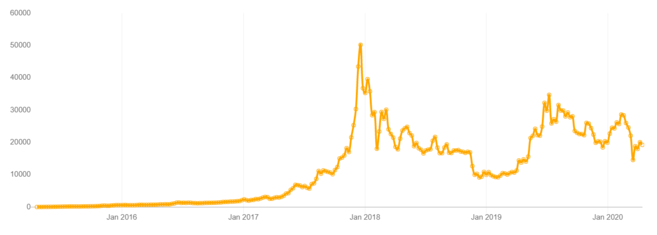
Performance by investing $10 in BTC every week for the last five years. Source: dcabtc.com
Do you want to get started with cryptocurrencies? Buy Bitcoin on Binance!
The disadvantages of planned investment
Although planned investing is a lucrative strategy, it also has its skeptics. It undoubtedly works best when markets experience large fluctuations. This makes sense because the strategy is designed to mitigate the effects of high volatility on a position.
According to some, however, this will negatively affect performance when the market performs well. How so ? If the market is in a persistent uptrend, it is possible to assume that those who invest earlier will achieve better results. Dollar cost averaging can therefore have a moderating effect on gains in an uptrend. In this case, the one-time investment will outperform the scheduled investment.
Even though most investors don't have a lot of funds available to invest at one time. However, they might be able to invest small amounts over the long term. Planned investment remains an appropriate strategy in this case.
To conclude
Timed investing is a recognized strategy for entering into a position while minimizing the effects of volatility on the investment. This involves dividing the investment into small blocks and buying at regular intervals.
The main advantage of using this strategy is as follows. It's difficult to time the market, and those who don't want to actively follow the markets can still invest this way.
However, according to some skeptics, this method may underperform in a bull market. That being said, making less money is not the end of the world. Scheduled investing can still be a practical investment strategy for many of us.