


TL;DR - SUMMARY
When withdrawing or depositing cryptocurrencies to your Binance account, pay special attention to the network you choose. It's easy to confuse Binance Smart Chain (BEP-20) with Ethereum (ERC-20) and send your tokens to the wrong blockchain.
If the crypto wallet you deposited to supports BEP-20 and ERC-20 tokens, you can send your cryptocurrency to Binance with a few simple steps.
If your wallet only handles ERC-20 or BEP-20, you will need to import your wallet's private key to a new wallet that supports both blockchains.
Depositing to the wrong blockchain in your Binance account, another crypto exchange, or custodial wallet is more complicated to resolve. In this case, please contact your wallet's support team to see if they can help you.
Introduction
If you have been making withdrawals from Binance, you have probably noticed that some coins have different transfer networks available. Even experienced HODLers sometimes feel baffled when choosing the right blockchain for their transactions. Which one do you choose when withdrawing your crypto to another wallet?
In short, you should choose the same network as the one used by the destination receiving wallet. Technically, that will depend on the token standard you are using, such as ERC-20, BEP-20, or BEP-2.
If you have sent your cryptocurrencies to the wrong blockchain, it is essential to find out the type of wallet they were sent to. If you can access your private key or seed phrase, you have a non-custodial wallet. If you can't, your wallet is in custody. With this information, you can try our three possible solutions.
I sent funds to the wrong network. What should I do?
First of all, don't panic. If you sent ERC-20 tokens (like ETH) using Binance Smart Chain (BSC) or sent BEP-20 tokens over the Ethereum network, you should be able to get them back. There are three different situations, each with its own solution:
1. You sent the tokens to a wallet that supports BSC and Ethereum.
You can send the tokens back to the correct network on Binance.
2. You sent the tokens to a wallet that only supports BSC or Ethereum.
You will need to access your private key to import it into a wallet that supports both.
3. You sent the tokens to a custodial wallet or crypto exchange.
Ask your wallet provider or exchange customer service for help. It may not be possible to recover your funds.
Before working on a solution, it's worth understanding what happened to avoid the same problem in the future.
What is the difference between BEP-20 and ERC-20?
ERC-20 and BEP-20 are token standards that describe specific rules and technical guidelines for tokens. They govern how transactions, deposits and withdrawals are made. Both ERC-20 and BEP-20 standardize how a token interacts with different wallets, projects, and smart contracts.
The two standards share many similarities in their operation, but ERC-20 is unique to Ethereum and BEP-20 is unique to Binance Smart Chain. In simple terms, they are token standards that belong to a different blockchain.
If your crypto is on the wrong network, it may not be able to be used for the purpose you need it to. For example, Ethereum sent to BSC will not be able to be used in Ethereum DApps and smart contracts.
What happens when I send a BEP-20/ERC-20 token to the wrong blockchain?
If you send an ERC-20 token to BSC or a BEP-20 token to Ethereum, the token will drop into the same wallet address on the chosen network. Your BSC and Ethereum wallet addresses are identical and can be accessed with the same private key.
For example, sending ETH to BSC will end up as a BEP-20 token pegged to Ether at your wallet address in BSC. You can use BscScan.com to verify this with your transaction ID or Etherscan.io when you have sent the BEP-20 tokens to the Ethereum network.
Here is an example (from BscScan) of someone who withdrew their ERC-20 ETH and chose the BSC transfer network (BEP-20) on their Binance wallet. These tokens now appear as Binance-Peg Ethereum under the same wallet address on BSC.

Fortunately, your crypto won't be gone. All you need to do now is send it back to the correct blockchain you need. Check out our solutions below that fit your situation.
Recover them from a BSC and Ethereum compatible wallet
You should have no problem finding your tokens in a wallet that supports both blockchains. Look for an alternate list of tokens for each network to enable if you still can't see your crypto.
MetaMask, for example, has an [Add Token] button that allows you to browse through all your available tokens.

If you cannot see the token in the list, you will need to enter the token contract into your wallet. You can see this process in step 5 of Recovering a wallet that only supports BSC or Ethereum.
If you want to return your token to its original blockchain, there are two options: Binance Bridge or the manual method.
Binance Bridge
Binance Bridge is a simple tool to convert your assets between blockchains. You just need to connect MetaMask or Binance Chain Wallet and choose what you want to transfer. Don't forget that you will need BNB for BSC gas fees or ETH for Ethereum gas fees.
Follow our Introduction to Binance Bridge to learn more about the process.

Manual conversion
Manually converting your tokens requires sending your cryptocurrency back to Binance. The deposit network in your Binance spot wallet must match the blockchain your token is currently on. Once it has arrived, you can successfully send it to your external wallet.
In this example, we will convert Binance-Peg ETH (BEP-20) back to ERC-20 ETH. Make sure the wallet you are sending from has BNB for gas fees.
1. On your Binance cryptocurrency withdrawal page, select ETH and the deposit network as BEP-20 (BSC). If you deposit to the wrong network, Binance will not be able to recover your funds.

2. Once your ETH is back in your Binance account, convert it to ERC-20 by withdrawing it to an Ethereum-compatible wallet and selecting Ethereum (ETH) ERC20 as your transfer network.

Your funds will now be safely on their way to the correct blockchain in your external wallet.
Recover them from a BSC and Ethereum compatible wallet
To recover your tokens in this situation, you will need to import your wallet's private key to a new wallet that supports both blockchains. Depending on the import wallet, you may also be able to use your seed phrase instead of your private key.
Import a private key
When you import the private key from one wallet to another wallet, you gain access to the funds related to that private key, even when you use a different wallet.
In other words, importing a wallet's private key will not send the funds to your import wallet. It will simply make the external wallet accessible from a different application. Please note that custodial wallets usually do not have this option as they do not provide you with a private key.
The most used wallets to do this are Metamask, Trust Wallet, Math Wallet, SafePal and TokenPocket.
This example will use the MetaMask Google Chrome extension and recover ETH that was accidentally sent to BSC.
Recover your funds
1. Access your MetaMask wallet or create a new one if you don't already have one. MetaMask is also available as an app for iOS and Android.
2. If you are creating a new account, you will be given the option to import the seed phrase from your old wallet.

3. If you already have an account, simply click on the MetaMask extension pin, followed by your account profile in the top right.

4. Click [Import Account] and then enter the private key of your wallet that contains the missing crypto. Click [Import] to finish. You can also upload a JSON file if you have one.
5. Next, you will need to manually add the BSC network to your MetaMask account. Click on the MetaMask extension pin, followed by the network drop-down menu at the top center. Click [Custom RPC] at the bottom of the list.


6. You will need to add details to allow MetaMask to access Binance Smart Chain. These details include a remote procedure call (RPC) URL. This URL allows MetaMask to query information from the BSC blockchain and make transaction requests.
Complete the following information in their respective fields and click [Save] at the bottom.
Number of red: BSC Mainnet
New RPC URL: https://bsc-dataseed1.binance.org/
ChainID: 56
Symbol: BNB
Block Explorer URL: https://bscscan.com/

7. Now, add the correct token contract to your MetaMask wallet. This step will allow your chosen wallet that supports BEP-20 to search for the lost token. You can find a list of tokens and token contracts on BscScan. For ETH ERC-20 sent to BSC, click Binance-Peg Ethereum Token (ETH) to find your token contract.
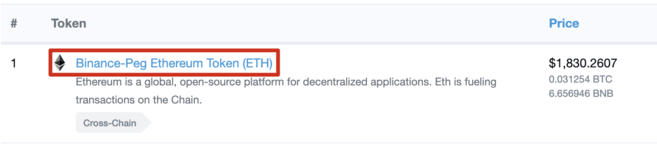
8. Copy the token contract in preparation for the next step and make a note of the Decimals field.

9. Select [BSC Mainnet] from the network drop-down list, click [Add Token], and then click [Custom Token].


10. Enter the token contract address, token symbol, and precision decimals. For our ETH example, these are:
Token contract address: 0x2170ed0880ac9a755fd29b2688956bd959f933f8
Token symbol: ETH
Decimal precision: 18
Haz clic en [Agregar tokens] para confirmar.
11. You should now see your lost ETH tokens in your wallet balance. From here, you have the option to send them back to your Binance account's BEP20 wallet address. You can also use Binance Bridge with MetaMask to convert your token to ERC-20 if you wish.
See Recovering a Wallet That Supports BSC and Ethereum for more information on how to bridge your tokens.
➟Are you thinking about getting started in the world of cryptocurrencies? Buy BNB on Binance!
Recovery from a custodial wallet or exchange
If you are attempting to withdraw your funds to a custodial wallet that does not support BEP-20, such as another crypto exchange, you will need to contact the custodian wallet holder.
Some custodial wallet providers may help you by paying a fee or allowing you to access your private keys. You can then import the private key to a BSC compatible wallet. Most, including exchanges, unfortunately will not be able to provide you with your key.
If you deposit tokens to your Binance account with the wrong blockchain selected, Binance cannot help you recover your crypto.
In conclusion
Choosing the right transfer network is one of the trickiest parts of withdrawing your crypto from Binance. But once you understand everything, you won't be sending your BTC or ETH to the wrong network anytime soon. In most cases, with a standard wallet, your funds are SAFU and can be recovered with a little work.