


In brief
A spread is the difference between the lowest bid price for an asset and the highest ask price. Liquid assets like Bitcoin have smaller price spreads compared to assets with less liquidity and trading volume.
Slippage occurs when a trade pays an average price that differs from the price the trader originally requested. This phenomenon often occurs when executing market orders. If there is insufficient liquidity to complete the order or the market is volatile, the order may be changed at the last moment. To combat slippage when trading illiquid assets, you should split your order into smaller parts.
Introduce
When you buy or sell assets on a cryptocurrency exchange, the market price is directly related to supply and demand. Besides price, other important factors to consider are trading volume, market liquidity, and order type. Depending on market conditions and the type of order you use, you may not always get the price you want for a trade.
There is always a continuous negotiation between buyers and sellers, creating a price difference between the two sides (bid-ask spread). Depending on the amount of asset you want to trade and its volatility, you may also experience slippage (this will be covered later). So, to avoid any surprises, having some basic knowledge of an exchange's order book will go a long way.

What is the bid-ask spread?
Spread is the difference between the highest bid price and lowest ask price of an order book. In traditional markets, spreads are typically created by market makers or brokerage liquidity providers. In the cryptocurrency market, spreads are the result of the difference between limit orders between buyers and sellers.
If you want to make an immediate market price purchase, you need to accept the lowest offer price from the seller. If you want to sell immediately, you will take the highest bid from the buyer. More liquid assets (like foreign exchange) have narrower bid and ask spreads. This means that buyers and sellers can execute their orders without causing a significant change in the price of the asset. This is because there is always a large amount of orders in the order book. Price spreads will be wider and there will be more significant price fluctuations, especially when closing large volume orders.
Market making and arbitrage tools
The concept of liquidity is very important to financial markets. If you trade low-liquidity markets, you may find yourself waiting hours or even days until another trader fills your order.
Creating liquidity is important, but not all markets have enough liquidity from individual traders alone. For example, in traditional markets, brokers and market makers provide liquidity in return for arbitrage profits.
A market maker can take advantage of bid spreads simply by buying and selling an asset simultaneously. By selling at a higher ask price and buying at a lower ask price repeatedly, market makers can use arbitrage to make a profit. Even a small spread can bring a significant profit, if the volume throughout the day is large enough. High-demand assets have tighter spreads as market makers compete and close spreads.
For example, a market maker could simultaneously offer to buy BNB for $350 per coin and sell BNB for $351, creating a $1 spread. Anyone wanting to trade immediately in the market will have to cover their positions. The spread is now the pure arbitrage profit between the market maker's bid and ask price.
Depth and spread charts
Let's look at some real-world cryptocurrency examples and the relationship between volume, liquidity, and price spreads. In the Binance exchange UI, you can easily see the price difference by switching to the [Depth] chart view. This button is in the upper right corner of the chart area.
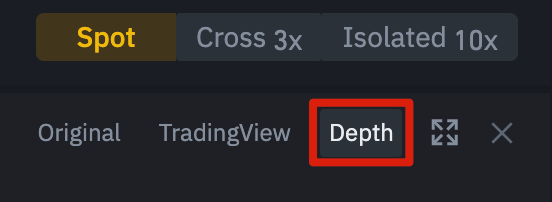
The [Depth] option displays a graphical representation of an asset's order book. You can see the quantity and bid price in green, along with the quantity and ask price in red. The distance between these two areas is the bid-ask spread, which you can calculate by taking the red bid price and subtracting the green bid price.

As we mentioned before, there is an implied relationship between liquidity and smaller spreads. Trading volume is a commonly used liquidity indicator. So we expect volumes to be higher and spreads to be smaller as a percentage of the asset price. Cryptocurrencies, stocks, and other assets that are frequently traded will see more competition among traders looking to take advantage of price differences.
Price difference ratio
To compare the price difference of different cryptocurrencies or assets, we have to evaluate it in percentage terms. The formula is very simple:
(Ask price - Bid price) / Ask price x 100 = Price difference ratio
Let's look at an example. At the time of writing, BIFI had an ask price of $907 and a bid price of $901. This difference gives us a price difference of $6. Divide 6 by 907, then multiply by 100, giving us an odds ratio of about 0.66%.

Now, let's say that Bitcoin has a bid-ask spread of $3. Although, that is only half of what we saw with BIFI, when we compare them by percentage, the Bitcoin bid-ask spread is only 0.0083%. BIFI also has significantly lower trading volume, which proves the theory that less liquid assets tend to have larger bid-ask spreads is correct.
Bitcoin's narrower spreads allow us to draw some conclusions. An asset with a smaller bid-ask spread may be much more liquid. If you want to execute large market orders, it is often less risky to pay a price you did not expect.
What is price slippage?
Slippage is common in markets with high volatility or low liquidity. Slippage occurs when a trade is executed at a different price than the expected price.
For example, let's say you want to place a buy order in a large market for $100, but the market does not have the necessary liquidity to fill your order at that price. Therefore, you will have to execute subsequent orders (over $100) until your order is fully executed. This will make your average purchase price $100 higher, and that's what we call slippage.
In other words, when you create a market order, an exchange that matches your buy or sell order automatically limits the order on the order book. The order book will match the best price, but you will have to keep going up the order chain, if not enough quantity matches your desired price. This process results in the market filling your order at different and unexpected prices.
In the cryptocurrency market, price slippage is a common occurrence on automated market makers and decentralized exchanges. Slippage can be as much as 10% higher than the expected price for volatile or low-liquidity altcoins.
Active sliding
Price slippage doesn't necessarily mean you'll end up with a worse price than expected. Positive slippage can occur if the price falls while you create a buy order or increases if you execute a sell order. Although uncommon, positive slippage can occur in some highly volatile markets.
Slip resistance
Some exchanges allow you to manually set slippage tolerance levels to limit any slippage you may experience. You will see this option in automated market makers like PancakeSwap on Binance Smart Chain and Uniswap on Ethereum.

The amount of slippage you set may affect the completion time of your order. If you set low slippage, your order may take a long time to fully execute or not be executed at all. If you set it too high, another trader or bot can see your pending order and trade it first for you.
In this case, front running occurs when another trader sets a higher gas fee than you to buy the asset first. The informed trader then enters another trade to sell you at the highest price you are willing to take based on your tolerance for slippage.
Minimize negative slippage
While you can't always avoid price slippage, there are some strategies you can use to minimize it.
1. Instead of executing one large command, try to break it down into smaller blocks. Keep a close eye on the order book to spread out your orders, making sure not to place orders larger than the available amount.
2. If you are using a decentralized exchange, don't forget to factor in transaction fees. Some networks have huge fees, depending on the traffic volume of the blockchain. This could result in the loss of any profits you made or efforts to avoid price slippage.
3. If you are trading assets with low liquidity, such as a small liquidity pool, your trading activity can significantly affect the price of that asset. A single transaction may miss by a small amount, but many smaller transactions will affect the price of the next block of transactions you make.
4. Use limit orders. These orders ensure you will receive the desired price or better when trading. If you ignore the speed benefits of a market order, you can be sure that you won't experience any negative slippage.

summary
When you trade cryptocurrencies, don't forget that price differences or slippage can change the final price of your trades. You can't always avoid them, but they're worth considering before you make a decision. For small trades, this difference is not much but keep in mind that with high volume orders, the average price per unit may be higher than expected.
For anyone experimenting with decentralized finance, understanding slippage is an important part of trading basics. Without some basic knowledge, you run a high risk of losing money through front-running or excessive slippage.