


Perpetual contracts remain one of the largest verticals in DeFi and have evolved a lot since Bitmex launched many years ago. Today, there are many different on-chain iterations of perpetual futures, including order book-based protocols such as dYdX, Vertex, Hyperliquid, and Aevo, as well as AMM-based protocols such as GMX, Gains, and Synthetix.
What all of these have in common is that deep liquidity is almost more important to traders than anything else. The difference, however, is that order book liquidity primarily comes from established market makers, while AMM liquidity is provided in a more permissionless manner. Elixir is the first protocol to introduce trustless liquidity provisioning to order book-based perpetual trading protocols such as Vertex, dYdX, etc.
I interviewed Cole0x Cole0x of Elixir Protocol to learn more about the protocol design, upcoming integrations, and the $ELXR token launch.
Key Points
Order Books and AMMs
Order book design
The role of market makers
AMM Design
Elixir Protocols
Overview
Dex Integration
Technical Design
Upcoming Developments in 2024
Order Books and AMMs
The first generation of crypto perpetual futures platforms (Bitmex, Binance, etc.) all used the CLOB (central limit order book) model popular in traditional finance. While this design has changed and evolved since moving on-chain through protocols like dYdX and Hyperliquid, other designs have gone in different directions. GMX, Gains, and ApolloX, among others, use a more decentralized solution; the AMM (automated market maker) model. The image below shows many different perpetual futures designs.
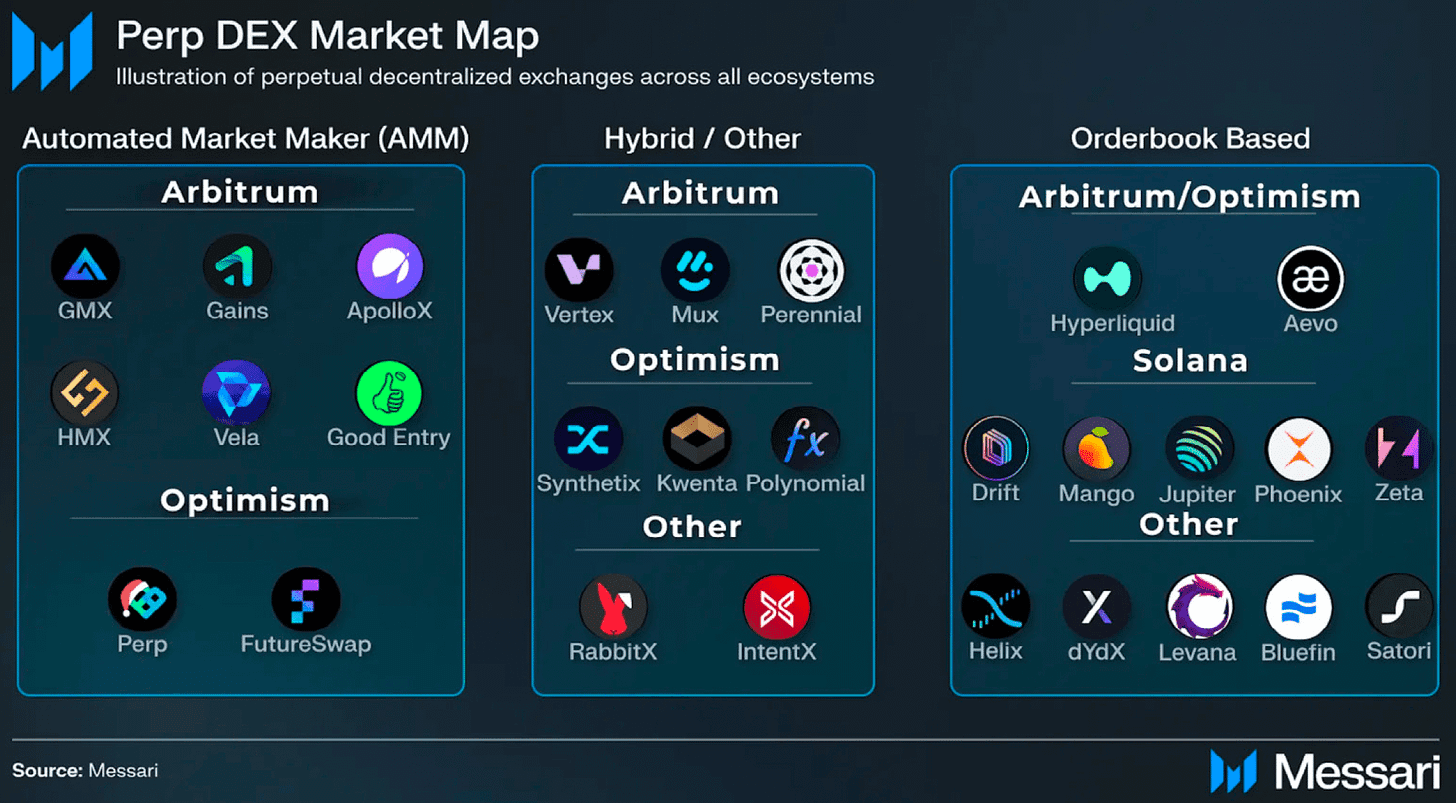 On-chain Perpetual Futures Landscape - Source
Order book design
Almost all exchanges in and outside of crypto use order books, which are an effective design for accurately pricing assets and ensuring a good overall trading experience. On order book exchanges, there are two types of traders: price takers and price makers.
Price Taker - Wants to buy or sell an asset at the current price, so places a market order
Price Makers – wish to buy or sell an asset at a specific price and therefore place a limit order
Furthermore, if a trader wants to buy an asset, it is called a “bid” and if a trader wants to sell an asset, it is called an “ask.”
The order book is a collection of limit orders. Therefore, placing a limit order adds liquidity to the order book, while taking an order removes liquidity from the order book. This is why maker orders usually have lower fees than taker orders.
The more (and larger) limit orders an exchange has, the better the liquidity and trading experience. The spread on an order book exchange is the difference between the highest buy limit order and the lowest sell limit order. The lower the spread, the better the liquidity.
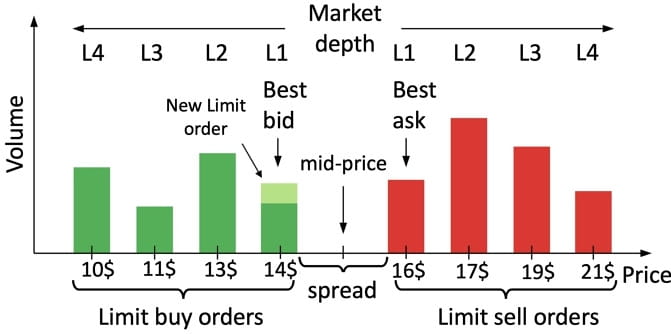 Order Book Example
Order book based perpetual trading protocols are typically more centralized than automated market makers as the order book is run from a single point of control. dYdX V4 is one of the first protocols to fully decentralize its order book as on-chain validators are now in full control.
The role of market makers
The role of a market maker is to ensure deep liquidity on the order book in the form of limit orders. Technically, any trader who places a limit order is a market maker, but the term usually refers to larger, more established players whose sole purpose is to ensure deep order book liquidity. These include firms like Wintermute and Jump Trading, who are able to generate huge profits in a variety of ways through market making. Since exchanges are interested in deep liquidity, they often work with market makers, offering them benefits such as fee rebates.
Most market makers are delta neutral (no directional exposure) and earn fees from the spread between orders, but some also make markets more actively through certain advantages such as complex market making algorithms or privileged information.
There is a lot more to market making, but this is an introduction to the general structure of the business.
AMM Design
Automated market makers were first introduced by Uniswap on its V2 spot market and later as perpetual futures in various iterations of protocols such as Synthetix and GMX. AMMs allow for a higher degree of decentralization as the centralized market maker on the order book is replaced by a group of liquidity providers. On AMMs, users can provide liquidity to spot and futures markets in a simple and permissionless way without having to operate at scale and work directly with the exchange itself behind the scenes.
In summary, market making (providing liquidity) can be highly profitable and lucrative if done correctly, but from a retail perspective this has previously been primarily achieved on AMMs rather than order book exchanges.
This is what Elixir is changing.
Elixir Protocols

Overview
I had the pleasure of discussing the design and upcoming developments of the Elixir protocol with Cole0x.
In short, Elixir is a chain-agnostic DPoS network that sits off-chain and allows users to provide liquidity to order books in a similar way to liquidity providers on AMMs like Uniswap V2. Elixir can leverage almost any blockchain and provide liquidity to the native DEX, whether it’s Arbitrum, Ethereum mainnet, Solana, Injective, or elsewhere.
Our goal is not to provide proprietary high-alpha trading strategies with high risk. Instead, Elixir provides a permissionless and trustless liquidity network that allows users to provide USDC liquidity with one click to subscribe to ledger pairs for Perps and Spot and get paid for their liquidity through exchanges.
Decentralized exchange integration
Elixir currently runs on Vertex Protocol, a hybrid order book and AMM DEX on Arbitrum. Users can act as liquidity providers on the Vertex order book for both spot and futures markets, as shown below.
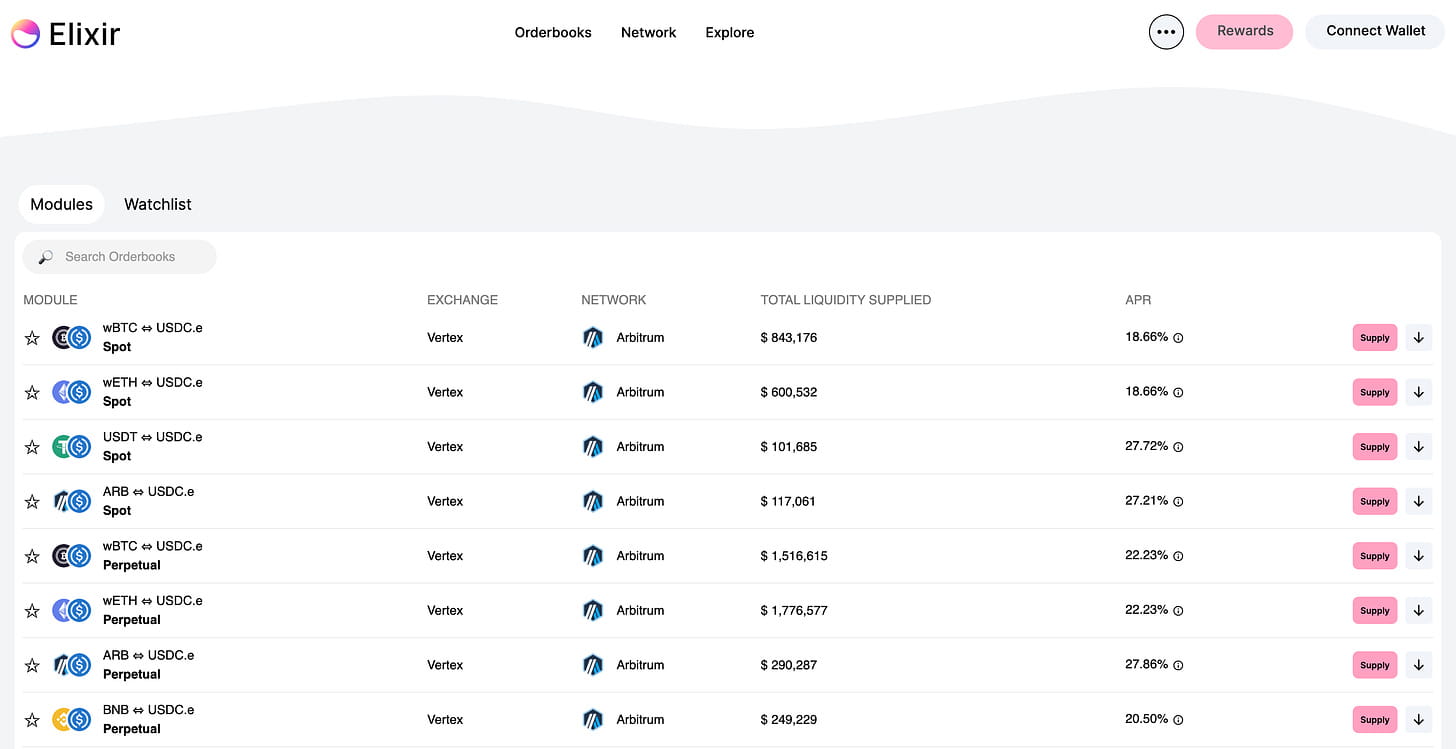 app
app
The returns earned by liquidity providers on Elixir depend on the specific market-making benefits of the integrated DEX operation. In the case of Vertex, rewards are a function of uptime (how long an order stays on the order book) and the size (quantity) of liquidity provided.
“I would say at the end of the day, what matters most is the percentage of total liquidity we represent on the exchange. For Vertex, we represent about half of their order book liquidity, which rewards us (our users) and makes it easy to quote within a range and avoid toxic order flow, but still capture a decent amount of volume.”
Due to the market making requirements of DEX and the 1 second delay of Elixir's off-chain synchronization, the liquidity is finally quoted about two to three points below the top of the book. This allows Elixir to actively earn rewards from market making programs, fee distributions, and token incentives, and pass them on to users.
Technical Design
Elixir is powered by protocol validators and will move to a fully decentralized structure with the introduction of a native Elixir token. Validators launch servers to run the Elixir network, all of which run a separate instance of the protocol. Elixir then pulls order book data from integrated exchanges and runs it through a set of validators, all of which individually compute the same information. If the validators reach consensus, the protocol forwards the order back to the exchange level. Since this process happens off-chain, it takes less than a second.
The design can be seen in more detail in the image below.
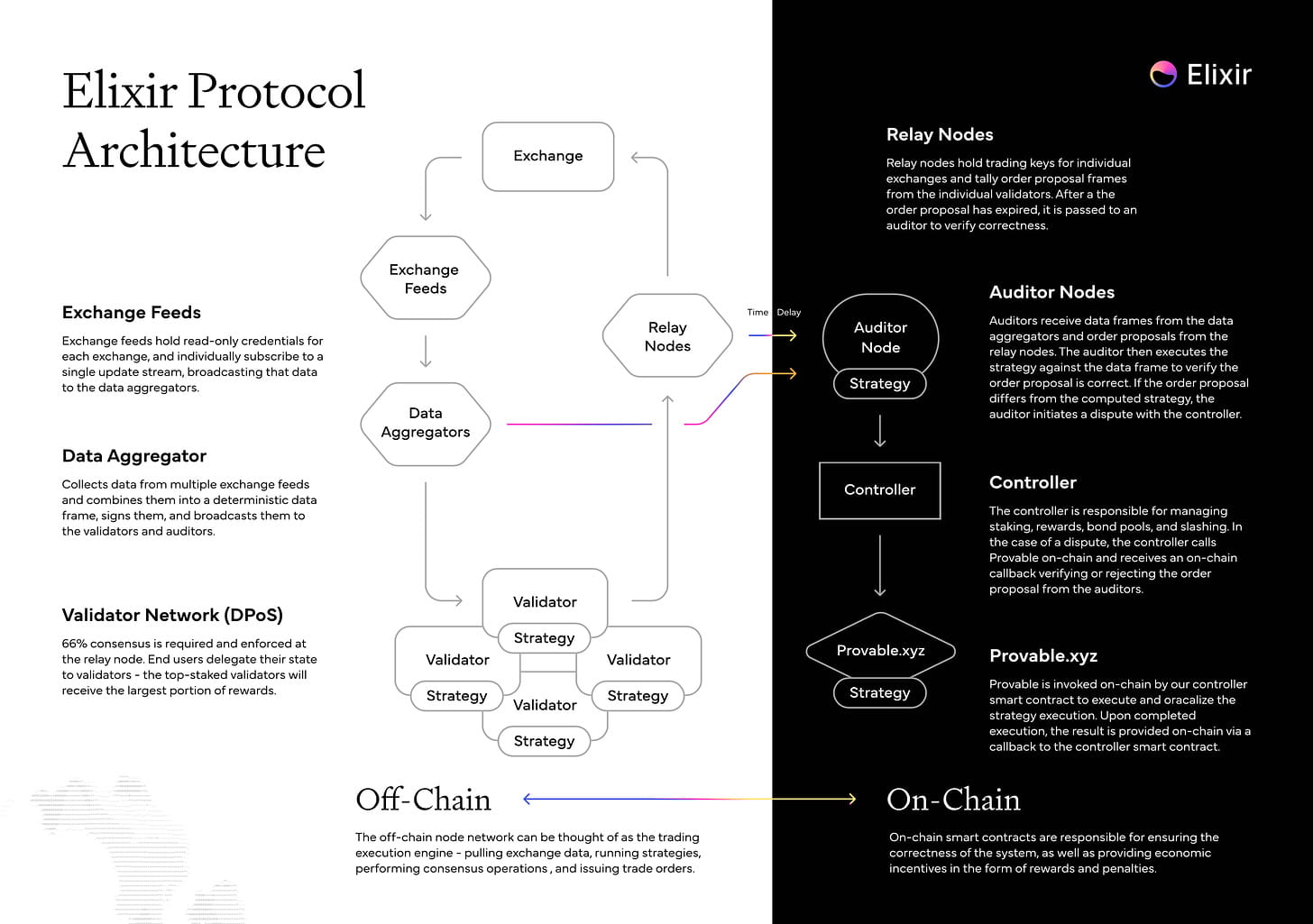 Elixir protocol architecture - source
Upcoming Developments in 2024
As Elixir fully rolls out in 2024, multiple new markets will be integrated to provide liquidity to users. In the short to medium term, these include RabbitX, Starknet native order book DEX, dYdX V4, Bluefin on Sui, Injective, and others.
In addition to this, the network token $ELXR will be live sometime next year. At that time, $ELXR must be staked to start a validator, and users can delegate their $ELXR to active validators to receive a portion of the network fees. The Elixir mainnet is currently scheduled to go live at the end of Q1, at which time the validator network and $ELXR token will be live, thus fully decentralizing the protocol.
Elixir is just at the tip of the iceberg in terms of what’s possible with its liquidity design. I’m excited to see Elixir launch mainnet next year and integrate new markets for liquidity providers to tap into. If you want to stay up to date with what’s going on with Elixir, you can find them on Twitter.
If you liked this article, please consider liking it and subscribing to free weekly research reports like this one.
Not financial advice!