


Original title: "DeSoc on the cusp: An in-depth analysis of the four major decentralized social protocols"
By Dustin Teander, Messari
Compiled by: BlockTurbo
Traditional social products are often thought of as fully packaged content and communication applications. However, at their core, they are primarily identity products. They provide a fundamental connection between a person's digital persona and their data, content, and social relationships. The connection between people and content is the foundation of digital communication, yet it is monopolized, manipulated, and monetized through the sugar-coated bullets built by a few closed platforms.
The Decentralized Social (DeSoc) protocol is re-building digital identity to be owned and managed by users. With DeSoc, users can freely communicate and build applications with trust, without manipulation or censorship for profit. Before this can happen, the DeSoc network needs to reach a minimum level of network scale and overcome the current centralized platform paradigm.
In the traditional social field, many platforms are almost invulnerable in competition because the rich personal data and content data (social graph) they possess are inaccessible to outsiders. Although platforms can make huge profits from it, restricting access to social graphs will bring three core problems to creators and related businesses:
Disconnected Creator Monetization – In addition to social media, creators are often forced to use tools like email lists, blogs, and other partnerships in order to fully monetize their content. While the overall creator market has grown from approximately $14 billion in 2021 to over $100 billion in 2022, creators’ revenue is limited due to the increased user friction of having to transition across tools and platforms.
Disproportionate platform value share — While social platforms have earned over $230 billion in revenue primarily from advertising, content creators have only earned about $6.5 billion in revenue share. For example, on YouTube, which has the most generous revenue share, nearly 98% of creators would not be able to make the U.S. poverty line with ad revenue share alone.
Concentrated creator revenue distribution - Since social algorithms optimize for predictable results, only top creators with predictable appeal receive the vast majority of ad revenue. If developers cannot access social graph data, there is no subsequent business model innovation to support the middle group of creators.
Given the huge income imbalance between platforms and creators, there is a huge incentive in the market to use technology to bridge the gap. With an open social graph that anyone can build, DeSoc in the Web3 era poses a viable threat to existing social platforms, whose competitive moats come from their closed architectures.
DeSoc Architecture
The DeSoc protocol, like traditional social protocols, provides the core link between personal account information and digital content. Account profiles are typically NFTs, and published content, whether posts, videos or comments, is tied to a core account on-chain or off-chain. Since all account and content relationships (the social graph) are open and readable by developers, anyone can build front-end applications and features on top of the social graph. This breaks the technology stack of traditional platforms and significantly expands the potential for innovation.
Just as increasing the surface area of contact between two chemicals creates a faster, richer reaction, increasing the surface area between developers and technology exponentially increases the potential for new applications and capabilities.

As development has increased, many projects have been launched to solve problems outside the core social graph. They are building all aspects of consumer applications, from developer infrastructure like video transcoding to features like messaging and search.
While still in the early stages, these projects are largely composable and are therefore quickly becoming viable infrastructure for consumer applications.
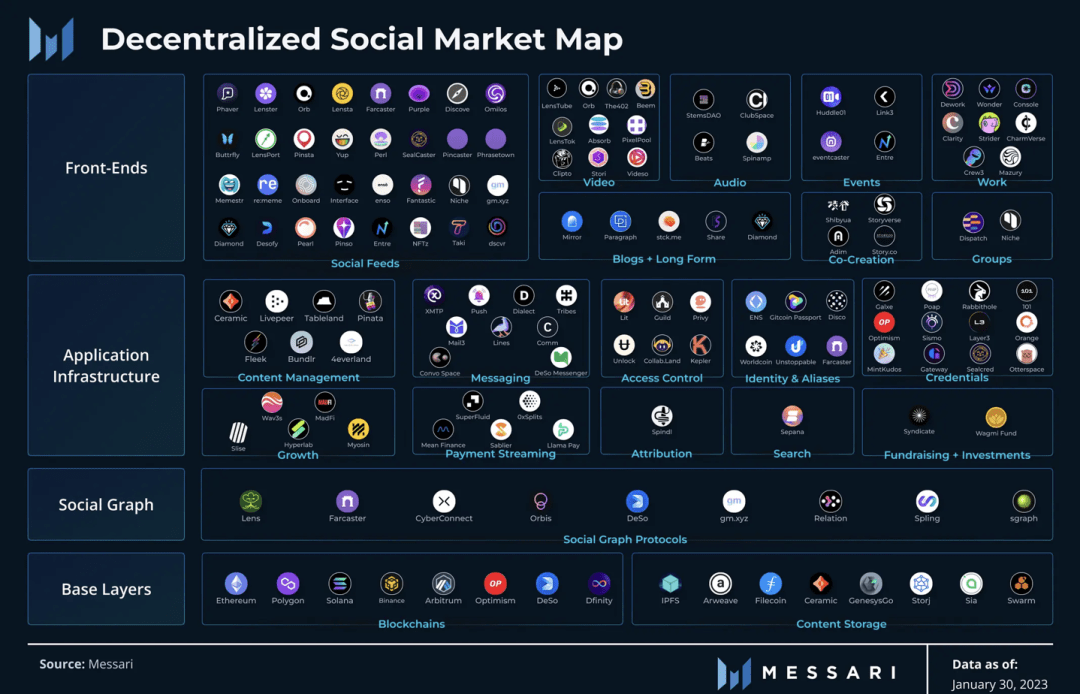
Personal accounts and content relationships in the social layer are at the core of any consumer application today. Typically, this layer of infrastructure benefits from shared standards. However, core social graph protocols, each with different design standards and tradeoffs, are in the early stages of building user bases and integrations. As a result, upward investment in front-end and application infrastructure is challenging.
However, a deep understanding of the design trade-offs between scalability, developer experience, and decentralization of social graph protocols can reveal advantages.
Social Graph Protocol
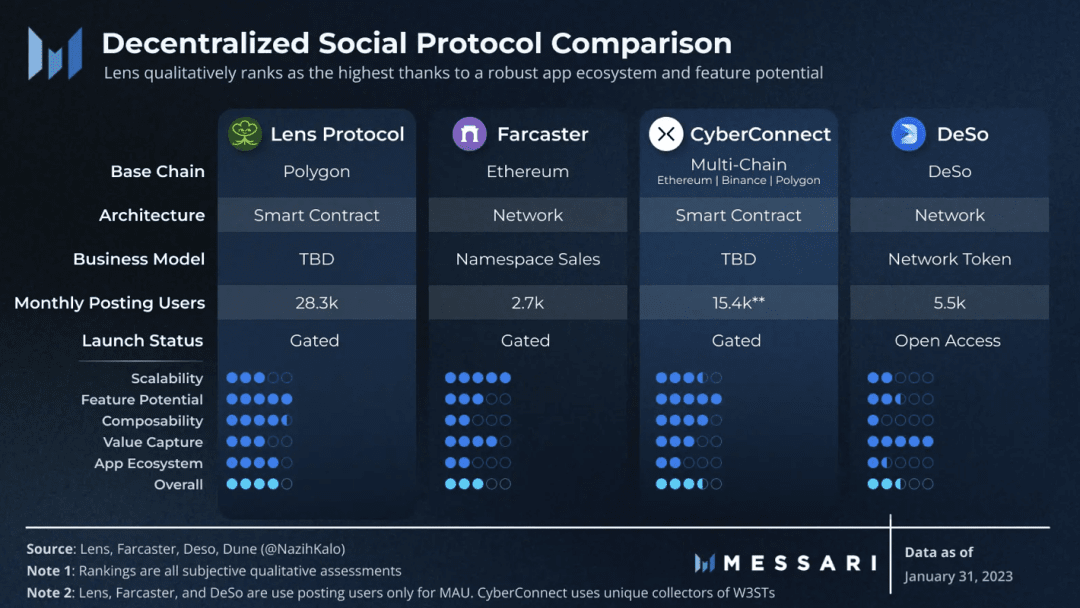
The four most popular social graph protocols are Lens, CyberConnect, Farcaster, and DeSo. Each defines its own core framework for creating accounts, following other accounts, and publishing content. These four protocols are at different stages of maturity and have unique designs and trade-offs.
Lens
Protocol Design
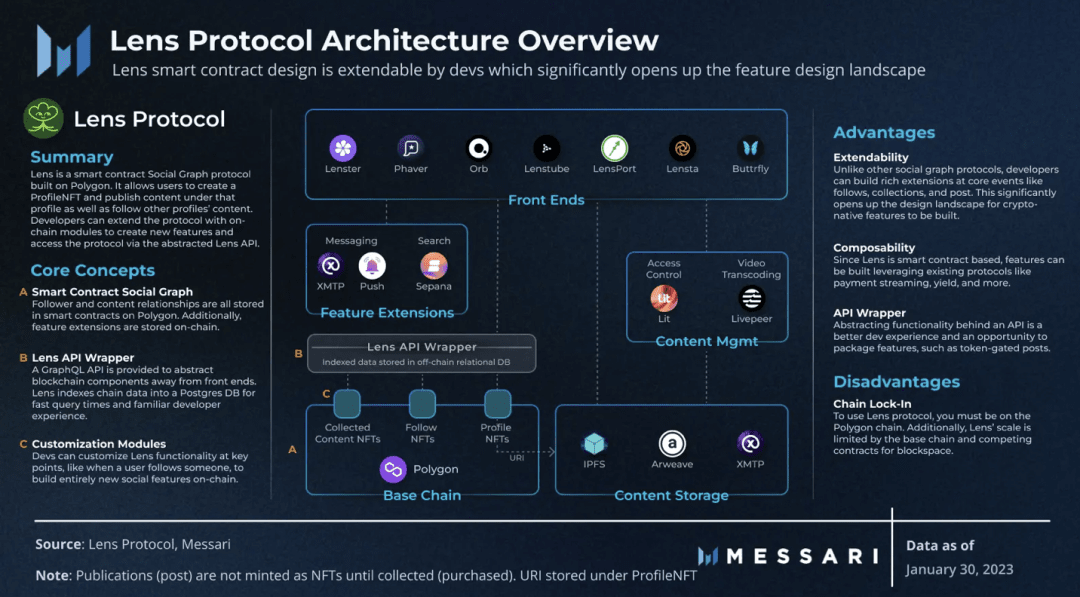
Lens, which is currently in the closed release phase, is designed based on smart contracts and built on Polygon. Each Lens profile issues a ProfileNFT, and all followers of the profile issue a FollowerNFT to represent the connection. In addition to basic personal accounts and follow-up content, other core concepts of Lens are:
Publications — Posts published by a profile are stored in the user’s ProfileNFT, with a URI pointing to metadata stored in an off-chain solution such as IPFS. To save gas, publications become NFTs only after they are “collected”.
Collecting — Users can “collect” another user’s post, which will be minted as an NFT in their wallet. Collecting is a way for creators to monetize their content directly, and for users to build stronger relationships with other profiles. It also introduces a new avenue of monetization for those who find and repost valuable content.
Mirrors – Mirrors are re-shared publications. Since they are not real publications, they cannot be collected directly. However, if the original content is collected by other users, the person who reposts the valuable content can receive part of the proceeds. In addition, Mirrors creates a new form of advertising technology, where users can incentivize others, thereby promoting their content.
Modules — Modules are smart contracts that execute when triggered by an event like a new follow or favorite. Developers can customize the functionality of Lens within modules and use them to build new features, including monetization. For example, a follow module could require payment or subscription to follow a profile. Modules drive scale and feature potential because developers have a framework to add nearly any functionality to Lens while the social graph remains standardized and therefore composable.
Built-in governance - FollowNFTs are effectively badges that show a user is part of a group. Understanding the potential, Lens built additional logic into FollowNFT for things like voting delegation. Users can come together to form a social DAO, which can have its own profile and be governed by its FollowNFT holders. Additionally, DAO owners can program special voting and governance rules directly into FollowNFTs.
integrated
The front end interacts with the Lens contract primarily through the Lens API. The Lens team indexes all Lens contracts, such as ProfileNFT and FollowNFT. It then stores the formatted data in a Postgres database. The data is accessible through a standardized Lens API, improving performance and speeding up the onboarding time for front-end developers.
Since Lens is a smart contract built on a general-purpose blockchain, it requires another network to handle high-throughput functions such as content management and messaging. For messaging, Lens recently partnered with the message storage and encryption network XMTP. It is used to securely send DMs to other personal accounts in the Lens API.
Application developers determine content storage for images, videos, and general metadata, typically choosing IPFS and Arweave. However, controlling access to content, and thus scarcity, requires a key management network that encrypts and decrypts content, such as the Lit Protocol.
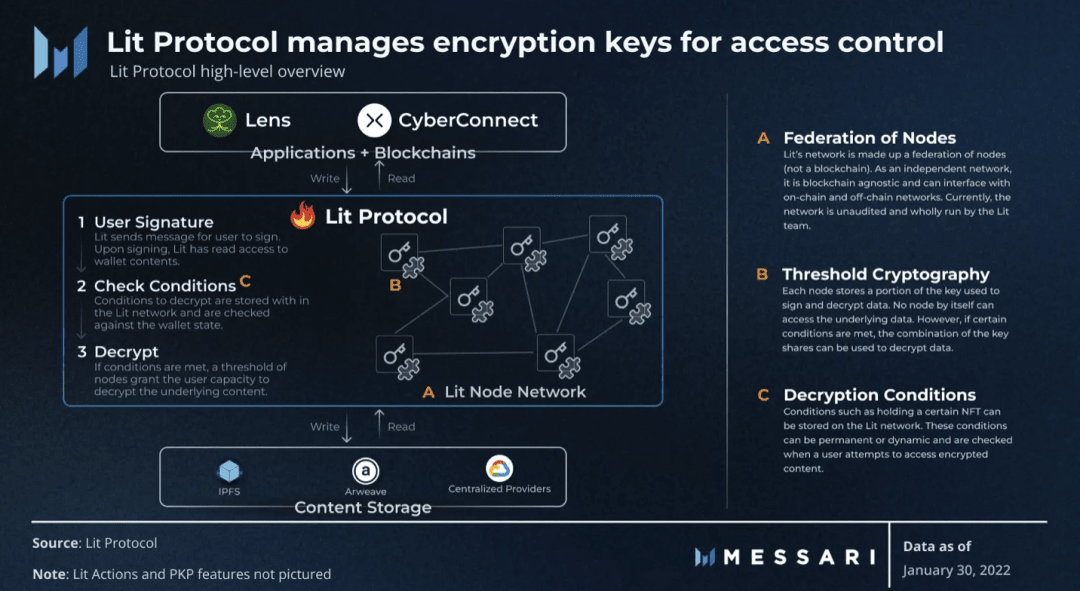
The Lit Protocol is used at the developer level to encode rules for access to content. For example, a user can token-gate a post so that only holders of a subscribed NFT or other token can view it. Lens recently embedded token-gated posts using the Lit Protocol into the Lens API, making it easier for developers to build content scarcity into their applications.
pros and cons
The core advantages of Lens and other smart contract-based social graph protocols are composability and extensibility. Developers are free to implement Lens extensions that interface with any other smart contract protocol. In addition, other protocols that interact with Lens, such as reputation-gated DeFi or DAO tools, can be deployed more easily. The design surface area of smart contract social graphs like Lens is a major advantage compared to traditional social platforms and web-based crypto social graphs.
However, one drawback is the limited and generic recommendation engine in the Lens API (which provides basic content feeds today, with potential for improvement). Without strong recommendation capabilities in the API, social feed projects must build their own indexers and then their own recommendation algorithms to recommend new content to users. As front ends mature and seek to gain competitive advantage, they will almost certainly explore rolling their own indexing and recommendation algorithms. Furthermore, this trend will extract value from Lens, as front ends with strong indexing and algorithmic capabilities will have no incentive to pay taxes or write data back to the Lens contract.
Currently, Lens is only deployed on Polygon, which limits Lens’ user base and scalability to the base chain (a drawback of all smart contract systems). However, there is nothing stopping Lens from launching new chains in the future and aggregating social graph data in its indexing process and exposing the cross-chain social graph through its API, similar to how CyberConnect does it today.
CyberConnect
Protocol Design
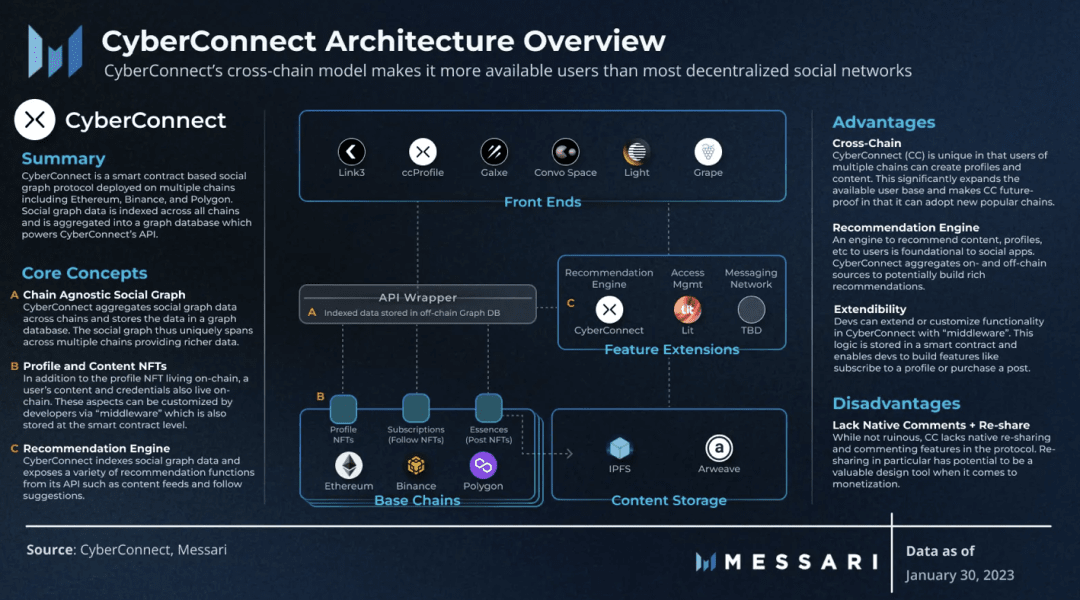
CyberConnect is a closed-launch multi-chain social graph protocol that recently acquired over 20,000 account profiles. As a smart contract-based social graph, CyberConnect is similar to Lens in that both use NFTs to represent profiles and followers. However, they differ in terms of content representation and API approach.
CyberConnect's core features include:
Account NFT - Each individual account profile (ccProfile) is a non-transferable NFT. Once created on one chain, the account name is preserved on other chains. The Account NFT acts as a central relationship point for all user content and subscribers. Additionally, this NFT collects any payments from collected content or subscribers.
Subscription NFTs - After following a profile, a subscription NFT is minted to the user's address, representing the connection between the user and the newly followed profile NFT. In addition, account owners can set rules, such as requiring ownership of tokens or paying some small amount before issuing a subscription NFT.
Essence NFTs - Account-generated content is represented as Essence NFTs, which follow the OpenSea metadata standard. They can be any digital object the user wants, such as a post, blog, video, or certificate indicating social status. Similar to Lens, other users can collect Essence NFTs for free or for a fee, depending on how the developer configures the middleware that manages the Essence NFT functionality.
Middleware - Developers can configure rules that are called during events such as publishing an account, subscribing to an NFT, or collecting an EssenceNFT. Similar to Lens Modules, CyberConnect Middleware allows users to customize how they want to monetize their content and shape the user experience.
Multichain - CyberConnect is currently deployed on Ethereum, Binance Chain, and Polygon, where users can create accounts and content. New accounts, subscribers, content, and various on-chain activities are indexed across all chains and then aggregated by CyberConnect in its API.
Off-chain data - Data from data storage networks such as IPFS and Arweave is indexed and stored alongside other off-chain data sources such as Rarible, Twitter, and Foundation. By linking on-chain and off-chain data together, CyberConnect is able to build a comprehensive view of users.
Interest Graph Engine – CyberConnect aggregates cross-chain index data first into a relational database and then into a graph-based database (Neo4j). From the graph database, CyberConnect exposes data through its API. Additionally, CyberConnect has built a recommendation model that recommends profiles to follow, content feeds, and more. Developers can access these models from the API, significantly reducing initial application development costs.
integrated
The CyberConnect API is the primary tool that allows developers to leverage CyberConnect profiles and content in their applications. The API interfaces with a graph database that aggregates the CyberConnect social graph from across chains. Additionally, CyberConnect provides a recommendation engine that provides profile and content feed suggestions. Similar to Lens, standardized data and recommendation algorithms accelerate time to market for new front-end applications.
Also similar to Lens, CyberConnect interfaces with the Lit Protocol to provide developers with access control and content scarcity tools. To further enhance privacy, CyberConnect is exploring features such as zero-knowledge proofs to provide downstream applications with a user's social graph without revealing the exact details of the social graph data.
CyberConnect profiles and content reside on a universal blockchain, enabling high-throughput messaging, a function that cannot be performed natively. As a result, the CyberConnect program announced integration with messaging protocols to provide secure, end-to-end encrypted communications for its users.
pros and cons
CyberConnect’s core advantage is its multi-chain deployment and data indexing pipeline. Aggregation of cross-chain and off-chain data sources allows CyberConnect to build a richer social graph than competing protocols. Since CyberConnect uses a graph database instead of a relational database to store its data, it expands the capabilities of its recommendation engine given that graph-based algorithms are natively available.
While CyberConnect’s EssenceNFT is promoted as allowing developers to issue credentials and use them as social posts, the protocol lacks native support for forwarding content and commenting on content. While app developers can add this functionality themselves, it only makes it slightly more difficult than with more socially deterministic protocols like Lens or Farcaster.
Similar to Lens, if CyberConnect’s recommendation engine fails to meet application-specific needs, the social graph protocol may lose value capture to front-ends with their own storage and processing data scale. However, recreating the CyberConnect indexing process may be more difficult given the various cross-chain and off-chain inputs, making it inherently valuable as part of an SDK for application developers.
Farcaster
Protocol Design
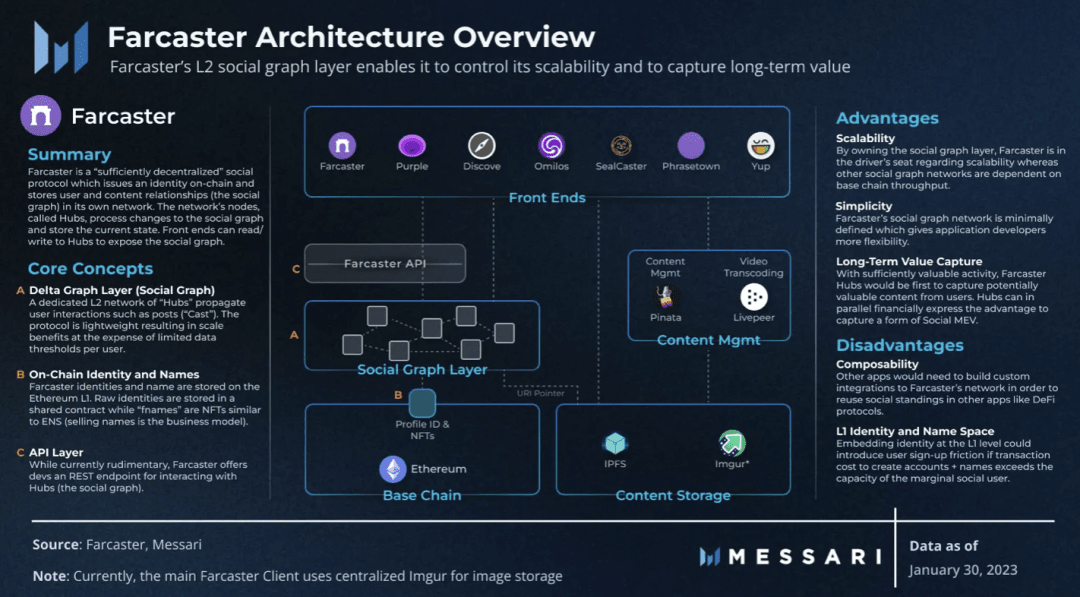
Unlike Lens and CyberConnect, which are smart contract-based networks, Farcaster is a web-based social graph that is currently invite-only on testnet. Its profile IDs are stored within the Farcaster contract on Ethereum, but the social graph is stored in a separate Farcaster network of hubs. Each hub in the peer-to-peer network broadcasts updates, such as a new message (called a Cast in Farcaster), to each other. Broadcast updates, called incremental writes, are initiated by a new user action that adds a new node or connection to the social graph. There are six possible defined incremental writes in the Farcaster protocol:
Cast — A message sent by a user. A Cast can be a simple text post or comment, or it can reference metadata stored somewhere else, such as IPFS for a larger message, such as an image or video.
Reaction — Likes, retweets, and other types of simple message-specific actions from other users.
Amps – Instead of traditional “follows”, Farcaster uses Amps to expose another user’s content to the initiating user for a period of time (think of it as a temporary follow). Currently, the limit is 3 months and 100 Amps.
Varifications — proof of ownership, are two-way signed messages linking a Farcaster wallet to another (e.g. an Ethereum wallet). They allow users to import NFTs and other assets into Farcaster without transferring tokens.
User data - standard metadata about the user, such as description, profile picture, etc.
Signers - key pairs that users are authorized to sign increments. It is a special type of increment that is initially set up to allow users to create additional messages.
Users can purchase an "fname", a human-readable name for use in Farcaster and represented by an NFT on the Ethereum mainnet. While similar to ENS names in implementation, fnames do have additional properties, such as recoverability and cheaper minting costs. These properties make them more suitable for social applications.
By extension, fnames also provides a viable business model, as proceeds from the initial sale and re-registration of fnames can be used as profit or to incentivize the operation of the Hub. The namespace registration business model has historically been one of the few successful on-chain models, as ENS is second only to OpenSea in terms of on-chain revenue over the last year.
integrated
Frontends (clients) integrate directly into the Farcaster Hub network by running their own Hub, or indirectly through third-party APIs that have indexed the network. Given that the application is currently in testnet, only Farcaster sponsor company Merkle Manufacturing is running Hubs, but the goal is to open Hubs in the first half of 2023. Therefore, network access to the frontend is currently through the Farcaster API. The API is currently very simple, with only a chronological content endpoint and no dynamic recommendation engine. Given that Farcaster is hiring data engineers to build search and content recommendations, a more powerful API may be in the works.
Given that Farcaster is web-based and in the early stages of development, there are no other third-party live integrations. While Farcaster’s messaging is open, and it currently lacks crypto-native functionality and digital scarcity elements, it is possible to speculate that Farcaster or the app develops integrations to enable such functionality in the future.
pros and cons
Together with its advantageously simple design, Farcaster can benefit long term by capturing value as a network-based social graph rather than a smart contract social graph. Hubs in the network will be first to gain access to new messages, making them the first participants in that information. In a world where headlines can move markets and high-frequency bots dominate trading, being first to access information is a highly profitable position that someone might pay to exploit. Therefore, if Farcaster moves to a token-based model tied to network participation, the token can capture marginal value from that social MEV.
By far the biggest challenge facing Farcaster, and web-based social graph protocols in general, is information bloat. The volume of messages (data) sent by users can grow so large that the cost of running nodes and P2P networks becomes unmanageable for decentralization. Farcaster has chosen to limit the amount of messages a user can send to the network by deleting old messages.
While pruning preserves the scalability of the network, it does limit its value capture, as hubs can only retain about a year’s worth of data for each user. If the best recommendation algorithms end up powering the most used applications, and the best algorithms end up benefiting from the largest datasets, then data storage costs simply shift to the application level. Applications that have the scale to index and store the network’s historical data may develop a competitive advantage.
Countryside
Protocol Design
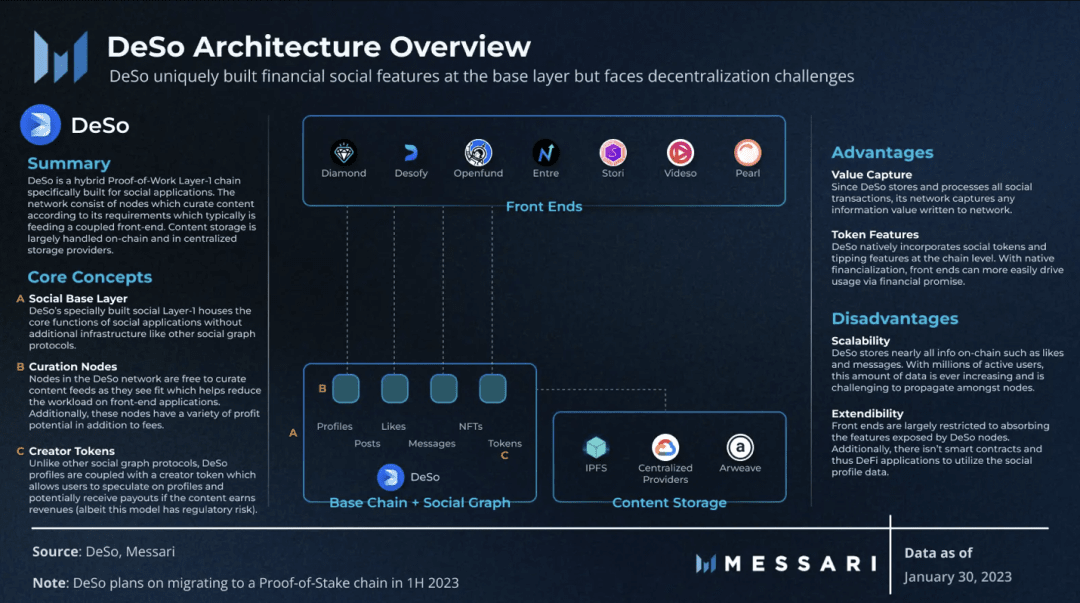
After launching controversially in March 2021 under the name BitClout, DeSo continues to move forward with its unique layer 1 chain designed for social applications. The chain is currently a hybrid proof-of-work chain based on the Bitcoin algorithm and therefore does not have features such as smart contracts. However, in the first half of 2023, DeSo will undergo a hard fork to migrate the network to a proof-of-stake design.
In order to customize the chain for social applications, DeSo abandoned the general chain and instead defined core transaction patterns specific to social applications. Standard social activities such as posts and profile updates and NFT transaction types are defined at the network level. In addition, DeSo defines financial transactions that support standard token exchanges, as well as DeSo's creator tokens and social tipping functions called Diamonds.
Diamonds act as a tipping mechanism for content creators. For every diamond tip a user receives, the more DeSo tokens they earn. Creator coins are automatically assigned to accounts and can be purchased in exchange for DESO tokens. The hypothesis is that as an account becomes popular, people will want to hold (buy) this creator's coins, causing the price to rise for existing holders.
All content in DeSo is stored on-chain, with the exception of raw images and videos, which are stored in centralized providers like Google Cloud or decentralized providers like IPFS. By this design, the state of the chain is constantly growing, limiting its long-term decentralization potential.
pros and cons
DeSo's main advantage is also its disadvantage. As the network expands to accommodate different social applications, it becomes exponentially more difficult to maintain. As new posts and transactions continue to expand the state, DeSo nodes will eventually struggle to pay the cost of storing all of this data. So while in the short to medium term DeSo will be able to scale based on its design decisions, there will come a time when the choice is either decentralization with prolific low-cost nodes, or a more centralized chain with extremely high costs per node.
Another major drawback of DeSo is the design space provided to application developers. Without general-purpose smart contracts, it is nearly impossible to build novel crypto-native functionality. Instead, applications are forced to use deterministic features coded by the DeSo team, such as creator coins and tipping functions. However, with the upcoming hard fork, DeSo is introducing access control and associations, which does expand the design possibilities of applications.
Social Graph Appeal
Of the four major social graph protocols, Lens has the most traction. Its momentum is partly due to the heavily promoted ETHGlobal hackathon, which attracted many developers and projects. In turn, users are attracted to the products built, resulting in more than 100,000 Lens profile accounts and about 24,000 active accounts per month.
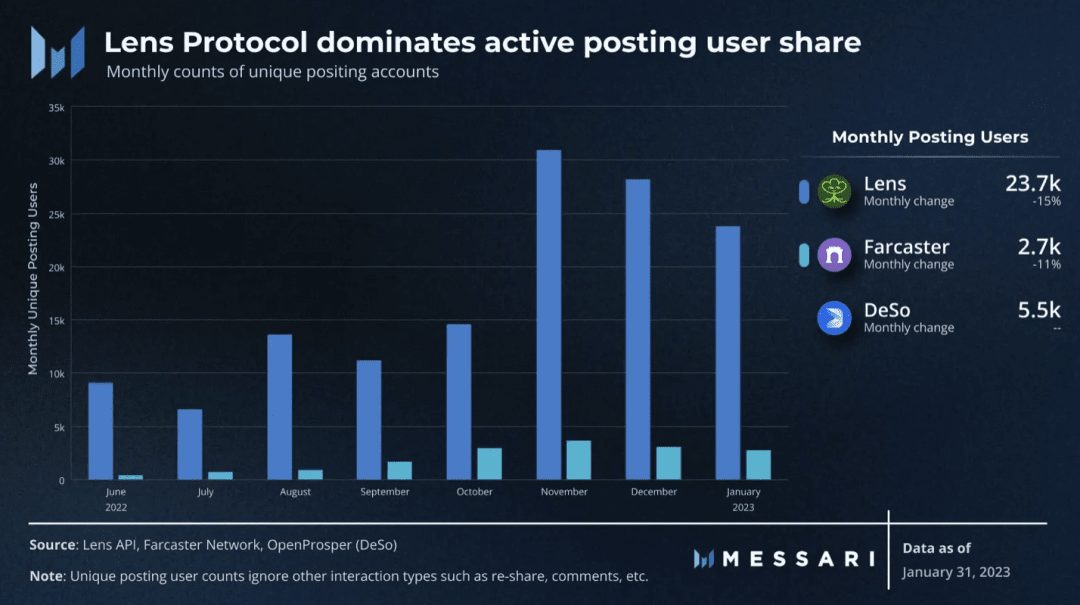
Farcaster and CyberConnect are both earlier in their launch process, so they have less overall traction than Lens.DeSo, despite being the longest active protocol and the only one not in closed release, has 75% fewer active posting users (~5,500) than Lens. In addition, DeSo’s content is more dominated by bots because it is low-cost and open to everyone.
While Lens dominates the market, no social graph protocol has seen truly compelling, differentiated products built on top of it. As a result, early user metrics are not reflective of the target market for the next “killer” app.
What matters more at this early stage (1 million users and below) is protocol design. Designing for the potential of new business models means more than just the initial number of users of the first generation of applications. That said, the features and product direction of the first generation of applications do predict how the front end may eventually package features and try to compete in an open source, open data environment.
Front-end application
The application layer combines all the functionality exposed in the social layer into a familiar user experience. While each application largely uses the same underlying components, the use cases for applications vary and generally fall into three broad categories:
Entertainment apps – Social feeds, video sharing, and other apps that are primarily used for connection and entertainment.
Workplace Apps — Group and DAO tools focused on coordinating tasks. Traditional examples include Slack and Discord, as well as task management apps Asana and Trello. While not yet connected to DeSoc, crypto apps like Console, Dework, and Wonder will all be crypto-native examples.
Free Apps — Adjacent apps that offer services like NFT trading often integrate Profiles in some limited way, as Profiles are not core to the product or service.
While entertainment applications such as social feeds are considered core use cases for social applications, workplace applications are responsible for a large amount of content created every day. In large companies, millions of PowerPoint slides and memos are produced with the sole purpose of communicating with others within the organization. This form of content creation is then shared via email or Slack instead of traditional social media channels.
As DAOs shift efforts from a closed to an open paradigm, the stereotypical role of the content creator will expand significantly to include more tangible and useful things rather than entertainment content creation. This untapped pool of content creators remains a huge growth opportunity for DeSoc as the requirements for commercial content creation (i.e. financial aspects and certifications) strongly favor the crypto track over the traditional social media track.
As it stands, most front-end applications built on top of decentralized social graph protocols are entertainment-centric. Many of these applications are social feed applications that are primarily focused on the Lens ecosystem.
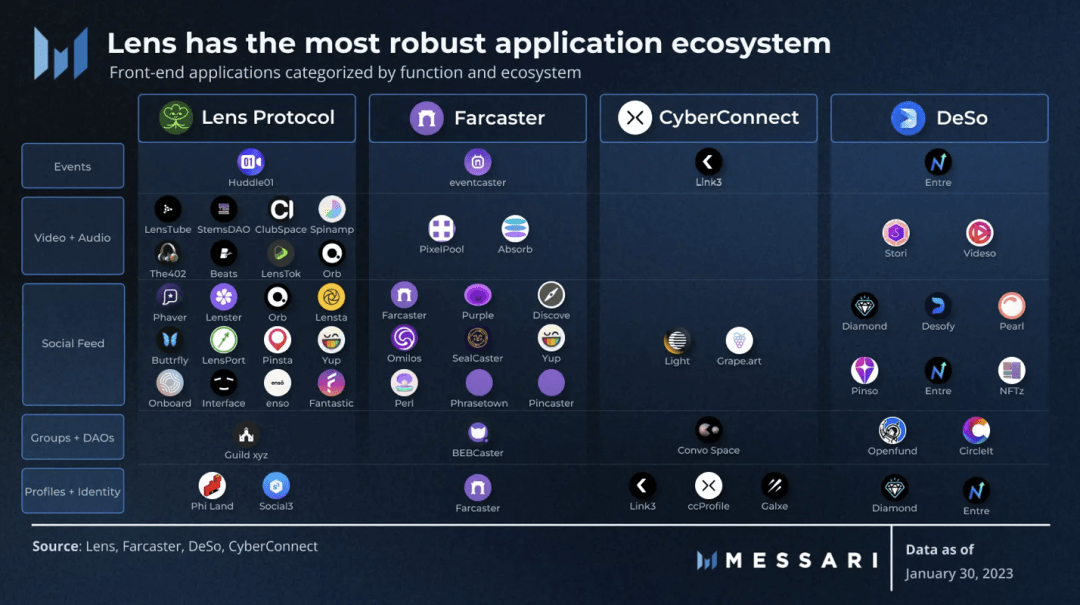
lenses
The top three Lens apps by number of posts — Lenster, Phaver, and Orb — are all social feed protocols. Lenster, a web-based Twitter-like app, has the most weekly posters, at over 35,000. Since its launch, Lenster has accounted for approximately 30-50% of all weekly posts on Lens, and over 90% of browser-based Lens posts. Weekly Lenster posts have grown 44% over the past four weeks, outpacing the 7% growth of Phaver, the second-largest frontend.
Phaver
Phaver is a mobile app built on Lens with all the standard social features. Its main purpose is to introduce unique gamification features to incentivize future activity and reward users. Each user can "stake" tokens on posts that they think will be noticed by others. If the post performs well, the user will receive additional tokens as a reward. In addition, users can publish their content in "premium channels". After sacrificing some points, content publishers will be able to earn additional points for each user who subsequently stakes on the post.
This incentive mechanism rewards both top content creators and top curators (stakers). Additionally, it prevents spam since paid posts incur fees. However, staking on posts is currently free, which results in a skewed incentive toward frequent posting until the cost is unlocked. As a result, Phaver has nearly 40% of posts dedicated to Lenses, but only 9% of secondary engagement from comments and reposts.
Orb
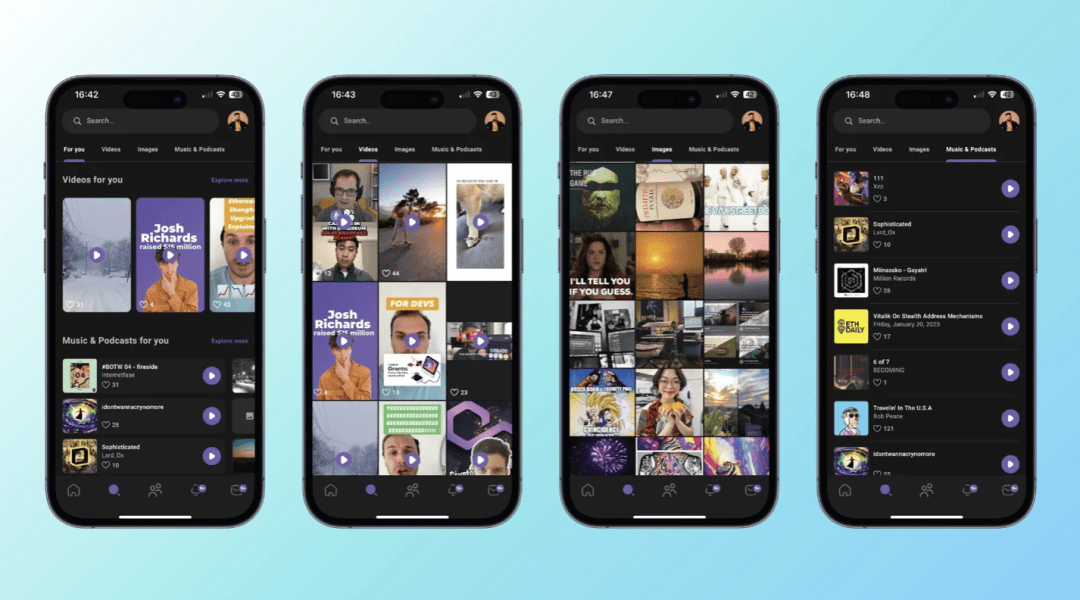
Orb, an iOS mobile app built on Lens, is one of the fastest growing Lens frontends, growing over X% after launching last month. In addition to content feeds, Orb also offers video, podcasts, music, and chat features on its platform as part of its recent launch. Additionally, Orb has integrated Wav3s, a growth tool that allows users to boost their content by incentivizing other users to repost it within their network. By adopting tools like Wav3s, which is part of the broader Web3 Growth Stack, Orb and other applications can quickly incentivize user adoption and engagement in ways that traditional platforms cannot.
CyberConnect
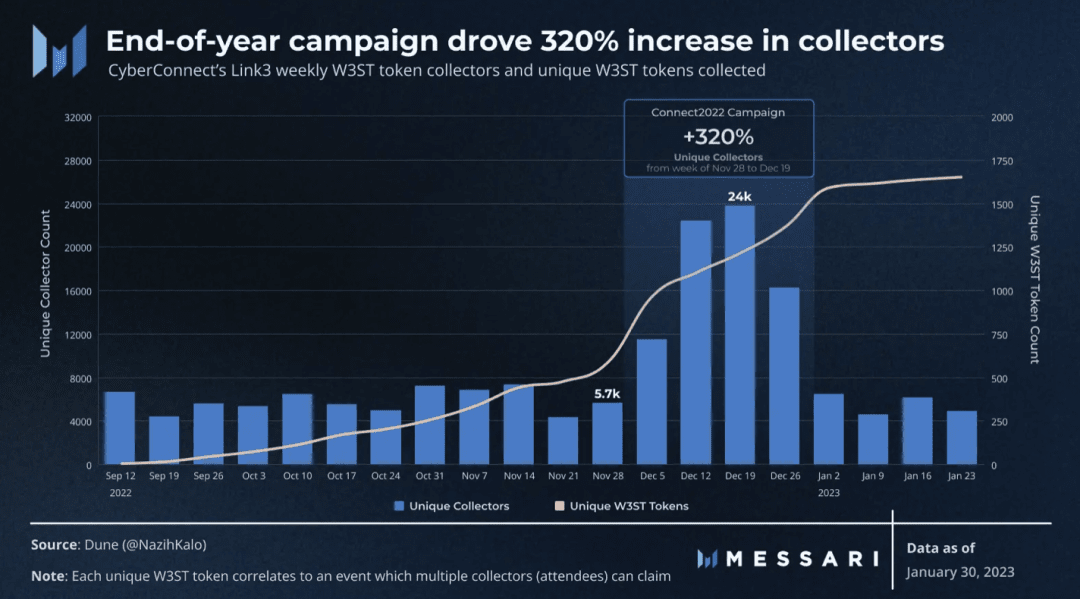
While CyberConnect doesn’t have as strong an application ecosystem as other social graph protocols, it has gained decent traction with its uniquely positioned Link3 product. Link3 is both a global social identity similar to Linktree and an event product. It allows users to host webinars and issue NFTs (W3ST) to attendees indicating their attendance, as well as conduct local raffles for attendees. CyberConnect’s 2023 summit, hosted by Kyle Samani et al., was held entirely on the Link3 platform.
Since launch, the platform has minted over 1.1 million NFT certificates of attendance, and by December, the number of unique NFTs issued and the number of unique collectors per week were both above or near all-time highs.
Farcaster
Given the network’s early development stages, the vast majority of activity is driven by Farcaster’s own client, a Twitter-like mobile app that was recently released on the App Store. While the network and its app usage account for about 10% of active posters on Lens, the network has a highly engaged user base. Nearly half of active posters have been posting consistently for more than three months, with nearly 75% of those posters having been posting for a month or more.
While Farcaster's apps have driven most of the network's usage so far (mostly due to Hubs being closed), there have been a number of new clients joining recently, such as Purple, Omilos, and Discove. Each client offers a similar social feed style platform with marginal improvements, such as curated feeds for various topics. However, there have recently been alpha-stage projects like Pixel Pool that aim to move away from Twitter-like products and offer video on top of Farcaster.
Once Hubs are open, the number of frontends and the diversity of their functionality will likely increase.
So
While DeSo has a range of apps, from blogging to fundraising, more than 75% of its web posts come from three social apps:
Desofy – A mobile social media app and the DeSo app with the most posts. The app is backed by the DeSo Foundation and allows users to earn money through diamond tipping and selling NFTs.
Diamond – A web-based social feed product backed by the DeSo team. Its functionality includes all the monetization aspects of DeSo, enabling users to post short-form and long-form content on the site in addition to images and videos.
DeSocialWorld – A multilingual social feed designed to cater to a global audience. It also showcases most of DeSo’s features, including content and monetization.
Currently, given DeSo’s deterministic design, the feature sets of applications are very similar. However, with the upcoming hard fork, DeSo will introduce access groups to build more customized features.
However, one problem is the lack of independent projects building on top of DeSo. Given that DeSo is one of the only social graph protocols open to all users, most usage is through DeSo-sponsored applications, and independent builds have little to gain.
Competitive Dynamics
Since any application can display a user's posts, friends, and overall social graph, users are free to choose any front-end to participate in their network. However, this user mobility brings fierce competition to the front-end layer that is not found in traditional social applications. This competition comes from the network effect advantages retained by the social layer, while the front-end lacks a strong moat to retain users.
Frontends can build competitive moats in two ways: through a token model like Phaver, or by building advanced recommendation algorithms into their own indexing process.
While token models and loyalty programs can drive user adoption and retention, successful moats have traditionally been driven by scale. In a world where airdrops and token models drive down fees in industries like DeFi, front ends that can scale to support custom data collection, indexing, and recommendation capabilities may be more sustainable. Additionally, since the front end has richer information about user interactions with the product (page dwell time, scrolling behavior, etc.), the user data used to build the recommendation engine becomes richer over time.
Over longer time horizons, the potential increased data collection and scale of the front-end layer creates competitive risk for the social layer. If the front-end is able to scale beyond all competitors, the incentive to write data back to the social graph will be greatly reduced, reducing the potential value capture of the social graph protocol.
polymerization
While most front ends are specific to a particular social graph, there is nothing stopping a front end from spanning multiple social graph protocols and aggregating content for users. An early example of this style approach is Yup, which spans Lens, Farcaster, Mirror, and even Twitter.
In Web2 businesses, aggregators tend to be the primary business model identified by Ben Thompson. However, a key difference between Web2 aggregation and crypto aggregators is the accessibility of the underlying data. Popular aggregators such as Google, Facebook, and others aggregate information that is difficult but not impossible for individual users or small companies to collect.
In crypto, with its open data and social graphs, the convenience of aggregation is too low to be a sustainable moat. While there are benefits to having customer relationships, it is difficult to maintain those relationships in the face of a barrage of airdrops and other incentive strategies. However, if aggregators manage to reach a scale where they index and process data (rather than read it), then the aggregation business model may once again triumph over other unfavorable competitive dynamics.
Summarize
Money acts as an incentive to drive human movement, just as physical forces concentrate energy into less concentrated areas. When the incentives of the platforms cannot balance $230 billion with the nearly $6 billion of creators, there is a huge incentive for developers to create balancing technology and for creators to adopt it.
DeSoc’s open architecture enables anyone to build applications on top of the social graph. Without major network effect barriers, the feasibility of new social applications and business models is greatly expanded — for both traditional creators of entertainment applications and knowledge worker creators.
However, front-end applications need to build crypto-native features that provide compelling value to users (i.e., beyond traditional social in crypto). Given the current state of applications and application infrastructure, it may take some time for DeSoc to move beyond the functional pilot phase before it can become the foundation of people’s online identities.