


By Alex Xu
introduction
Inscription assets represented by the BRC20 series have been very popular recently. I have the impression that this is the second wave of asset appreciation since the launch of the Ordinal protocol. The author recently conducted a survey on the current inscription market. In addition to digesting industry information and data, he also participated in some online and offline BRC20 theme exchange activities, and formed some phased views on this market, which he tried to organize and express through this article.
This article attempts to answer the following questions:
What are inscription assets? What are the selection criteria for popular BRC20 assets?
What is the core value proposition of inscription assets represented by BRC20 assets?
Are inscription assets a good business innovation?
What is the mechanism logic and driving force behind the surge in inscription assets?
What scripts are there for the next phase of Inscription?
The path of the collapse of inscription assets
The following article represents the author’s interim views at the time of publication. It may contain errors and biases in facts and opinions. It is for discussion purposes only, and we look forward to corrections from other investment research colleagues.
Inscription assets and the criteria for “high-quality assets”
Inscription assets refer to virtual assets that are created by recording information in a specified format on BTC (or other blockchains), and then converting the accounting information in a specified format on the chain through a specific index protocol. Such assets can be homogeneous assets (such as BRC20 assets) or non-homogeneous assets (such as NFT-like Bitcoin Frogs).
For Bitcoin, as a public ledger, its main purpose in the past was to record transfer transactions on the network. After Bitcoin completed the Taproot upgrade in November 2021, it provided more efficient data storage capabilities as a public ledger, allowing text and multimedia content to be uploaded at a lower cost, which provided a technical foundation for inscription assets.
Compared with Ethereum, the issuance and operation of assets are based on smart contracts, while for BTC's inscription assets, they are issued and operated based on on-chain information + index specifications.
Although the mechanisms are different, both are assets issued based on data in the blockchain public ledger.
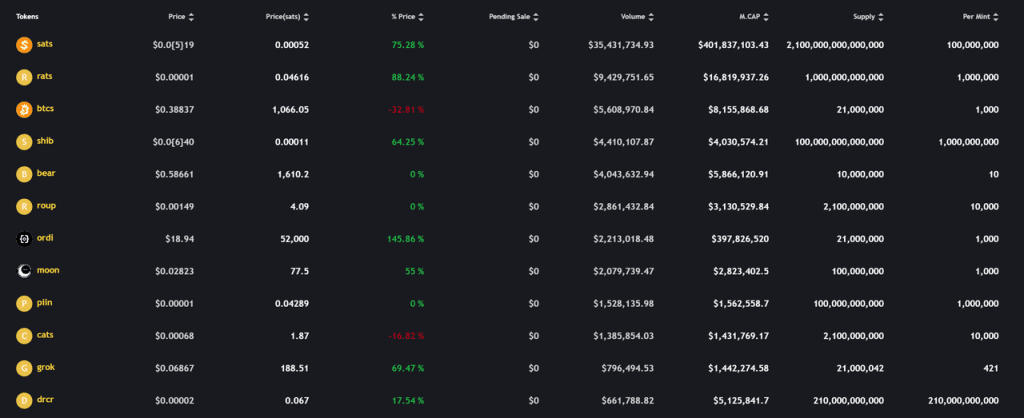 Token-based inscription assets on Bitcoin, source: BTCTOOL
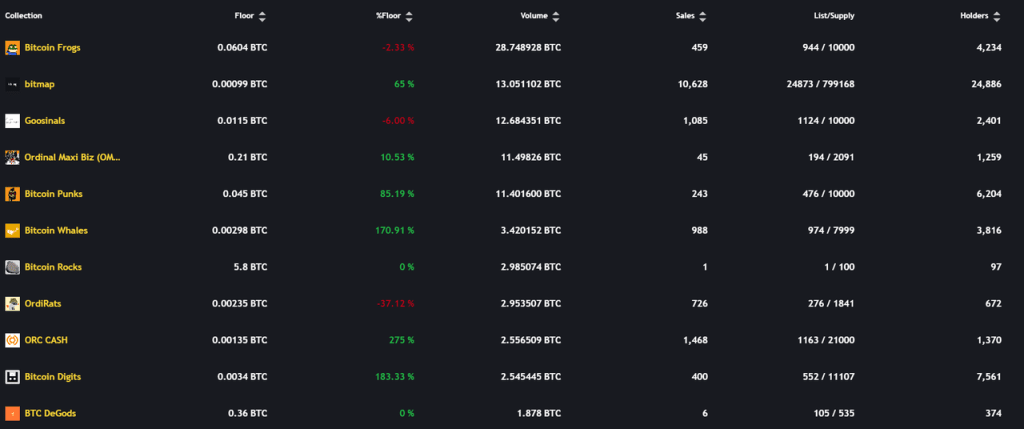 NFT-like inscription assets on Bitcoin, source: BTCTOOL
Based on the different inscription index specifications, homogeneous assets include different types such as BRC20 and ORC20.
This article mainly discusses BTC inscription assets, with a focus on BRC20 assets as an example. Currently, the inscription assets with the highest market value are mostly in the BRC20 series.
Although this year, there have been BRC20 star assets such as Ordi and Sats that have seen huge increases, and other BRC20 assets such as Rats have also seen significant increases, most of the BRC20 assets issued during the same period have returned to zero and completely lost liquidity within one or two months after issuance.
From the several Inscription Asset and BRC20 discussions I have participated in, the participants of Inscription Asset have the following overview of the “promising” BRC20 asset characteristics:
Good names: related to Bitcoin and inscription culture (Ordi, Sats), or animal coins (the Meme craze in 21 years is also mostly named after animals)
Be original: Don’t be a crude copy of other memes, create your own IP
Look at the community: Does the project have influential leaders? Does the project have radical, high-profile, and continuously publicized community expansion activities?
Look at the chips: In the early stage, the proportion of chips held by large investors should not be too high, especially the proportion of chips held by pure investors (those who do not participate in promotion and just hold coins) should not be too high
Of course, the application of the above criteria in practice is not simple.
The quality of a name is a matter of personal opinion. Even in the relatively narrow track of inscriptions, trends have changed many times. The "naming logic" that the market buys into now may not be "attractive" in a few weeks.
Value Proposition and Commercial Innovation of BRC20 Assets
There are many opinions on the value proposition of BRC20 assets in the market. The author summarizes the main points as follows:
The fair launch mechanism ensures that everyone can only obtain assets in an equal manner. Unlike mainstream web3 projects, which have VCs making early investments, they can obtain chips at a lower cost and then sell them to the public at a high price in the secondary market.
BRC20 has a simple protocol format and single function, so there are no risks associated with smart contracts, such as project party Rug, blacklisting, contract hacking, etc.
It enriches the accounting purposes and asset categories of the Bitcoin network, creates a large amount of network fees, and can fill the Bitcoin network security budget after the subsequent BTC block output continues to decrease.
In my opinion, the above statements all make sense, but they are not the main source of the hot BRC20 assets and huge wealth effect this year.
So, is the inscription asset represented by BRC20 a good business innovation?
It depends on the standpoint of interest from which the term "good" is evaluated.
This is certainly a good innovation for trading platforms, asset speculators and Bitcoin mining practitioners, because the emergence and popularity of such assets have actually increased their income.
However, as to whether inscription assets provide broad commercial value, such as reducing the production costs of goods and services, improving business efficiency, and optimizing resource allocation, based on current observations, the author holds a negative attitude.
BRC20 is essentially just a new form of Meme asset.
The author does not reject Meme. Although Meme assets are a negative-sum game in terms of the overall wealth of speculators (trading platforms and project owners will continue to extract money from speculative behavior), they provide the mental pleasure that accompanies speculative and gambling behavior, which actually meets the needs of such users. This is also one of the reasons why people still occasionally or continuously visit casinos even though they know that many gambling activities are mathematically unprofitable.
People's gambling and greed are often no less strong than their physiological needs such as food and sex. This is the source of the long-term survival of the Meme track.
But as far as the Meme track is concerned, BRC20 assets can only be said to have enriched the product categories, and the changes in technical mechanisms have not brought much real innovation.
Taking BRC20's most recognized "fair distribution" as an example, as long as it is properly designed, fair distribution based on smart contracts can also be achieved. It is not an exclusive function of the inscription track.
The much-criticized model of "VC investing in the early stage and retail investors taking over in the later stage" means that VCs invest in projects at a stage where there is nothing but a business plan. This faces huge uncertainties and requires extremely low early investment prices as a condition for hedging risks. By the time the project tokens circulate in the secondary market, many of the "uncertainties" of the previously invested projects have been transformed into "certainties", such as available products, data that can be evaluated and observed, a more mature market environment, and trading platforms seeking to be listed. At this time, the project is no longer the "early project" that was invisible and intangible in the early days and only existed in white papers and financing PPTs, so the token price is naturally different.
According to this logic, the same is true for VC-free meme projects such as Shib and Pepe. In the early days, they were just a concept. Whether they could get enough attention and speculative funds in the future, whether they would get the attention and recommendation of other KOLs, were all "uncertain", so buying their tokens was extremely cheap at that time. When their holders grew rapidly, resources became increasingly abundant, and more and more people were optimistic about them, "uncertainty" became certainty, and their secondary prices were already dozens or hundreds of times higher than the original.
So, as a not-so-new form of meme, what is the reason for the explosion of BRC20 assets this year, especially in the second half of the year?
The mechanism logic and driving force behind the surge in inscription assets
We analyze the BRC20 wealth carnival phenomenon from two perspectives: mechanism logic and driving force.
Mechanism Logic
As mentioned above, BRC20 is essentially a speculative medium, and the only utility of speculative media for participants is to "quickly create amazing wealth." The law of large numbers that "people always tell others when they are rich, and always keep silent when they lose money" determines that even if the majority of people in a market lose money, the headlines circulating in the community may still be "investment stories of group members who made a hundred times the profit." This point disproportionately amplifies the public impression that "rich people frequently emerge" in certain asset speculation.
This time, BRC20 is more efficient in creating the "wealth effect" than the conventional ERC20 Meme.
The core reason is that most BRC20 assets were traded in the form of OTC orders in the early days, and even until now, while the trading platforms of ERC20 format Meme are mainly AMM DEX or CEX, and the depth of the former is much smaller than that of the latter. This also means that the funds required to pull the price of BRC20 assets are much lower than those of regular ERC20 assets (especially during the rising period of market sentiment), and the same buying pressure can provide a higher increase.
To translate, due to the thin liquidity of the OTC model, the same purchasing power can bring more exaggerated increases in BRC20 assets than ERC20 Memes, forming a stronger and faster "wealth effect".
In addition to the difference in the cost of pulling the price, BRC20, which is not traded on CEX, also lacks short-selling mechanisms such as perpetual contracts, which further liberates the short-term upside potential of related assets.
In addition, during the exchange, the core participants of BRC20 said that the speculative behavior in this field has a high "mother rate". That is, a large number of investors entering the market are not "old leeks" who are familiar with Defi and keen on investing in mainstream crypto assets. Instead, there are many middle-aged investors who are encouraged by "team leaders" and guided by "ground forces". They are more obedient and easily influenced by community leaders. Some of them don't even know how to sell. This has formed a (3,3) pattern of holding coins without selling in some projects, reducing the short-term selling pressure of the projects.
The good experience of Web3 wallet promoted by Okex this year in BRC20 asset transactions and the complete infrastructure on the wallet side have further smoothed and shortened the entry path for "mom-based speculators", allowing them to successfully enter this new market.
Driving force
The popularity of BRC20-type inscription assets is a rare speculative bright spot in the bear market. Many stakeholders have sufficient motivation to promote the continued development and expansion of this trend.
Mining community: Inscription transactions are booming, miners and mining pools earn a lot of commissions, and mining machines are easier to sell. They are the direct beneficiaries, and naturally hope that this "summer of inscriptions" will not end too early.
Exchanges: The new speculative business brings more fees + more new users + the effective activation of this strategic product, wallet. Okex is undoubtedly the big winner of the summer of inscriptions, and Binance has also begun to follow up.
CX team: New themes, new stories, and the headcount resources in hand can be monetized again
The above three forces are likely to accelerate the popularity of inscription assets to the next stage.
The next stage of the script
The next stage must have a script for the next stage to make this already large market even bigger and hotter. The following may be some representative event nodes:
Second-tier CEXs continue to list more inscription assets besides Ordi and Sats, continue to drive other Meme prices up, and introduce more traditional crypto investors into the BRC20 speculative market
Binance and other leading CEXs have launched more inscription assets, and introduced mainstream crypto funds into the BRC20 market through CEX
Other innovations besides pure memes have emerged, such as the BRC20 meme that introduced the Ponzi mechanism, which has a more exaggerated wealth effect.
But will the inscription market leap into a hotter stage as expected, or will it gradually cool down or even crash?
Let’s look at the possible paths and conditions for its collapse.
The path of the inscription market collapse
As mentioned above, the exaggerated wealth effect of BRC20 assets in the early stage was determined by a combination of factors such as the low liquidity of the OTC order trading mechanism, the high proportion of mother-related investors, and the large number of stakeholders.
Low liquidity can cause asset prices to soar during an uptrend, but can also cause asset prices to plummet when they fall because there are no buyers. Most people do not understand that 95% of the wealth in their wallets may be "virtual market value", which is based on the premise that they can run fast and have other people as exit liquidity.
The elements of this market crash include:
Over-issuance and rapid exit of sickle-shaped projects. Under the premise of limited users and funds in the market, the main opponents of the dealer forces of each BRC20 project are dealers from other projects. When users and funds are attracted to buy other BRC20 projects, part of the funds in the market that can take over their own chips disappear. Therefore, due to the fierce competition for users and funds, the overall time node for dealers to distribute chips and get out will be increasingly advanced to ensure their own profits. This leads to a shorter and shorter window period for users to speculate on floating profits. When the loss stories in the market are overwhelmingly higher than the wealth stories, negative communication and ridicule become the mainstream, users will no longer make moves, and the liquidity of the BRC20 Meme market will be exhausted.
User inflow stalls. Factor 1 may cause some CEXs to be cautious in listing more BRC20 assets, which further causes the inflow of users and funds to lag behind the speed of the dealers.
After BRC20 is listed on CEX, the main liquidity battlefield will also be transferred to CEX, which will lead to increased resistance to pulling up the market. In addition, short-selling tools such as contracts are complete. If the mechanism is not changed, the wealth effect after listing may obviously fade.
Factors 1, 2, and 3 continue to reinforce each other, and a collapse pattern is formed.
postscript
Strong greed and gambling are the most important sources of vitality in the crypto industry. I will continue to observe how the Summer of Inscriptions experiment will evolve.
For related articles about Meme, you can also read "Don't Choose Meme When Buying at the Bottom of a Bear Market".