

Although there has been a sharp increase since the beginning of October, and the market outlook in October has always been optimistic.
But the outlook for these three bearish cryptocurrencies below remains negative, with technicals suggesting the worst is yet to come.
Let’s analyze it together. Friends who have positions need to pay attention to the risks.
ApeCoin (Ape) Almost Falls Below $1
ApeCoin (Ape) is one of the cryptocurrencies that has attracted much attention recently. However, the recent price fluctuations of ApeCoin have attracted widespread attention in the market. According to the latest data, the price of ApeCoin has almost fallen below the $1 mark.
ApeCoin is a decentralized digital asset that currently has a certain degree of popularity in the cryptocurrency market. However, due to market instability and investor concerns, the price of ApeCoin has been falling.
This downward trend may be related to the overall market situation or to the fundamental factors of ApeCoin itself. Investors need to pay close attention to market dynamics and the development of ApeCoin to make wise investment decisions.
Ape price has been falling below a descending resistance trendline since April 12.
This trend line has been validated multiple times, most recently on August 14 (illustrated in red).
This rejection accelerated the decline and resulted in a new all-time low of $1.06 on September 17, with prices rising continuously since then.
Moreover, it is trading below the $1.40 horizontal area, which could provide resistance, and the fact that this line coincides with the area adds to its significance.
The daily RSI helps determine the direction of future trends.
RSI is a commonly used indicator among traders to measure momentum and inform their buying and selling decisions for an asset.
Readings above 50, especially in an uptrend, are considered bullish, while readings below 50 are considered bearish.
If the RSI reading is above 50 and the trend is up, the bulls still have the advantage but if the reading is below 50, the opposite is true.
Although the RSI is rising, it is still below 50 (red circle), which is a sign of an undetermined trend.
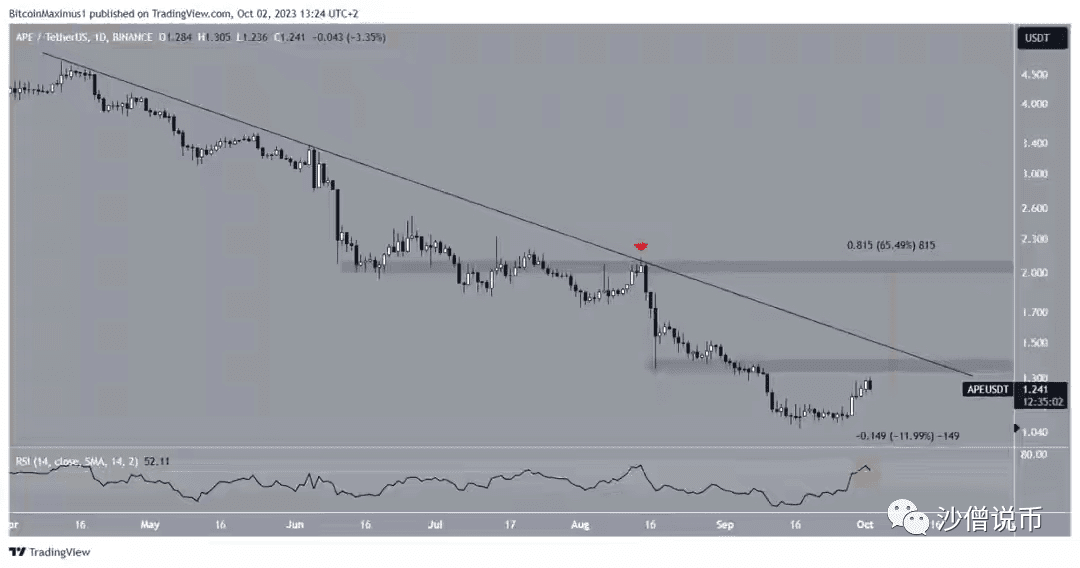
A breakout above the trendline could result in a 65% increase in price to the next resistance level at $2.
However, if the price fails to break out of the $1.40 resistance, it could drop by 12% and fall to the $1.05 horizontal support area.
In summary, the fact that ApeCoin (Ape) almost fell below $1 has aroused market concern. Investors need to be cautious about this situation and pay close attention to market dynamics to make appropriate investment decisions.
Chiliz (CHZ) Struggles with Long-Term Resistance
The cryptocurrency Chiliz (CHZ) has been experiencing a period of long-term resistance in the market recently. Chiliz is a cryptocurrency project focused on the sports industry that aims to provide sports fans with a better interactive experience through blockchain technology. However, since the launch of the project, it has been facing resistance from the market.
Long-term resistance refers to an obstacle that prevents the price of an asset from rising above a critical level over a period of time. In the case of Chiliz (CHZ), the project’s price has been fluctuating within a certain range and has not been able to break through the long-term resistance line.
So why has Chiliz (CHZ) encountered long-term resistance? First, the market has always been divided on the view of cryptocurrencies. Although blockchain technology is considered to have revolutionary potential, there are still some challenges and uncertainties in its actual application. This has made some investors reserved about the future development of cryptocurrencies, thus creating certain resistance.
Secondly, Chiliz (CHZ) has also encountered some challenges in the highly competitive market. Although the project focuses on the sports industry, there are also other competitors that provide similar solutions. This has led to relatively low market demand and recognition for Chiliz (CHZ), which has also become one of the reasons for long-term resistance.
However, despite these challenges, Chiliz (CHZ) is still working hard to overcome long-term resistance and seek breakthroughs. The project team continues to improve and perfect the product, enhance the user experience, and establish strategic partnerships with partners in the sports industry. These efforts are expected to bring new growth opportunities to Chiliz (CHZ).
Similar to Ape, CHZ price has been falling below a descending resistance trendline since the beginning of the year.
On September 11, the decline reached a low of $0.055, after which the price rebounded and increased.
Chiliz has now almost reached the major horizontal resistance at $0.065.
This area has intermittently acted as support and resistance since June.
Therefore, price clearing is crucial for the trend to be considered bullish.
The daily RSI supports the possibility of a breakout as it has risen above 50 (green illustration) and is rising.
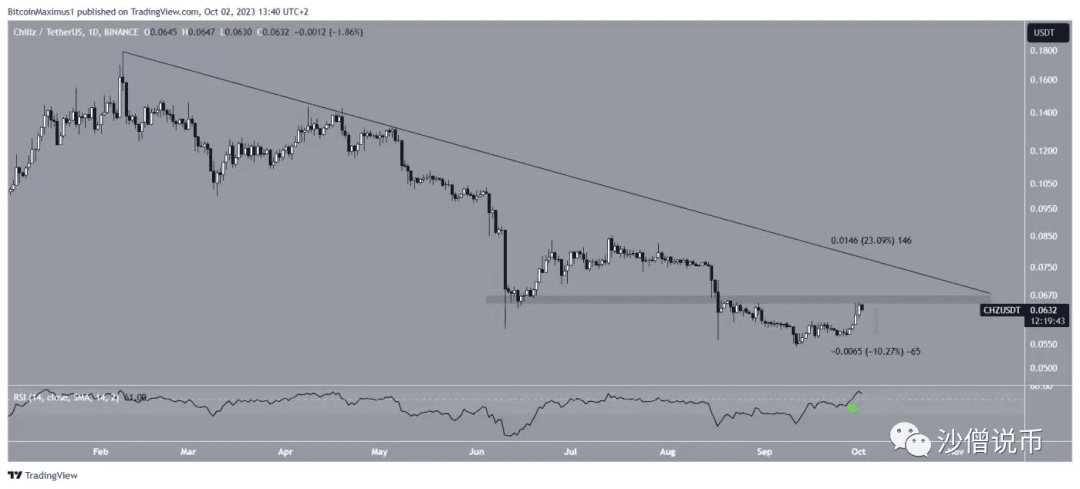
Although the RSI is bullish, the proximity to the long-term downtrend line narrows the potential upside.
A breakout above the $0.065 area might only result in a 23% gain to the descending resistance trendline at $0.077.
On the other hand, a rejection of the $0.065 area could result in a 10% drop in price to the nearest support at $0.057.
Overall, it is not uncommon for Chiliz (CHZ) to struggle with long-term resistance. In the cryptocurrency market, many projects will encounter similar challenges. However, the key lies in the efforts and innovation capabilities of the project team, as well as the market's recognition of the project. Only through continuous efforts and breakthroughs can Chiliz (CHZ) overcome resistance and achieve further development and growth.
EOS price ends 10 months of bearishness for crypto
EOS price experienced a downward trend in October. Like other cryptocurrencies, the overall bearish sentiment of the market towards cryptocurrencies is relatively obvious. EOS is a cryptocurrency based on blockchain technology, and its price is affected by market supply and demand as well as investor sentiment. In October, EOS price was affected by multiple factors, including the global economic situation and regulatory policies.
First of all, the global economic situation has had a certain impact on the price of EOS. Factors such as the slowdown in global economic growth and the intensification of geopolitical tensions have caused certain uncertainties in the cryptocurrency market, and investors' preference for risky assets has decreased, thus exerting certain pressure on the prices of cryptocurrencies such as EOS.
Secondly, regulatory policies have also had a certain impact on the price of EOS. Different countries have different regulatory policies on cryptocurrencies. Some countries have adopted stricter regulatory measures on the cryptocurrency market, which may lead to a decline in investor confidence in cryptocurrencies such as EOS, thus affecting its price.
EOS price has been declining below the descending resistance line since June 2021.
Recently, it was rejected by this line in April 2023 and accelerated its decline.
The price then turned down from the $0.90 horizontal support area in June.
This breakout led to a drop to a low of $0.50 in August, just above the all-time low of $0.47.
Although the price has since rebounded, it is still below the descending resistance line.
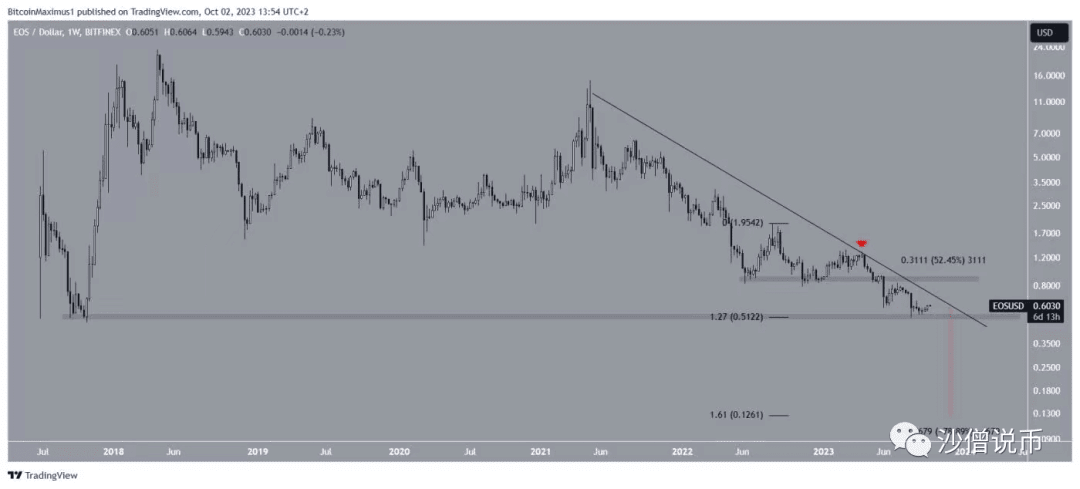
If the EOS price breaks down from the $0.50 area, it could drop by 80% and reach the next Fibonacci support level at $0.12.
However, if the price breaks out, a 50% surge to the $0.90 area is possible.
In summary, the price of EOS experienced a downward trend in October, which is closely related to factors such as the global economic situation and regulatory policies. Investors should be cautious when participating in the cryptocurrency market, pay attention to market dynamics, consider investment from a long-term perspective, and avoid blindly following the trend.