


Main topics of the post:
Trading analytics, especially in the volatile cryptocurrency market, empowers traders with data-driven insights for informed decision-making.
Binance offers a variety of analysis tools, including technical and fundamental analysis information sources, historical price analysis, real-time market data, and technical indicator charts.
Developing your analysis skills takes time and practice.
The power of analysis in trading is undeniable. Data-driven insights and patterns help traders make more informed decisions. In the volatile world of cryptocurrencies, this is a must. You can gain a deeper understanding of market trends, price movements, and trading volumes through careful use of analysis tools. Fortunately, for Binance users there is a wealth of information available to examine and use on our platform.
From real-time price charts to adjustable technical indicators, it's easy to get up to speed quickly. Consider this article as your guide to navigating our analysis resources and begin your crypto trading journey with more confidence and accuracy.
What is cryptocurrency analysis?
Let's start by defining what exactly we mean by analysis and how traders make use of it. Basically, analysis involves examining data to discover patterns, trends, and important information. There is a large amount of data generated by blockchain networks and market activities that we can use. Analysis involves studying this data.
There are two main methodologies used:
Technical Analysis (TA): it involves studying price charts and making mathematical calculations based on the data collected. These calculations called technical indicators are typically displayed on the price chart.
Technical indicators can be simple such as Moving Average (MA) or more complex such as Bollinger Bands. The data available on Binance is best suited for technical analysis and that is what we will focus on in this guide. For a basic overview of Technical Analysis and a selection of indicators you can use, check out our guide5 essential indicators used in Technical Analysis the Binance Academy.Fundamental Analysis (FA): involves researching the underlying technologies, use cases, teams, partnerships and developments of a cryptocurrency or project. Fundamental Analysis is typically used to evaluate long-term potential and value rather than short-term price fluctuations. To learn more about this analysis, see our Guide to Fundamental Analysis for Cryptocurrencies on Binance Academy.
Using data sources for analysis and Binance tools
While Binance shouldn't be the only platform where you collect and analyze data, it certainly has a lot of features and information available for you to utilize.
Analysis of price history and real-time market data
By examining the Binance Spot market, you can easily observe historical price data for a wide variety of cryptocurrencies. This information can be used to examine past price trends and identify patterns or cycles.
With a data-driven approach, you can begin to understand how specific assets perform under different market conditions. Armed with this knowledge, you will be able to make more informed predictions about possible future price movements.
Along with historical data, you also have access to the exact price of cryptocurrencies according to some of the most liquid and high-volume markets in the industry. The cryptocurrency world operates 24/7 and market conditions can change quickly. On Binance, it's very simple to find up-to-date information on prices, trading volumes, and order book depth.
This real-time information allows you to see potential opportunities and respond promptly to market fluctuations. For example, a large number of sell orders around the same price on the order book may indicate a potential resistance point in an asset's price.
TradingView integration for technical analysis indicators
Binance offers a variety of technical analysis indicators such as Moving Average, Relative Strength Index (RSI), and Bollinger Bands through our integration with the TradingView charting platform. These indicators help users evaluate price trends, momentum, and potential reversals. By interpreting these indicators, traders can try to predict market movements and adjust their strategies as necessary.
You can check the “Trading View” option in the top right corner of the price table. On this chart we have a moving average indicator selected, displayed at the top of our candlestick chart.
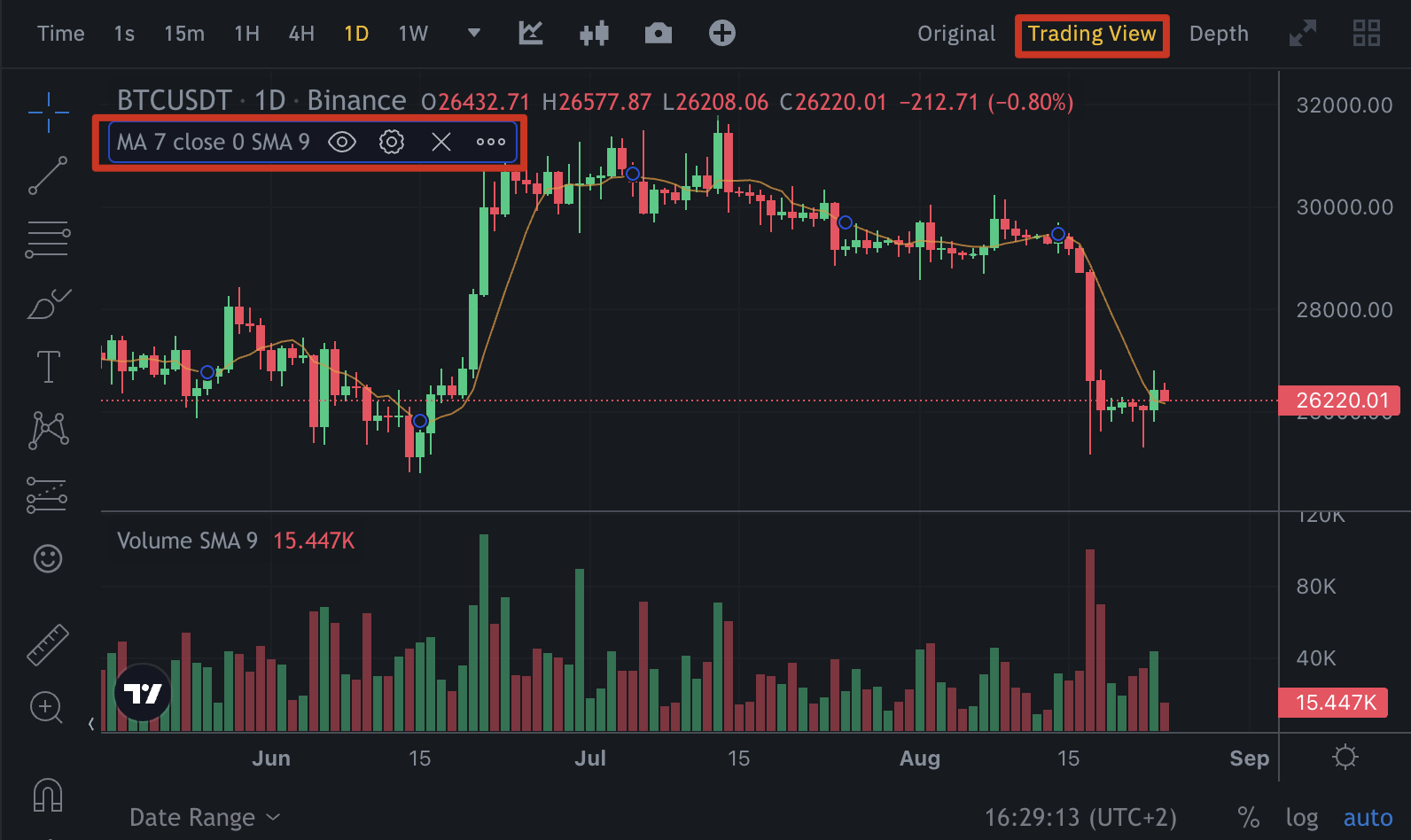
Our integration with TradingView is a powerful tool in the hands of users who want to explore analytics in detail. Be sure to read our TradingView Beginner's Guide for a more detailed tutorial on how the feature can be used.
Market sentiment analysis
Understanding market sentiment is a key aspect of successful trading. With the Binance Feed platform you can monitor the latest industry news, discussions, and trends to gauge current market sentiment. Binance users can obtain information about the market, whether it is rising or falling, and this information can be valuable in making trading decisions.
Customizable alerts and advanced orders
Traders often want to know when certain market prices are reached to consider in their analysis. Perhaps you are interested in a potential selling price or resistance point. Setting price alerts will help keep you informed about the market price without the need for constant monitoring.
You can even go further. According to your analysis and strategy, you can set up an order in advance. A Limit, Stop Limit or other type of order may be exactly what you need, it gives you greater control over how you enter or exit the market.
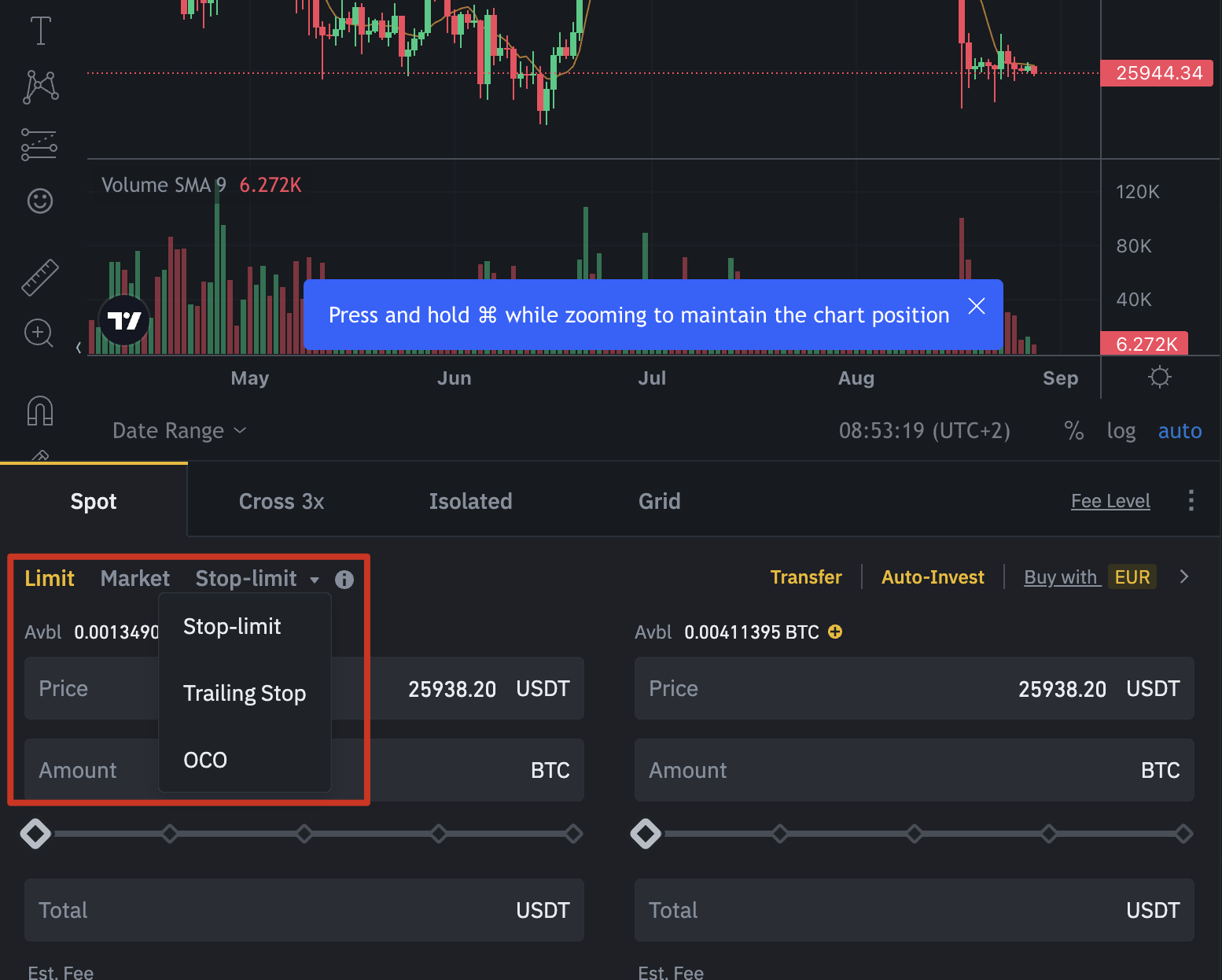
Let's look at an example. According to Binance Academy, Stop Limit orders “allow traders to set the minimum amount of profit they want to make or the maximum amount they are willing to risk on a trade. Once the activation price is reached, a Limit order will be sent automatically, even if the user is not logged in.”
Strategy backtesting
Binance tools allow users to backtest their trading strategies using historical data from certain markets and pairs. This means you can simulate your newly developed strategies through analytics to see how they would have performed in the past. Backtesting can help you improve your strategies, identify strengths and weaknesses, and optimize your approach for better real-time trading results.
For more information, see our guide on How to Set Up Custom Indicators and Backtest Your Strategy on Binance.
Education and information
Binance doesn't just provide tools, it also offers educational resources and information. Our users and the broader blockchain community can access articles, guides, and tutorials on the Binance Blog and Binance Academy. These features empower users with a deeper understanding of market dynamics, fundamentals, analysis and news.
Your basic analysis checklist and workflow
With some of Binance's analytics tools and features covered, let's look at a basic set of steps you can follow to work with analytics. Each trader will develop their own style and methodology, so our steps below are just a starting point!
Learn the basics
Understand blockchain: Familiarize yourself with the fundamental concepts of blockchain technology. This includes learning about decentralized ledgers, smart contracts, and the cryptographic principles that underpin cryptocurrencies.
Get to know different tokens: study the variety of cryptocurrencies available. Different tokens serve different purposes, from payments (e.g. Bitcoin) to utility tokens of a specific platform (e.g. Ether from Ethereum) and more.
Develop your trading strategy
Define your goals: Decide whether you are trading for short-term gains, long-term investments, or a combination of the two. Your strategy will guide your analytical approach.
Risk Assessment: Assess your risk tolerance. Blockchain markets can be highly volatile, so it is crucial to establish what level of risk you are comfortable with.
Gather market data
Select reliable data sources: Use trusted platforms like CoinMarketCap and Binance to obtain accurate market data, including prices, trading volumes, and market capitalizations.
Stay informed: Subscribe to trusted blockchain and cryptocurrency news sources. Market-moving news can significantly impact prices.
Perform technical analysis
Study Price Charts: Learn how to read and interpret candlestick charts. Understand chart patterns, trend lines and indicators such as Moving Average, Relative Strength Index (RSI) and Moving Average Convergence and Divergence (MACD).
Identify trends: Analyze historical price data to identify trends, such as upswings, downtrends, and sideways movements.
Perform fundamental analysis
Research projects: Investigate the fundamentals of the projects behind the cryptocurrencies you are interested in. Understand your use cases, development teams, partnerships, and technology advancements.
Evaluate usefulness: Determine the usefulness of a cryptocurrency in your ecosystem. Strong utility often means greater potential value.
Monitor market sentiment
Social media and forums: Monitor platforms like Twitter, Reddit, and Telegram to stay up to date with discussions and sentiments about specific cryptocurrencies.
Sentiment analysis tools: Explore sentiment analysis tools that automatically assess audience sentiment based on social media and news data.
Understand market dynamics
Market order books: learn how to read order books on broker platforms. They show current buy and sell orders, helping to assess supply and demand levels.
Liquidity: understand the concept of liquidity and its importance. Cryptocurrencies with greater liquidity tend to have smoother price movements.
Stay up to date on news and events
Important Events: Be aware of important events such as protocol updates, regulatory developments, partnerships, and security breaches that may impact pricing.
Regulatory environment: Stay informed about changing regulatory scenarios in various countries as regulations can affect market sentiment.
Practice risk management
Set Stop-Loss and Take-Profit: set the price at which you will automatically sell to minimize losses or guarantee gains.
Diversify: Spread your investments across multiple cryptocurrencies to reduce the impact of an asset's underperformance.
Remember that improving your analysis and trading skills takes time and practice. You can always start with small investments as you develop your skills and confidence. Be patient, stay informed and continuously improve your approach based on your experiences and changing market landscape.
Analytical skills require practice
The role of analytics in the world of cryptocurrencies cannot be underestimated. From predicting market trends to deciphering sentiment and minimizing risk, you'll find a wide variety of uses for analytics. If you really want to improve your skills as a trader, you will need to improve and work on these skills over time. Luckily for you, Binance is a great place to do just that.
Further reading
Information and analysis | Research on digital assets and blockchain
What are fundamental analysis and technical analysis?
7 common mistakes in Technical Analysis (TA)
Risk Notice and Disclaimer: This content is presented to you "as is" for general informational and educational purposes only, without representation or warranty of any kind. The content should not be construed as financial advice and is not intended to recommend the purchase of any specific product or service. Digital asset prices can be volatile. The value of your investment may go down as well as up and you may not get back the amount invested. You are solely responsible for your investment decisions and Binance is not responsible for any losses. This material should not be construed as financial advice. For more information, see our Terms of Use and Risk Notice.
The products and services mentioned herein may be restricted in certain jurisdictions or regions or to certain users, in accordance with applicable legal requirements and regulations. These materials are intended only for users who have permission to access and receive the products and services mentioned and are not intended for users for whom restrictions apply. You are responsible for informing yourself and observing any restrictions and/or requirements imposed with respect to access and use of any products and services offered or made available by Binance in each country or region that you access or on your behalf. Binance reserves the right to change, modify or impose additional restrictions with respect to access to and use of any products and/or services offered from time to time, at its sole discretion, at any time, without notice.