


Original title: Ripple vs SEC — a $200m showdown that’s been brewing for two decades
Original author: Tyler Pearson, DL News
Compiled by: Heilsman, ChainCatcher
Ripple’s battle with the SEC is far from over.
The crypto exchange and the SEC are preparing to fight it out in court in the second quarter of next year.
Earlier, Ripple CEO Brad Garlinghouse said the company has paid more than $200 million in legal fees to date.
When U.S. District Judge Analisa Torres ruled partially in favor of Ripple in July, some crypto experts hailed it as a “definitive” victory for the company.
XRP, the token used by Ripple to facilitate transactions on its network, surged in price following the verdict.
Still, the SEC, led by SEC Chairman Gary Gensler, has not let Ripple off the hook. Since the collapse of cryptocurrency exchange FTX last year, the SEC has launched a series of enforcement actions against the industry, including lawsuits against cryptocurrency exchanges Binance and Coinbase.
This week, a judge denied the SEC’s motion to appeal parts of the Ripple ruling. While this is a setback for the regulator, the case is still expected to go to trial in 2024, with other parts yet to be decided.
We’ve put together a timeline of the SEC and Ripple case to help understand what’s happening: how the case got to this point and what might happen next.
year 2004
Ripple’s origins date back to 2004, when Canadian programmer Ryan Fugger released RipplePay, a peer-to-peer payment program that predated blockchain technology by several years. It relied on some form of digital IOU or credit rather than cryptocurrency.
year 2011
May: Things really began in 2011 when cryptographer David Schwartz, Mt. Gox founder Jed McCaleb, and video game designer and chief strategist Arthur Britto became interested in Bitcoin. Together, they sought to develop a more efficient system that did not require proof-of-work mining.
In 2011, McCaleb published a post on the Bitcointalk forum criticizing the energy consumption of Bitcoin mining.
2012
June: Schwartz, McCaleb, and Britto purchase the rights to Fugger's RipplePay name and brand. They rename the entity Ripple Labs. The team launches the XRP Ledger.
August: Angel investor Chris Larsen joins Ripple and eventually becomes Ripple's COO.
Ripple Labs developed Ripple’s blockchain infrastructure, resulting in the payment network RippleNet.
year 2013
April: Ripple receives $3.5 million in funding from multiple investors, but does not disclose the total amount at the time.
July: McCaleb leaves Ripple to start a new project.
Year 2014
February 18: MIT Technology Review includes Ripple Labs in its list of 50 smartest companies, with Ripple ranking 50th.
June: McCaleb founded Ripple competitor Stellar. He previously received 9 billion XRP, worth about $126 million at the time, for his early work as a founder and developer. In 2021, it was revealed that McCaleb sold his holdings for more than $2 billion as the price of XRP rose.
September: Ripple announces partnerships with CBW Bank and Cross River Bank. The company says they are the first U.S. banks to adopt Ripple’s open-source distributed transaction infrastructure.
2015
April: Ripple hires former Yahoo COO Brad Garlinghouse for a position at the payments network. Garlinghouse begins marketing the XRP token for banks and institutions to use as a bridge currency and SWIFT alternative.
May: FinCEN fines Ripple Labs $700,000 in the U.S.’s “first civil enforcement action against a virtual currency dealer,” according to the regulator. The agency accuses Ripple of “willful violations” of multiple regulations, including unregistered sales of digital currencies and failure to implement anti-money laundering practices. Ripple is required to pay $450,000 immediately to cover part of the fine and must pay the remainder within 30 days.
October: Ripple Labs rebrands itself to Ripple.
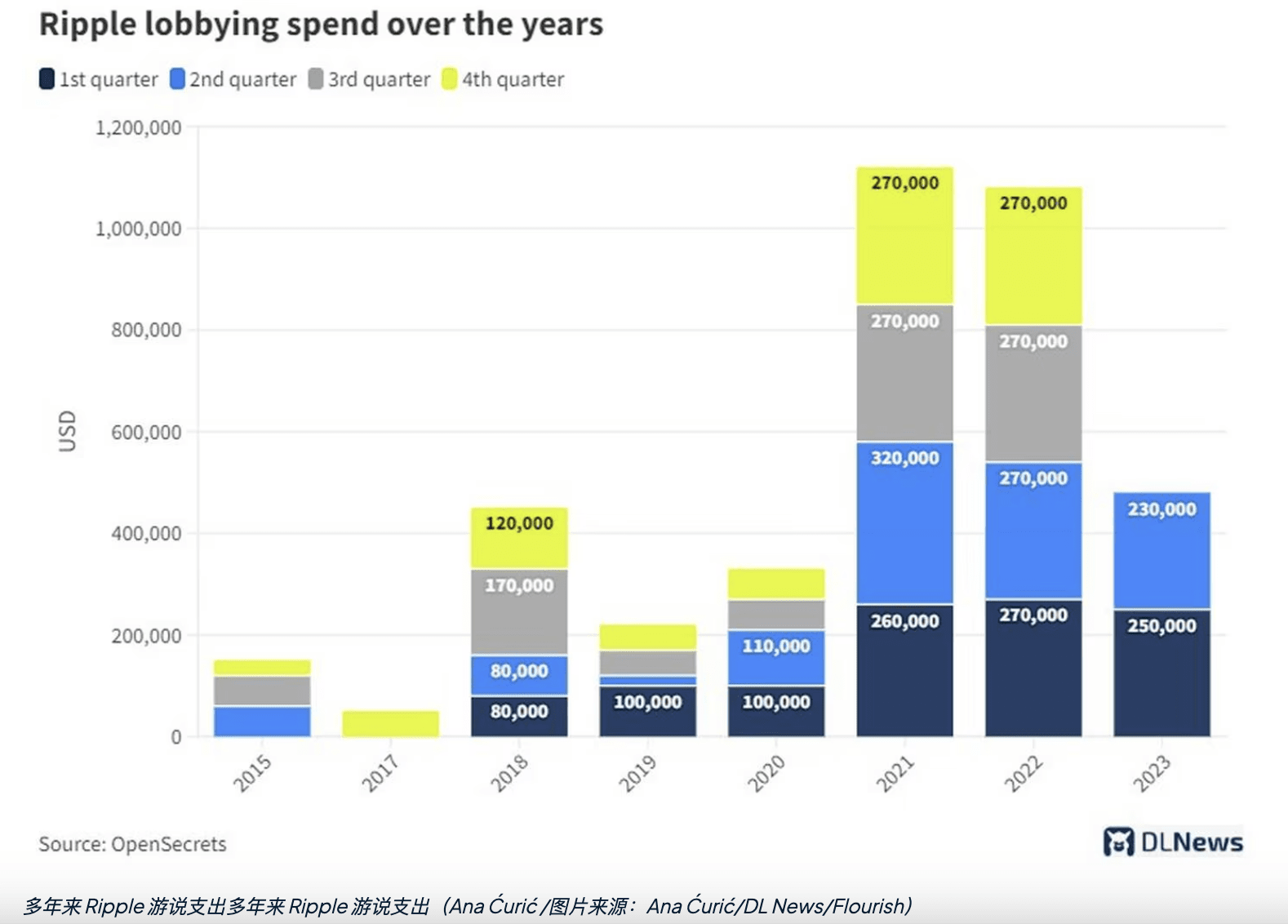
According to OpenSecrets, an organization that tracks U.S. lobbying, Ripple spent a total of $150,000 on U.S. lobbying in 2015.
2016
June: Ripple receives a virtual currency license from the New York State Department of Financial Services. It applies under the company name XRP II LLC.
September: Ripple raises $55 million in Series B funding from backers including Standard Chartered Bank and CME Group.
2017
September: Blockchain startup R3 sues Ripple Labs over a contract dispute that allowed it to buy XRP at a significant discount until 2019. Ripple’s CEO attempted to terminate the contract, which prompted R3 to sue Ripple. R3 has since provided solutions for multiple central bank digital currency projects.
December: XRP price surpassed $1 from $0.0063 on January 1, a 15,873% increase.
According to OpenSecrets, Ripple spent $50,000 on lobbying in 2017.
2018
January: Ripple says it has provided its xCurrent product to more than 100 financial institutions. XRP briefly replaces Ethereum as the second-largest cryptocurrency by market value after Bitcoin.
September: Ripple and R3 settle their dispute behind closed doors. They remain secretive about the outcome, though leaked documents in 2020 suggest the settlement is worth more than $240 million.
According to OpenSecrets, Ripple spent $450,000 on lobbying in 2018.
2019
June 17: Ripple announces a partnership with MoneyGram, one of the largest international remittance companies, to use Ripple’s xRapid product. The partnership ends in 2021.
December 16: XRP fell to $0.183 from its all-time high of $3.32 in January 2018. It plummeted as much of the cryptocurrency market suffered from a bear market.
According to OpenSecrets, Ripple spent $220,000 on lobbying in 2019.
2020
September 24: The XRP Ledger (or XRPL) Foundation is established as an independent non-profit entity to drive adoption of XRP. The foundation raises $6.5 million to create the XRP Community Fund and strengthen infrastructure.
December 21: The SEC sues Ripple Labs as well as Garlinghouse and Larsen. The agency claims that Ripple conducted an unregistered securities offering. Garlinghouse denies the SEC’s allegations and commits the company to legal action. Following the news, XRP drops from $0.58 to $0.21.
December 22: Judge Analisa Torres is assigned to the Ripple case.
December 28: Cryptocurrency exchange Coinbase delists XRP token, with Coinbase Chief Legal Officer Paul Grewal citing recent litigation as the main reason.
According to OpenSecrets, Ripple spent $330,000 on lobbying throughout 2020.
2021
March 3: Garlinghouse and Larsen challenge the SEC’s approach, arguing that the agency did not give them fair notice that Ripple’s XRP token was classified as a security. In their letter to the court, they say the SEC has failed to provide clear guidance to cryptocurrency companies — an argument that will be echoed in some form by numerous cryptocurrency executives in the coming years.
March 8: The SEC requests a hearing with Judge Sarah Netburn to address Ripple executives’ fair notice claims and other issues.
March 22: Judge Netburn ruled that XRP has value and utility, which distinguishes it from cryptocurrencies like Bitcoin. The ruling is significant because it highlights the legal differences between cryptocurrencies and paves the way for future classification and enforcement actions.
April 13: SEC Commissioner Hester Peirce proposes Safe Harbor 2.0, which would grant cryptocurrency companies a three-year grace period “under certain conditions” during which they would be “exempt from the registration provisions of the federal securities laws in order to facilitate participation and development of functional or decentralized networks.” She also said that the appointment of Gensler as the new SEC chair marks “an opportune time for the Commission to reconsider how to modify our rules to responsibly accommodate this new technology.”
June 14: The court extends the SEC’s deadline to August 31. The court had previously required the agency to disclose its internal policies on cryptocurrency trading, conflicts of interest, and securities classification.
August 27: Ripple’s lawyers filed a motion asking the SEC to disclose its policies regarding cryptocurrency transactions between agency employees. The application was rejected by the court in September.
Oct. 15: Expert discovery deadline set to gather input from a diverse group of people in the cryptocurrency and traditional finance sectors. The discovery phase is intended to flesh out opinions on the case.
According to OpenSecrets, Ripple spent $1.12 million on lobbying in 2021.
2022
September 17: The court approved a request by the Chamber of Digital Commerce, a U.S. cryptocurrency advocacy group, to file an amicus curiae brief. Amicus curiae means “friend of the court” and refers to a person or organization that is not a party to a case. An amicus curiae brief is a written submission to the court in which someone makes legal arguments and recommendations regarding a particular case. In the brief, the Chamber of Digital Commerce did not take a position on the SEC’s assertion that XRP is an unregistered security, but highlighted what the group said was a lack of regulatory clarity in digital asset law.
October 31: Coinbase files a friend of the court brief petition in federal court on behalf of Ripple Labs. In the brief, Coinbase raises the question of whether the SEC gave fair notice before taking enforcement action against Ripple. A few months later, in 2023, Coinbase will face an enforcement action from the SEC.
December 2: The SEC and Ripple Labs released statements of support to the public following the November 30 deadline. The documents provide new insights into each party’s arguments and legal claims. Both parties urged the appointed judge, Torres, to rule in their favor and not send the case to trial.
December 22: The SEC asks the court to block the release of the “Hinman documents,” which Ripple Labs argues are relevant to the case due to their sensitivity. The documents contain a draft of a 2018 speech by former SEC Director William Hinman, in which he said Ethereum’s ether token is not a security.
According to OpenSecrets, Ripple spent $1.08 million on lobbying in 2022.
2023
May 8: CEO Garlinghouse says Ripple has spent $200 million defending the SEC case.
June 6: The SEC sues Coinbase for illegally operating an exchange and facilitating unregistered securities transactions.
June 12: The Hinman documents are released. While the documents reveal previous statements by Hinman, their impact is fairly muted upon release.
According to OpenSecrets, Ripple spent $480,000 on lobbying in the first half of 2023.
July 13: A split decision was reached in the SEC v. Ripple Labs case. Torres ruled that Ripple did not break the law by selling XRP publicly to exchanges, but that it was illegal to offer XRP to institutions. It was decided that the case would go to a jury trial. Coinbase and other exchanges relisted XRP after the ruling.
July 21: The SEC hints it may appeal after a judge in the Terraform Labs case questions Torres’ ruling.
July 24: Ripple’s UK and European boss Sendi Young tells DL News that the partial victory over the SEC lays the foundation for further international expansion.
August 7: A former SEC litigator tells DL News that just because Judge Terra rejected Torres’ ruling, it’s game over for Ripple. “Just as this court has clearly rejected the XRP ruling, another court could just as easily have clearly rejected it,” said Teresa Goody Guillén, a partner at BakerHostetler and a former SEC litigator.
August 9: On the same day that Judge Torres sets a tentative timetable for a jury trial in the second quarter of 2024, the SEC announces it is seeking to appeal part of her July decision.
August 17: DL News revealed that Ripple is one of the cryptocurrency companies that spent the most money on lobbying in the United States in 2023. The list includes Binance, Coinbase, and Crypto.com.
August 28: Ripple announces on X (formerly Twitter) that it will host a "community celebration" in New York in September. "As promised — time for a real victory party," Garlinghouse tweeted.
September 6: DL News published a report that Ripple paid lobbyists to try to influence laws to make the Commodity and Futures Trading Commission the de facto cryptocurrency regulator in the United States. Many in the crypto community consider the CFTC to be a friendlier, softer regulator than the SEC. Former FTX CEO SBF lobbied the CFTC to regulate cryptocurrencies before his exchange collapsed.
October 3: Torres denies the SEC’s motion for leave to appeal.