


Written by: Jasmine, Cat Brother
The current crypto market is experiencing a downturn. This bear market has brought many challenges to many entrepreneurs, such as tight funding, reduced user activity, and the loss of core talents. Nevertheless, such a market environment also provides rare opportunities for visionary entrepreneurs. As the industry says: "Funding in a bull market, construction in a bear market." In this context, many entrepreneurs have decided to dig deep and look forward to reaping rich rewards when the market picks up.
Web3 accelerators have become a tool to help entrepreneurs cope with challenges and continue to build in a bear market. This article will explore the rise of Web3 accelerators, the comparison and characteristics of current high-quality accelerators, and how entrepreneurs can choose an accelerator that suits them. In particular, we will focus on analyzing the recently highly anticipated SpringX accelerator and reveal its strategy and value to you.
Bear Market: The Golden Age of BUIDL and the Active Field of Accelerators
The bear market is not only a critical period for project construction, but also an active stage for accelerators. There are several advantages to accelerating projects in a bear market:
Long-term investment: The bear market cleans and screens out projects with long-term sustainable competitive advantages, and entrepreneurs can focus more on these Web3 projects with long-term growth potential.
Lower valuations: With bear market sentiment low, some Web3 projects may be undervalued, allowing investors to enter at more favorable terms and expect to receive strong returns when the market recovers.
Reduced competition: In a bear market, many investors and competitors may be cautious or exit the market, resulting in relatively less competition for projects, making it easier for entrepreneurs to find projects of interest and negotiate favorable investment terms.
At the same time, the bear market is also considered a critical period to test the true value of the project and the team's commitment. For determined Web3 entrepreneurs, this has both advantages and disadvantages, with opportunities and challenges coexisting. For example, GameFi's leading project Axie infinity and NFT exchange's leading project Opensea are well-known projects that have survived the last round of bear market. They have received widespread attention in the bull market of 2021, achieved tenfold and hundredfold growth, and made great achievements.
While the bear market provides entrepreneurs with a range of opportunities, it also brings some risks that cannot be ignored:
Shortage of funds: The total amount of investment and financing decreases in the bear market, and entrepreneurs face the challenge of tight funds. According to Wu VC Monthly Report, the investment and financing situation of various tracks in the crypto market in the past three months, the average monthly investment and financing total is about US$550 million, a year-on-year decrease of 65% from US$1.6 billion in the same period of 2022.
Lower user activity: User activity declined during the bear market, and the user appeal of the project weakened. Taking Ethereum GAS as an example, the current median gas fee is 15.960 GWEI, which continues to hit a low point in nearly 8 months.
Talent loss: Some developers and employees may choose to leave due to project funding issues or market pessimism, resulting in a slowdown in development.
For Web3 entrepreneurs, solving these problems is crucial, especially in the trough of the market. At this time, Web3 accelerators can be a powerful tool to help entrepreneurs overcome these challenges. The following will discuss the emergence of Web3 accelerators, the comparison between the current high-quality accelerators, and how entrepreneurs can choose the accelerator that suits them.
What is the difference between Web3 accelerator and Web2 accelerator?
Startups are the key to driving innovation, and accelerators provide a fertile ground for these companies to grow. In the Web2 era, we have witnessed many successful accelerators, such as Y Combinator, which has nurtured industry giants such as Dropbox, Reddit, and Airbnb. In China, accelerators such as Qiji Chuangtan and Sequoia China YUE have also become an important part of the entrepreneurial ecosystem, supporting many startups.
However, with the rise of Web3, we are also seeing a new entrepreneurial ecosystem with its own characteristics and needs. Technological progress and the rise of the digital economy have reduced the cost of entrepreneurship, but have also brought about the problems of fierce competition and younger and less experienced entrepreneurs.
Why Web3 accelerators are rising:
Common challenges: Whether it is infrastructure, GameFi, NFT or SocialFi, Web3 projects face similar problems, such as community building and token issuance. The industry is still in its early stages, and everyone faces similar challenges and opportunities, and has common problems to solve.
Young entrepreneurs: Web3 entrepreneurs are often young and energetic, but they may lack the necessary entrepreneurial experience. Accelerators provide them with a platform for learning and cooperation.
Strengthen cooperation: Unlike Web2, Web3 projects are more likely to cooperate in areas such as products and market operations to promote interoperability and achieve win-win results.
The Web3 market has great potential and is developing rapidly, but it also brings chaos and disorder. Therefore, accelerators will play a valuable role in it, gathering resources to screen good projects and help them grow.
A16Z’s views also reflect this trend:
Since the first Crypto Startup School in 2020, the industry has rapidly evolved at a pace that is even faster than technical standards, yet the tools needed to build a lasting web3 product remain poorly defined and unevenly distributed. This is especially true for new founders entering the space from other sectors, who are attracted to web3's promise of a more open internet but are unsure how to navigate this landscape. Over the years, we've seen accelerator programs successfully provide this launch pad in other areas of technology. However, there is no program tailored to the specific needs of web3 founders, who require a novel set of tools and resources to scale.
How to choose a suitable Web3 accelerator?
Choosing the right accelerator is more than just finding a platform that provides funding. The real value lies in the depth of support and professional curriculum. Here are some key factors:
In-depth knowledge and practical experience: A good accelerator should provide in-depth knowledge about project development, such as product innovation, token model design, and other key areas such as brand building, internationalization strategy, and community building.
Support at the thinking level: In addition to technology and strategy, entrepreneurs also need guidance in strategic decision-making, team management and financing strategies.
Ongoing mentor network support: A strong mentor network can provide ongoing support to entrepreneurs, not just during the acceleration period.
Currently, there are many high-quality Web3 accelerators around the world, such as Seedclub, LongHash, and A16Z. Entrepreneurs should consider the accelerator's brand, resources provided, cost, and historical record and the quality of concurrent projects when choosing.
A comparative analysis of some high-quality Web3 accelerators is shown below. It can be seen that the reference valuation given to projects by most accelerators is around 5 million US dollars. The entry of some accelerators represents investment. The acceleration benefits mainly include courses, demodays, 1v1 mentorship, resource docking, talent recruitment, ecological support, etc. Some will provide differentiated help such as economic model design.
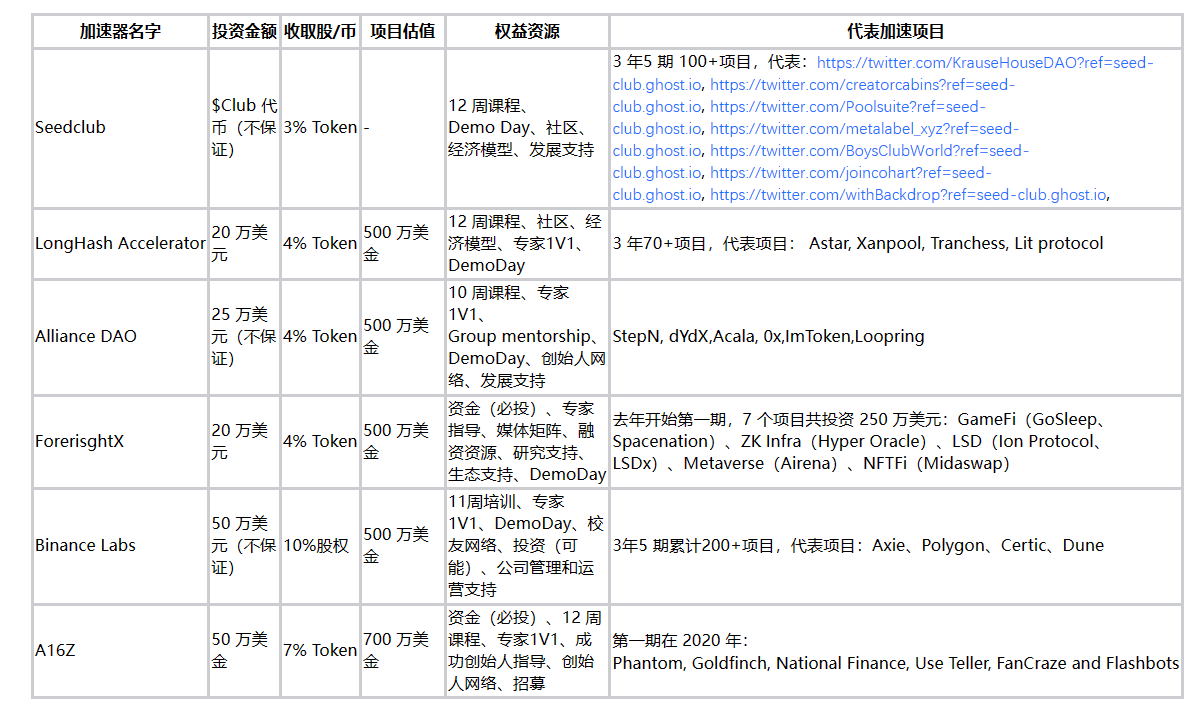
Reference:
https://www.seedclub.xyz/https://www.seedclub.xyz/
https://longhash.vc/accelerator/
https://alliance.xyz/
https://www.foresightx.net/
https://labs.binance.com/
https://az.swoogo.com/a16zcryptostartupschool
How is SpringX different?
Recently, the accelerator SpringX has caused quite a stir in the market. Compared with the above accelerators which are mainly led by institutions, the concept of "founders helps founders" is somewhat different. The following will analyze this.
Spring Xcelerator (SpringX for short) was jointly initiated by 14 project founders and 3 investment institutions, aiming to provide Web3 entrepreneurs with $20 million in start-up funds, systematic courses and strong resource support. It covers all major tracks of Web3, with business in North America and Asia-Pacific, covering all stages from angel round to token issuance. According to official information and the initiator's public channel statement, we believe that there are several unique aspects that deserve the attention of Web3 founders.
Unique point 1: The accelerator is initiated by founders, reflecting SpringX’s slogan: By founders, for founders
The sponsors include 14 leading projects and 3 first-tier funds. While ensuring sufficient financial support, they also focus on project founders with first-hand experience. Unlike many other accelerators, the "mentors" here do not leave after the class. In the publicity, they mentioned sufficient offline time together. It can be foreseen that they hope to establish a deep relationship between projects.
This industry is very new and developing rapidly. Although there are many excellent developers and founders with strong technical capabilities, they lack awareness and true understanding of the industry's gameplay, or the project is technically excellent but lacks the ability to bring the project to the market. In the later stages of development, there will be a series of compliance, listing, liquidity and other issues. This information is difficult to obtain in public channels. Probably only founders who have really practiced it know the details. SpringX's course design provides these special supports. Interestingly, the course also mentions "Business English", which is indeed a pain point for many Chinese founders. It can also be seen that the initiator is indeed thinking about the actual pain points and real needs from his own perspective.
Unique point 2: Deep binding of concurrent projects
It is worth noting that there are relatively few high-quality projects in the Web3 field. According to rough statistics from previous data, there are no more than 10 Chinese projects with great future development potential (supported by top institutional investments, etc.) that emerge every six months on average. SpringX only has 10 projects per period. A small number of projects is more conducive to resource concentration, and small classes and offline courses are adopted, which helps the founders to establish deep friendships and provide a platform for mutual support for future development. In addition, the projects have formed a relationship of mutual holding of token pools, which promotes strong cooperation and interest connection.
Unique point 3: Focus on international development
According to the list of sponsors, we found that some of them focus on the North American market, some projects have narratives that conform to "orthodoxy", and some originate from the inland and Asia-Pacific regions, covering multiple fields and industries. The project will carry out activities in many key cities around the world, aiming to help the project access local resources. The overall layout of these projects almost covers the markets in key regions of the world, and BuidlerDAO is also establishing global nodes, which shows that it is really actively preparing for internationalization and playing a big game. On Twitter, we can see that English promotion is even more frequent than Chinese promotion. In contrast, the momentum of many Chinese accelerators rarely spreads overseas.
Unique point 4: Possible future forms of DAO accelerators
Well-known overseas DAO-type accelerators such as AllianceDAO and SeedClub have incubated many well-known projects. According to the previous financing PR of BuidlerDAO and the public information of the founder, BuidlerDAO's vision is to establish an open network of talents and projects. Although it has only been established for a year, BuidlerDAO has maintained a stable and rising level of activity regardless of the market, and has attracted a large number of talents in its community, which is relatively comprehensive, including developers, researchers and market operators. The community research content is original, neutral and hardcore, and it has organized many developer activities and appeared at many industry conferences. The third proposal of the community clearly lists university associations and developer communities such as Tsinghua Blockchain Association, Yale Venture Capital, Denglian Community, and Rebase as node guardians. It seems that BuidlerDAO is actively and continuously absorbing high-quality talents, organizations and projects to become a community owned by all "Buidlers". The promotional article also mentioned that DAO tokens will be allocated to the projects entering the camp. This move is expected to improve the problems of information closure and community disunity in the Chinese community. BuidlerDAO is expected to achieve the smooth flow of capital, talent and information, improve the current situation, and thus build an infrastructure conducive to the development of talent and projects.
It is worth mentioning that the initiator has the ability to provide multiple services such as API services and security audits. For example, the founder of Galxe clearly stated on Twitter that he would "allocated some perks from @Galxe for participants."
According to public information, BuidlerDAO is the first project of Sequoia Accelerator YUE and the only Web3 project in YUE Phase III Accelerator Camp so far. From the content production, promotion rhythm, delivery quality and some design ideas, it can be seen that it has inherited many characteristics of YUE and demonstrated its sincere desire to provide truly valuable support to entrepreneurs and promote the prosperity of the Chinese entrepreneurial ecosystem in the Web3 field.
As mentioned at the beginning, the similarities and interactivity between Web3 projects are expected to make Web3 accelerators more different from traditional accelerators, and build stronger project networks and alumni networks. In Silicon Valley, YC has established a strong alumni system. Can the Chinese entrepreneurial ecosystem in Web3 break out of such an accelerator to promote collaboration and win-win between Chinese projects and go global together? We will wait and see.