

Market advance
The previous prediction of a rebound in October started on September 12 (there was also a false move on September 11).
From September 12 to October 2, BTC reached %28000, which actually means it has rebounded for 20 days!
Calculated in October, it was 18 days earlier than expected. Even after the dot plot was released (September 21), it was still 9 days earlier than expected.
The reason is simple. The dealer said, "Leeks, I predicted your prediction!" On the other hand, both the June and September dot plots show that Federal Reserve officials are more likely to support another rate hike in 2023. However, CME's interest rate futures show that the market still has an 81.4% probability that there will be no rate hike in November and a 64.3% probability that there will be no rate hike in December.
Therefore, the rebound in October may also end early. After all, the November interest rate meeting comes early - November 2, and there is a certain probability that it may also start to fall early.
Will interest rates rise?
Fed officials predict: Both the June and September dot plots show that Fed officials are more likely to support another rate hike in 2023. The most recent dot plot shows that the probability of another rate hike in 2023 is 63.16%.
Market expectations: CME's interest rate futures show that the market still has an 81.4% probability that there will be no interest rate hike in November, and a 64.3% probability that there will be no interest rate hike in December.
Focus on time
Next, we need to pay attention to two time points (although the data is just so-so, the market will pay attention to):
October 6th 20:30 US non-farm data
October 12, 20:30 US CPI data
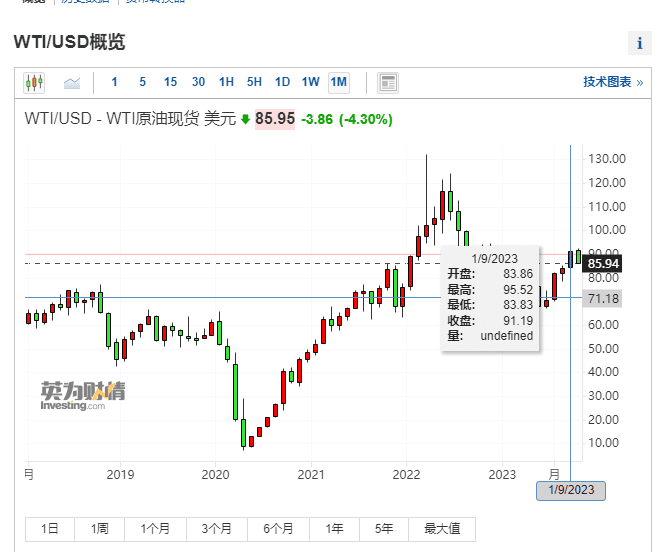
Because the WIT crude oil spot price rose by 8.74% in September, the CPI is likely to perform poorly. The interest rate hike is likely to be over, so the market may be more sensitive to non-agricultural data. After all, non-agricultural data is not only related to CPI, but also can reveal the economic recession.
Current market outlook:
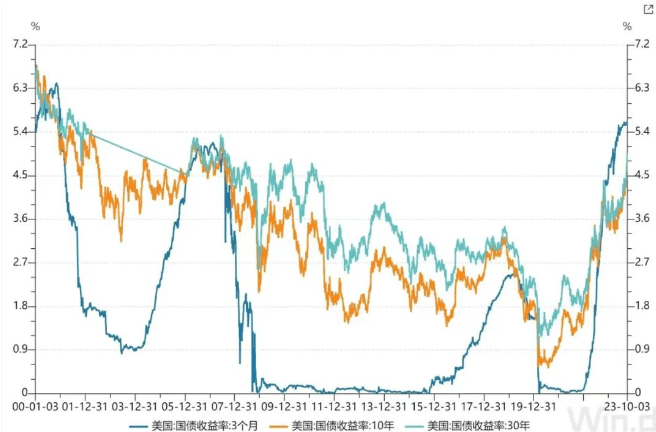
The market is still falling today, mainly dragged down by two pieces of news. First, the Speaker of the U.S. House of Representatives was impeached and removed from office for the first time in history (it should be noted that the Speaker of the House of Representatives is the leader of the majority party in the House of Representatives. The fact that he was impeached and removed from office shows that his party has split), which has exacerbated the market's concerns about the downtime of the U.S. market (because there will be a leadership vacuum). In addition, combined with the positive U.S. employment data, the Federal Reserve is more confident in fighting inflation, and U.S. Treasury yields continue to rise. Corresponding equity assets: such as the stock market and the crypto market have fallen.
The second piece of news is that the Federal Reserve is making trouble again. This time, an official said that if inflation fails to reach the expected level, it is likely that the Federal Reserve will continue to support raising interest rates at the next meeting.
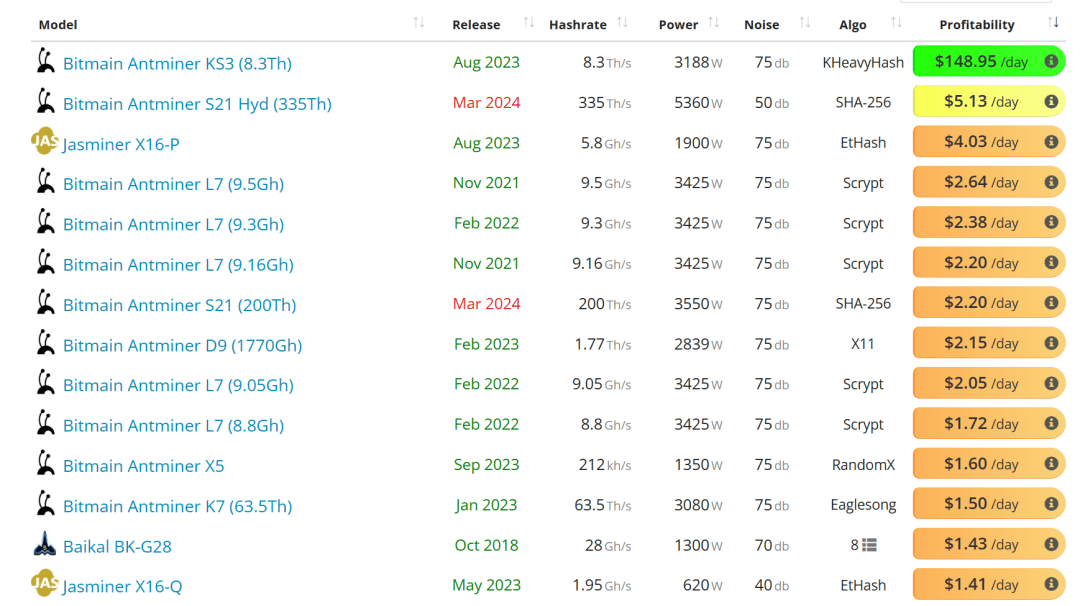
At present, mining machines are generally profitable, and many people dream of starting a bull market from now on. This is unrealistic. The mining machine owners must reach a loss again before they can start a bull market. In addition, we have to say that Bitmain is really powerful. The most powerful mining machine can make a profit of more than 100 US dollars a day, which is really a money printing machine.
Speculations about the next bull market:
At present, Bitcoin accounts for 48% of the total market value, and ETH accounts for 18% of the total market value, with a gap of 2.6 times. Without considering the token issuance factor, ETH is very likely to compete with Bitcoin for the new leader in this round. Then it will be a great boost to ETH-related concepts. The first benefit is of course ETH itself, and secondly, L1 competitors SOL, DOT, etc., such as L2 concept OP ARB and ZK series to be issued in the future, such as ETH staking series LDO, etc. are all great boosts. This bull market is expected to see this scene.
In the second half of a bear market, you only buy and don't sell. In the second half of a bull market, you only sell and don't buy?
In the second half of the bear market, you can only buy and not sell, but buying is not unlimited, there is also a safety margin upper limit.
The time and space advantages of entering the market last year and this year are different, so you should also set different safety margin limits.
Similarly, in the second half of the bull market, only selling and no buying
So what is the lower limit of the selling price? I think the lowest price should be set above the previous high of 69,000. Of course, I am talking about the big cake here. That is to say, when the big cake breaks through the previous high, you should consciously think about how to gradually sell it.

Of course, everyone has different preferences for the left and right sides, so we won't go into detail here. We'll continue the disassembly tomorrow or the day after tomorrow.
Strictly adhere to the position configuration
In this part, we talked about that only by knowing the core demand drivers of different targets in this market can we better guide our asset allocation.
For example: Is the rising logic behind Da Bing and Yi Tai the same?
If not, what is the difference?
The rising logic of these two assets is fundamentally different.
The driving force behind the rise of Bitcoin: hiding money, extreme decentralization (invincibility), true private property, demand for fund transfer, etc.
The logic behind the rise of Yitai: the emergence of continuous popular tracks and popular applications, which will carry more funds.
You see, these are obviously two different logics of rising.
The logic behind BTC's rise is more due to outside funds;
The logic behind ETH's rise is more due to funds within the circle.
When the flood came, ETH was the first to see an influx of funds, and of course its increase exceeded that of BTC. But when the flood receded, the opposite happened to ETH.
This is just an example to illustrate that the demand driving forces behind the two are different. It is actually the same when we invest in other small coins and other altcoins. You need to know what their core driving forces are.
If you don’t know what the core driving force is, it is better to just buy the first and second ones with the clearest driving force, which saves you both trouble and effort.
As for the core driving forces in the crypto market, we often screen and judge based on the most core qualitative and quantitative analysis of fundamentals.
Today’s article ends here. If you think it’s well written, you can click to follow and read~