


By Juliet Tang, Investment Analyst at Huobi Ventures
Each bull market has a different starting engine, and behind each bull market engine is a long bear market development process. Crazy MEME, DeFi summer... With the development of Web3 technology and infrastructure, the social track has also ushered in new development opportunities.
Will the Web3 social track be the next bull market engine?
As a track that requires developers to give full play to their imagination at the application layer, social, identity, NFT, DAO, fans, etc. can all be classified into the category of Web3 social. The social track is still in its very early stages. With the launch of Cyber tokens, Twitter's name change and creator incentive plans, the market popularity of the social track has gradually increased.
Friend.Tech, a social application on the L2 chain BASE, has quickly become popular since its launch on August 10. In less than 20 days since its launch, it has over 120,000 registered addresses and over 20,000 active addresses.
Application tools such as CyberConnect and Lens Protocol have also attracted a large number of users and market attention.
This article discusses the current status of Web3 social development and the characteristics of track products. It also analyzes several leading projects in the track and studies the risks and challenges faced by the track. In general, the future of the Web3 social track is promising, and this sector has good investment potential and development prospects.
This research report is produced by Huobi Ventures, Huobi’s global investment arm that integrates investment, incubation and research to identify the best and most promising projects in the world.
Why focus on social?
The crypto track has always been regarded as an interdisciplinary science that integrates computer science, finance, cryptography, mathematics and other disciplines. However, due to its short appearance time, imperfect infrastructure, different regulatory standards, and certain learning thresholds and costs, it has not yet achieved widespread popularization and use worldwide. With the increasingly perfect construction of smart contract public chains represented by Ethereum, the development of on-chain Dapps has also ushered in an explosion since 2020. As shown in the figure below, the current cumulative Defi user addresses have exceeded 40m. Defi took the lead in introducing users to on-chain interactions. Its real and convenient application scenarios drove the construction and development of the on-chain economy, attracting and cultivating a group of on-chain Degen. Since then, chain games and NFTs have begun to lead a new round of user waves since 2021. The new on-chain gameplay, Ponzi effect token economic design and diversified value system have helped the Web3 field attract a large number of new users. Among them, chain games have attracted a large number of Web2 gamers and low-income people in the third world due to their gold farming effect, and NFTs have attracted a large number of collectors, art lovers and traditional brand merchants because of their identity value, collection value and brand value.
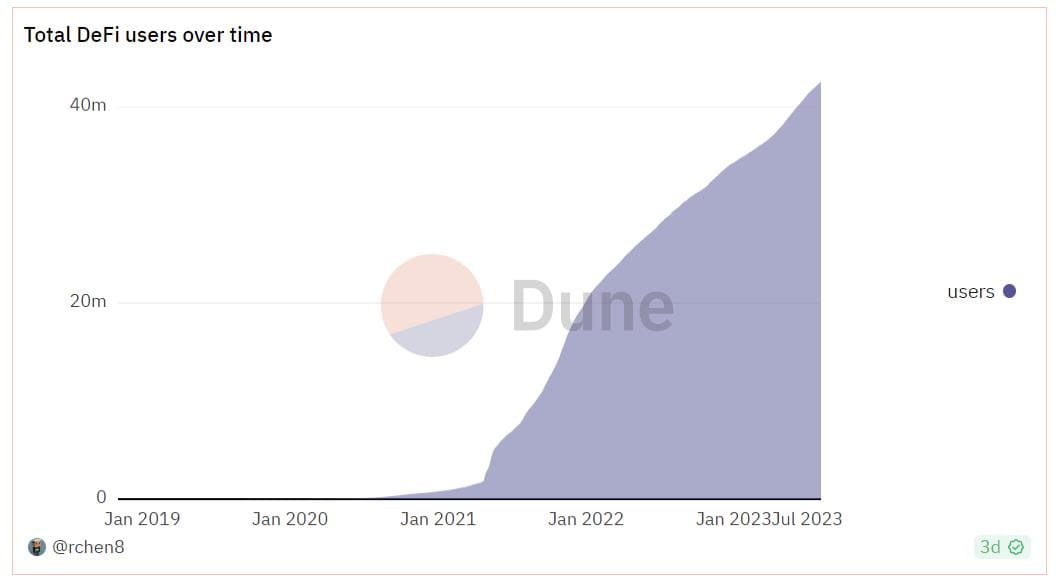
Total number of Defi user addresses in the entire chain
Source: https://dune.com/rchen8/defi-users-over-time
Since 2022, the market has entered a long bear market. The popularity of games, NFTs and other tracks that were popular in the early stage has declined, and the Ponzi economic model has collapsed rapidly due to insufficient growth. The growth of Web3 users has entered a bottleneck period. At present, the innovation of Web3 is still continuing, and developers are constantly exploring new possibilities in various fields such as infrastructure, zero-knowledge proof, payment, identity, Defi2.0, etc., but the current small number of users is still one of the core problems facing the development of the Web3 field. In today's bear market, a large number of ecosystems and projects on their ecosystems are facing the dilemma of completed projects but lack of real users. If the airdrop studios and multi-wallet users are excluded, the actual number of on-chain users may not be optimistic.
From the supply side, the current development of Web3 needs to expand more application scenarios and create more ways to attract new users. At present, the social track is expected to become the next track to detonate Web3 users; from the demand side, the social track has been confirmed by the traditional Internet field to have great potential, and the huge user base and commercial value have been fully utilized in this track. From the early MSN, to the mid-term Facebook, Instagram and the later Tiktok, each technological iteration of the social track is accompanied by the birth of Internet giants and has spurred a large number of upstream and downstream employment opportunities in the industry chain. As people's awareness of the privacy value and commercial value of data ownership increases, more and more voices are calling for users to master their own social information and data through Web3 and enjoy the value of their own identity and behavior data. Therefore, the exploration of social projects in the Web3 field is one of the most promising and commercially valuable topics in the future.
With the maturity of the ecology of Cyber Connect, Lens Protocol, etc., the entire social sector ecology is becoming more and more magnificent. At present, the entire social sector is in the early stage of outbreak. Recently, some social projects have attracted market attention. For example, Elon Musk, the biggest KOL in the currency circle, took over Twitter. His repeated calls for Dogecoin and the inclusion of Bitcoin in Tesla's official documents have brought global traffic to the encryption field. Although it has stated that Twitter will never issue tokens, speculations about Twitter's social identity and token reward payments have been discussed in the market for a long time. In addition, Lens Protocol completed a financing of US$15 million, and Internet social giants such as Instagram issued NFTs, Cyber tokens, etc. were launched on multiple head exchanges at the same time, and the industry expanded and developed.
Social Track Features
There is currently no unified definition of Web3 social. We can classify all products that involve the release and exchange of information between people and can be used to profile users into the field of social. Judging from the current development results, it mainly includes social public chains, social graphs, social identities, various types of social applications, service tools, etc.
In the Web2 field, traditional social platforms such as Twitter, Instagram, Tiktok, etc. already have a large number of users and have derived mature and rich business models. When we talk about Web3 social networking, we need to verify the necessity and feasibility of Web3 social networking development. Compared with Web2, Web3 has an insufficient user base in the development of social networking and is still in the technical exploration stage. In general, this article believes that the key factors for the development of Web3 social networking include:
1. Anonymity and censorship resistance
Compared with Web2 social networking, one of the biggest advantages of Web3 social networking is anonymity and anti-censorship, which has been verified as one of the needs of users. In the Web2 field, data is in the hands of centralized institutions, and users may be arbitrarily censored of their data information, forced to delete and modify their social comments, etc. In essence, Web2 social networking is still a social model under a regulatory system, and users cannot protect their privacy. The decentralized Web3 naturally has the characteristics of protecting user privacy and resisting centralized institutional censorship. These characteristics can meet the user's demands for protecting privacy and maintaining their own security.
2. Users have data ownership
In the social model of Web2, the ownership of user data belongs to the centralized platform organization. By mastering the user's data, the platform can realize user portrait characterization, analyze the user's behavior preferences, and then launch corresponding advertisements and products to maximize the monetization of traffic. At the same time, the data itself also has certain commercial analysis value. In the field of Web3, users can obtain the commercial value of data traffic by enabling them to master data ownership. From the user's perspective, it is attractive to design projects that allow users to easily realize the value of data. In fact, this model has been tried in the business model of Web2 and has achieved certain results. For example, the cash rewards provided by Pinduoduo for watching videos and the cash rewards for inviting friends to participate in "Kan Yidao" (essentially attracting new members to social networks) are all attempts by users to realize traffic monetization. At present, there have been many attempts in this area in the field of Web3, such as Nostra based on Bitcoin Lightning Network, Lens based on Polygon, and multi-chain protocol CyberConnect, all of which are trying to return the ownership of user data to users. This article believes that in Web3, due to the diversity of tokens, the volatility of the value of tokens themselves, and the richness of token economic design, the commercial value of data ownership can be derived in Web3 to generate many interesting gameplays that attract users, which may even exceed the wealth-creating and new user-attracting effects created by the previous round of blockchain game bull market.
3. Easy to use
One of the elements of social projects is to achieve abundant and free flow of information within the circle, and abundant information depends on a large number of users. How to introduce a large number of users is the biggest challenge and opportunity faced by Web3 social projects. One of the important reasons for the current limited development of the encryption field is that the user base is too small. First, there is a certain learning threshold for users to enter the encryption field. Users need to master certain computer and encryption knowledge to participate in on-chain interactions. Second, the current encryption projects are more complicated to use than Web2 user tools, which are not simple and convenient enough. Taking the EOA wallet as an example, the complex mnemonics and storage methods, the potential risk of being phished and stealing private keys, and the update iteration and compatibility issues between software all affect the user experience. Blocking a large number of Web2 users from the encryption world, relatively speaking, this also means that once the problems of learning costs and entry barriers can be solved, once there is a social project that can be easily used and allows users to operate without feeling, it will bring huge user traffic.
4. Composability
In Web2 social networking, due to the existence of various centralized institutions, huge data islands have actually been formed. Internet giants formed by huge data islands have data access rights and pricing rights. Projects of other categories need to obtain permission from the data owner if they want to use the data or build applications on it. At the same time, there are compatibility issues and potential competition between the huge data islands. The final result is that many Web2 applications are not interoperable. Users often have to register new accounts and re-accumulate information and data to use a platform. This article believes that ideal Web3 social products may have the opportunity to solve the problem of data islands. The description of user portraits such as POAP and ENS can be regarded as an attempt to solve the problem of data islands. In the future, there may be simpler and barrier-free standard protocols that help users to easily master data ownership while being compatible with access to most protocols. This area is one of the key exploration directions of DID.
Overview of top projects
According to different project types, social projects mainly include social graphs, social applications and tool projects.
Social Graph
Social graphs serve as infrastructure in Web3 social networking, providing general standards, data information sources, etc. for other application projects. Social graphs should have rich data sources, wide composability, and low barriers to use. From this point of view, there is little necessity for independently built new public chain social projects and native social projects built on unpopular public chains, which increases the isolation from other mature ecosystems. At present, the general standards for social identity built on mature chains are the mainstream choice for the development of social graphs, including Lens Protocol, CyberConnect, and RSS3, which are all mainstream projects in this track.
CyberConnect
CyberConnect is a multi-chain social graph that can verify and accumulate user interaction data, provide users with personal business cards, social graphs and smart contract wallets, and provide other Dapp developers with standard API data interfaces to achieve the migration of user data on multiple Dapps. Currently, CyberConnect has been connected to Polygon, Linea and Optimism, and will be connected to networks such as Arbitrum in the future. The number of users is expected to grow further. As shown in the figure below, as of August 8, 2023, the cumulative number of accounts has reached 368k, the cumulative number of user operations has reached 738k, and the total number of user profiles has exceeded 1.25m.
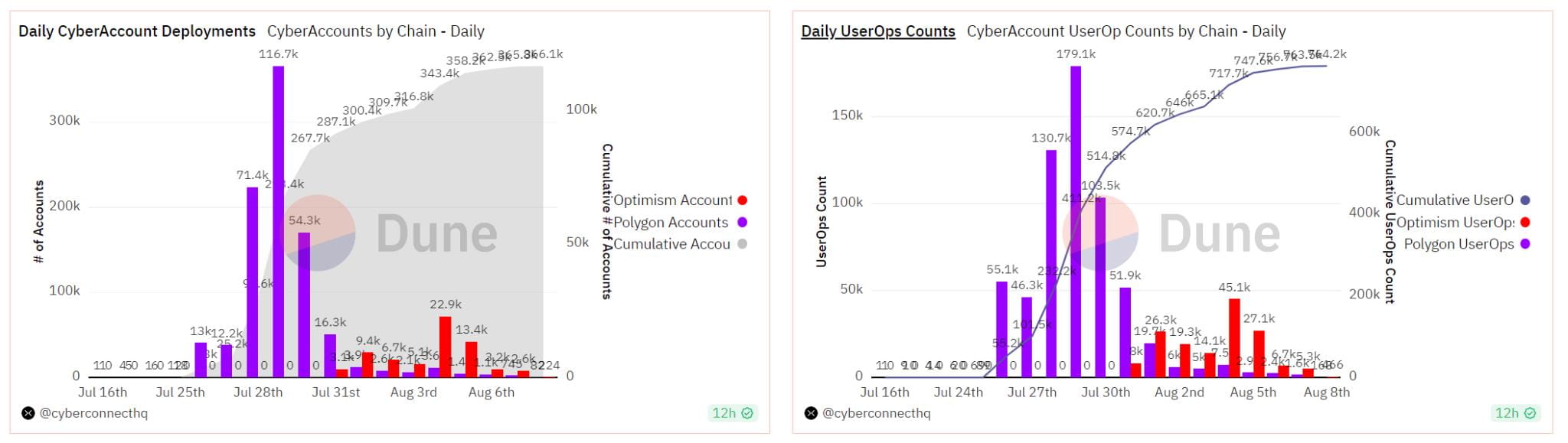
CyberConnect User Data
Source: https://dune.com/cyberconnecthq/cyberaccount-cyberconnects-4337-smart-account
Under the current sluggish market conditions, CyberConnect's average daily traffic DAU still remains above 10k, and the overall traffic is relatively large.
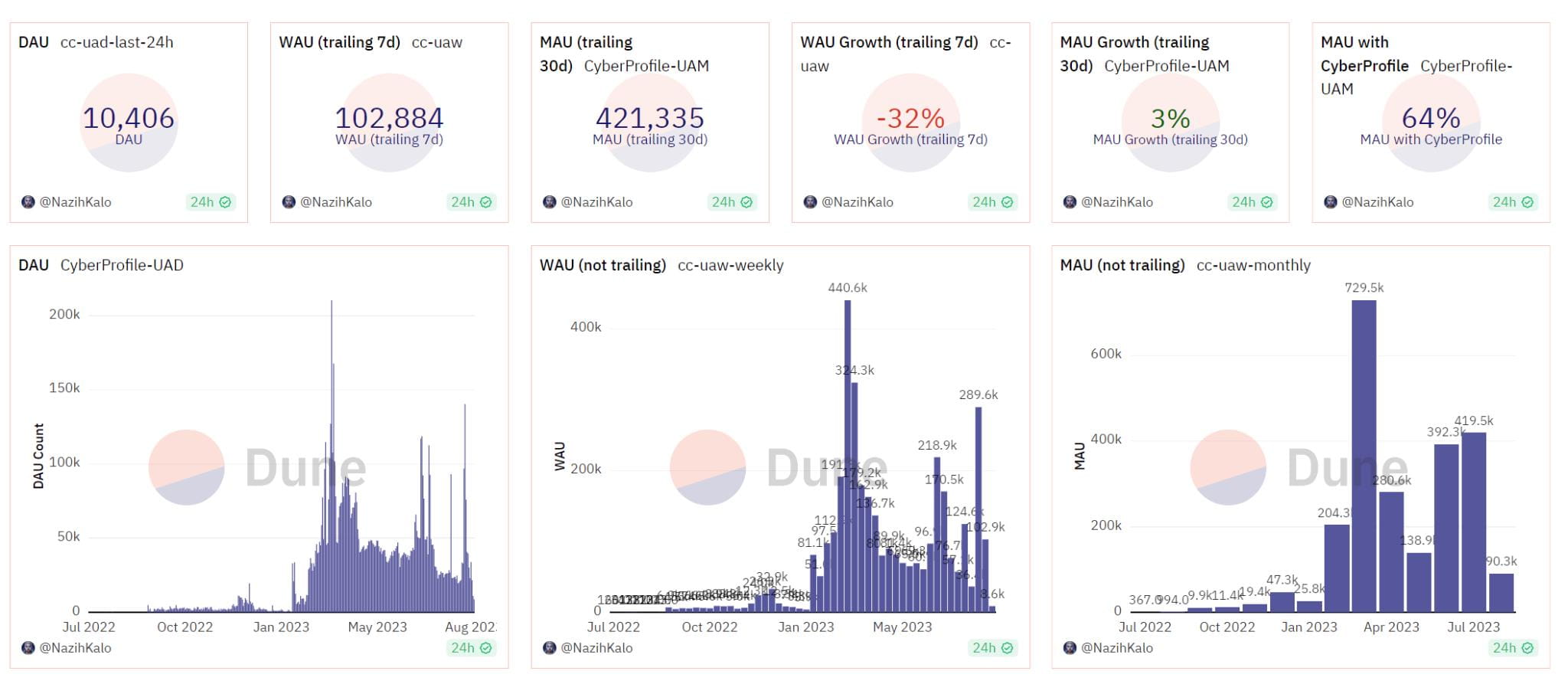
CyberConnect Traffic Data
Source: https://dune.com/cyberconnecthq/cyberconnect-link3-metrics
Lens Protocol
Lens Protocol is a social project developed by the well-known old Defi lending project AAVE team. It is a social graph protocol built on Polygon, which allows anyone to create non-custodial social profiles and build new social Dapps. Users can create their own social business card NFT by connecting to the wallet, and use the social business card to interact with other users. Users can also build corresponding interactive Dapps based on Lens (users can use Lens to log in, interact within the Lens ecosystem, and interaction records will also be recorded in the Lens social business card).
The figure below shows some projects in the Lens ecosystem. Currently, there are more than 100 projects built on the Lens ecosystem, including various Dapps for social interaction, play and earn, streaming media sharing, DAO tools, advertising management, information transmission, knowledge payment, and lottery. Although most of the ecological projects are still in the early and mid-development stages, the overall number and types are very rich, and the richness of the ecosystem even exceeds that of some public chains. In general, the on-chain social ecosystem created by Lens is very friendly to the creator economy.
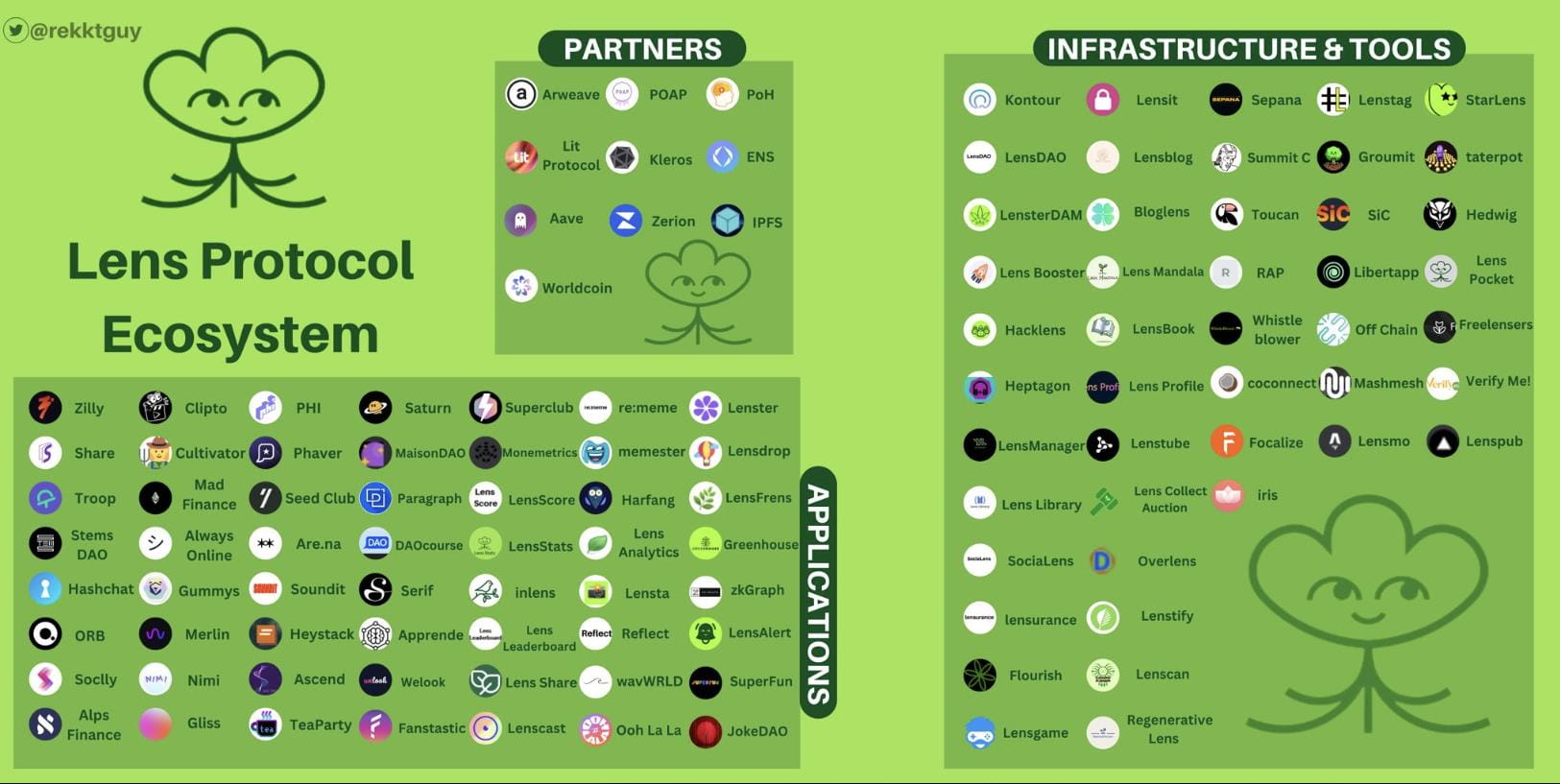
Some of Lens Protocol’s ecological projects
Source: https://twitter.com/rekktguy/status/1582288617229406209?s=20
As of July 2023, more than 110,000 addresses have obtained Profile social business cards. As shown in the figure below, Lens has accumulated more than 360,000 users and 21.93 million transactions. The peak of transactions and users occurred in February 2023, and a large number of retail investors or airdrop studios may participate in the layout. At present, the number of daily on-chain transactions is between 15,000-20,000, and the number of users participating in the interaction is between 3,000-5,000 wallet addresses per day. In the context of a bear market, there are still a large number of users participating in the interaction of the social track, showing the good user data performance and growth potential of this track.
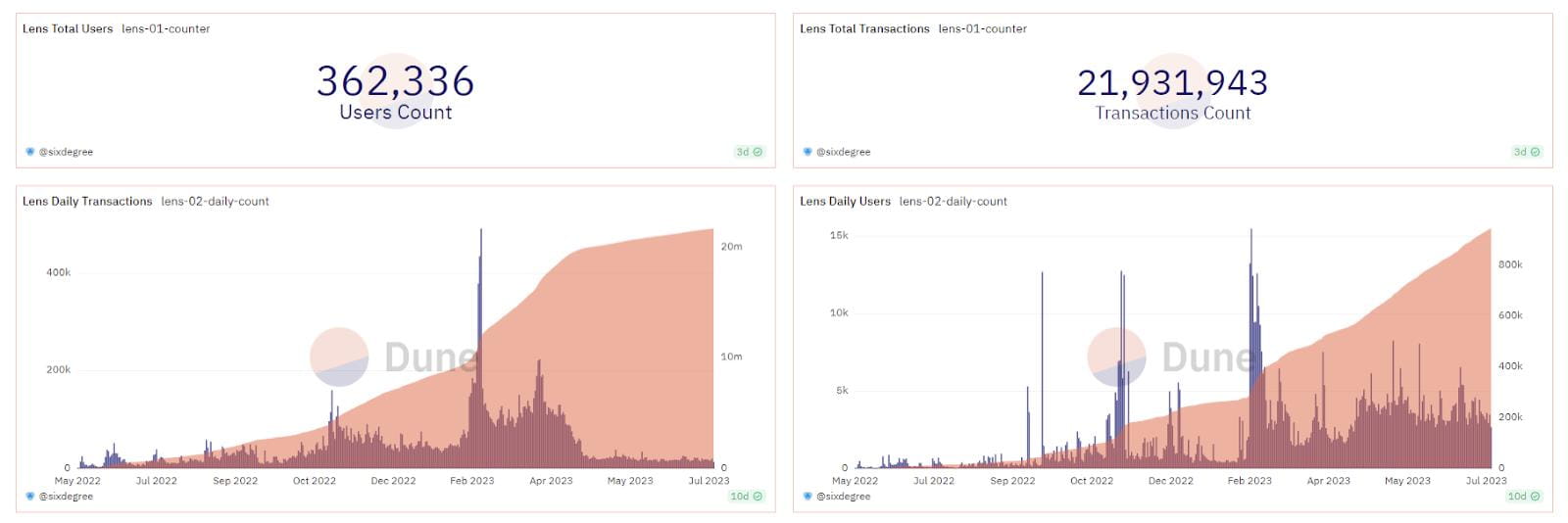
Lens Protocol User Data
Source: https://dune.com/sixdegree/lens-protocol-ecosystem-analysis
In general, the social graph is the infrastructure and general tool of the entire social track. A unified, simple, and convenient social graph is conducive to lowering the user's usage threshold, reducing the usage barriers between different Dapps, and accumulating more users and data. In comparison, Lens Protocol is built on Polygon and focuses on building its own social ecosystem, while CyberConnect does not have its own content platform and ecology. It supports multiple chains and interacts with multiple applications. At the same time, it is also actively exploring ways for Web2 users to enter the game on the wallet side, focusing on creating an open social business card. The two projects are currently the top projects in the social track. With the further construction and launch of Lens Protocol, the social track led by the two projects may usher in an explosive period.
Social Apps
Farcaster
Farcaster is a decentralized social platform created by Dan Romero, a former Coinbase executive. It is built on Ethereum and is comparable to Twitter. It is currently in the beta testing stage. Farcaster generates and stores identity information for users on the chain and provides a database Hub to store other information off the chain, achieving a fast and low-cost decentralized social interaction experience comparable to Web2. In addition, Farcaster also allows users to use the self-hosted mode, allowing users to approve and receive messages without a gateway to ensure the realization of decentralization. Currently, nearly 20 derivative projects have been built under its ecosystem, including data analysis, image beautification, hot topics, related topics, and search engines.
As of August 9, 2023, the total number of Facaster wallet addresses exceeded 13k, and many crypto industry Degens, including Vitalik Buterin, have registered accounts. The weekly user growth rate was 2.2%, and 2.5k dynamic posts were posted in the past seven days. As an independent social application, its number of users and user activity are not bad.
At present, in addition to the advantages of decentralized anonymity, how to attract Web2 users to migrate from Twitter to Farcaster is an important research direction for the subsequent development of the project.
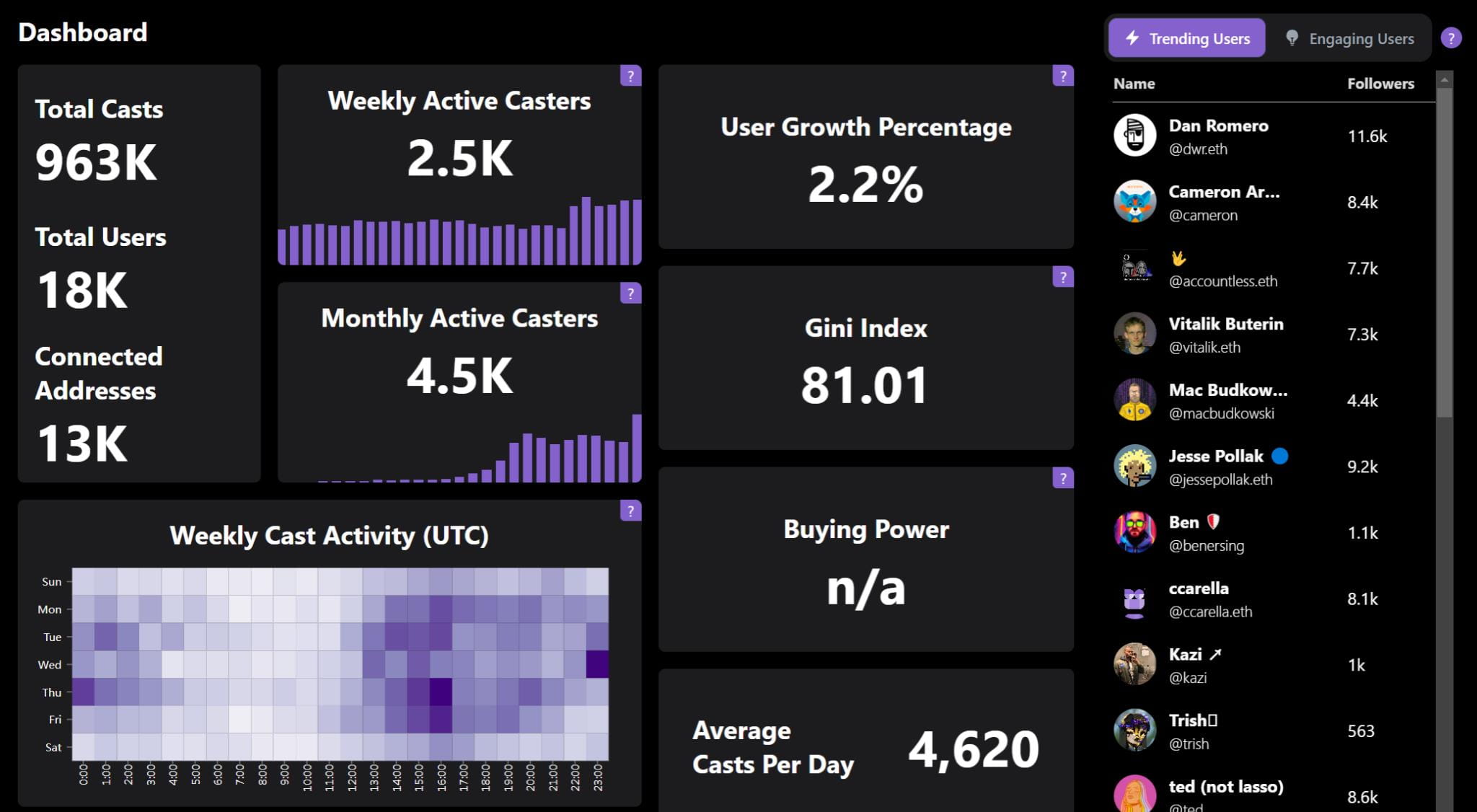
Facaster user statistics
Source: https://farcaster.network/
Our
Nostr is a decentralized open source social transmission protocol. Developers can build Dapps based on Nostr. There is no centralized server on Nostr. The protocol uses the design of client and relay to send and receive information. Compared with Web2 social networking, the protocol is completely decentralized, censorship-resistant and protects user privacy. Damus is a decentralized Twitter-like social product built on Nostr. Users can enjoy the product features of decentralization, anonymity and no advertising on the basis of experiencing a social platform similar to Twitter. The product is still in the early stages of development and has also been recommended and supported by Jack Dorsey, the founder of Twitter.
As a completely open, anonymous, decentralized, and censorship-resistant product, Damus is more competitive than traditional social products in terms of privacy and security, and has a clear market and target customers. However, in order to attract a wider range of Web2 users, new product designs and features may be needed.
Friend.Tech
Friend.Tech is a social application invested by Paradigm and deployed on Coinbase's L2 chain BASE. This application is similar to traditional fan token/creator economy projects. The platform provides fan communities and token issuance services for creators, and users join the creator community by holding tokens issued by creators. The product has quickly become popular since its launch on August 10. As shown in the figure, as of August 29, 2023, within less than 20 days of the product's launch, there are more than 120,000 registered addresses and more than 20,000 active addresses (user space viewed on the same day).
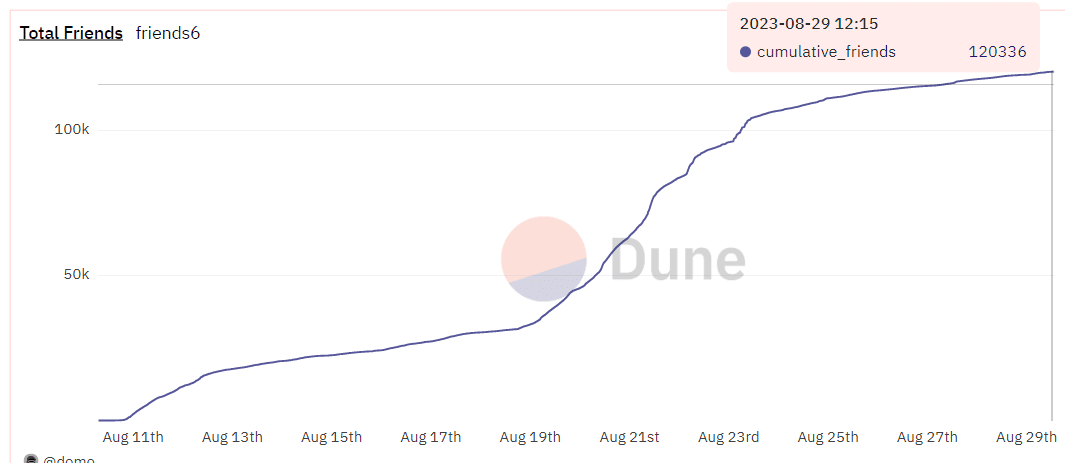
Source: https://dune.com/domo/friendtech
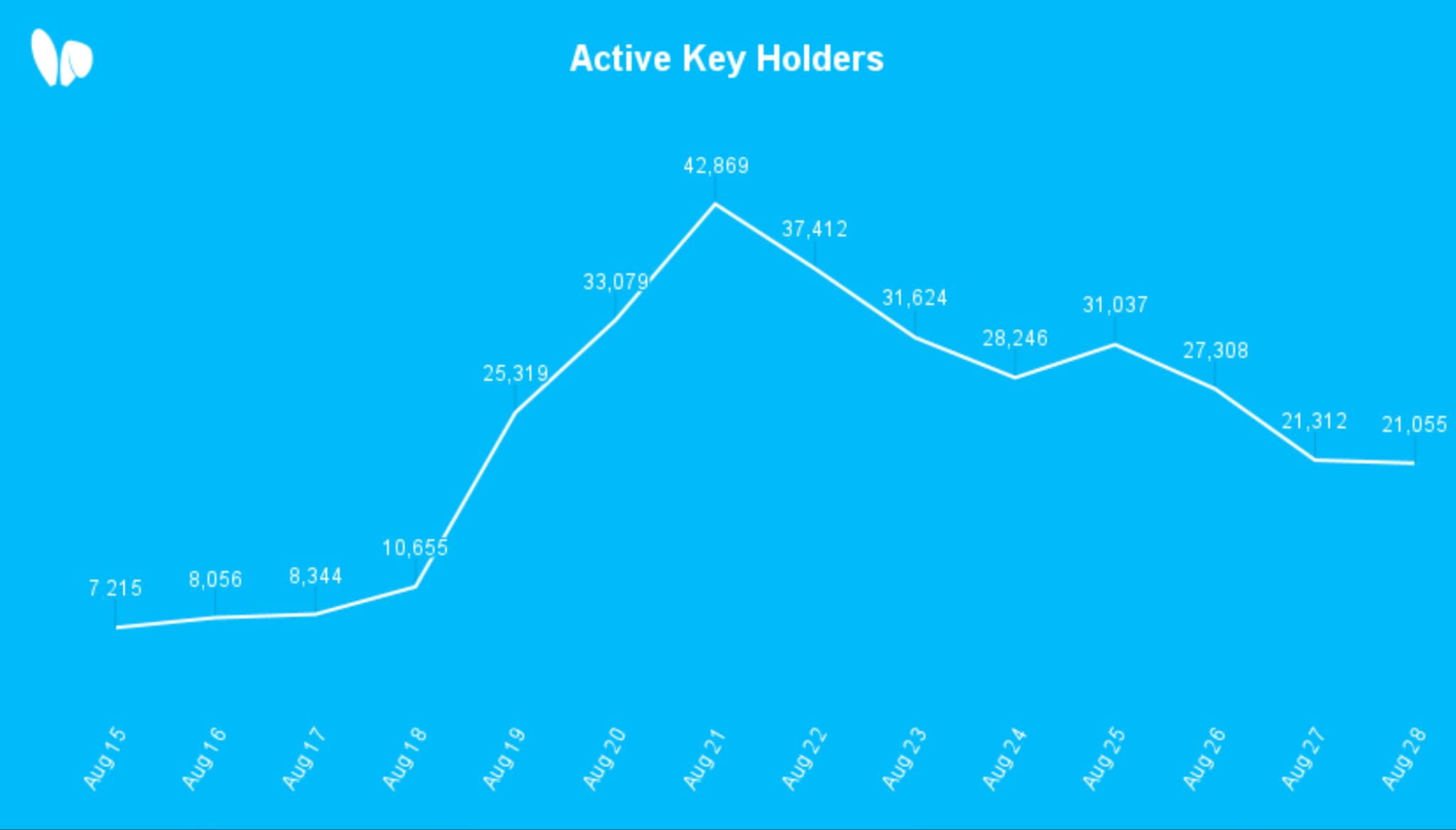
Source: https://twitter.com/friendtech/status/1696599323637846444/photo/1
Users need to pay a 10% transaction fee for each transaction, of which 5% goes to the creator and 5% goes to the protocol. As shown in the figure below, as of August 28, 2023, the protocol has accumulated more than 4 million US dollars.
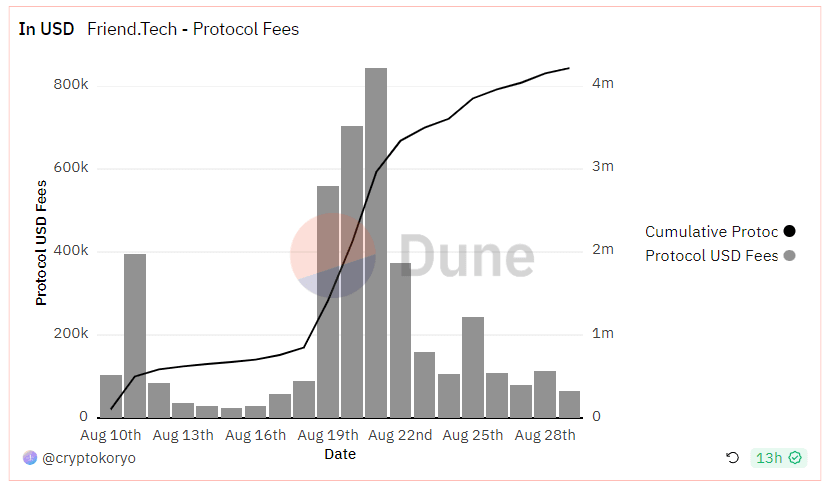
Source: https://dune.com/cryptokoryo/friendtech
The rapid rise of Friend.Tech products has, to a certain extent, triggered market attention and speculation on the social track. What model did the product use to attract users so quickly and on a large scale? This article believes that, in terms of the product itself, Friend.Tech has not yet broken away from the original social product and token model design, but its success at this stage is traceable, mainly including the following points:
1. Ponzi economic design of fan tokens
Currently, there are two main design modes for fan tokens: one is to issue fan tokens. Users reach the entry threshold of the creator community by holding a certain number of fan tokens. Fan tokens comply with the price fluctuations under the market economy. In addition, there may be designs for fan token functions such as repurchase, destruction, profit-sharing, and pledge; the second is to issue fan NFTs. Users reach the entry threshold of the creator community by holding NFTs. NFTs comply with the price fluctuations under the market economy. In addition, there may be mapping of new token issuance, airdrop of new NFTs, or realization of other rights and interests.
In general, in the token economy design before Friend.Tech, the driving force for the buying and selling of fan tokens mainly came from users' love for creators, and the attraction to the rise and fall of token prices was neutral. The user invitation mechanism + fan token economics launched by Friend.Tech has subverted the original lack of vitality in the token economy mechanism. Friend.Tech stated that it will distribute 100 million points within six months. The points distribution rules have not yet been disclosed, but user points are generally believed to be linked to token airdrops. The combination of this mechanism and the user invitation mechanism has promoted the motivation of users to attract new users, and also promoted users to buy more shares of different creators to brush transaction fees and data. This strategy is similar to Blur's airdrop strategy. Through long-term point incentives + airdrop expectations, users are attracted to use the product. At the same time, because the cycle is long enough, it can increase user stickiness to the product and continue to occupy market share after the airdrop cycle ends.
In the design of token economics, since the official has not yet disclosed the relevant calculations, according to the currently generally recognized Laurence Day's calculations and statistics on the price model, as shown in the figure below, the price of Friend.Tech's fan tokens follows the price curve of P=suppy^2/16000. Under this pricing model, both price increases and decreases will show exponential fluctuations. Early investors have the opportunity to enjoy huge profits. This Ponzi economic design will continue to cause price surges before the buying and selling users reach equilibrium, attracting more speculative users to participate in the buying and selling of tokens. This is also one of the most important reasons for the short-term explosion of the project. A similar design is also reflected in the Meme project XEN. Through the Ponzi economic token design and the dividend incentive mechanism for early users, the project has exploded the market in a short period of time.
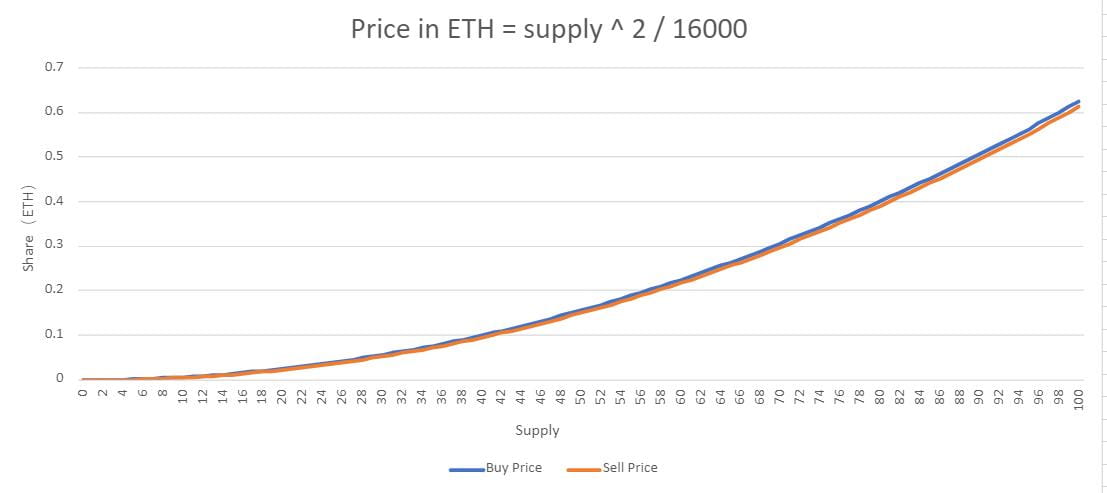
Source: https://onedrive.live.com/view.aspx?resid=C078415A103A3F40!1094&ithint=file%2cxlsx&authkey=!ANE0-sqb5hAftiI
2. Bonuses in the early stage of BASE chain launch
Friend.Tech was previously built on other chains, and its recent launch and popularity are also closely related to the popularity of BASE and L2 tracks. Since the launch of Arbitrum in early 2023, the overall performance of the L2 track has been very impressive in the bear market. The subsequent Zksync ecosystem, OP Stack, and BASE have all triggered a market boom. It is expected that Starknet, Scroll, and Zksync will be launched and coin issuance will be expected this year. In addition, with the upcoming Cancun upgrade, the entire L2 can be called the most important and most eye-catching track in the currency circle in 2023, and BASE is also backed by Coinbase, a listed exchange in the currency circle. Friend.Tech chose to issue BASE at the beginning of its launch, cleverly seizing the market's hot spots and time dividends.
3. Paradigm's top VC background endorsement
As a top investment fund in the cryptocurrency circle, Paradigm's endorsement naturally adds a lot of points to the project. When Friend.Tech has not yet developed a web page, and only has a rough beta version, lacking various project white papers and explanatory materials, the market still trusts the project and invests a lot of enthusiasm in participating, which is closely related to Paradigm's endorsement. At the same time, the project's points mechanism can be seen in an incentive design similar to Blur, which may be guided by Paradigm.
In general, Friend.Tech is relatively traditional in terms of product mechanism, but is bolder than traditional social projects in terms of token economic design, customer acquisition strategy and marketing methods. In the short term, Friend.Tech may replicate Blur's user growth path, but as a social product, the realization of long-term social attributes requires observation after the product is launched.
Tool Project
Social tool projects mainly play a service role. Currently, most of them are positioned as projects that serve Dapps, such as Lenscan for browsing data under LensProtocol, LensDAO for organization and community management, Alertcaster for information reminders under Farcaster ecology, and FarQuest for initiating questionnaires. Other general auxiliary tools can also be classified as social tools, such as the Debank Hi module that helps with social promotion, Utopia that helps with DAO treasury governance, and various NFT design tools, account management tools, wallet management tools, etc.
In general, the social track is a track that gives full play to the imagination of developers at the application layer. In addition to social graphs and application tools, especially in social applications, various types of social platforms, fan platforms, streaming media platforms, etc. are colorful. At present, this track is still in its very early stage, and the enthusiasm and efforts of developers and investors will continue to help this track accumulate results.
Risks and Challenges
The current encrypted social track has attracted the participation of many developers and capital. While seeing the opportunities, we should also be clear about the risks and challenges that exist in this track. The current problems mainly exist in technology, user growth and compliance.
technical challenge
Social products as a whole are at the application layer, and their development awaits the maturity of infrastructure and technology. As the number of users grows, more and higher requirements will be placed on social products. At the same time, the development of social applications depends on the resolution of issues such as data storage, cross-chain information transmission, information transmission costs, and network congestion. The current infrastructure is not yet sufficient to accommodate the emergence of large-scale user social software at the Web2 level.
User growth
In addition to anonymity and anti-censorship, why are Web2 users willing to switch to Web3 social applications? It is clear that not every user has extremely high requirements for privacy. A large number of users can still realize their social demands on existing centralized social platforms. Apart from these users, how to attract more users, or should the target users only focus on users with privacy needs? If you consider using economic returns to motivate users, how to design an economic model while avoiding falling into an economic closed loop or Ponzi economic dilemma? At the user level, Web3 social networking has already achieved good market popularity and traffic, but the current popularity still remains within the encryption circle. In the future, whether to solve the problems of existing social products or create new functions and needs is a problem that Web3 social products need to face in order to increase the number of users.
Compliance
The selling points of Web3 social products are also the main points that distinguish them from Web2 products: first, decentralization, anti-censorship, and privacy protection; second, users have data ownership; and third, users can realize data ownership benefits. The advantages of Web3 social products may become risks to a certain extent. It is foreseeable that the product characteristics of Web3 are very likely to attract practitioners in the black and gray industries, and will also attract the attention of regulators. As the Web3 track matures and the user base expands, developer security issues and potential regulatory agency inquiries need to be taken into consideration in advance.
Summarize
The Web3 social track is in the early stages of development and depends on the maturity of other infrastructure construction, including but not limited to cross-chain information transmission, data storage, reduction of transaction costs, and compliance issues. At present, social track products mainly include social graphs, social tools, and social applications, among which social graphs are the most basic, and social applications have the largest number and the widest categories. At present, a large number of developers are trying to develop Web3 social products, and capital is gradually paying attention to and investing in this track. Including the launch of Cyber tokens, Twitter's name change and creator incentive plans, all show that the market heat of the social track is gradually rising. While social networking presents opportunities, we should also be fully aware of the challenges currently faced by this track. This article believes that the main challenges include the current imperfect infrastructure technology construction, new user growth bottlenecks, and potential compliance issues. In general, this article believes that the Web3 social track has performed well in terms of development prospects, development trends, and market heat. With the improvement of infrastructure, project development, capital accumulation, and the listing of tokens, this article believes that this sector has good investment potential and development prospects.