


Author: Climber, Golden Finance
Since the Ethereum Shanghai upgrade in April this year, LSD WAR has become more and more intense. Liquidity pledge allows users to maximize their capital returns, and various DeFi projects continue to launch product LEGOs to compete for market share. Under this market trend, Pendle has reaped a lot of benefits, with the highest TVL growth of nearly 10 times since the beginning of the year.
Pendle is a decentralized yield trading protocol where users can execute various yield management strategies. Soon after it was launched on Binance in early July, it received investment from Mantle Ecosystem Fund and Binance Labs. Recently, Pendle announced that it will use MakerDao's sDAI and Flux Finance's fUSDC in its first RWA product.
RWA is one of the hottest crypto tracks at the moment. While everyone is still waiting for Pendle to add it to the camp, these two types of investment portfolios have been launched simultaneously. And in just five days, its TVL has exceeded 15.3 million US dollars, and the sDAI interest rate trading LP pool has surpassed the GLP pool to become the second largest TVL pool on Pendle.
1. Fundamental Analysis
LSDfi is a series of protocols based on LSD, including not only DEX and lending protocols, but also more complex protocols built using LST properties, such as Baskets protocols, stablecoins, yield strategies, etc.
Pendle is a crypto asset yield strategy protocol. By using the DeFi products it provides, users can increase their yield exposure in the bull market and hedge against downward yields in the bear market, thereby maximizing their returns.
The Pendle project system is mainly composed of three parts: income tokenization, AMM, and vePENDLE. Through this system, Pendle can package user crypto assets into standardized income tokens SY, and SY can be further divided into principal and income components, namely PT (principal token) and YT (income token). Both PT and YT can be traded through Pendle's AMM.
vePENDLE is a functional token used for Pendle governance, which users can obtain by staking PENDLE.
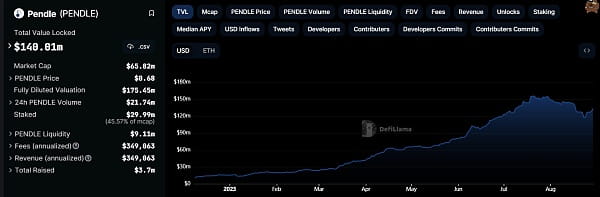
With the help of the LSD track, Pendle's further product design - the profit maximization mechanism has attracted a large number of users. According to DeFiLlama data, Pendle's TVL is US$140 million, and the highest increase since the beginning of this year has reached 1000%.
However, the staking income track has a long history. After the popularity of LSD, many strong projects have taken advantage of this transformation, including Lido, MakerDAO, RocketPool, Stkr (Ankr), Stakewise, etc. In comparison, the Pendle project was established relatively recently. Even though it provides slightly better returns, it still faces development bottlenecks in the fierce market share competition.
Against the backdrop of global economic recession, deep bear market in crypto market, and rising U.S. Treasury bond yields, the RWA track has been favored by investors seeking stable returns with low risk.
Currently, the RWA track is developing rapidly. In addition to the participation of established crypto projects, traditional financial institutions are also accelerating their entry.
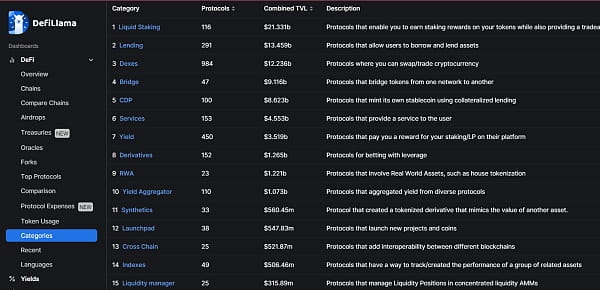
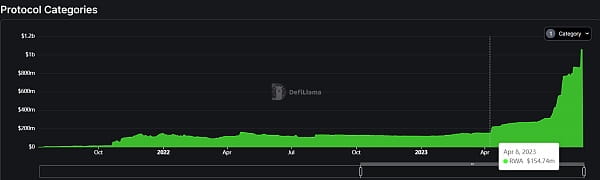
In DeFiLlama's breakdown of DeFi categories, the LSD sector ranked first with a TVL of $21 billion, nearly double the lending sector. The RWA sector has grown rapidly, especially since April 8 this year. Its TVL has risen rapidly from $150 million to $1.2 billion as of this writing, an increase of nearly 900% in four months.
Being in the most valuable sector of the DeFi track, Pendle has already got a piece of the pie, but Pendle obviously has a bigger appetite and has extended its tentacles to the RWA sector, which is the fastest growing and has great potential.
2. Protocol Mechanism
In DeFi, users put funds into yield mining pools and can earn APY that fluctuates over time. For example, DAI staked in Compound is represented as cDAI; ETH staked in Lido is represented as stETH.
However, the generation of these passive incomes depends on the length of the pledge period, and the expected returns are also bound in disguise, and cannot be maximized. Even through circular lending, not only will the risk be increased, but the gas fee will also be high.
Pendle not only unties the user's principal and income, but also provides them with more trading options for the use of their income while ensuring that they have fixed income.
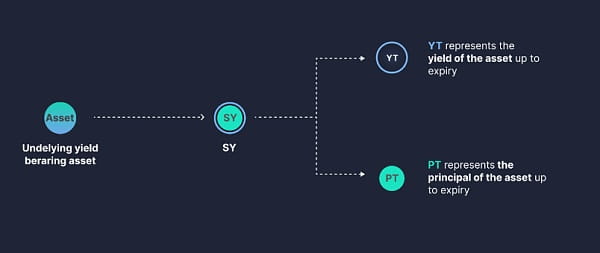
Specifically, Pendle packages LSD\LST into the platform's native SY, and then splits it into PT (principal token) and YT (income token), that is, income tokenization.
Users can buy and sell PT on Pendle AMM, and its price is generally determined by market supply and demand. Since PT does not include the yield part, the PT corresponding to the purchased asset is relatively cheap, that is, it is purchased at a discount. Therefore, the product can only be equivalent to the original asset after it reaches maturity.
For example, assuming there is a stETH pool in Pendle with a term of 1 year, then holders of PT stETH can redeem stETH at a 1:1 ratio after 1 year.

It is worth noting that although the underlying assets of PT can only be redeemed upon maturity, users can also choose to sell them in advance based on their own circumstances and market conditions.
YT (income token) can be traded in the same pool with PT (principal token) on Pendle AMM. At the same time, as the income portion of the pledged principal, YT can be traded at any time.

If investors believe that the average APY in the future will be higher than the current market implied APY, they can choose to go long on yield. The average APY in the future can refer to the current underlying APY, which is the APY generated in the underlying protocol. If all conditions remain exactly the same from now to expiration, the future APY should be the same as the underlying APY.
Specifically, when the implied yield > underlying APY, the long-term yield APY will be negative. This means that, assuming the underlying APY remains constant, the cost of buying YT will be higher than the average future yield collected, so it is better to choose to sell YT.
However, even when Implied APY < Underlying APY, if a user purchases YT with a positive long-term yield APY, the average future APY may be lower than the Implied APY of the transaction, resulting in a loss.
Therefore, the user's long position profit depends on the holding or increase of income.
The trading basis of PT and YT comes from Pendle's unique AMM mechanism design, which is a unilateral trading pool. That is, through built-in automatic routing, anyone with any major assets can trade PT and YT on Pendle through a single liquidity pool.
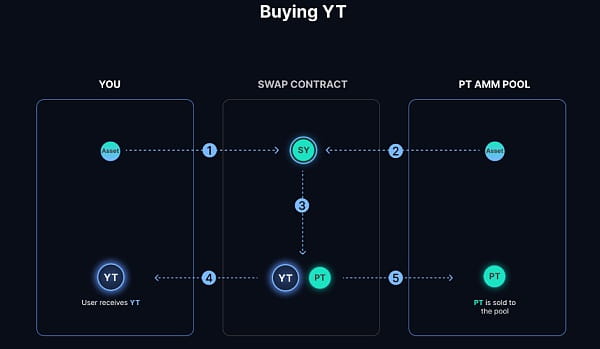
The AMM curve changes to account for yields over time and narrows the price range of PTs as they approach expiration. By concentrating liquidity into a narrow, meaningful range, capital efficiency in trading yields increases as PTs approach expiration.
The liquidity pool in Pendle V2 is set as PT/SY, for example PT-aUSDC / SY-aUSDC. Swapping PT is a simple process of swapping between 2 assets in the pool, while swapping YT is enabled by a flash swap in the same pool.
In addition, the design of Pendle V2 also ensures that the problem of impermanent loss is negligible. Pendle's AMM mitigates time-related impermanent loss by moving the AMM curve to push the PT price towards its potential value over time, thereby allowing the natural price appreciation of PT.
3. Accessing RWA: Open Source and Efficiency Enhancement
According to data from Pendle's official website, the TVL of the new RWA pool has grown rapidly. After only one week of launch, the TVL of PT sDAI Pool reached 13.7 million US dollars, and the TVL of PT fUSDC Pool reached 2.69 million US dollars.
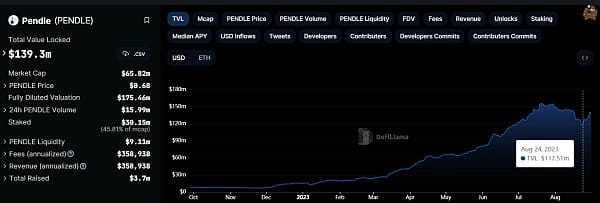
From the overall trend of Pendle TVL, it reached a peak of $155 million on July 20 and then stabilized, and even showed a downward trend. However, it began to rise after the announcement of the addition of RWA products. It is worth noting that the crypto market was still in a sideways stage at this time.
Such a significant increase in liquidity comes from the high yield Pendle has set for PT sDAI Pool. As can be seen from the figure, the fixed APY of the sDAI pool is 3.74% and the long-term return APY is 32.4%.
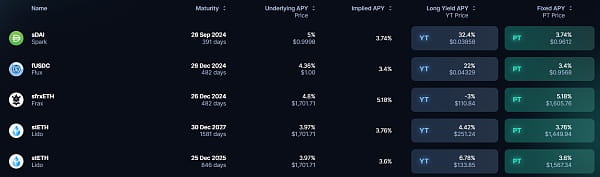
In addition, by providing liquidity to the sDAI pool, users can not only obtain partial fixed income exposure, but also obtain a mixed income of sDAI local yield and additional rewards: sDAI DSR + transaction fees + sDAI fixed income (from PT-sDAI) + PENDLE incentives.
Previously, Spark Protocol’s DSR has been reduced from 8% to 5%, but this high interest rate is still subsidized by MakerDAO revenue. Moreover, as a de facto EDSR mechanism, if USDT fluctuates strongly or MakerDAO revenue decreases, the actual income of users may be lower than the yield provided for sDAI products in Pendle.
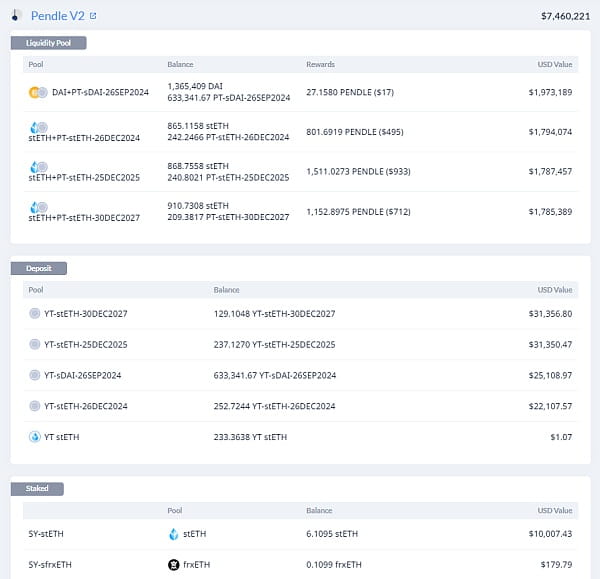
The new RWA pool has also attracted some big whales to join. The wallet address 0xa8321f92e4589f7754831cac607180372197b7f6 with a total value of US$7.7 million deposited US$2 million in Pendle's sDAI pool.
Another wallet address 0x18f7a7ad23163c5ea7d5c059c1a98c3ce57cb5c0 with a total value of $2.5 million deposited $1 million. In addition, there are many other accounts with large deposits.
Conclusion
The lack of liquidity in the crypto bear market has become a problem faced by all market participants. How to maximize the use of funds and reduce risks is the current demand of most investors. After LSD releases the funds pledged by users, it needs to generate greater efficiency, and Pendle provides a new option for this.
The continued expansion of the RWA track has also allowed institutions and investors to see a broader market. The tokenization of U.S. debt is just a pilot, and it is believed that more real-world assets will become tokenized financial products in the future. Therefore, Pendle's timely move also gives it a ticket to occupy a larger market share in the future.