

#tether
tether
4.9M views
7,699 Discussing
Hot
Latest

·
--
⚖️ $USDT | USDT at $0.9987: is a 0.13% gap a non-issue or a warning sign?
Tether trades at $0.9987 against an assumed $1.00 peg, a deviation of -0.13%, with a $182.3 billion market cap and $47.8 billion in 24-hour volume as of the 2026-10-26 21:50 UTC snapshot. Supporters read such small gaps as normal friction for a token described as 100% backed by USD reserves, while critics argue that any persistent discount invites questions about redemption mechanics and how reserves are verified. Both readings rest on the same numbers, but they weigh trust in the issuer very differently.
Why it matters: For a stablecoin, the debate is never about upside but about whether a small peg gap reflects routine market friction or a deeper question about reserves and redemption.
💬 Does a -0.13% deviation from the peg say more about healthy market mechanics or about how much trust users place in the issuer's reserves?
Source: Official site https://tether.to/
#Tether #Stablecoins
·
--
⚖️ $USDT | USDT at $0.9987: a routine peg wobble or a signal worth watching?
At the 2026-10-26 19:58 UTC snapshot, Tether traded at $0.9987, a deviation of -0.13% from the assumed USD 1.00 peg, with a 24h price change of -0.0% and market cap of $182.3 billion. One reading treats such a small gap as ordinary noise for a token designed to mirror the dollar, especially with $47.0 billion in 24h volume. The other asks whether any persistent discount, however slight, deserves attention given that USDT's value rests on reserves and redemption rather than market discovery.
Why it matters: For a stablecoin, the peg and the credibility of reserves and redemption matter more than daily price moves, so even small deviations are best read as a question about design, not direction.
💬 Does a -0.13% deviation from the peg tell you anything meaningful about USDT's reserves and redemption model, or is it just noise?
Source: Official site https://tether.to/
#Tether #Stablecoins
·
--
⚖️ $USDT | USDT at $0.9993: a dollar substitute or a promise in reserve?
Tether is commonly described as a digital dollar, and the snapshot supports the trading side of that: $0.9993 against an assumed USD 1.00 peg, a -0.07% deviation, $182.4 billion market cap and $33.3 billion in 24h volume as of 2026-10-26 09:14 UTC. The fact sheet adds that it is, per the official Tether site, 100% backed by USD held in reserve, and that it offers liquidity to exchanges that cannot deal in dollars and with banks. Supporters read that combination as a working dollar replacement across many chains; skeptics note that a stable value rests on reserves and redemption rather than on the token itself.
Why it matters: A stablecoin's usefulness depends less on its price chart than on whether its reserves and redemption design hold up under stress.
💬 Does a tight peg and deep liquidity tell you enough about a stablecoin, or do reserves and redemption terms matter more?
Source: Official site https://tether.to/
#Tether #Stablecoins
·
--
⚖️ $USDT | USDT at $182.4B market cap but $32.6B daily volume: deep liquidity or thin turnover?
At the 2026-10-26 08:25 UTC snapshot, Tether carried a $182.4 billion market cap and ranked 3rd, while 24h volume stood at $32.6 billion, roughly a fifth of its size. One reading sees that turnover as healthy proof of USDT's role as trading liquidity across venues; another notes that a large share of supply sits idle as a dollar substitute rather than changing hands. The price sat at $0.9993, a -0.07% deviation from the assumed USD 1.00 peg, with market cap down -0.1% over 24h.
Why it matters: For a stablecoin, the ratio of daily volume to market cap hints at how much supply is actively circulating versus parked, which shapes how its liquidity and peg are read.
💬 Does USDT's volume-to-market-cap ratio signal genuine liquidity depth, or mostly supply sitting idle as a dollar substitute?
Source: Official site https://tether.to/
#Tether #Stablecoins


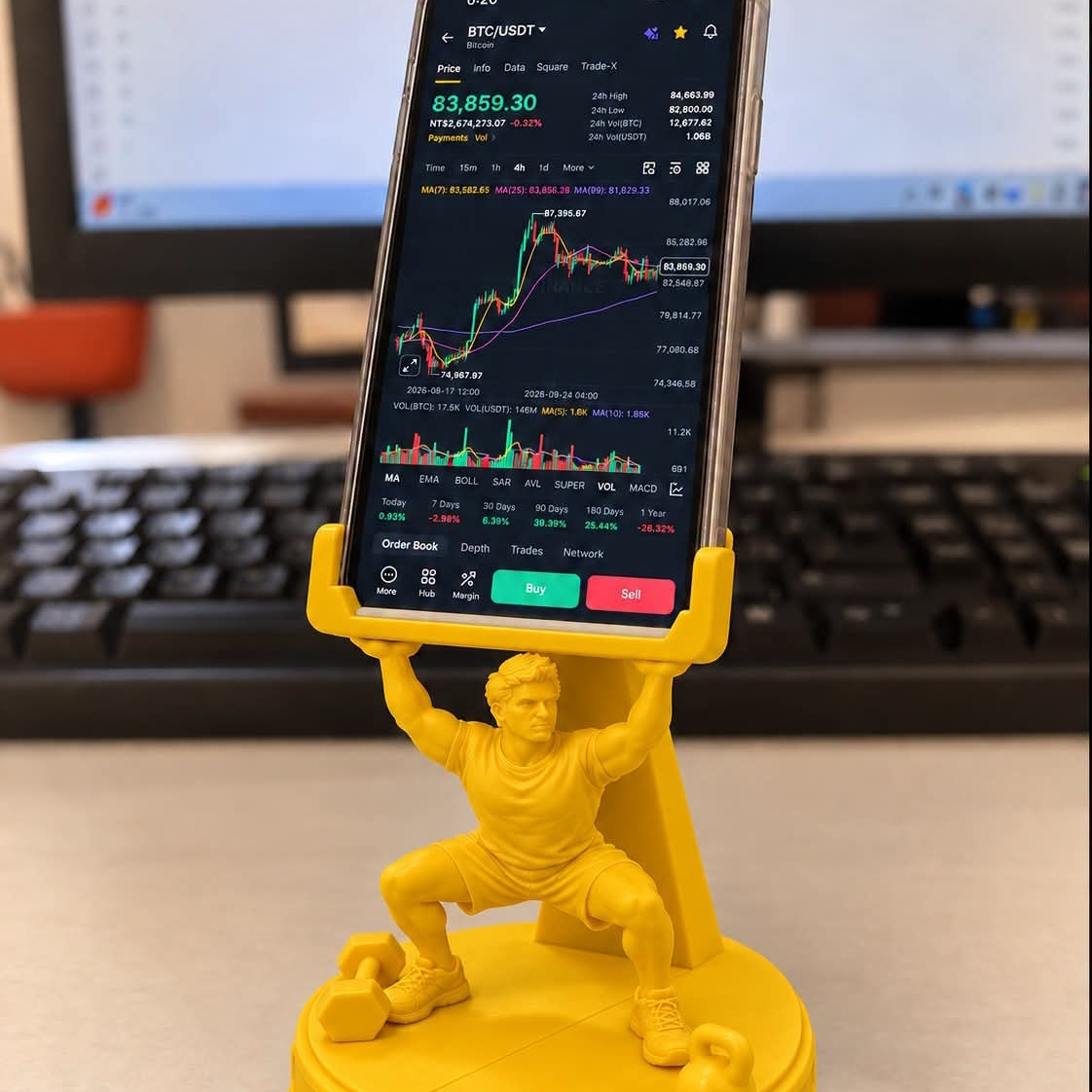
⛏️ LATEST: Tether Goes Open-Source!
15 top mining firms including Bitmain, Foundry Digital & F2Pool backed Tether's new Mining Development Kit 🚀
An open-source layer to make Bitcoin mining infrastructure AI-ready - efficiency, predictive analytics & scalable mining!
Big move for $BTC mining future. Are you bullish?
#Tether #Bitcoin #F2Pool #CryptoNews #bitmain


2
67
·
--
⚖️ $USDT | USDT at $0.9990: proof of a solid peg or a warning sign?
At the 2026-10-26 00:48 UTC snapshot, Tether traded at $0.9990, a -0.10% deviation from the assumed USD 1.00 reference, with a $182.3 billion market cap and $25.6 billion in 24-hour volume. Supporters read that tiny gap as evidence that a deeply liquid dollar substitute is doing its job across the many chains it runs on. Critics argue a -0.10% drift still raises the question of how redemption and reserves would hold up under heavier stress. Both readings rest on the same number.
Why it matters: For a stablecoin, the debate is never direction but whether the peg, reserves and redemption design can absorb stress, and a -0.10% gap is where that argument starts.
💬 Does a -0.10% deviation show a peg working as designed, or does it reveal a fragility worth scrutinizing?
Source: Official site https://tether.to/
#Tether #Stablecoins
68


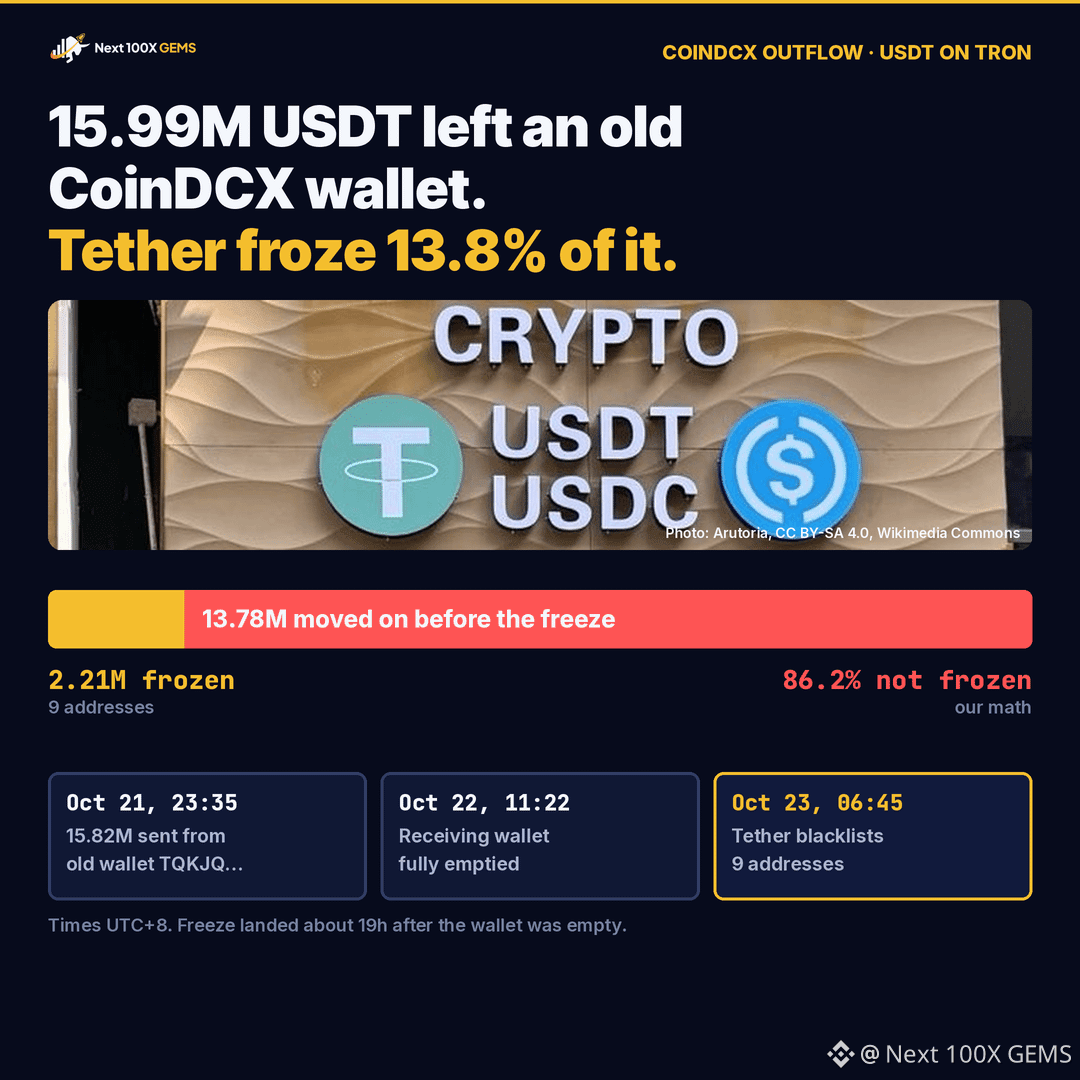
CoinDCX has now put a number on its TRON outflow: 15.99M USDT, lost from an old wallet it had called retired. Tether froze 2.21M of it. That is 13.8%.
On Oct 21 at 23:35 UTC+8, the old address TQKJQ sent 15,819,002 USDT in one transfer to a new wallet, which also took about 172,000 USDT from 39 smaller addresses. By 11:22 UTC+8 on Oct 22 that wallet had sent everything on to six addresses.
Tether blacklisted nine linked addresses at 06:45 UTC+8 on Oct 23, about 19 hours after the first wallet was empty. Those nine hold 2,212,850 USDT. By our math, about 13.78M, or 86.2%, had already moved on.
In a blog post on Oct 25, CoinDCX said the loss hit "old, deprecated wallet infrastructure which had unknown vulnerabilities", that its sweeping service had failed for a period, and that it absorbed the loss. It says customer balances are fully accounted for.
On-chain records read by CryptoWatchDesk show the same old address forwarding USDT as late as May 2026.
A freeze only catches what is still sitting still. Only deposit to the address your exchange app shows you today, never to one saved from before.
$USDT
#CoinDCX #Tether
NFA. DYOR.
149

𝙴𝙵𝙵𝙸𝙲𝙸𝙴𝙽𝙲𝚈 𝙸𝚂 𝚃𝙷𝙴 𝙽𝙴𝚆 𝙰𝙻𝙿𝙷𝙰.
Tether is expanding its ecosystem beyond stablecoin issuance by integrating AI automation into Bitcoin mining operations. By securing backing from industry giants like Bitmain and Canaan for its MDK platform, Tether is positioning itself as a critical infrastructure provider for the mining sector. This move signals a strategic shift toward optimizing hash rate efficiency and operational management through open source technology.
#Tether #BitcoinMining ⠀
63

·
--
October 23 and November 3. Blumenthal’s first deadline for Cantor Fitzgerald has passed, and the second is already for Tether itself
for the first one I promised to write on October 9. here it is: there is no public response from Cantor. the letter was only a request for information, not a subpoena, so the silence is lawful
on October 22, letters went to Tether and Nxum Group, the firm co-founded by Bo Hines
Hines left the White House in August 2025; now he runs Tether’s U.S. business
Tether agreed to pay Nxum $415000 a month, and more than $6 million in total has gone there — the senator wants a receipt for every payment
how I read this: from custodian to issuer, from questions about sanctions to money for a former official. each letter gets closer to Tether itself
for now these are letters from one senator, not a lawsuit. my USDT and USDC are sitting in Simple Earn Flexible, I’m not moving anything
on November 3 I’ll check whether Tether and Nxum replied — follow if you’re waiting
#Tether #Cantor

72

·
--
Tether makes its move! It spent $1 billion buying BTC—the stablecoin giant is starting to hoard crypto too $BTC $ETH
Stablecoin giant Tether just did something big: it used treasury funds to buy $1 billion worth of Bitcoin, marking the first time it has used such a large amount of its reserves to buy BTC.
You read that right—it’s Tether, the company behind USDT. It used to be more of a money-printing machine, but now it’s becoming a buyer.
Spending $1 billion shows that even giants are allocating stablecoin reserves to BTC. At this level, purchases provide real support for the market over the long term.
What do you think— is Tether buying BTC as a long-term investment or to support the market in the short term? Let’s discuss in the comments.
#Tether #Stablecoins
13
·
--
🔎 $USDT | Daily Market Brief
USDT at $0.9991: a tight peg, or a thin cushion?
At the snapshot taken 2026-10-25 00:28 UTC, Tether traded at $0.9991, about -0.09% from the assumed USD 1.00 reference, with a market cap of $182.5 billion and 24h volume of $36.6 billion. Market cap was roughly flat over 24 hours at -0.0%, and USDT ranked third by market cap. Supporters read the small deviation and deep volume as signs of a functioning peg, while critics note that a stablecoin's value rests on the credibility of its reserves rather than on trading activity alone.
Why it matters: For a stablecoin, the size of the deviation from $1.00 and the depth of trading volume are the practical measures of how well the peg is holding.
Data: CoinGecko, snapshot as of 2026-10-25 00:28 UTC. Not financial advice.
💬 Does a -0.09% deviation plus $36.6 billion in daily volume tell you more about peg stability than reserve disclosures do?
Source: CoinGecko https://www.coingecko.com/en/coins/tether
#Tether #Stablecoins
41

·
--
Tether makes its move: $1 billion in treasury USDT enters the market to buy BTC for the first time $BTC
Big news: Tether has used treasury funds for the first time, buying Bitcoin with $1 billion in USDT. Until now, it simply issued USDT and let the market do the buying. This time, it’s stepping in directly and buying up Bitcoin—a powerful signal.
The stablecoin giant buying BTC itself is tantamount to publicly taking Bitcoin’s side. Combined with the steady ETF inflows lately, institutional and whale money is lining up to enter the market. A $1 billion purchase is definitely no small move.
Do you think Tether is buying the dip or positioning itself ahead of time? Let’s discuss in the comments.#比特币 #Tether
93

·
--
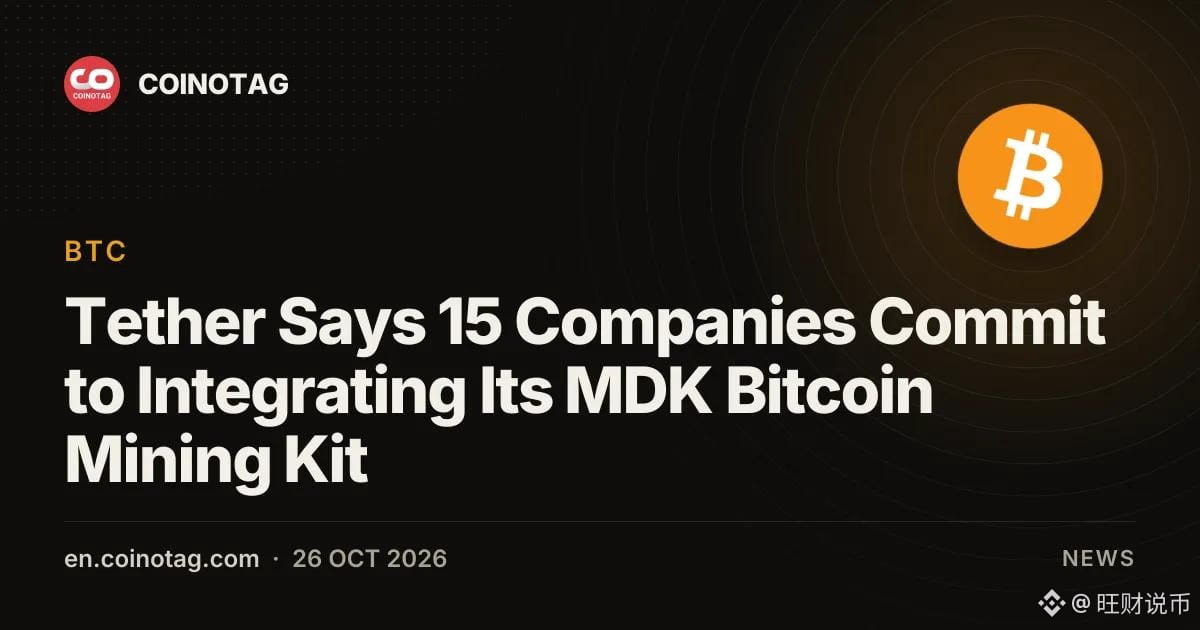
⛏️ Tether isn’t just issuing stablecoins anymore—it’s now looking to get involved in the “underlying systems” of Bitcoin mining!
According to Coinotag, 15 companies have committed to integrating Tether’s open-source mining toolkit, MDK. They include Bitmain, MicroBT, and Canaan—all three major mining hardware manufacturers. Its AI agent, QVAC, is also in trial operation.
👉 My take:
1️⃣ Mining hardware manufacturers adopting a unified open-source software stack could reduce miners’ reliance on closed mining pools and firmware
2️⃣ Tether is expanding from “issuing tokens and earning interest” into computing-power infrastructure, deepening its ecosystem ties
3️⃣ The short-term impact on BTC’s price is likely limited. BTC is currently around $79,429 (24h: -1.68%, CoinGecko), and the Fear & Greed Index is at 50, neutral. $80,000 remains a key resistance level, so it’s mostly a wait-and-see approach ahead of the FOMC
⚠️ Risk: A company’s “commitment to integrate” doesn’t mean it’s already implemented. The actual scale of deployment remains to be seen.
Do you think Tether’s move into mining is good for $BTC decentralization, or does it pose a concentration risk? Let’s discuss in the comments 👇
#Tether #比特币挖矿 #BTC
These are personal views only and do not constitute investment advice

·
--
TETHER PREPARES MINING REVOLUTION: WHAT DOES IT MEAN FOR THE CRYPTO MARKET?
While $BTC faces selling pressure, Tether is doubling down on crypto industry infrastructure.
15 companies have rallied around the Mining Development Kit (MDK) - Tether's open-source software toolkit for mining operations. Participants include industry leaders such as Bitmain, Bitdeer, Canaan, Foundry Digital, and Block's Proto.
The primary objective is to build a unified interface enabling miners to manage hardware and services across disparate manufacturers. Tether anticipates releasing a stable MDK 1.0 version before the end of 2026.
Market conditions, however, remain volatile: on October 24, Bitcoin dipped below 80,000 USD as liquidations amplified near-term price swings. This serves as a reminder that positive structural updates rarely trigger immediate price appreciation.
Long-term infrastructure growth strengthens the underlying crypto ecosystem. However, Tether's mining developments alone do not guarantee price gains for $USDT or $BTC .
#news #bitcoin #Tether #miningBTC
80
·
--
⚖️ $USDT | USDT at $0.9991: proof of a solid peg or a warning sign?
Tether traded at $0.9991 at the 2026-10-24 21:56 UTC snapshot, a deviation of -0.09% from the assumed USD 1.00 reference, with a $182.5 billion market cap and $39.8 billion in 24-hour volume. Supporters read that tiny gap as evidence that a deeply liquid, widely used dollar token keeps its peg under normal conditions. Critics counter that a near-perfect peg says little about reserve transparency or how redemptions would hold up under stress, since the price alone cannot show what backs the token.
Why it matters: A stablecoin's price shows only the surface of the peg; reserve quality and redemption design are what actually determine whether it holds under stress.
💬 Does a near-perfect peg like this reflect genuine reserve strength, or does it mainly reflect trust that hasn't yet been tested?
Source: Official site https://tether.to/
#Tether #Stablecoins
·
--
The Bitcoin mining industry is trying something very “infrastructure-like”: standardizing interfaces. On October 24, Tether announced that 15 mining hardware manufacturers, mining pools, and mining farm operators—including Bitmain, Canaan, MicroBT, Bitdeer, F2Pool, Foundry Digital, and Luxor—had committed to building and maintaining integrations for its open-source Mining Development Kit (MDK).
The approach is for each company to write an MDK Worker that translates its own hardware, mining pool, or system interfaces into MDK’s common format. This means monitoring tools and AI operations agents won’t have to be rewritten for every type of equipment. Tether said its QVAC mining agent is already running on MDK, with the goal of releasing the first stable 1.0 version by the end of 2026.
It’s worth taking a level-headed view: this announcement is a “commitment to build integrations” and offers no data on efficiency gains or cost savings. With hashprice under pressure, tools that can streamline operations are certainly appealing, but their ultimate impact will depend on actual adoption after version 1.0 is released.
#比特币挖矿 #Tether #BTC #开源 $BTC $USDT
246

Tether’s response to the Bo Hines situation made me laugh: the lawyers they hired looked into it and “found no wrongdoing.”
That’s like an exchange issuing its own audit report saying it has sufficient reserves. Everyone who’s been around this industry long enough knows: whoever pays gets the conclusion they want.
Let’s lay out the timeline. On October 22, Senator Blumenthal sent Tether and Nxum a letter requesting payment records and wallet addresses, with a deadline of November 3. According to the WSJ, Nxum received about $6.3 million; some reports put it at $415,000 a month. Hines co-founded Nxum, and the payments came in while he was overseeing crypto policy at the White House and working on the GENIUS Act. Now he’s at Tether, running its U.S. business.
A policy adviser helps set stablecoin rules while collecting consulting fees from the biggest stablecoin issuer, then goes to work for that same company. The revolving door spins so smoothly—do I really need a lawyer to tell me there’s “nothing wrong”?
But don’t get carried away. This letter asks for voluntary cooperation; it’s not a subpoena. Whether Tether hands anything over by November 3, and how much, is entirely up to them. Three days later, accounts posting breaking news in various languages are still repeating “major investigation,” most with only a few dozen views. More emotion than facts.
My take: no real impact on U in the short term, so don’t use this as a reason to short anyone. What’s really worth watching is which provisions in the GENIUS Act are especially favorable to Tether. That’s what those consulting fees bought.
#Tether #Stablecoins
3
·
--
⚖️ $USDT | USDT at $0.9993: a tight peg, or a rounding trick?
At the 2026-10-24 18:40 UTC snapshot, Tether traded at $0.9993, a deviation of -0.07% from the assumed USD 1.00 reference, with a 24h change of +0.0% and a market cap of $182.5 billion on $40.6 billion in volume. One reading is that this is routine noise, since a fraction of a cent sits well inside normal stablecoin mechanics. The other is that any persistent gap, however small, is worth watching because the peg is the product, and holders rely on redemption at par rather than on daily price ticks.
Why it matters: For a stablecoin, the meaningful question is not the daily move but whether the peg holds and redemptions work at par.
💬 Does a -0.07% deviation tell you anything about USDT's peg, or is it just noise that distracts from reserves and redemption design?
Source: Official site https://tether.to/
#Tether #Stablecoins

·
--
Bullish
$BTC 🪙 Conduit has sued #Tether over the freeze of 2,760,000 USDT, which the company has been unable to access for more than a year.
Conduit is demanding the return of the funds and compensation of at least the same amount.
$USDT #RiskManagementMastery
{spot}(BTCUSDT)
$BTC 🪙 Conduit has sued #Tether over the freeze of 2,760,000 USDT, which the company has been unable to access for more than a year.
Conduit is demanding the return of the funds and compensation of at least the same amount.
$USDT #RiskManagementMastery
Conduit is demanding the return of the funds and compensation of at least the same amount.
$USDT #RiskManagementMastery

110
Log in to explore more content
Join global crypto users on Binance Square
⚡️ Get latest and useful information about crypto.
💬 Trusted by the world’s largest crypto exchange.
👍 Discover real insights from verified creators.
Email / Phone number
Trending Topics
1
#BinancePick
3.1M views
152,999 Discussing
2
#EarningsSeason
5.3M views
26,021 Discussing
3
#AnthropicTTMRevenueGrewAbout1200%
31,436 views
430 Discussing
4
#AnthropicS1ExpectedToday
27,028 views
353 Discussing
5
#SouthKoreaReportedlyWeighsFourthCryptoTaxDelay
31,293 views
480 Discussing
6
#FranklinTempletonFilesForTwoDividendToBitcoinETFs
41,297 views
547 Discussing
7
#StrategyMSTRSurpassesNasdaqInMarketCap
31,478 views
390 Discussing
8
#CanadaProposesStablecoinRedemptionWithin3BusinessDays
1,352 views
36 Discussing
9
#ElectrumWalletBugLetRogueServersStealFunds
31,702 views
470 Discussing
10
#ArgentineCourtDismissesLIBRACaseAgainstMilei
47,393 views
587 Discussing