
#pmi
pmi
121,686 views
396 Discussing
Hot
Latest

·
--
The statistics bureau’s October PMI figures released today have put a damper on the weekend: manufacturing came in at 49.3%, down 0.8 points from September, versus Reuters’ poll forecast of 50.0. New orders were 49.4% and production 49.8%—both supply and demand cooled, with only high-tech manufacturing still in expansion territory at 51.3%.
Now compare that with this week’s A-share weekly performance: the Shanghai Composite fell 2.48%, dropping below 3,600; the ChiNext fell 10.08%; and the STAR 50 fell 13.72%. The Shanghai Composite has now posted six consecutive weekly bearish candles. Banks, by contrast, rose 4.97% for the week, with ICBC and CCB hitting fresh highs—capital is flocking overwhelmingly to defensive plays.
From a Chan Theory perspective, after a sharp, sustained decline like this in the ChiNext, wait for a weekly-level divergence before talking about a bottom. Don’t rush to buy the dip before that divergence appears. At least the 10-year government bond yield has already fallen to around 1.63%, so there’s no shortage of money in the market; what’s missing is risk appetite.
When the market opens next Monday, do you think the PMI bad news will be priced in, or will growth stocks keep getting hammered?
#A股 #PMI
This is not investment advice.
71

·
--
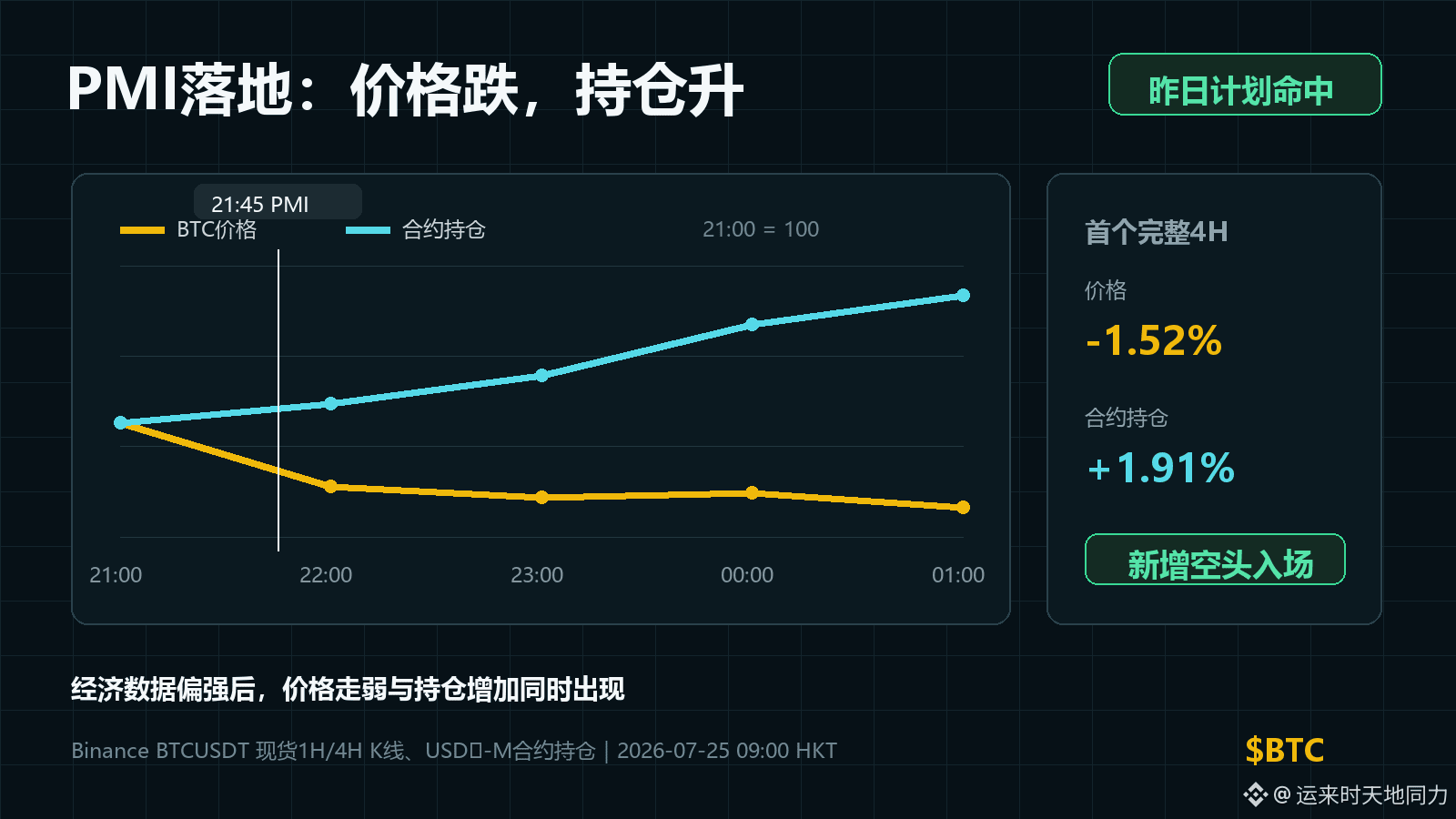
$BTC Last night after the PMI was released, prices fell and open interest rose; the bearish branch I planned yesterday hit. Yesterday at 21:45 I was waiting for the U.S. July PMI: the composite index rose from 51.9 to 53.6, meaning economic activity was stronger than last month, and companies’ rate of price increases is also accelerating.
In the first full 4H after the news landed, BTC fell from 65,083 to 64,094, while contract open interest actually increased by 1.91%. This suggests that during the decline, someone actively opened short positions—it's not only long holders passively exiting. Therefore, the conditions I set yesterday were confirmed.
After that, price did not show any clear rebound, and open interest did not decrease. Next, we’ll see whether the new shorts continue to stay open: if the price stops falling and open interest drops, it means shorts take profit and exit; if the price keeps weakening and open interest rises again, it means actively opening shorts is still increasing.
#BTC #交易复盘 #PMI
173

·
--
Newly released US production data is sending fairly mixed signals.
Specifically, the ISM Manufacturing PMI index reached 55.6 points, beating expectations quite clearly versus the forecast of 53.9 (the previous period was 53.3), indicating that factory activity is growing more strongly than expected. In contrast, S&P Global’s Manufacturing PMI index was flat at 53.9 points, reflecting that this sector is still maintaining a steady pace.
#Economy #US #PMI $USD $BTC
$NEAR

117

·
--
The newly released U.S. manufacturing data is sending some fairly mixed signals.
Specifically, the ISM Manufacturing PMI index reached 55.6 points, beating expectations quite clearly versus the forecast of 53.9 (the prior period was 53.3), indicating that factory activity is growing much more strongly than expected. By contrast, S&P Global’s Manufacturing PMI remained flat at 53.9 points, reflecting that this sector is still maintaining a stable pace.
#Economy #US #PMI $USD $BTC
$NEAR

135

·
--

Article
Macroeconomy Weekly Outlook Week of August 31 – September 6, 2026$BTC Macroeconomy Weekly Outlook☕️
Weekly Bias: 🟩Bullish | Strong bullish trend intact with ADX confirming strength. RSI cooling to 72 from 82, still overbought but healthy pullback. TD Sequential at 3 Down suggests the correction may be nearing exhaustion. Key catalysts this week: China PMI, ISM Manufacturing, JOLTS, ADP, Jobless Claims, and the mother of all data – NFP on Friday.
Monday, 31 Aug: 🟩 Green. China Manufacturing PMI forecast at 49.5 from 49.2 previous, a slight recovery. China Non-Manufacturing PMI at 49.5 from 49.0 previous. Chicago PMI at 13:45 UTC forecast at 57.8 from 57.6 previous, a slight beat. Japanese Capital Spending at 23:50 UTC forecast at -0.2% from 0.0% previous.
Monday is a data-light session with China data as the headline catalyst. China Manufacturing PMI is expected to recover slightly from 49.2 to 49.5, still in contraction but improving. This is a mild bullish signal for global growth. Chicago PMI is expected to beat slightly at 57.8 from 57.6, a green signal that could strengthen the DXY. However, the market is still digesting the Jackson Hole rhetoric, which leans dovish. Teacher expects green on Monday with Blackrock buying. The structural bull case remains intact.
Prediction: Bitcoin volatile with price range $77,500~$79,500
Direction: 🟩Bullish
Tuesday, 1 Sep: 🟨 Sideways. China RatingDog Manufacturing PMI at 01:45 UTC forecast at 51.5 from 50.9 previous, a beat. S&P Global Manufacturing PMI at 13:45 UTC forecast at 53.2 from 53.2 previous, flat. ISM Manufacturing PMI at 14:00 UTC forecast at 55.2 from 55.6 previous, a slight drop. ISM Manufacturing Prices at 71.2 from 71.1 previous, flat. JOLTS Job Openings at 14:00 UTC forecast at 7.330M from 7.359M previous, a drop. Fed Vice Chair Barr speaks at 13:05 UTC.
Tuesday is packed with manufacturing and labour data. ISM Manufacturing is expected to drop from 55.6 to 55.2, a dovish cooling signal that weakens the DXY and supports Bitcoin. JOLTS is expected to drop from 7.359M to 7.330M, another dovish labour signal. S&P Global PMI is flat at 53.2. The data leans dovish overall. However, Barr speaking is a wildcard. Teacher predicts Bitcoin will be sideways with Blackrock selling into strength. Expect a range-bound session with a slight bullish skew.
Prediction: Bitcoin slow with price range $77,000~$79,000
Direction: 🟨Sideways
Wednesday, 2 Sep: 🟩 Green. ADP Nonfarm Employment Change at 12:15 UTC forecast at 47K from 44K previous, a slight recovery. Factory Orders at 14:00 UTC forecast at 0.6% from -0.3% previous, a significant recovery. Crude Oil Inventories at 14:30 UTC forecast at 0.095M from 0.095M previous, flat. Beige Book at 18:00 UTC.
Wednesday is ADP and Factory Orders day. ADP is expected to recover from 44K to 47K, a green signal that strengthens the DXY and pressures Bitcoin. Factory Orders are expected to recover sharply from -0.3% to 0.6%, another green signal. Crude Oil Inventories are flat at 0.095M. The data leans green, which should pressure Bitcoin. However, Teacher predicts Bitcoin will be green on Wednesday, arguing that the ADP number is still "hina" (low) and not enough to give the Fed room to be hawkish. The Beige Book will likely confirm slowing growth. Expect a green day with a potential pump towards 80k.
Prediction: Bitcoin volatile with price range $77,500~$80,000
Direction: 🟩Bullish
Thursday, 3 Sep: 🟥 Red. Japanese Services PMI at 00:30 UTC forecast at 52.3 from 52.3 previous, flat. Initial Jobless Claims at 12:30 UTC forecast at 205K from 203K previous, a rise. Continuing Claims at 1,778K from 1,778K previous, flat. Trade Balance at 12:30 UTC forecast at -86.40B from -73.30B previous, a widening deficit. ISM Non-Manufacturing PMI at 14:00 UTC forecast at 54.1 from 54.1 previous, flat. ISM Non-Manufacturing Prices at 70.3 from 70.3 previous, flat. Fed Walker speaks at 14:00 UTC. Atlanta Fed GDPNow at 4.0% from 4.3% previous, a drop.
Thursday is Jobless Claims and ISM Services day. Initial Jobless Claims are expected to rise from 203K to 205K, a dovish labour signal that should weaken the DXY and support Bitcoin. However, ISM Non-Manufacturing PMI is flat at 54.1, neutral. Trade Balance widening to -86.40B from -73.30B is a structural dollar negative. The data leans dovish, but Teacher predicts Bitcoin will be red on Thursday with Blackrock selling. Expect a pullback towards 77k.
Prediction: Bitcoin volatile with price range $76,500~$78,500
Direction: 🟥Bearish
Friday, 4 Sep: 🟩🟥 Volatile. NFP Day. Nonfarm Payrolls at 12:30 UTC forecast at 58K from -23K previous, a recovery. Average Hourly Earnings forecast at 0.3% from 0.1% previous, a rise. Unemployment Rate forecast at 4.1% from 4.1% previous, flat. Private Nonfarm Payrolls at 50K from 30K previous. Participation Rate at 61.4%.
Friday is the absolute king of the week. NFP is expected to recover from -23K to 58K, a significant improvement but still historically weak. Average Hourly Earnings are expected to rise from 0.1% to 0.3%, a green signal that could cap the upside. Unemployment rate flat at 4.1%. The data is mixed but leans dovish overall. Teacher predicts Bitcoin will be green on Friday with Blackrock buying big. However, Friday is always a pump and dump day. The weekend war premium and profit-taking will trigger a dump after the initial spike. Expect a pump towards 81k, followed by a dump towards 79k.
Prediction: Bitcoin volatile with price range $78,000~$81,500
Direction: 🟩Bullish then 🟥Bearish (Pump and Dump)
Saturday, September 5
Analysis: Weekend. No data. Markets closed. Geopolitical headlines (War Premium) may emerge. It is advisable to not trade on weekend, rest well and have fun with family and friends.
Prediction: Bitcoin slow with range $78,000~$79,500 because no data/holiday/no institution movement.
Direction: 🟨Sideways☕️
Sunday, September 6
Analysis: OPEC Meeting at 10:00 UTC. Potential oil supply decision. Geopolitical headlines (War Premium) may emerge. It is advisable to not trade on weekend, rest well and have fun with family and friends.
Prediction: Bitcoin slow with range $78,000~$79,500 because no institution movement. OPEC meeting is a wildcard.
Direction: 🟨Sideways☕️
Bias: The structural bull case remains intact. NFP is expected to recover from -23K to 58K, but this is still historically weak and does not give the Fed room to be hawkish. The Treasury buyback narrative, yen weakness, and Jackson Hole dovish rhetoric continue to provide a tailwind. The pullback to 77.7k is healthy and likely finished. The next leg higher towards 82k is expected, driven by NFP weakness and Blackrock inflows. Risk management is key. Weekend war risks remain the wildcard.
#NFA #DYOR 🔥
Not a futures signal🛑
$ETH $BNB #PMI #jolts #ISM #ADP #NFP
Macroeconomy Weekly Outlook Week of August 31 – September 6, 2026
$BTC Macroeconomy Weekly Outlook☕️
Weekly Bias: 🟩Bullish | Strong bullish trend intact with ADX confirming strength. RSI cooling to 72 from 82, still overbought but healthy pullback. TD Sequential at 3 Down suggests the correction may be nearing exhaustion. Key catalysts this week: China PMI, ISM Manufacturing, JOLTS, ADP, Jobless Claims, and the mother of all data – NFP on Friday.
Monday, 31 Aug: 🟩 Green. China Manufacturing PMI forecast at 49.5 from 49.2 previous, a slight recovery. China Non-Manufacturing PMI at 49.5 from 49.0 previous. Chicago PMI at 13:45 UTC forecast at 57.8 from 57.6 previous, a slight beat. Japanese Capital Spending at 23:50 UTC forecast at -0.2% from 0.0% previous.
Monday is a data-light session with China data as the headline catalyst. China Manufacturing PMI is expected to recover slightly from 49.2 to 49.5, still in contraction but improving. This is a mild bullish signal for global growth. Chicago PMI is expected to beat slightly at 57.8 from 57.6, a green signal that could strengthen the DXY. However, the market is still digesting the Jackson Hole rhetoric, which leans dovish. Teacher expects green on Monday with Blackrock buying. The structural bull case remains intact.
Prediction: Bitcoin volatile with price range $77,500~$79,500
Direction: 🟩Bullish
Tuesday, 1 Sep: 🟨 Sideways. China RatingDog Manufacturing PMI at 01:45 UTC forecast at 51.5 from 50.9 previous, a beat. S&P Global Manufacturing PMI at 13:45 UTC forecast at 53.2 from 53.2 previous, flat. ISM Manufacturing PMI at 14:00 UTC forecast at 55.2 from 55.6 previous, a slight drop. ISM Manufacturing Prices at 71.2 from 71.1 previous, flat. JOLTS Job Openings at 14:00 UTC forecast at 7.330M from 7.359M previous, a drop. Fed Vice Chair Barr speaks at 13:05 UTC.
Tuesday is packed with manufacturing and labour data. ISM Manufacturing is expected to drop from 55.6 to 55.2, a dovish cooling signal that weakens the DXY and supports Bitcoin. JOLTS is expected to drop from 7.359M to 7.330M, another dovish labour signal. S&P Global PMI is flat at 53.2. The data leans dovish overall. However, Barr speaking is a wildcard. Teacher predicts Bitcoin will be sideways with Blackrock selling into strength. Expect a range-bound session with a slight bullish skew.
Prediction: Bitcoin slow with price range $77,000~$79,000
Direction: 🟨Sideways
Wednesday, 2 Sep: 🟩 Green. ADP Nonfarm Employment Change at 12:15 UTC forecast at 47K from 44K previous, a slight recovery. Factory Orders at 14:00 UTC forecast at 0.6% from -0.3% previous, a significant recovery. Crude Oil Inventories at 14:30 UTC forecast at 0.095M from 0.095M previous, flat. Beige Book at 18:00 UTC.
Wednesday is ADP and Factory Orders day. ADP is expected to recover from 44K to 47K, a green signal that strengthens the DXY and pressures Bitcoin. Factory Orders are expected to recover sharply from -0.3% to 0.6%, another green signal. Crude Oil Inventories are flat at 0.095M. The data leans green, which should pressure Bitcoin. However, Teacher predicts Bitcoin will be green on Wednesday, arguing that the ADP number is still "hina" (low) and not enough to give the Fed room to be hawkish. The Beige Book will likely confirm slowing growth. Expect a green day with a potential pump towards 80k.
Prediction: Bitcoin volatile with price range $77,500~$80,000
Direction: 🟩Bullish
Thursday, 3 Sep: 🟥 Red. Japanese Services PMI at 00:30 UTC forecast at 52.3 from 52.3 previous, flat. Initial Jobless Claims at 12:30 UTC forecast at 205K from 203K previous, a rise. Continuing Claims at 1,778K from 1,778K previous, flat. Trade Balance at 12:30 UTC forecast at -86.40B from -73.30B previous, a widening deficit. ISM Non-Manufacturing PMI at 14:00 UTC forecast at 54.1 from 54.1 previous, flat. ISM Non-Manufacturing Prices at 70.3 from 70.3 previous, flat. Fed Walker speaks at 14:00 UTC. Atlanta Fed GDPNow at 4.0% from 4.3% previous, a drop.
Thursday is Jobless Claims and ISM Services day. Initial Jobless Claims are expected to rise from 203K to 205K, a dovish labour signal that should weaken the DXY and support Bitcoin. However, ISM Non-Manufacturing PMI is flat at 54.1, neutral. Trade Balance widening to -86.40B from -73.30B is a structural dollar negative. The data leans dovish, but Teacher predicts Bitcoin will be red on Thursday with Blackrock selling. Expect a pullback towards 77k.
Prediction: Bitcoin volatile with price range $76,500~$78,500
Direction: 🟥Bearish
Friday, 4 Sep: 🟩🟥 Volatile. NFP Day. Nonfarm Payrolls at 12:30 UTC forecast at 58K from -23K previous, a recovery. Average Hourly Earnings forecast at 0.3% from 0.1% previous, a rise. Unemployment Rate forecast at 4.1% from 4.1% previous, flat. Private Nonfarm Payrolls at 50K from 30K previous. Participation Rate at 61.4%.
Friday is the absolute king of the week. NFP is expected to recover from -23K to 58K, a significant improvement but still historically weak. Average Hourly Earnings are expected to rise from 0.1% to 0.3%, a green signal that could cap the upside. Unemployment rate flat at 4.1%. The data is mixed but leans dovish overall. Teacher predicts Bitcoin will be green on Friday with Blackrock buying big. However, Friday is always a pump and dump day. The weekend war premium and profit-taking will trigger a dump after the initial spike. Expect a pump towards 81k, followed by a dump towards 79k.
Prediction: Bitcoin volatile with price range $78,000~$81,500
Direction: 🟩Bullish then 🟥Bearish (Pump and Dump)
Saturday, September 5
Analysis: Weekend. No data. Markets closed. Geopolitical headlines (War Premium) may emerge. It is advisable to not trade on weekend, rest well and have fun with family and friends.
Prediction: Bitcoin slow with range $78,000~$79,500 because no data/holiday/no institution movement.
Direction: 🟨Sideways☕️
Sunday, September 6
Analysis: OPEC Meeting at 10:00 UTC. Potential oil supply decision. Geopolitical headlines (War Premium) may emerge. It is advisable to not trade on weekend, rest well and have fun with family and friends.
Prediction: Bitcoin slow with range $78,000~$79,500 because no institution movement. OPEC meeting is a wildcard.
Direction: 🟨Sideways☕️
Bias: The structural bull case remains intact. NFP is expected to recover from -23K to 58K, but this is still historically weak and does not give the Fed room to be hawkish. The Treasury buyback narrative, yen weakness, and Jackson Hole dovish rhetoric continue to provide a tailwind. The pullback to 77.7k is healthy and likely finished. The next leg higher towards 82k is expected, driven by NFP weakness and Blackrock inflows. Risk management is key. Weekend war risks remain the wildcard.
#NFA #DYOR 🔥
Not a futures signal🛑
$ETH $BNB #PMI #jolts #ISM #ADP #NFP
1
138

·
--
Tim Moore, Global Economics Director at S&P Global, disclosed in the latest UK August Purchasing Managers’ Index (PMI) report that the final UK services PMI reading rebounded from 52.1 in July to 52.5 in August, the highest pace of growth since April this year. With the services sector—the main pillar of the UK economy—recording expansion for the second month in a row, business and consumer spending has shown a degree of resilience after an earlier pullback. However, this final reading is slightly below the market consensus of 52.8. More importantly, the report clearly noted a significant increase in the number of companies reporting rising costs, with signs that inflation pressure is starting to build.
From a macro perspective, this seemingly moderate expansion masks risks of stagflation. As a key source of core inflation, the services sector’s renewed rise in cost and price pressures directly undermines the optimistic narrative in the market that inflation will fall steadily. For the Bank of England, given stubborn cost-side pressures, any premature or overly aggressive rate-cutting move could trigger a second round of inflation. This data not only dispels fantasies of a rapid pivot to easing, but further reinforces the policy logic that interest rates will remain at a high level for longer.
In traditional financial markets, persistent cost pressure combined with sticky inflation will provide upward support to UK government bond yields, delaying the normalisation of the yield curve. Although the pound may receive a temporary boost as rate-cut expectations cool, this resilience—driven by cost pressure rather than productivity gains—will in reality erode companies’ forward profit margins, thereby exerting an implicit drag on valuations of risk assets such as equities. As a result, global capital markets’ risk appetite faces further contraction.
For the crypto asset market, with major overseas central banks being constrained by sticky inflation and postponing the release of liquidity, the macro liquidity environment is unlikely to provide incremental momentum in the near term. Under the double squeeze of persistently high real interest rates and uncertainty in the geopolitical situation, risk assets represented by bitcoin are likely to remain in a defensive period characterised by limited liquidity. Investors should be highly alert to the risk of asset price pullbacks when rate-cut expectations repeatedly fail to materialise.
#英国经济 #PMI #Inflation
50

According to the latest data released by S&P Global, the UK’s services sector PMI for September came in at 51.7, not only below the market expectation of 52.0, but also clearly down from the previous reading of 52.5, marking the lowest level in nearly three months. Meanwhile, driven by rising energy costs prompted by the geopolitical situation in the Middle East, the services-sector price growth rate hit a new high in nearly four months. Chris Williamson, Chief Economist at S&P Global, said that the quarter’s UK economic growth rate on a quarter-on-quarter basis is expected to slow to 0.1%, presenting a complex situation in which business activity growth is slowing while inflationary pressure persists.
From a macroeconomic fundamentals perspective, this data shows that the Bank of England (BOE) is facing a dual challenge of weak economic growth and sticky inflation. Although the momentum of services-sector expansion has weakened, the rebound in the price index within the indicators suggests that the tight monetary environment may last longer. However, from a technical and funding-game perspective, a slowdown in real-economy growth typically forces monetary authorities to accelerate policy shifts, which would limit the room for further rate hikes—potentially providing support for long-term liquidity easing.
In financial markets, the British pound exchange rate and UK government bond yields saw wide-ranging volatility after the data release. Although sticky inflation dampens expectations for rate cuts in the short term, as the economic data cools clearly, market pricing for how long high interest rates will be maintained is being recalibrated. As funds seek tools to hedge against erosion of the currency’s purchasing power and macro uncertainty, the underlying support logic for both global risk assets and safe-haven assets is gradually strengthening.
For the crypto market, macro-level concerns about inflation and slowing growth are often catalysts for funds to shift from traditional systems to inflation-hedging assets. $BTC has demonstrated very strong resilience to drawdowns at a key support level, and its technical structure has maintained a benign consolidation trend. As major global central banks will eventually turn toward easing to address economic downturns, expectations of abundant liquidity are likely to become the core driver pushing digital assets into the next upward leg.📊
#PMI #Inflation #CryptoMarket
82

·
--
Fresh macroeconomic data released on September 3 reveals a notable acceleration in the United States service sector for August. The US Services PMI rose sharply from 54.6 to 56.5, recording its strongest expansion since December 2024, while the ISM Services index climbed from 54.1 to 55.4, easily beating expectations. As highlighted by S&P Global Market Intelligence economist Usamah Bhatti, private sector activity is regaining significant momentum despite ongoing supply chain bottlenecks and elevated price pressures.
This robust rebound underscores the resilient foundation of the US economy compared to other global peers, diminishing immediate recession fears. However, persistent cost pressures embedded in the services sector complicate the inflation trajectory, suggesting that price stability might take longer to achieve than previously anticipated.
For traditional markets, such strong economic readings typically reduce the urgency for aggressive Federal Reserve rate cuts. Treasury yields and the US Dollar Index often find support in this backdrop, creating short-term headwinds for non-yielding assets like gold.
In crypto markets, resilient growth reduces systemic economic risks, but persistent yields and delayed monetary easing could temporarily limit speculative liquidity for $BTC and altcoins. Investors should watch whether steady growth eventually transitions into renewed risk-on appetite.
#macro #PMI #economy
53
The U.S. Institute for Supply Management (ISM) and S&P Global released the latest August economic survey data on September 3. The data show that the U.S. August services PMI rose from 54.6 to 56.5, recording the strongest expansion since December 2024. Meanwhile, the ISM services PMI also increased from 54.1 to 55.4, exceeding market expectations of 54.1 and hitting a new interim high. The figures confirm that the U.S. economy demonstrated strong resilience during the third quarter, with business activity in the private sector accelerating across the board.
From a macro fundamentals perspective, services—the core pillar of the U.S. economy—has delivered robust performance that effectively alleviates prior market concerns about a hard landing. Although the August services PMI was slightly lower than the initial estimate of 56.8 and manufacturing growth has shown some slowdown, the overall index has remained in a high range well above the 50-point boom-bust line, indicating that the underlying strength of the economy is still better than that of most other major global economies. This provides solid fundamental support for the valuation of risk assets.
In traditional financial markets, the upside rebound in economic data beyond expectations has strengthened the soft-landing narrative. While some supply-chain delays and price pressures persist and may make the rate-cut path more gradual, strong macro growth momentum directly boosts market risk appetite. The U.S. dollar index has remained in a range-bound consolidation near a key resistance level. The yield curve on U.S. Treasuries has gradually flattened, and risk assets such as U.S. equities have shown a healthy pullback-and-build-up pattern.
For the crypto market, macroeconomic resilience is a catalyst for the long-term return of liquidity. As fears of recession are disproven by fundamentals, the willingness of incremental off-exchange capital to enter the market is warming up. After $BTC completes the clearing of positions in the key technical support range, the price action shows the classic bottoming-and-higher-low structure. Driven by a rebound in risk appetite, bullish momentum is accumulating; if subsequent volume can effectively expand, crypto assets may be set for another round of upside breakout行情.
#PMI #美国经济 #Cryptocurrency
191
·
--
The latest data released by the Institute for Supply Management (ISM) shows that in August, the non-manufacturing PMI came in at 55.4—up not only from the prior reading of 54.1, but also clearly above the market’s general expectation of 54.2. This indicates that activity in the services sector continues to accelerate and expand.
This stronger-than-expected result highlights the resilience of the underlying U.S. economy—especially in the services sector. However, in the current macro environment, robust economic indicators are not entirely positive. A rebound in services activity suggests that inflation persistence may be more stubborn than previously expected. This directly undermines the market’s optimistic pricing for aggressive rate cuts by the Federal Reserve in the near term, making the monetary policy path once again full of uncertainty.
Against this backdrop, traditional financial markets responded quickly. The U.S. dollar index and U.S. Treasury yields gained upward momentum, and cooling expectations for rate cuts weighed on overall risk appetite. With tightening expectations unable to fade completely for some time, capital remains highly cautious toward assets trading at high valuations, and cross-market liquidity is far from ample.
For the crypto market, the thwarted expectation of looser macro liquidity directly puts valuation pressure on risk assets led by $BTC . In the absence of incremental liquidity injections, the market is prone to quickly revert to a defensive mode. Investors should be alert to the pullback risk stemming from near-term macro data disruptions and should not blindly chase additional gains.
#PMI #美联储 #Macroeconomy
38
·
--
S&P Global’s latest release shows the final value of the U.S. manufacturing purchasing managers’ index (PMI) for September. The data indicates that the indicator ultimately came in at 55.9, which is not only below the prior reading of 57, but also reflects signs of a marginal slowdown in the expansion momentum of U.S. manufacturing.
Although the data remains in the expansion zone above the 50 break-even line, the sharp drop in the pace of expansion cannot be ignored. Against the backdrop of the Federal Reserve’s recent return to a tighter policy path, the cost and interest-rate pressures faced by real manufacturing are beginning to show up, and market assessments of economic growth resilience may need to be recalibrated.
The macro-financial markets have reacted in a defensive manner. Signals of slower economic growth may weigh on the U.S. dollar index in the near term, while fluctuations in the U.S. Treasury yield curve are in focus. If overall risk-off sentiment intensifies, it could also limit upside potential for commodities and traditional risk assets.
For the crypto market, weaker macro fundamentals are not simply a positive for rate cuts; they instead intensify concerns about stagflation during a period of liquidity contraction. In the absence of strong incremental capital inflows, core assets such as $BTC may face greater near-term volatility and adjustment pressure. Investors should be alert to downside risks stemming from a decline in sentiment.📉
#MacroEconomics #PMI #CryptoMarket
108
·
--
S&P Global released preliminary US Purchasing Managers’ Index (PMI) data for October today. The preliminary US manufacturing PMI came in at 56, significantly above the market forecast of 55.5 and the previous reading of 55.9, reaching its highest level in nearly 53 months. The preliminary services PMI came in at 57.9, slightly below the forecast of 58.0 and the previous reading of 58.8, while the composite PMI remained firmly in expansion territory at 57.6.
The sharp rebound in manufacturing activity reflects the continued resilience of the US real economy, but also reinforces expectations that inflation will remain sticky. With concerns about inflation still lingering, stronger-than-expected output data has directly weakened bets on a rapid shift toward accommodative monetary policy, putting rate-cut trades to a severe repricing test.
As a result, risk appetite in traditional financial markets came under clear pressure. The S&P 500 and Nasdaq both fell to nearly five-week lows, down 0.4% and 0.2%, respectively, on the day. Meanwhile, supported by economic resilience, the dollar index and US Treasury yields remained elevated, continuing to weigh on the valuations of risk assets.
For crypto markets, a meaningful easing of macro liquidity conditions appears unlikely in the short term, dampening investors’ appetite for high-volatility assets. If an overheated economy prompts central banks to maintain a hawkish stance, $BTC could face valuation pressure from tighter liquidity. Investors should remain highly cautious and guard against the risk of a second bottom.📉
#PMI #USMarket #MacroEconomics
40
The Institute for Supply Management (ISM) has released its latest non-manufacturing PMI data for August. The actual reading was 55.4, which not only rose above the prior figure of 54.1, but also clearly exceeded the market’s common expectation of 54.2. The expansion momentum in the services sector remains strong, further confirming the resilient performance of the U.S. economy’s fundamentals.
From a macro perspective, non-manufacturing accounts for more than two-thirds of the U.S. economy. This data has continued to stay in the robust expansion range above the 50 boom-or-bust line, effectively dispelling earlier market concerns that the economy might be headed for a “hard landing.” Against the backdrop of gradually controlled inflation, the strong and resilient economic fundamentals provide solid support for a soft-landing narrative. There are no signs that the fundamentals are beginning to lose momentum.
In traditional financial markets, after the data was released, U.S. Treasury yields and the U.S. dollar index stabilized in the short term and then moved higher. Risk appetite in equities has remained positive. Healthier macroeconomic data further reduces the probability of systemic liquidity risks, creating a relatively sound macro environment for valuation repair across risk assets.
For the crypto market, while overly aggressive expectations for rate cuts have eased, the steady solidity of the economic base is more favorable for a stable and well-timed inflow of liquidity over the long run. Supported by fundamentals, defensive selling pressure has been effectively absorbed. Bitcoin $BTC ’s structural uptrend is expected to be further consolidated, and once liquidity buildup is complete, it will be more conducive to the start of a new round of technical breakthroughs.
#PMI #美国经济 #Macro analysis
135
According to the latest data released by S&P Global in August, the eurozone’s August services PMI final reading came in at 51.6, slightly below the prior value and the market expectation of 51.7. The composite PMI was 52.0, remaining in the expansion zone above the 50 breakeven level. Although the expansion slope for the services sector eased modestly to a two-month low, the overall fundamentals of the private sector still hold up a steady growth trend.
From a macro structural perspective, the 51.6 figure indicates that overall demand in the eurozone remains resilient and has not suffered a sudden and sharp weakening. S&P senior economist Joe Hayes said the economic growth logic for the third quarter still stands: the rebound in industry and the services sector’s ability to resist downturns effectively offset pressure from energy price volatility. While the data came in slightly short of expectations, it essentially gives the European Central Bank greater room to cut rates and implement further easing.
In terms of macro financial asset reactions, the economy is in the “sweet spot” of moderate expansion with easing inflation. This directly suppresses excessive upward pressure on core eurozone government bond yields, and limits the upside momentum of the U.S. dollar index. Expectations that liquidity at the margin is becoming looser are strengthening, creating an excellent technical “bottom support” for a price repair in risk assets.
For the crypto market, improved expectations for macro liquidity support is favorable for a rebound in risk appetite. $BTC and the market’s mainstream assets currently show strong acceptances/holding power around key technical moving averages. With no major macro negative shocks hitting the market, the positioning structure is further stabilized. As market pricing of the global rate-cutting cycle deepens, capital is expected to gradually shift from waiting on the sidelines to returning to the market, driving the crypto assets into a new round of technical bullish rebounds.
#eurozone #PMI #Macroeconomic Analysis
57
S&P Global has released the latest initial data for Germany’s September manufacturing PMI, which came in at 53.8, below market expectations of 54.0, and slightly down from the prior value of 54.3. Although the data shows a mild downward trend, the overall index remains comfortably above the 50 boom-bust line, indicating that manufacturing activity in Europe’s largest economy is still in an expansionary range and there are no signs of a hard landing.
From a technical and macro-cycle perspective, this slight pullback in the PMI is entirely within a healthy adjustment range that the market can absorb. Combined with the momentum repair that has persisted for several months, the narrow-range fluctuations of manufacturing data within the expansionary range represent a typical pattern of an upward continuation. This suggests that while Europe’s economy is affected by the lagged impact of a high-interest-rate environment, its underlying resilience is still sufficient to avoid systemic risks of a deep recession, providing a cushion for a smooth transition in subsequent macro liquidity.
In traditional financial markets, the easing of economic data effectively helps curb any secondary rebound in inflation expectations, thereby reinforcing the ECB’s dovish expectations for further rate cuts within the year. European and U.S. bond yields face downward pressure as they retreat, and the U.S. dollar index is nearing a loss of upward momentum at a key resistance level. For risk assets, stronger certainty around the rate-cut cycle typically means lower discount rates and marginal improvement in global liquidity, which offers solid technical support for risk exposures such as equities and commodities.
For crypto assets, the warming of expectations for ECB easing is gradually releasing incremental marginal liquidity. After $BTC completes a chip turnover at the high-level key support zone, the spillover effect driven by the macro decline in interest rates will become an important catalyst for breaking through the resistance level above. As long as core inflation does not unexpectedly run out of control, the macro logic of easier liquidity will continue to dominate the Q4 market, and the market has ample momentum to move into a stronger structural uptrend.📈
#PMI #MacroEconomics #CryptoMarkets
119

·
--
🟠 US PMIs Due: Will Data Drive Fed Pivot Hopes or Reinforce Rate Hike Fears?
The June US Flash PMIs are dropping Tuesday, and this isn't just another economic report. With the Fed ditching forward guidance, every data point becomes a potential market mover. Traders are scrambling to read the tea leaves, and these PMIs are the first big ones on the calendar. Expect the Services PMI to tick up slightly to 51, while Manufacturing might dip a hair to 54.7. The Composite should hold above 50, signaling continued expansion, but the devil is in the details. Keep a close eye on the inflation and employment sub-components. An uptick here could fuel more rate hike speculation 🔥, pushing the dollar higher and potentially crushing risk assets. Conversely, weaker numbers could spark a short-term USD slide. The market is desperate for direction, and this data could provide it, one way or another. The Fed wants us focused on the data, and this is the first major test of that strategy. Don't sleep on this one; it could set the tone for the week and beyond ⚡.
📊 Expect immediate USD volatility. Better-than-expected PMIs, especially with rising inflation, will likely strengthen the dollar and pressure BTC and ETH lower. Weaker data could offer a brief reprieve for risk assets.
#pmi #fed #dollar #inflation #employment
45

·
--
According to the latest data released on September 3 by S&P Global and the U.S. Institute for Supply Management (ISM), the U.S. services sector PMI for August rebounded significantly. Specifically, S&P Global’s services PMI rose from 54.6 to 56.5. Although it was slightly below the initial forecast of 56.8, it still posted the largest increase since December 2024. Meanwhile, the ISM non-manufacturing PMI also climbed from 54.1 to 55.4, beating the market expectation of 54.1. Overall, business activity in the private sector clearly accelerated, indicating that the U.S. economy remains resilient heading into the third quarter.
The key point in this data is that it once again breaks the market’s earlier single concern about a rapid economic downturn. S&P Global economist Usamah Bhatti noted that although economic momentum has recovered, supply-chain delays remain evident, and overall price pressures are still higher than the historical average. This means that while U.S. fundamentals are performing better than those of other major global economies, the “soft landing” outlook and worries about sticky inflation are once again in a tug-of-war, making judgments about the Federal Reserve’s subsequent policy path more nuanced.
For traditional financial markets, strong PMI data typically suppresses overly heated bets on aggressive rate cuts. In the short term, the U.S. dollar index and Treasury yields may receive some support, limiting the space for risk-free rates to fall rapidly. As funds repeatedly weigh the earnings support from a strong economy against borrowing costs that remain high for longer, U.S. stocks and assets such as gold have also entered a phase of two-sided observation.
For the crypto market, the mixed signals from macro data have increased the level of wait-and-see sentiment. On one hand, strong economic data alleviates fears of a deep recession and provides fundamental support for risk assets; on the other hand, it also delays a major easing of liquidity, causing $BTC and major cryptocurrencies to be more inclined toward range-bound trading in the near term. Currently, bullish and bearish factors coexist in the market, and the subsequent direction of capital flows still needs to be monitored further based on the performance of additional major indicators such as the labor market.
#PMI #美联储 #Macroeconomic
42

·
--
PMI service sector data for August in two leading European economies has just been released, showing many signals of divergence. While France’s service PMI unexpectedly fell to 48 points, below the expected 48.4, Germany recorded a more positive rebound than forecast, reaching 49.7 versus the estimated 48.5 points.
With both indicators staying below the 50-point threshold, it reflects that the services sector in the Eurozone is still in a contraction zone. Although Germany shows signs of a better-than-expected bottoming out, France’s persistent economic weakness continues to increase pressure on the European Central Bank (ECB) to speed up the schedule for monetary policy easing to support growth.
In broader financial markets, the EUR comes under adjustment pressure as the region’s economic outlook remains bleak, indirectly providing short-term support for the USD Index (DXY). At the same time, yields on government bonds denominated in the single European currency tend to cool off as market participants increase bets on the ECB’s upcoming rate cuts.
For the crypto market, the temporary rebound strength of the USD may create short-term cautious sentiment, causing $BTC v and risky assets to move in a tug-of-war pattern. However, the wave of monetary easing expanding from major central banks worldwide is still a positive liquidity driver for the market in the medium and long term.
#kinh_te_vi_mo #pmi #ecb
75

·
--
Wow, China’s manufacturing PMI is back above 50, and Asian stocks jump right at the open!
In September, the official manufacturing PMI hit 50.1, up from 49.8 in August—returning to the expansion zone for the first time since June. Beijing wasted no time with a “combo deal”: lowering financing costs and the central bank stepping up lending. At the open, Japan’s Nikkei surged 647 points to 66,128. TSMC touched 25,05 New Taiwan dollars. Philadelphia’s semiconductor stocks rose 1.3% overnight. Meanwhile, the Hang Seng index actually fell 0.53%, as money took profits before the National Day holiday.
This is a macro tailwind for the market: risk appetite is back. BTC was quoted at 83,430, up 0.57%, and funds behind Shan Sai’s institutional targets are rotating next. Goldman Sachs put it plainly: this looks more like a policy signal than an immediate, strong stimulus.
With China’s PMI back above the breakeven line, Asian buying keeps at it. Tonight, stay cautious before the U.S. PCE data lands.
#宏观 #PMI
$BTC $ETH
1
65

·
--
🔥 US ISM Manufacturing PMI comes in! One article to understand the logic behind gold, silver, + BTC/ETH market moves!
Key data: September ISM Manufacturing PMI 54.5, below expectations of 55; prior reading was 54.6. It still holds above the 50 line dividing expansion and contraction.
One-sentence takeaway: Economic resilience is still there, but the expansion momentum is cooling off—this is a neutral-to-slightly bullish signal, “not bad, but not strong.”
✨ Gold & Silver
The data came in below expectations. Market expectations for the Fed to keep interest rates high eased slightly. Treasury yields saw downward pressure, giving gold and silver a chance for a short-term rebound.
👉 Strategy: Gold—try a small long position near support; take profit in batches at overhead resistance levels. Silver—higher sensitivity means stronger volatility; control position size strictly.
⚠️ Note: The data did not break below the expansion/contraction line, so it’s not a major bullish signal for a recession scenario. This rebound is more like a range-bound market—don’t chase higher prices!
✨ BTC & ETH
Crypto assets are risk assets. This data suggests the US economy is not facing a “hard landing” risk, so it won’t trigger panic-style crashes. However, it’s also not strong enough to ignite a full-blown bull run. Most likely, prices will continue to trade in a range.
👉 Strategy: Don’t chase upside with heavy size. You can continue holding BTC/ETH positions; reduce exposure in batches near higher levels. If you’re on the sidelines, wait for a pullback to key support before considering a low entry. Focus on upcoming catalysts like the Non-Farm Payrolls and PCE inflation data.
💡 Summary: This report is just a warm-up; the main event is still ahead—Non-Farm Payrolls + PCE. The current market is mostly range-bound. Don’t go all-in, and keep leverage light.
Do you think gold will surge first tonight, or pull back first? Let’s discuss in the comments!
⚠️ Risk warning: Viewpoints are for market analysis only and do not constitute any investment advice. Leverage trading carries extremely high risk. #ISM #PMI $BTC $ETH $XAU
{future}(XAUUSDT)
{future}(ETHUSDT)
{future}(BTCUSDT)
🔥 US ISM Manufacturing PMI comes in! One article to understand the logic behind gold, silver, + BTC/ETH market moves!
Key data: September ISM Manufacturing PMI 54.5, below expectations of 55; prior reading was 54.6. It still holds above the 50 line dividing expansion and contraction.
One-sentence takeaway: Economic resilience is still there, but the expansion momentum is cooling off—this is a neutral-to-slightly bullish signal, “not bad, but not strong.”
✨ Gold & Silver
The data came in below expectations. Market expectations for the Fed to keep interest rates high eased slightly. Treasury yields saw downward pressure, giving gold and silver a chance for a short-term rebound.
👉 Strategy: Gold—try a small long position near support; take profit in batches at overhead resistance levels. Silver—higher sensitivity means stronger volatility; control position size strictly.
⚠️ Note: The data did not break below the expansion/contraction line, so it’s not a major bullish signal for a recession scenario. This rebound is more like a range-bound market—don’t chase higher prices!
✨ BTC & ETH
Crypto assets are risk assets. This data suggests the US economy is not facing a “hard landing” risk, so it won’t trigger panic-style crashes. However, it’s also not strong enough to ignite a full-blown bull run. Most likely, prices will continue to trade in a range.
👉 Strategy: Don’t chase upside with heavy size. You can continue holding BTC/ETH positions; reduce exposure in batches near higher levels. If you’re on the sidelines, wait for a pullback to key support before considering a low entry. Focus on upcoming catalysts like the Non-Farm Payrolls and PCE inflation data.
💡 Summary: This report is just a warm-up; the main event is still ahead—Non-Farm Payrolls + PCE. The current market is mostly range-bound. Don’t go all-in, and keep leverage light.
Do you think gold will surge first tonight, or pull back first? Let’s discuss in the comments!
⚠️ Risk warning: Viewpoints are for market analysis only and do not constitute any investment advice. Leverage trading carries extremely high risk. #ISM #PMI $BTC $ETH $XAU

503
Log in to explore more content
Join global crypto users on Binance Square
⚡️ Get latest and useful information about crypto.
💬 Trusted by the world’s largest crypto exchange.
👍 Discover real insights from verified creators.
Email / Phone number
Trending Topics
1
#EvolveAtBinanceBlockchainWeek
1.5M views
16,522 Discussing
2
#ChainflipVaultTheftHaltsProtocol
14,143 views
253 Discussing
3
#VitalikWantsWalletChipDesignsOpened
22,541 views
336 Discussing
4
#MalaysiaFirstBitcoinETFToListOnDecember2
7,287 views
98 Discussing
5
#ColdcardFlawLeadsToTheftOfAtLeast1789BTC
8,357 views
80 Discussing
6
#ClaudeAccusedOfDroppingUserPreferences
6,965 views
81 Discussing
7
#DowJonesAdds591.99Points
10,194 views
67 Discussing
8
#SECIssuesNoActionLetterOnMoleculeModel
899 views
16 Discussing
9
#AnzaUrgesSolanaNodesUpgradeAgave
8,355 views
150 Discussing
10
#EthereumGlamsterdamKeepsStorageFeeChange
50,723 views
491 Discussing