

#hype
hype
11.3M views
49,612 Discussing
Hot
Latest


·
--
Bearish
$37.8M WORTH OF $HYPE JUST MOVED TO COINBASE.
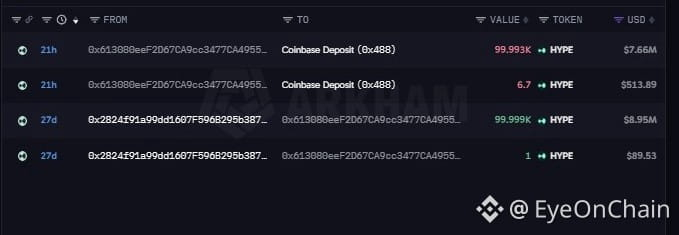
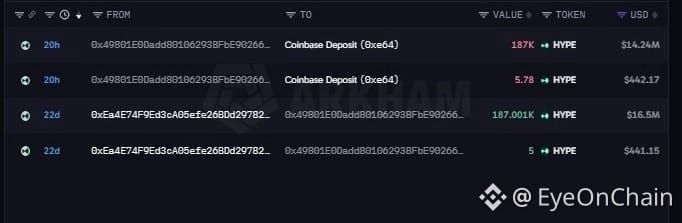
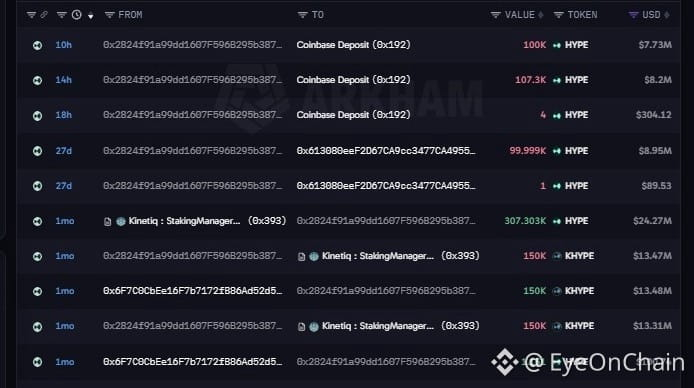
Something big is happening with HYPE. Over the past 24 hours, three wallets have sent a combined 494,310 #hype , worth around $37.83 million, to Coinbase.
These wallets may belong, to the same whale, though that connection hasn't been confirmed.
Here are the three addresses,
0x2824f91a99dd1607F596B295b3870042A3cdd9cA
0x613080eeF2D67CA9cc3477CA4955D4a9FdAae15B
0x49801E0Dadd80106293BFbE90266015deF03cee3
Moving this much #HYPE , onto an exchange naturally raises questions about possible selling pressure. But a deposit doesn't automatically mean the tokens have been sold ... the next transactions will tell us more. Nearly $38M in HYPE on the move. Is a major sell-off coming, or is this just a wallet reshuffle? let's see.
{future}(HYPEUSDT)
{spot}(HYPEUSDT)
$37.8M WORTH OF $HYPE JUST MOVED TO COINBASE.
Something big is happening with HYPE. Over the past 24 hours, three wallets have sent a combined 494,310 #hype , worth around $37.83 million, to Coinbase.
These wallets may belong, to the same whale, though that connection hasn't been confirmed.
Here are the three addresses,
0x2824f91a99dd1607F596B295b3870042A3cdd9cA
0x613080eeF2D67CA9cc3477CA4955D4a9FdAae15B
0x49801E0Dadd80106293BFbE90266015deF03cee3
Moving this much #HYPE , onto an exchange naturally raises questions about possible selling pressure. But a deposit doesn't automatically mean the tokens have been sold ... the next transactions will tell us more. Nearly $38M in HYPE on the move. Is a major sell-off coming, or is this just a wallet reshuffle? let's see.
Something big is happening with HYPE. Over the past 24 hours, three wallets have sent a combined 494,310 #hype , worth around $37.83 million, to Coinbase.
These wallets may belong, to the same whale, though that connection hasn't been confirmed.
Here are the three addresses,
0x2824f91a99dd1607F596B295b3870042A3cdd9cA
0x613080eeF2D67CA9cc3477CA4955D4a9FdAae15B
0x49801E0Dadd80106293BFbE90266015deF03cee3
Moving this much #HYPE , onto an exchange naturally raises questions about possible selling pressure. But a deposit doesn't automatically mean the tokens have been sold ... the next transactions will tell us more. Nearly $38M in HYPE on the move. Is a major sell-off coming, or is this just a wallet reshuffle? let's see.
1
1.3k

·
--

Article
$HYPE COIN: A NEW ATH AHEAD, OR A BIGGER CORRECTION COMING? 👀🚀Hyperliquid ($HYPE ) Is Facing a Critical Moment — What Could Happen Next?
The crypto market never stops surprising us, and $HYPE is a token worth watching closely! 🔥💎
After reaching an all-time high near $98 in September 2026, HYPE has pulled back toward the $75–$76 area. This correction raises an important question: Is this a temporary pause before another rally, or could sellers push the price even lower? 📉📈
🔍 What Makes HYPE Interesting?
$HYPE is the native token of Hyperliquid, a blockchain ecosystem focused on decentralized trading, including perpetual futures.
Here are three factors that could influence its future:
🔥 1. Protocol Growth
If Hyperliquid continues attracting traders and increasing trading activity, demand for its ecosystem could strengthen. Sustainable growth in real usage will be more important than short-term hype.
💎 2. Fee Revenue and Token Burns
Hyperliquid's Assistance Fund uses protocol fee revenue to purchase HYPE on the open market, with tokens potentially being permanently removed from circulation. This mechanism could support demand, although it does not guarantee price appreciation.
⚠️ 3. Token Supply and Market Sentiment
Future token unlocks, emissions, profit-taking, and broader crypto-market conditions could create selling pressure. Even promising projects can experience sharp corrections.
📊 $HYPE Price Outlook: What Comes Next?
🐂 Bullish Scenario: If buyers regain control and HYPE reclaims important resistance levels with strong volume, another recovery toward its previous high could become possible.
🐻 Bearish Scenario: If selling pressure continues and support levels fail, HYPE could experience a deeper correction before finding a stable bottom.
👀 What Should Traders Watch?
Trading volume and buying momentumKey support and resistance levelsHyperliquid's protocol revenue and user activityUpcoming token unlocks and broader Bitcoin market trends
🔮 My Take on HYPE's Future
I believe $HYPE deserves attention because it is connected to an active decentralized trading ecosystem rather than relying solely on meme-driven hype.
However, its future depends on continued adoption, sustainable revenue, token supply dynamics, and overall market conditions. A return to its previous high is possible, but a new all-time high is not guaranteed.
The smartest move is to follow the data, avoid emotional decisions, and wait for confirmation instead of chasing every green candle. 📊🧠
🔥 What do you think? Can $HYPE reclaim $98 and move toward a new all-time high, or will another correction come first?
👇 Share your thoughts in the comments!
⚠️ Risk Disclaimer: This article is for educational purposes only and is not financial advice. Cryptocurrency markets are highly volatile, and you could lose your entire investment. Always do your own research (DYOR) before making any trading decisions.
#hype #Hyperliquid #crypto #altcoins #DeFi #CryptoAnalysis #BinanceSquare #DYOR
{future}(HYPEUSDT)
$HYPE COIN: A NEW ATH AHEAD, OR A BIGGER CORRECTION COMING? 👀🚀
Hyperliquid ($HYPE ) Is Facing a Critical Moment — What Could Happen Next?
The crypto market never stops surprising us, and $HYPE is a token worth watching closely! 🔥💎
After reaching an all-time high near $98 in September 2026, HYPE has pulled back toward the $75–$76 area. This correction raises an important question: Is this a temporary pause before another rally, or could sellers push the price even lower? 📉📈
🔍 What Makes HYPE Interesting?
$HYPE is the native token of Hyperliquid, a blockchain ecosystem focused on decentralized trading, including perpetual futures.
Here are three factors that could influence its future:
🔥 1. Protocol Growth
If Hyperliquid continues attracting traders and increasing trading activity, demand for its ecosystem could strengthen. Sustainable growth in real usage will be more important than short-term hype.
💎 2. Fee Revenue and Token Burns
Hyperliquid's Assistance Fund uses protocol fee revenue to purchase HYPE on the open market, with tokens potentially being permanently removed from circulation. This mechanism could support demand, although it does not guarantee price appreciation.
⚠️ 3. Token Supply and Market Sentiment
Future token unlocks, emissions, profit-taking, and broader crypto-market conditions could create selling pressure. Even promising projects can experience sharp corrections.
📊 $HYPE Price Outlook: What Comes Next?
🐂 Bullish Scenario: If buyers regain control and HYPE reclaims important resistance levels with strong volume, another recovery toward its previous high could become possible.
🐻 Bearish Scenario: If selling pressure continues and support levels fail, HYPE could experience a deeper correction before finding a stable bottom.
👀 What Should Traders Watch?
Trading volume and buying momentumKey support and resistance levelsHyperliquid's protocol revenue and user activityUpcoming token unlocks and broader Bitcoin market trends
🔮 My Take on HYPE's Future
I believe $HYPE deserves attention because it is connected to an active decentralized trading ecosystem rather than relying solely on meme-driven hype.
However, its future depends on continued adoption, sustainable revenue, token supply dynamics, and overall market conditions. A return to its previous high is possible, but a new all-time high is not guaranteed.
The smartest move is to follow the data, avoid emotional decisions, and wait for confirmation instead of chasing every green candle. 📊🧠
🔥 What do you think? Can $HYPE reclaim $98 and move toward a new all-time high, or will another correction come first?
👇 Share your thoughts in the comments!
⚠️ Risk Disclaimer: This article is for educational purposes only and is not financial advice. Cryptocurrency markets are highly volatile, and you could lose your entire investment. Always do your own research (DYOR) before making any trading decisions.
#hype #Hyperliquid #crypto #altcoins #DeFi #CryptoAnalysis #BinanceSquare #DYOR
The crypto market never stops surprising us, and $HYPE is a token worth watching closely! 🔥💎
After reaching an all-time high near $98 in September 2026, HYPE has pulled back toward the $75–$76 area. This correction raises an important question: Is this a temporary pause before another rally, or could sellers push the price even lower? 📉📈
🔍 What Makes HYPE Interesting?
$HYPE is the native token of Hyperliquid, a blockchain ecosystem focused on decentralized trading, including perpetual futures.
Here are three factors that could influence its future:
🔥 1. Protocol Growth
If Hyperliquid continues attracting traders and increasing trading activity, demand for its ecosystem could strengthen. Sustainable growth in real usage will be more important than short-term hype.
💎 2. Fee Revenue and Token Burns
Hyperliquid's Assistance Fund uses protocol fee revenue to purchase HYPE on the open market, with tokens potentially being permanently removed from circulation. This mechanism could support demand, although it does not guarantee price appreciation.
⚠️ 3. Token Supply and Market Sentiment
Future token unlocks, emissions, profit-taking, and broader crypto-market conditions could create selling pressure. Even promising projects can experience sharp corrections.
📊 $HYPE Price Outlook: What Comes Next?
🐂 Bullish Scenario: If buyers regain control and HYPE reclaims important resistance levels with strong volume, another recovery toward its previous high could become possible.
🐻 Bearish Scenario: If selling pressure continues and support levels fail, HYPE could experience a deeper correction before finding a stable bottom.
👀 What Should Traders Watch?
Trading volume and buying momentumKey support and resistance levelsHyperliquid's protocol revenue and user activityUpcoming token unlocks and broader Bitcoin market trends
🔮 My Take on HYPE's Future
I believe $HYPE deserves attention because it is connected to an active decentralized trading ecosystem rather than relying solely on meme-driven hype.
However, its future depends on continued adoption, sustainable revenue, token supply dynamics, and overall market conditions. A return to its previous high is possible, but a new all-time high is not guaranteed.
The smartest move is to follow the data, avoid emotional decisions, and wait for confirmation instead of chasing every green candle. 📊🧠
🔥 What do you think? Can $HYPE reclaim $98 and move toward a new all-time high, or will another correction come first?
👇 Share your thoughts in the comments!
⚠️ Risk Disclaimer: This article is for educational purposes only and is not financial advice. Cryptocurrency markets are highly volatile, and you could lose your entire investment. Always do your own research (DYOR) before making any trading decisions.
#hype #Hyperliquid #crypto #altcoins #DeFi #CryptoAnalysis #BinanceSquare #DYOR
119

·
--
🚀 $HYPE LONG SETUP — BULLISH MOMENTUM! 🟢🔥
HYPE bulls are stepping in! 👀📈
Watching for another potential move higher!
🟢 LONG $HYPE
🎯 Take Profit: $81
🛑 Stop Loss: $74
💥 Eyes on the next move — let the setup play out!
⚠️ Manage risk, avoid FOMO, and trade responsibly. No profit is guaranteed.
{spot}(HYPEUSDT)
#HYPE #CryptoTrading #BinanceFeed #Altcoins
🚀 $HYPE LONG SETUP — BULLISH MOMENTUM! 🟢🔥
HYPE bulls are stepping in! 👀📈
Watching for another potential move higher!
🟢 LONG $HYPE
🎯 Take Profit: $81
🛑 Stop Loss: $74
💥 Eyes on the next move — let the setup play out!
⚠️ Manage risk, avoid FOMO, and trade responsibly. No profit is guaranteed.
#HYPE #CryptoTrading #BinanceFeed #Altcoins
HYPE bulls are stepping in! 👀📈
Watching for another potential move higher!
🟢 LONG $HYPE
🎯 Take Profit: $81
🛑 Stop Loss: $74
💥 Eyes on the next move — let the setup play out!
⚠️ Manage risk, avoid FOMO, and trade responsibly. No profit is guaranteed.
#HYPE #CryptoTrading #BinanceFeed #Altcoins
116

·
--
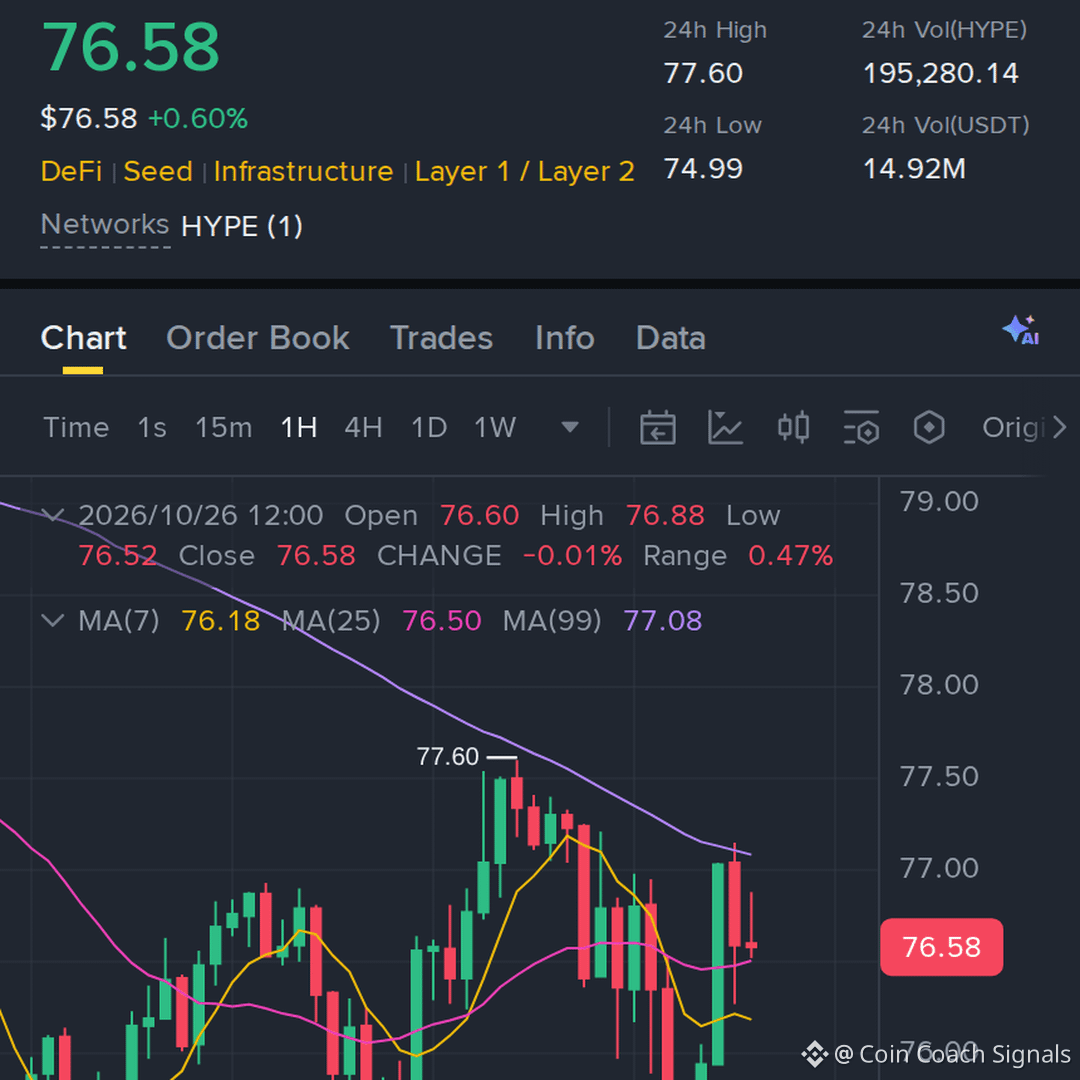
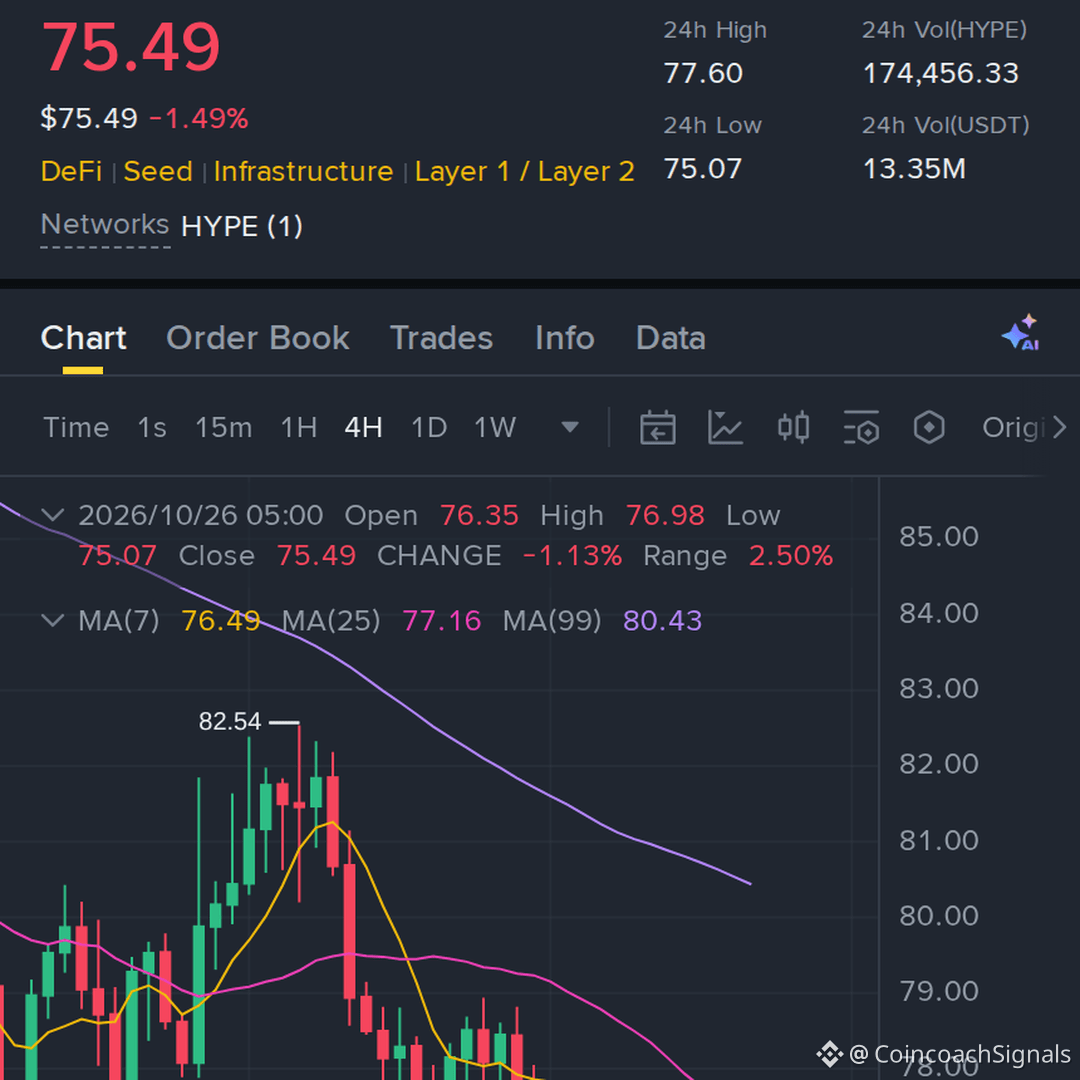
Volume spikes 1.55x above average while $HYPE holds $76.45. 📈
The latest hourly close sits at 76.59 after testing a 24-hour high of 77.60. Volatility expansion without follow-through means patience matters.
Scenario watch: A sustained push above the 77.60 high signals bullish continuation. Conversely, dropping below the 74.99 range low invalidates the setup and points to downside risk.
Will you wait for a confirmed hourly close above 77.60, or does a drop back toward 74.99 change your bias?
Tap $HYPE for the live chart. #HYPE #BinanceSquare
Volume spikes 1.55x above average while $HYPE holds $76.45. 📈
The latest hourly close sits at 76.59 after testing a 24-hour high of 77.60. Volatility expansion without follow-through means patience matters.
Scenario watch: A sustained push above the 77.60 high signals bullish continuation. Conversely, dropping below the 74.99 range low invalidates the setup and points to downside risk.
Will you wait for a confirmed hourly close above 77.60, or does a drop back toward 74.99 change your bias?
Tap $HYPE for the live chart. #HYPE #BinanceSquare
The latest hourly close sits at 76.59 after testing a 24-hour high of 77.60. Volatility expansion without follow-through means patience matters.
Scenario watch: A sustained push above the 77.60 high signals bullish continuation. Conversely, dropping below the 74.99 range low invalidates the setup and points to downside risk.
Will you wait for a confirmed hourly close above 77.60, or does a drop back toward 74.99 change your bias?
Tap $HYPE for the live chart. #HYPE #BinanceSquare
3

this is getting interesting, $HYPE tried to recover but the bounce is losing energy again, keeping the setup around 49x
Entry: 76.53–76.76
TP1: 74.79 | TP2: 73.49 | TP3: 71.14
Stop Loss: 77.87
#HYPE #Write2Earn #Crypto #Binance
this is getting interesting, $HYPE tried to recover but the bounce is losing energy again, keeping the setup around 49x
Entry: 76.53–76.76
TP1: 74.79 | TP2: 73.49 | TP3: 71.14
Stop Loss: 77.87
#HYPE #Write2Earn #Crypto #Binance
Entry: 76.53–76.76
TP1: 74.79 | TP2: 73.49 | TP3: 71.14
Stop Loss: 77.87
#HYPE #Write2Earn #Crypto #Binance
79

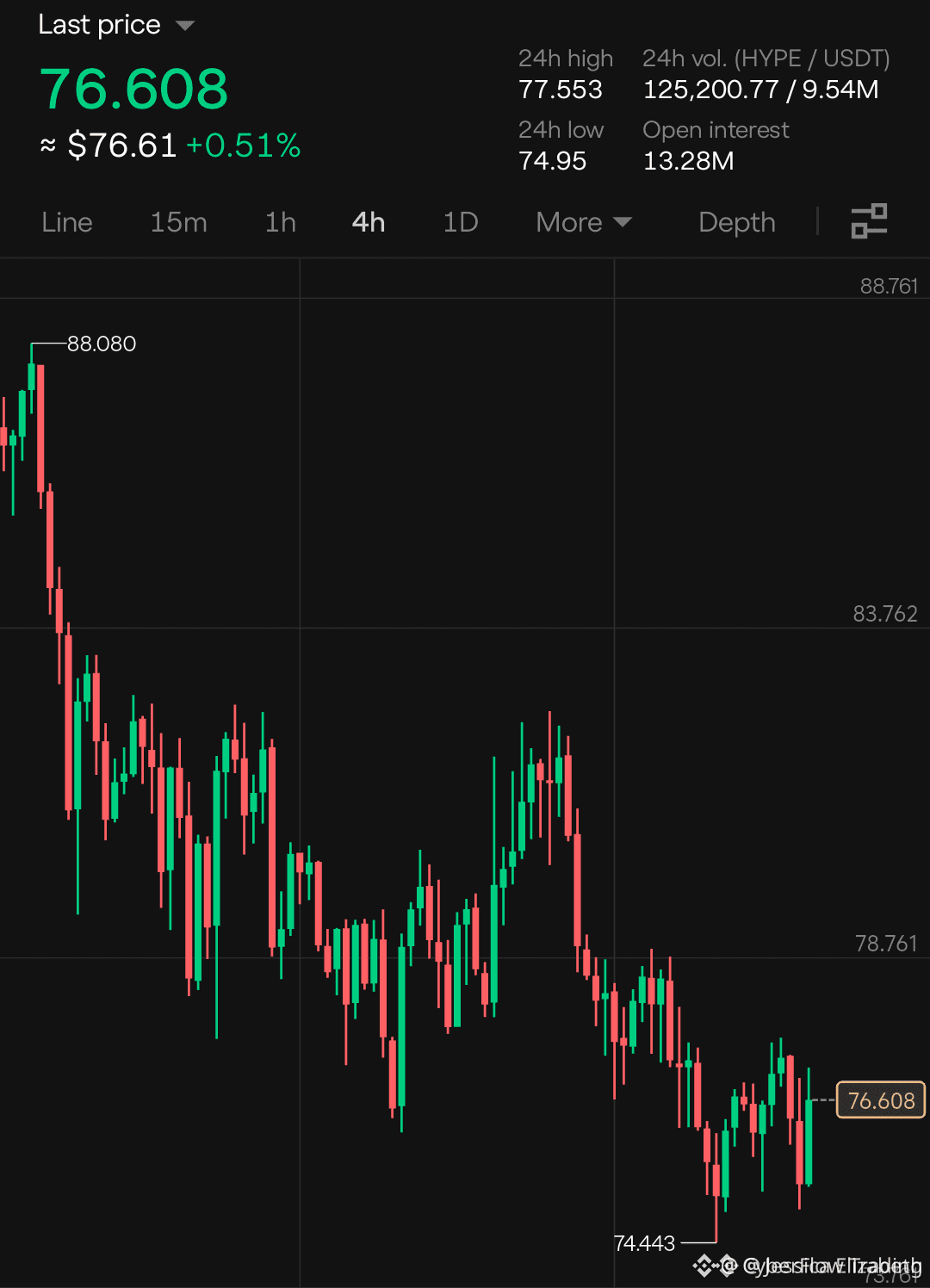
🚀 $HYPE SURGES INTO BULLISH ZONE – ENTRY AT 76.60 🟢
Entry: 76.60 ⚡
Target: 78.34 🚀
Stop Loss: 70.00 ⚠️
🦈 Smart money has been hoarding the 76.60 demand block, snapping up every dip as sellers bleed liquidity. 📊 Volume on the 4H chart spiked 3x the 20‑day average, confirming a genuine buying surge. ⚡ The next resistance at 78.34 aligns with the prior swing high, offering a clean breakout path.
💡 With a 1:2.5 risk‑reward, the setup rewards patience and tight stops. 🤔 Are you ready to ride the wave or waiting for the next liquidity sweep? 👇
⚠️ Not financial advice. Always manage your risk. 🛡️
🏷️ #HYPE #LongSetup #Bullish #Crypto
🔥 💎
🚀 $HYPE SURGES INTO BULLISH ZONE – ENTRY AT 76.60 🟢
Entry: 76.60 ⚡
Target: 78.34 🚀
Stop Loss: 70.00 ⚠️
🦈 Smart money has been hoarding the 76.60 demand block, snapping up every dip as sellers bleed liquidity. 📊 Volume on the 4H chart spiked 3x the 20‑day average, confirming a genuine buying surge. ⚡ The next resistance at 78.34 aligns with the prior swing high, offering a clean breakout path.
💡 With a 1:2.5 risk‑reward, the setup rewards patience and tight stops. 🤔 Are you ready to ride the wave or waiting for the next liquidity sweep? 👇
⚠️ Not financial advice. Always manage your risk. 🛡️
🏷️ #HYPE #LongSetup #Bullish #Crypto
🔥 💎
Entry: 76.60 ⚡
Target: 78.34 🚀
Stop Loss: 70.00 ⚠️
🦈 Smart money has been hoarding the 76.60 demand block, snapping up every dip as sellers bleed liquidity. 📊 Volume on the 4H chart spiked 3x the 20‑day average, confirming a genuine buying surge. ⚡ The next resistance at 78.34 aligns with the prior swing high, offering a clean breakout path.
💡 With a 1:2.5 risk‑reward, the setup rewards patience and tight stops. 🤔 Are you ready to ride the wave or waiting for the next liquidity sweep? 👇
⚠️ Not financial advice. Always manage your risk. 🛡️
🏷️ #HYPE #LongSetup #Bullish #Crypto
🔥 💎
4

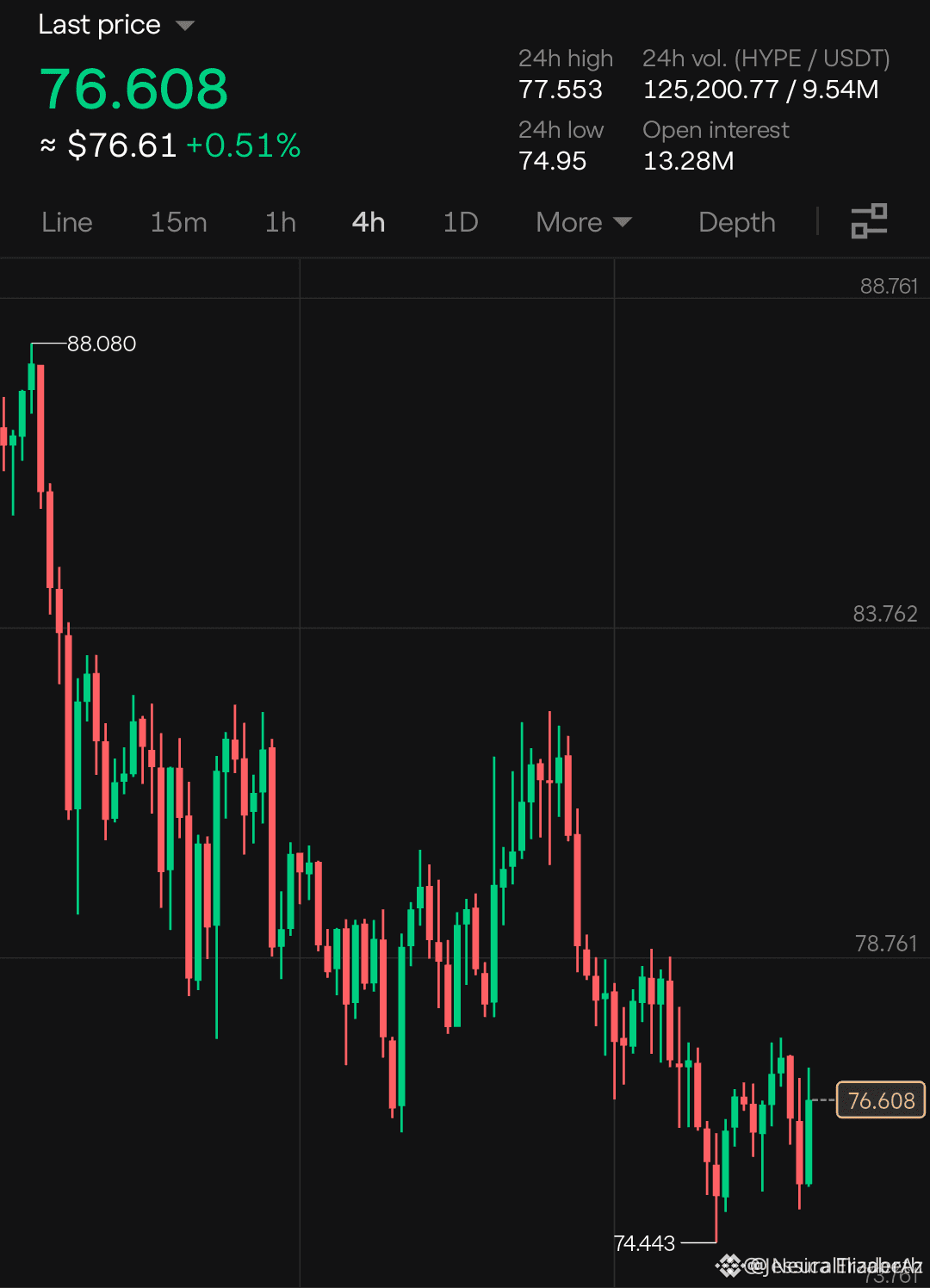
🚀 $HYPE BREAKS ABOVE 76.60 – SMART MONEY IS IN! 📈
Entry: 76.60 ⚡
Target: 78.34 🚀
Stop Loss: 70.00 ⚠️
🦈 The 76.60 demand block has swallowed three consecutive sell‑offs, signaling institutional accumulation. 📊 Volume on the 4H has been expanding, and the order block aligns with a prior liquidity sweep, suggesting a clean path to the next imbalance zone. 💡 The first profit corridor at 78.34 offers a crisp 1:1.5 R:R, while the secondary stretch toward 81.20 adds upside if the bullish momentum holds.
💬 Are you positioning for the full swing to 81.20 or targeting the tighter 78.34 zone? 👇
⚠️ Not financial advice. Always manage your risk. 🛡️
🏷️ #HYPE #LongSetup #LiquiditySweep #Crypto
🔥 💎
🚀 $HYPE BREAKS ABOVE 76.60 – SMART MONEY IS IN! 📈
Entry: 76.60 ⚡
Target: 78.34 🚀
Stop Loss: 70.00 ⚠️
🦈 The 76.60 demand block has swallowed three consecutive sell‑offs, signaling institutional accumulation. 📊 Volume on the 4H has been expanding, and the order block aligns with a prior liquidity sweep, suggesting a clean path to the next imbalance zone. 💡 The first profit corridor at 78.34 offers a crisp 1:1.5 R:R, while the secondary stretch toward 81.20 adds upside if the bullish momentum holds.
💬 Are you positioning for the full swing to 81.20 or targeting the tighter 78.34 zone? 👇
⚠️ Not financial advice. Always manage your risk. 🛡️
🏷️ #HYPE #LongSetup #LiquiditySweep #Crypto
🔥 💎
Entry: 76.60 ⚡
Target: 78.34 🚀
Stop Loss: 70.00 ⚠️
🦈 The 76.60 demand block has swallowed three consecutive sell‑offs, signaling institutional accumulation. 📊 Volume on the 4H has been expanding, and the order block aligns with a prior liquidity sweep, suggesting a clean path to the next imbalance zone. 💡 The first profit corridor at 78.34 offers a crisp 1:1.5 R:R, while the secondary stretch toward 81.20 adds upside if the bullish momentum holds.
💬 Are you positioning for the full swing to 81.20 or targeting the tighter 78.34 zone? 👇
⚠️ Not financial advice. Always manage your risk. 🛡️
🏷️ #HYPE #LongSetup #LiquiditySweep #Crypto
🔥 💎
3

·
--
$HYPE is trading at $76.28 within a tight 24h range of $74.99 to $77.60.
**Support/Resistance Compass:**
- **Defense Floor:** $74.99 (24h low)
- **Breakout Target:** $77.60 (24h high)
**Risk Note:** Avoid chasing the $77.60 resistance without a confirmed volume breakout. Newcomers often buy the top and get trapped. Wait for a healthy pullback toward support.
*Rule:* Never risk more than 2% of your capital on a single setup.
$HYPE #BinanceSquare #CryptoTrading #RiskManagement #HYPE
$HYPE is trading at $76.28 within a tight 24h range of $74.99 to $77.60.
**Support/Resistance Compass:**
- **Defense Floor:** $74.99 (24h low)
- **Breakout Target:** $77.60 (24h high)
**Risk Note:** Avoid chasing the $77.60 resistance without a confirmed volume breakout. Newcomers often buy the top and get trapped. Wait for a healthy pullback toward support.
*Rule:* Never risk more than 2% of your capital on a single setup.
$HYPE #BinanceSquare #CryptoTrading #RiskManagement #HYPE
**Support/Resistance Compass:**
- **Defense Floor:** $74.99 (24h low)
- **Breakout Target:** $77.60 (24h high)
**Risk Note:** Avoid chasing the $77.60 resistance without a confirmed volume breakout. Newcomers often buy the top and get trapped. Wait for a healthy pullback toward support.
*Rule:* Never risk more than 2% of your capital on a single setup.
$HYPE #BinanceSquare #CryptoTrading #RiskManagement #HYPE
33

·
--
Bullish
🚀 $HYPE LONG SETUP — BULLS TARGETING HIGHER! 🔥
{future}(HYPEUSDT)
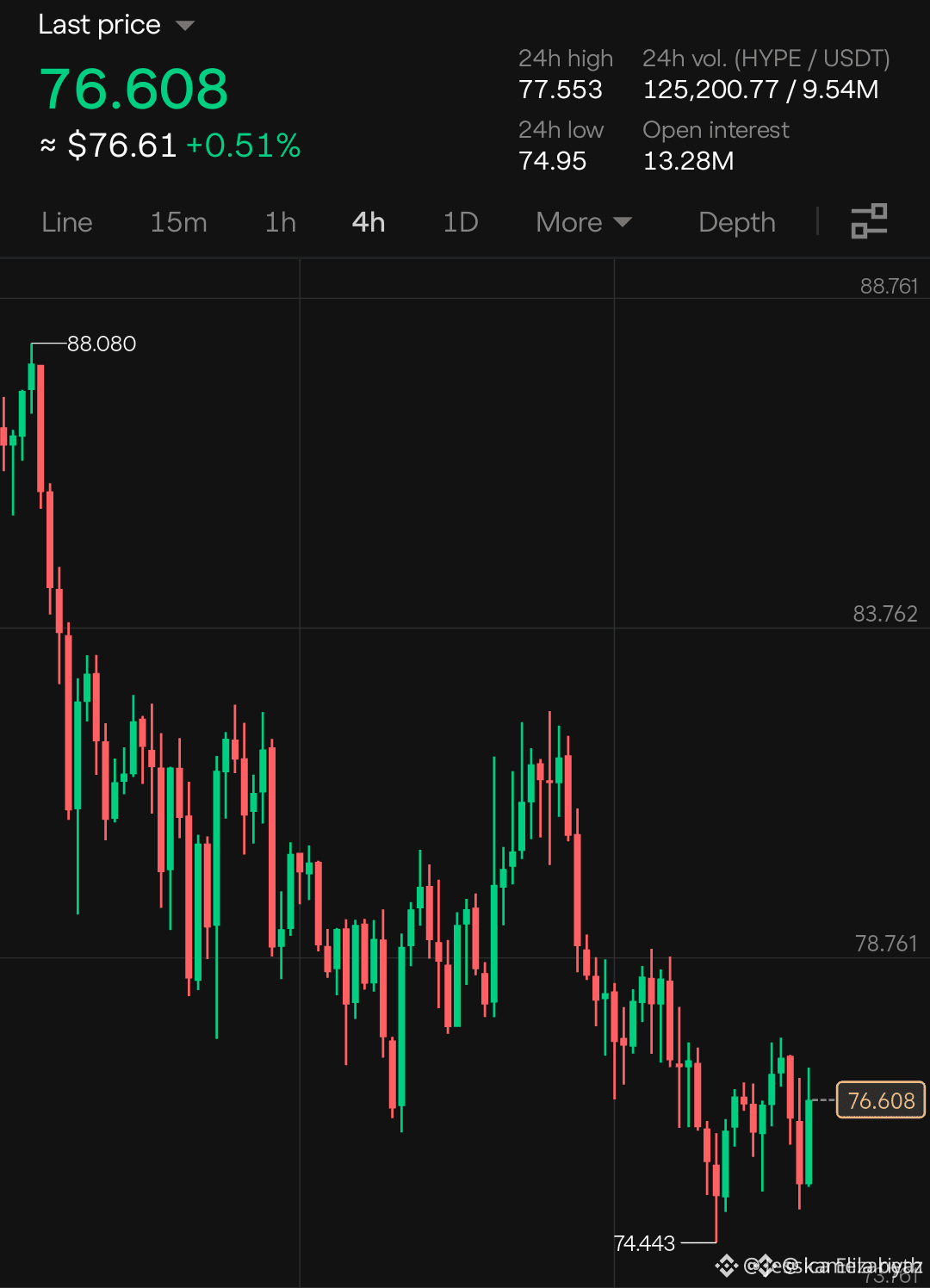
$HYPE USDT Perpetual is showing a modest gain in the supplied snapshot, trading around $76.61 (+0.86%). Can buyers push toward the next targets? 👀
📍 Potential trade setup
Entry (CMP): $76.60
🎯 TP1: $78.34
🎯 TP2: $81.20
🛑 Stop-loss: $70.00
📊 What to watch: Follow-through above the entry area could support further upside, while a loss of momentum may lead to a pullback.
⚠️ These are proposed levels, not a guaranteed signal. Verify the live price, manage position size, and remember that perpetual futures carry significant risk.
Are you bullish on $HYPE , or waiting for a better entry? 💬
#HYPE #Hyperliquid #CryptoTrading #FuturesTrading #RiskManagement
🚀 $HYPE LONG SETUP — BULLS TARGETING HIGHER! 🔥
$HYPE USDT Perpetual is showing a modest gain in the supplied snapshot, trading around $76.61 (+0.86%). Can buyers push toward the next targets? 👀
📍 Potential trade setup
Entry (CMP): $76.60
🎯 TP1: $78.34
🎯 TP2: $81.20
🛑 Stop-loss: $70.00
📊 What to watch: Follow-through above the entry area could support further upside, while a loss of momentum may lead to a pullback.
⚠️ These are proposed levels, not a guaranteed signal. Verify the live price, manage position size, and remember that perpetual futures carry significant risk.
Are you bullish on $HYPE , or waiting for a better entry? 💬
#HYPE #Hyperliquid #CryptoTrading #FuturesTrading #RiskManagement
$HYPE USDT Perpetual is showing a modest gain in the supplied snapshot, trading around $76.61 (+0.86%). Can buyers push toward the next targets? 👀
📍 Potential trade setup
Entry (CMP): $76.60
🎯 TP1: $78.34
🎯 TP2: $81.20
🛑 Stop-loss: $70.00
📊 What to watch: Follow-through above the entry area could support further upside, while a loss of momentum may lead to a pullback.
⚠️ These are proposed levels, not a guaranteed signal. Verify the live price, manage position size, and remember that perpetual futures carry significant risk.
Are you bullish on $HYPE , or waiting for a better entry? 💬
#HYPE #Hyperliquid #CryptoTrading #FuturesTrading #RiskManagement
2
136


·
--
Bullish
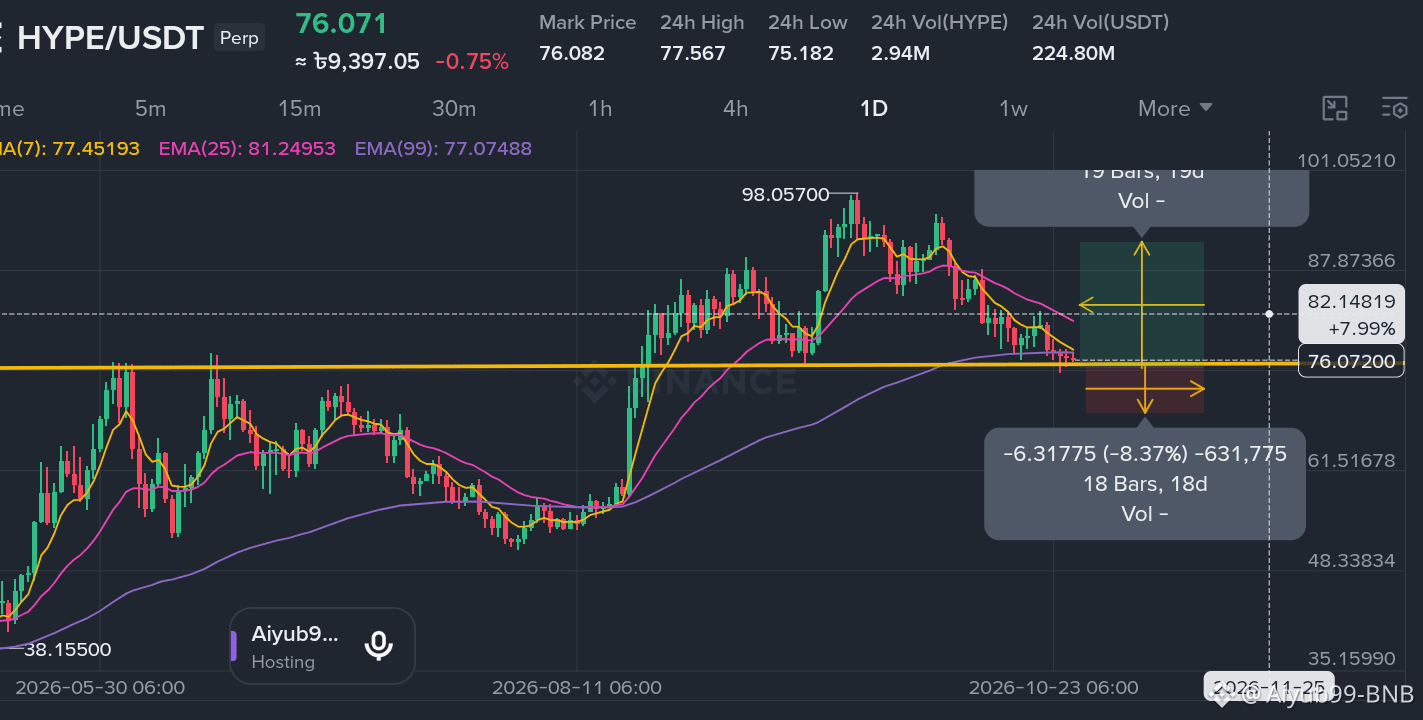
Everyone now i am setting $HYPE USDT long trade #hype Support zone 74.02-- now I am buying long it Lavarage : FUll and volume : 4000-20000 USDT future trade 🔥
Entry plan : 73.5-76.13
Take profit : 77-78-80
SL: 62
add more long trade $CAP $NEAR
{future}(NEARUSDT)
{future}(CAPUSDT)
{future}(HYPEUSDT)
#BinancePick #EarningsSeason #USQ3GDPAndSeptemberPCEDueNextWeek #SouthKoreaDelaysCryptoIncomeTax
Everyone now i am setting $HYPE USDT long trade #hype Support zone 74.02-- now I am buying long it Lavarage : FUll and volume : 4000-20000 USDT future trade 🔥
Entry plan : 73.5-76.13
Take profit : 77-78-80
SL: 62
add more long trade $CAP $NEAR
#BinancePick #EarningsSeason #USQ3GDPAndSeptemberPCEDueNextWeek #SouthKoreaDelaysCryptoIncomeTax
Entry plan : 73.5-76.13
Take profit : 77-78-80
SL: 62
add more long trade $CAP $NEAR
#BinancePick #EarningsSeason #USQ3GDPAndSeptemberPCEDueNextWeek #SouthKoreaDelaysCryptoIncomeTax
1
435

·
--
⚡ $HYPE TREND CONTINUATION SETUP IS CHARGING FOR A BREAKOUT SURGE 🚀
Entry: 83.477 ⚡
Target: 88.5319 🚀
Stop Loss: 81.792 ⚠️
$HYPE is displaying textbook trend continuation as buyers defend the 83.477 zone with conviction. 📊 Moving averages across short and long timeframes are perfectly stacked for momentum, backed by volume surging 2.23x above average baseline.
With MACD ticking firmly green and momentum accelerating, this short-term pullback presents a sharp continuation window before the next expansion. 💡 Sellers are getting absorbed rapidly at key support, setting up a clean move toward primary targets. 💬 Are you loading this pullback or waiting for a confirmed breakout higher? 👇
⚠️ Not financial advice. Always manage your risk. 🛡️
🏷️ #HYPE #LongSetup #Breakout #Crypto
🔥 💎
⚡ $HYPE TREND CONTINUATION SETUP IS CHARGING FOR A BREAKOUT SURGE 🚀
Entry: 83.477 ⚡
Target: 88.5319 🚀
Stop Loss: 81.792 ⚠️
$HYPE is displaying textbook trend continuation as buyers defend the 83.477 zone with conviction. 📊 Moving averages across short and long timeframes are perfectly stacked for momentum, backed by volume surging 2.23x above average baseline.
With MACD ticking firmly green and momentum accelerating, this short-term pullback presents a sharp continuation window before the next expansion. 💡 Sellers are getting absorbed rapidly at key support, setting up a clean move toward primary targets. 💬 Are you loading this pullback or waiting for a confirmed breakout higher? 👇
⚠️ Not financial advice. Always manage your risk. 🛡️
🏷️ #HYPE #LongSetup #Breakout #Crypto
🔥 💎
Entry: 83.477 ⚡
Target: 88.5319 🚀
Stop Loss: 81.792 ⚠️
$HYPE is displaying textbook trend continuation as buyers defend the 83.477 zone with conviction. 📊 Moving averages across short and long timeframes are perfectly stacked for momentum, backed by volume surging 2.23x above average baseline.
With MACD ticking firmly green and momentum accelerating, this short-term pullback presents a sharp continuation window before the next expansion. 💡 Sellers are getting absorbed rapidly at key support, setting up a clean move toward primary targets. 💬 Are you loading this pullback or waiting for a confirmed breakout higher? 👇
⚠️ Not financial advice. Always manage your risk. 🛡️
🏷️ #HYPE #LongSetup #Breakout #Crypto
🔥 💎
5
·
--
Hourly volume just spiked to 1.40x the daily average.
$HYPE changes hands at $76.23 on a 0.68% daily dip, holding inside a 24-hour range between $75.24 and $77.60 despite the quiet tape.
A short-term stabilization scenario develops if buyers reclaim the $77.60 high on increasing volume. Conversely, a breakdown below the $75.24 low invalidates the bounce setup.
Will volume expand to confirm a breakout above $77.60, or will sellers force a retest of $75.24?
Tap $HYPE for the live chart. #HYPE #BinanceSquare
Hourly volume just spiked to 1.40x the daily average.
$HYPE changes hands at $76.23 on a 0.68% daily dip, holding inside a 24-hour range between $75.24 and $77.60 despite the quiet tape.
A short-term stabilization scenario develops if buyers reclaim the $77.60 high on increasing volume. Conversely, a breakdown below the $75.24 low invalidates the bounce setup.
Will volume expand to confirm a breakout above $77.60, or will sellers force a retest of $75.24?
Tap $HYPE for the live chart. #HYPE #BinanceSquare
$HYPE changes hands at $76.23 on a 0.68% daily dip, holding inside a 24-hour range between $75.24 and $77.60 despite the quiet tape.
A short-term stabilization scenario develops if buyers reclaim the $77.60 high on increasing volume. Conversely, a breakdown below the $75.24 low invalidates the bounce setup.
Will volume expand to confirm a breakout above $77.60, or will sellers force a retest of $75.24?
Tap $HYPE for the live chart. #HYPE #BinanceSquare
9

·
--
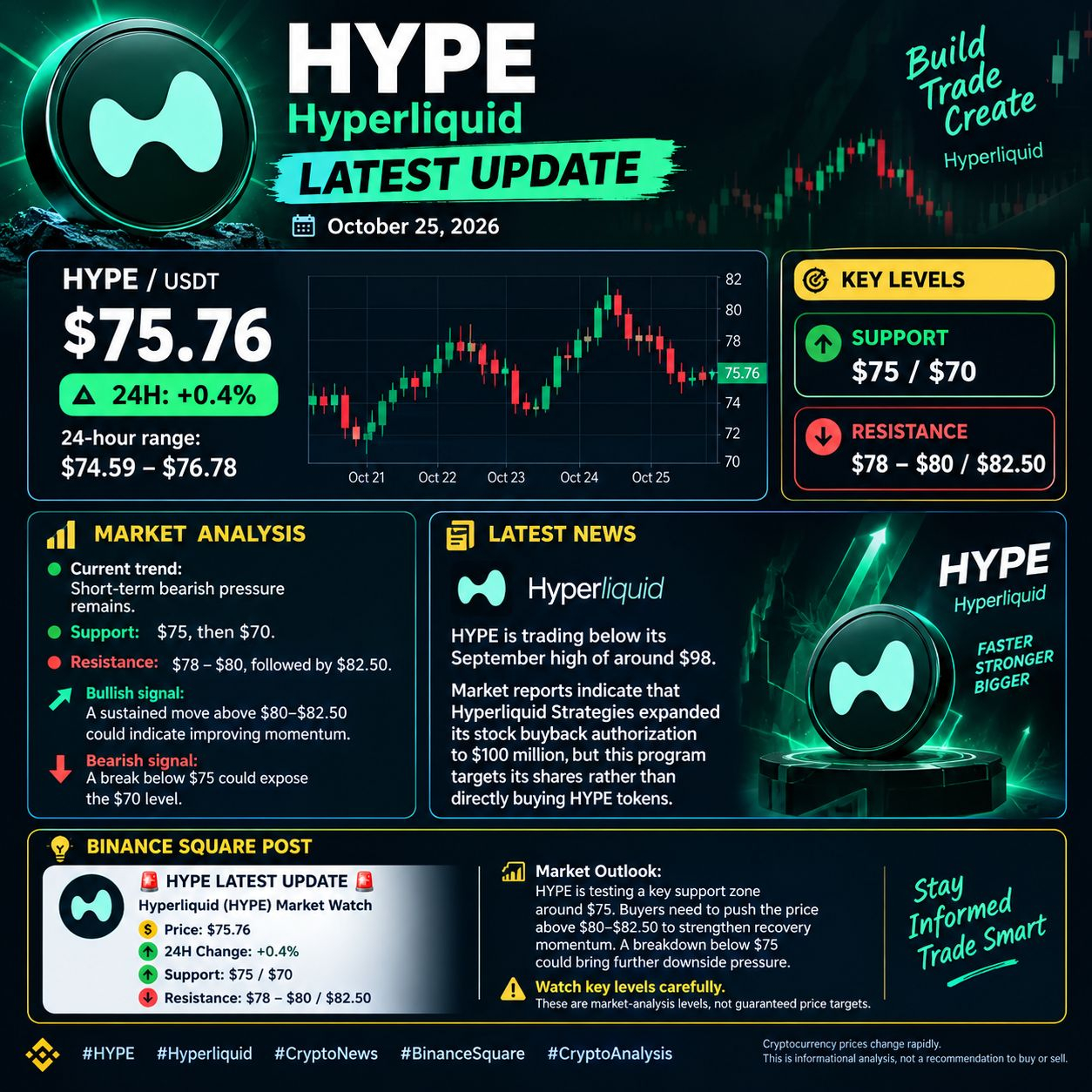
🪙 Hyperliquid ($HYPE ) Market Watch
💰 Price: $75.76
📈 24H Change: +0.4%
🟢 Support: $75 / $70
🔴 Resistance: $78–$80 / $82.50
📊 Market Outlook: $HYPE is testing a key support zone around $75. Buyers need to push the price above $80–$82.50 to strengthen recovery momentum. A breakdown below $75 could bring further downside pressure.
⚠️ Watch key levels carefully. These are market-analysis levels, not guaranteed price targets.
#HYPE #Hyperliquid #CryptoNews #BinanceSquare #CryptoAnalysis
{future}(HYPEUSDT)
🪙 Hyperliquid ($HYPE ) Market Watch
💰 Price: $75.76
📈 24H Change: +0.4%
🟢 Support: $75 / $70
🔴 Resistance: $78–$80 / $82.50
📊 Market Outlook: $HYPE is testing a key support zone around $75. Buyers need to push the price above $80–$82.50 to strengthen recovery momentum. A breakdown below $75 could bring further downside pressure.
⚠️ Watch key levels carefully. These are market-analysis levels, not guaranteed price targets.
#HYPE #Hyperliquid #CryptoNews #BinanceSquare #CryptoAnalysis
💰 Price: $75.76
📈 24H Change: +0.4%
🟢 Support: $75 / $70
🔴 Resistance: $78–$80 / $82.50
📊 Market Outlook: $HYPE is testing a key support zone around $75. Buyers need to push the price above $80–$82.50 to strengthen recovery momentum. A breakdown below $75 could bring further downside pressure.
⚠️ Watch key levels carefully. These are market-analysis levels, not guaranteed price targets.
#HYPE #Hyperliquid #CryptoNews #BinanceSquare #CryptoAnalysis
1
168

·
--
CORPORATE TREASURY SWEEPS 800,000 $HYPE IN MASSIVE 66.9M CAPITAL ALLOCATION! 🦈 💥
Smart money is making aggressive corporate balance sheet plays while retail hesitates. HypeStrat just locked down 800,000 $HYPE valued at $66.93 million while boosting cash reserves by another $59.10 million. 🏦
Corporate treasury accumulation of this magnitude removes serious liquid float from the open market, creating a structural supply squeeze across major ecosystem assets like $ZEC and $TAO . 📊 When institutions build cash reserves and accumulate core assets simultaneously, it signals heavy preparation for extended multi-month expansion. ⚡
💡 Are you following these institutional treasury flows early, or waiting until the liquid supply dries up completely? 👇
⚠️ Not financial advice. Always manage your risk. 🛡️
🏷️ #HYPE #Institutional #Treasury #DeFi #Crypto
🔥 💎
CORPORATE TREASURY SWEEPS 800,000 $HYPE IN MASSIVE 66.9M CAPITAL ALLOCATION! 🦈 💥
Smart money is making aggressive corporate balance sheet plays while retail hesitates. HypeStrat just locked down 800,000 $HYPE valued at $66.93 million while boosting cash reserves by another $59.10 million. 🏦
Corporate treasury accumulation of this magnitude removes serious liquid float from the open market, creating a structural supply squeeze across major ecosystem assets like $ZEC and $TAO . 📊 When institutions build cash reserves and accumulate core assets simultaneously, it signals heavy preparation for extended multi-month expansion. ⚡
💡 Are you following these institutional treasury flows early, or waiting until the liquid supply dries up completely? 👇
⚠️ Not financial advice. Always manage your risk. 🛡️
🏷️ #HYPE #Institutional #Treasury #DeFi #Crypto
🔥 💎
Smart money is making aggressive corporate balance sheet plays while retail hesitates. HypeStrat just locked down 800,000 $HYPE valued at $66.93 million while boosting cash reserves by another $59.10 million. 🏦
Corporate treasury accumulation of this magnitude removes serious liquid float from the open market, creating a structural supply squeeze across major ecosystem assets like $ZEC and $TAO . 📊 When institutions build cash reserves and accumulate core assets simultaneously, it signals heavy preparation for extended multi-month expansion. ⚡
💡 Are you following these institutional treasury flows early, or waiting until the liquid supply dries up completely? 👇
⚠️ Not financial advice. Always manage your risk. 🛡️
🏷️ #HYPE #Institutional #Treasury #DeFi #Crypto
🔥 💎
5
·
--
🚀 $HYPE TREND PULLBACK OFFERS A HIGH-CONVICTION CONTINUATION SETUP! 💥
Entry: 83.893 ⚡
Target: 86.5194 🚀
Stop Loss: 83.0175 ⚠️
$HYPE is displaying classic trend continuation mechanics on the short-term timeframe. 📊 Sellers are running out of steam on light volume, while the EMA 20/50/200 alignment remains firmly stacked in favor of the bulls. An ADX reading of 36.2 signals that trend power is far from exhausted.
Buyers are absorbing floating supply near the 83.893 demand zone, preparing for another expansion leg toward higher targets. ⚡ As long as price respects structural support, the path of least resistance continues upward. 💬 Are you taking the bid on this retest or waiting for a high-volume confirmation break? 👇
⚠️ Not financial advice. Always manage your risk. 🛡️
🏷️ #HYPE #LongSetup #Crypto #Breakout
🔥 💎
🚀 $HYPE TREND PULLBACK OFFERS A HIGH-CONVICTION CONTINUATION SETUP! 💥
Entry: 83.893 ⚡
Target: 86.5194 🚀
Stop Loss: 83.0175 ⚠️
$HYPE is displaying classic trend continuation mechanics on the short-term timeframe. 📊 Sellers are running out of steam on light volume, while the EMA 20/50/200 alignment remains firmly stacked in favor of the bulls. An ADX reading of 36.2 signals that trend power is far from exhausted.
Buyers are absorbing floating supply near the 83.893 demand zone, preparing for another expansion leg toward higher targets. ⚡ As long as price respects structural support, the path of least resistance continues upward. 💬 Are you taking the bid on this retest or waiting for a high-volume confirmation break? 👇
⚠️ Not financial advice. Always manage your risk. 🛡️
🏷️ #HYPE #LongSetup #Crypto #Breakout
🔥 💎
Entry: 83.893 ⚡
Target: 86.5194 🚀
Stop Loss: 83.0175 ⚠️
$HYPE is displaying classic trend continuation mechanics on the short-term timeframe. 📊 Sellers are running out of steam on light volume, while the EMA 20/50/200 alignment remains firmly stacked in favor of the bulls. An ADX reading of 36.2 signals that trend power is far from exhausted.
Buyers are absorbing floating supply near the 83.893 demand zone, preparing for another expansion leg toward higher targets. ⚡ As long as price respects structural support, the path of least resistance continues upward. 💬 Are you taking the bid on this retest or waiting for a high-volume confirmation break? 👇
⚠️ Not financial advice. Always manage your risk. 🛡️
🏷️ #HYPE #LongSetup #Crypto #Breakout
🔥 💎
7

⚡ $HYPE PULLBACK OFFERS A TEXTBOOK RETEST BEFORE THE NEXT LEG UP! 🎯
Entry: 83.55 - 83.80 ⚡
Target: 84.70, 85.35, 86.77 🚀
Stop Loss: 82.80 ⚠️
Smart money doesn't chase impulse moves at the top of 84.70. Instead, we let the market cool down into key EMA structure where real order flow accumulates. 📊
The broader trend structure remains firmly intact, making this orderly pullback toward the 83.55 pocket a prime spot to bid the reclaim. ⚡ As long as buyers defend support, momentum favors an aggressive continuation through overhead resistance. 💡
💬 Are you patient enough to wait for the retest zone, or are you sitting on the sidelines watching the trend extend? 👇
⚠️ Not financial advice. Always manage your risk. 🛡️
🏷️ #HYPE #LongSetup #Crypto #BreakoutRetest
🔥 💎
⚡ $HYPE PULLBACK OFFERS A TEXTBOOK RETEST BEFORE THE NEXT LEG UP! 🎯
Entry: 83.55 - 83.80 ⚡
Target: 84.70, 85.35, 86.77 🚀
Stop Loss: 82.80 ⚠️
Smart money doesn't chase impulse moves at the top of 84.70. Instead, we let the market cool down into key EMA structure where real order flow accumulates. 📊
The broader trend structure remains firmly intact, making this orderly pullback toward the 83.55 pocket a prime spot to bid the reclaim. ⚡ As long as buyers defend support, momentum favors an aggressive continuation through overhead resistance. 💡
💬 Are you patient enough to wait for the retest zone, or are you sitting on the sidelines watching the trend extend? 👇
⚠️ Not financial advice. Always manage your risk. 🛡️
🏷️ #HYPE #LongSetup #Crypto #BreakoutRetest
🔥 💎
Entry: 83.55 - 83.80 ⚡
Target: 84.70, 85.35, 86.77 🚀
Stop Loss: 82.80 ⚠️
Smart money doesn't chase impulse moves at the top of 84.70. Instead, we let the market cool down into key EMA structure where real order flow accumulates. 📊
The broader trend structure remains firmly intact, making this orderly pullback toward the 83.55 pocket a prime spot to bid the reclaim. ⚡ As long as buyers defend support, momentum favors an aggressive continuation through overhead resistance. 💡
💬 Are you patient enough to wait for the retest zone, or are you sitting on the sidelines watching the trend extend? 👇
⚠️ Not financial advice. Always manage your risk. 🛡️
🏷️ #HYPE #LongSetup #Crypto #BreakoutRetest
🔥 💎
8

·
--
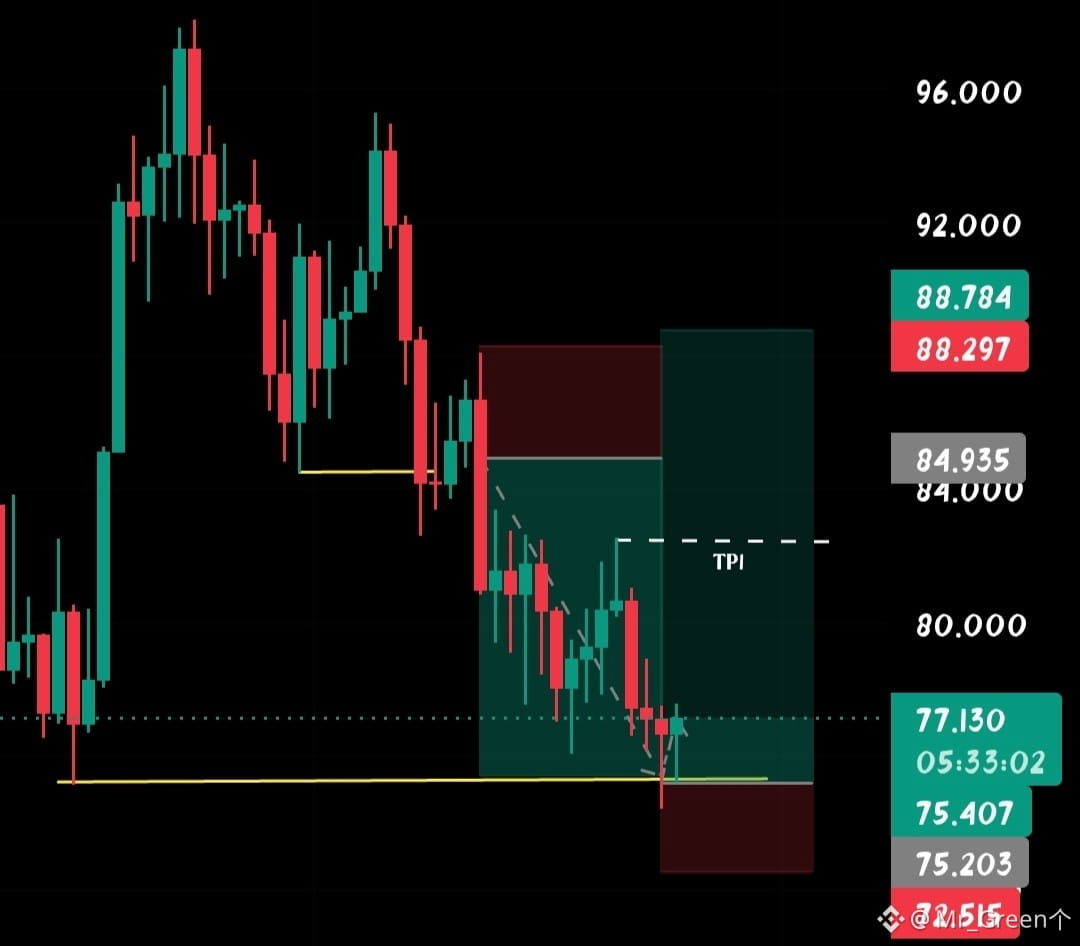
$HYPE 🎯 The support zone is playing out exactly as expected!
Price has reacted around the $75–$76 demand zone after a strong bearish move. Now the key is whether buyers can defend this level and push price toward $80–$81 (TP1).
I’m watching for a bullish reaction and confirmation. Others may prefer to wait for a clean retest before entering.
⚠️ If support fails, the next downside risk is around $72.50.
Patience over FOMO. Let price confirm the setup. 📈
#HYPE #Crypto #Trading #BinancePick #EarningsSeason
$HYPE 🎯 The support zone is playing out exactly as expected!
Price has reacted around the $75–$76 demand zone after a strong bearish move. Now the key is whether buyers can defend this level and push price toward $80–$81 (TP1).
I’m watching for a bullish reaction and confirmation. Others may prefer to wait for a clean retest before entering.
⚠️ If support fails, the next downside risk is around $72.50.
Patience over FOMO. Let price confirm the setup. 📈
#HYPE #Crypto #Trading #BinancePick #EarningsSeason
Price has reacted around the $75–$76 demand zone after a strong bearish move. Now the key is whether buyers can defend this level and push price toward $80–$81 (TP1).
I’m watching for a bullish reaction and confirmation. Others may prefer to wait for a clean retest before entering.
⚠️ If support fails, the next downside risk is around $72.50.
Patience over FOMO. Let price confirm the setup. 📈
#HYPE #Crypto #Trading #BinancePick #EarningsSeason
1
158

·
--
Decentralized chain, gated front door: the Hyperliquid "high risk" wallet flags
A thread on X today caught my attention. Trader @x256xx woke up to find their Hyperliquid wallet flagged "high risk" and blocked from the official app. The reason, as they explained it: months ago they lent a friend a few thousand dollars, and the friend repaid them from HTX (formerly Huobi). They say they never used HTX themselves.
HTX's parent was reportedly hit with UK sanctions in May, and screening tools now flag wallets that received funds from HTX-linked addresses, even indirectly. The chain itself still works: users point out the funds remain reachable through the API or other frontends. Only the official interface says no.
My take: this is the real trade-off of DeFi going mainstream. Front-ends need compliance screening to survive, but address-based taint scoring is blunt. It punishes the person at the end of the chain, not the one who created the risk.
Practical lessons for $HYPE traders and on-chain users in general:
- Know where incoming funds come from before accepting them to your main trading wallet.
- Keep a separate wallet for receiving P2P payments.
- Learn how to access your positions without the official UI, just in case.
Compliance is coming to every front door. Self-custody means knowing the back door too.
#Hyperliquid #DeFi #Compliance #HYPE
Not financial advice.
Decentralized chain, gated front door: the Hyperliquid "high risk" wallet flags
A thread on X today caught my attention. Trader @x256xx woke up to find their Hyperliquid wallet flagged "high risk" and blocked from the official app. The reason, as they explained it: months ago they lent a friend a few thousand dollars, and the friend repaid them from HTX (formerly Huobi). They say they never used HTX themselves.
HTX's parent was reportedly hit with UK sanctions in May, and screening tools now flag wallets that received funds from HTX-linked addresses, even indirectly. The chain itself still works: users point out the funds remain reachable through the API or other frontends. Only the official interface says no.
My take: this is the real trade-off of DeFi going mainstream. Front-ends need compliance screening to survive, but address-based taint scoring is blunt. It punishes the person at the end of the chain, not the one who created the risk.
Practical lessons for $HYPE traders and on-chain users in general:
- Know where incoming funds come from before accepting them to your main trading wallet.
- Keep a separate wallet for receiving P2P payments.
- Learn how to access your positions without the official UI, just in case.
Compliance is coming to every front door. Self-custody means knowing the back door too.
#Hyperliquid #DeFi #Compliance #HYPE
Not financial advice.
A thread on X today caught my attention. Trader @x256xx woke up to find their Hyperliquid wallet flagged "high risk" and blocked from the official app. The reason, as they explained it: months ago they lent a friend a few thousand dollars, and the friend repaid them from HTX (formerly Huobi). They say they never used HTX themselves.
HTX's parent was reportedly hit with UK sanctions in May, and screening tools now flag wallets that received funds from HTX-linked addresses, even indirectly. The chain itself still works: users point out the funds remain reachable through the API or other frontends. Only the official interface says no.
My take: this is the real trade-off of DeFi going mainstream. Front-ends need compliance screening to survive, but address-based taint scoring is blunt. It punishes the person at the end of the chain, not the one who created the risk.
Practical lessons for $HYPE traders and on-chain users in general:
- Know where incoming funds come from before accepting them to your main trading wallet.
- Keep a separate wallet for receiving P2P payments.
- Learn how to access your positions without the official UI, just in case.
Compliance is coming to every front door. Self-custody means knowing the back door too.
#Hyperliquid #DeFi #Compliance #HYPE
Not financial advice.
74

🚨 $HYPE /USDT — LONG SIGNAL 🟢📈
Entry zone 75.20–75.80
Take Profit 1 76.80
Take Profit 2 78.00
Take Profit 3 80.00
Stop Loss 74.40
⚠️ Trade smart: Avoid chasing the price. Risk only a small portion of your capital.
DYOR • NFA.
#HYPE #BinancePick #EarningsSeason #DowDrops653Points #MarketsPriceJust10%ChanceOfFedHikeNextWeek
🚨 $HYPE /USDT — LONG SIGNAL 🟢📈
Entry zone 75.20–75.80
Take Profit 1 76.80
Take Profit 2 78.00
Take Profit 3 80.00
Stop Loss 74.40
⚠️ Trade smart: Avoid chasing the price. Risk only a small portion of your capital.
DYOR • NFA.
#HYPE #BinancePick #EarningsSeason #DowDrops653Points #MarketsPriceJust10%ChanceOfFedHikeNextWeek
Entry zone 75.20–75.80
Take Profit 1 76.80
Take Profit 2 78.00
Take Profit 3 80.00
Stop Loss 74.40
⚠️ Trade smart: Avoid chasing the price. Risk only a small portion of your capital.
DYOR • NFA.
#HYPE #BinancePick #EarningsSeason #DowDrops653Points #MarketsPriceJust10%ChanceOfFedHikeNextWeek

1
183
Log in to explore more content
Join global crypto users on Binance Square
⚡️ Get latest and useful information about crypto.
💬 Trusted by the world’s largest crypto exchange.
👍 Discover real insights from verified creators.
Email / Phone number
Trending Topics
1
#BinancePick
2.6M views
141,866 Discussing
2
#EarningsSeason
5M views
24,385 Discussing
3
#FranklinTempletonFilesForTwoDividendToBitcoinETFs
2,034 views
111 Discussing
4
#StrategyMSTRSurpassesNasdaqInMarketCap
2,387 views
104 Discussing
5
#CanadaProposesStablecoinRedemptionWithin3BusinessDays
103 views
13 Discussing
6
#ElectrumWalletBugLetRogueServersStealFunds
8,951 views
240 Discussing
7
#ArgentineCourtDismissesLIBRACaseAgainstMilei
19,084 views
320 Discussing
8
#SKHynixReportedlyPlansSpecialDividendFromKioxiaStakeSale
3,158 views
48 Discussing
9
#KeystoneWebsiteBreachExposesBuyersShippingAddresses
1,688 views
41 Discussing
10
#USQ3GDPAndSeptemberPCEDueNextWeek
96,688 views
1,135 Discussing