
#gestaoderisco
gestaoderisco
67,783 views
209 Discussing
Hot
Latest

·
--
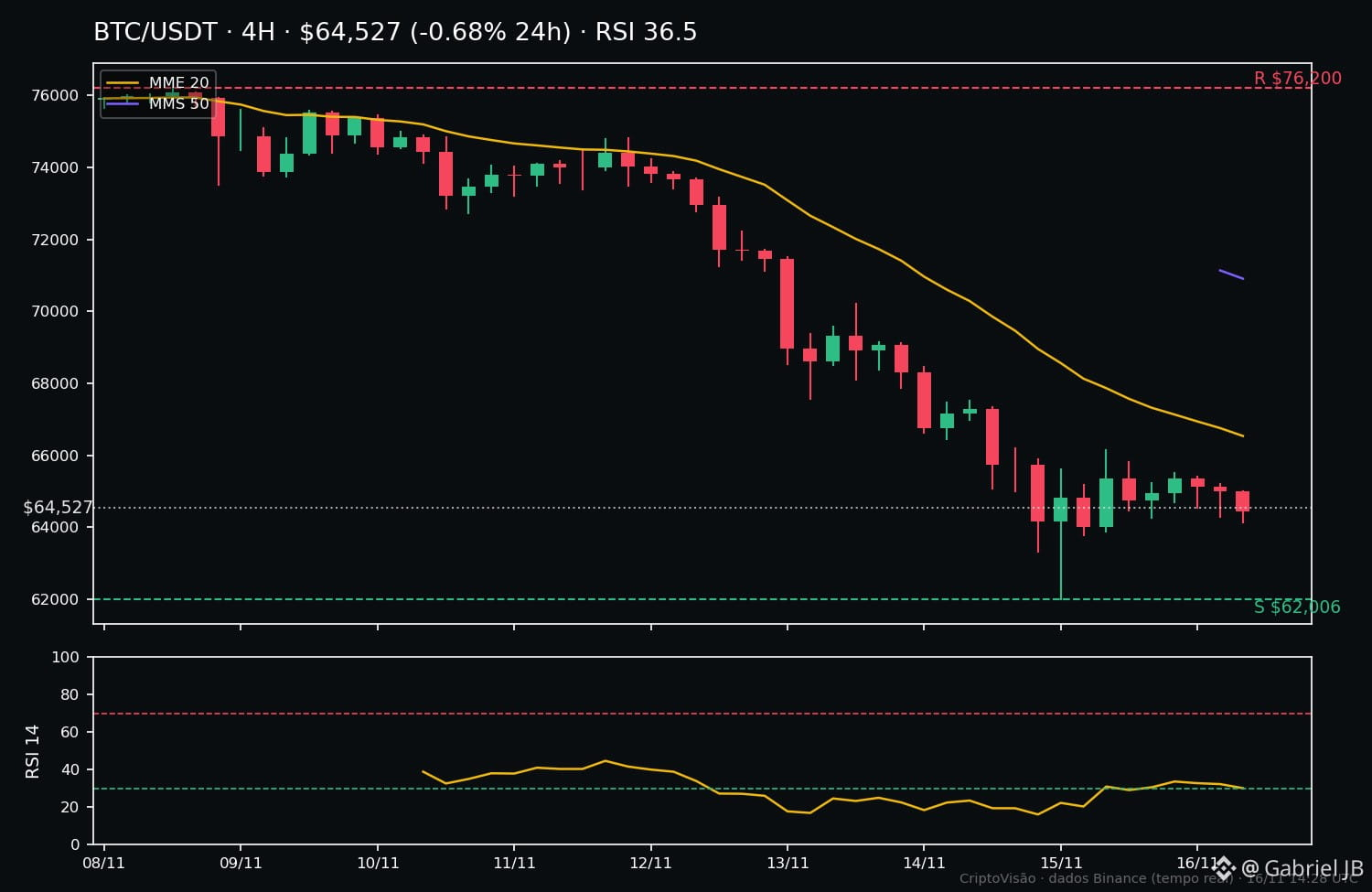
Buy $BTC now? The stop says no—do the math 🛡️
$BTC today: US$ 64.499,80 (-0,77% in 24h, -15,11% in 7 days). RSI 36,5, neutral, and the price remains below the 4h moving averages. The 7-day low, US$ 62.006, held yesterday—and resistance is US$ 66.456, the low it lost on 14/11. The price is in the middle of the range: the worst place to enter.
Today's lesson: don't set your stop at a round number. Not US$ 64.000 just because it looks nice—put it below the structure, below the actual low: US$ 61.700.
Let's do the math together, using a US$ 1.000 account:
1) Risk per BTC: entry at US$ 64.499,80 − stop at US$ 61.700 = US$ 2.799,80.
2) The 1% rule: the most you risk per trade is US$ 10.
3) Position size: US$ 10 ÷ US$ 2.799,80 = 0,00357 BTC, about US$ 230. That's all your risk allows.
4) Risk/reward: the target is resistance at US$ 66.456 → a gain of US$ 1.956,20. R:R of 0,70:1—below the minimum of 1,5:1. The entry FAILS.
The level is what matters: either wait for a retest of the US$ 62.006 low, or stay out. Preserving capital is strategy No. 1.
What about you: do you place your stop below the structure or at a round number? Tell us in the comments 👇
#Bitcoin #RiskManagement
1
·
--
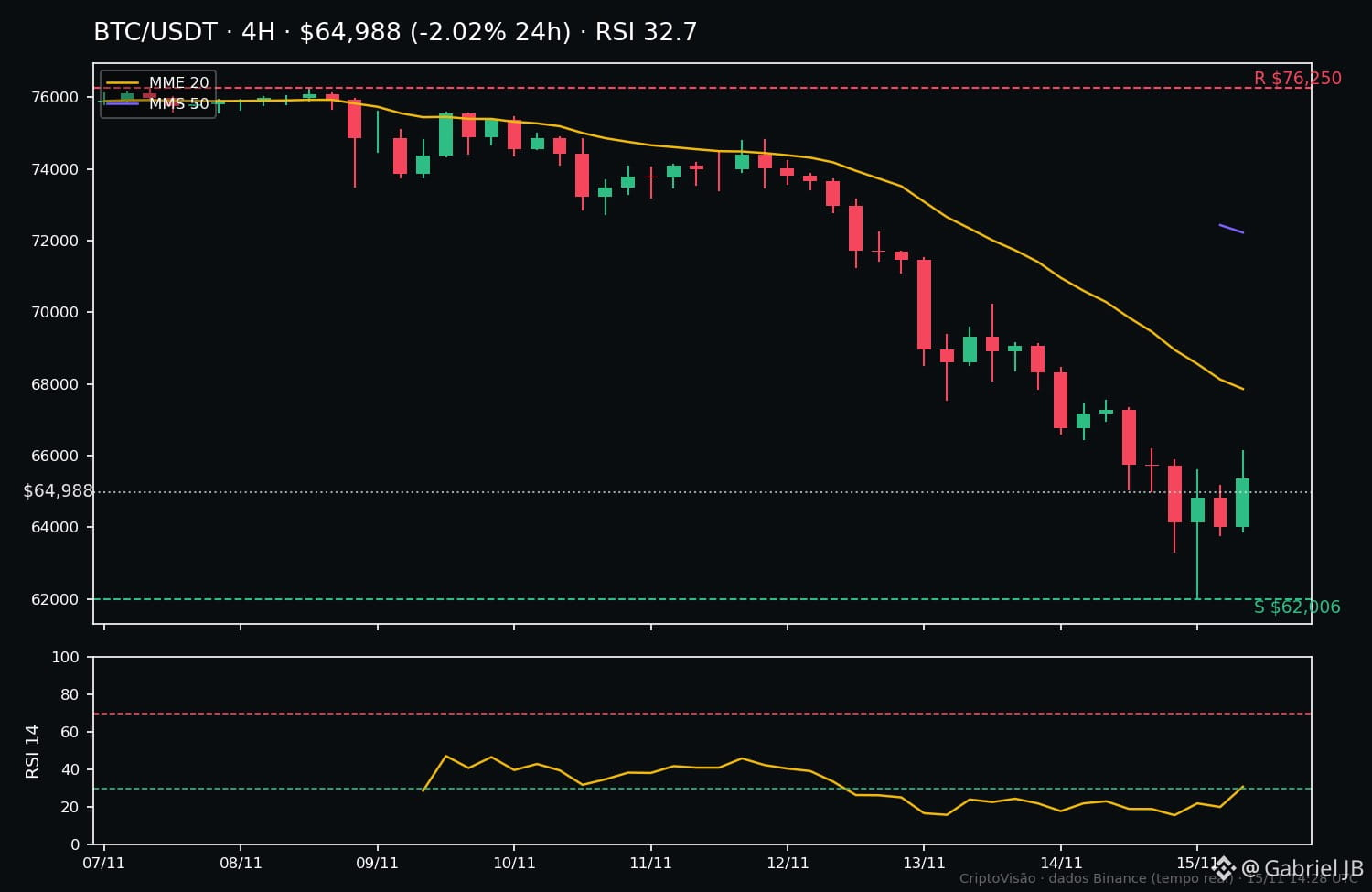
3 trades of 1% can be ONE 3% risk 📉
The $BTC is at US$ 64,997 today, down 13.89% in 7 days, with the week's low at US$ 62,006. The RSI-14 is at 32.7 and the price remains below the 4h moving averages. ETH fell 20.39% in the same week. When the market falls, everything falls together — correlation is working against those who don't account for it.
The trap: opening 1% in BTC, 1% in ETH, and 1% in SOL seems like risking 1% per trade. In practice, that's ~3% on a single bet, because all three move together. The real risk is the sum of correlated positions, not the risk of each one.
The calculation, on a US$ 1,000 account:
• 1% risk = US$ 10 per trade.
• Entry at US$ 64,997, stop at US$ 61,700 — below the actual support at US$ 62,006, not at a round number.
• Risk per BTC: US$ 3,297. Position: 10 ÷ 3,297 = 0.00303 BTC (~US$ 197).
• Target at the 20-period moving average (US$ 68,281): reward of US$ 3,284, R:R of 1:1 — below the 1:2 minimum. Trade rejected. The best trade today is no trade.
And remember: 10 stops of 1% cost 9.6% of your account. Ten trades risking 10% cost 65%. Several small stops are better than going all-in — preserving capital is strategy #1.
Do you add up the risk of your correlated positions before entering?
#Bitcoin #GestaoDeRisco #CriptoVisao
19
·
--
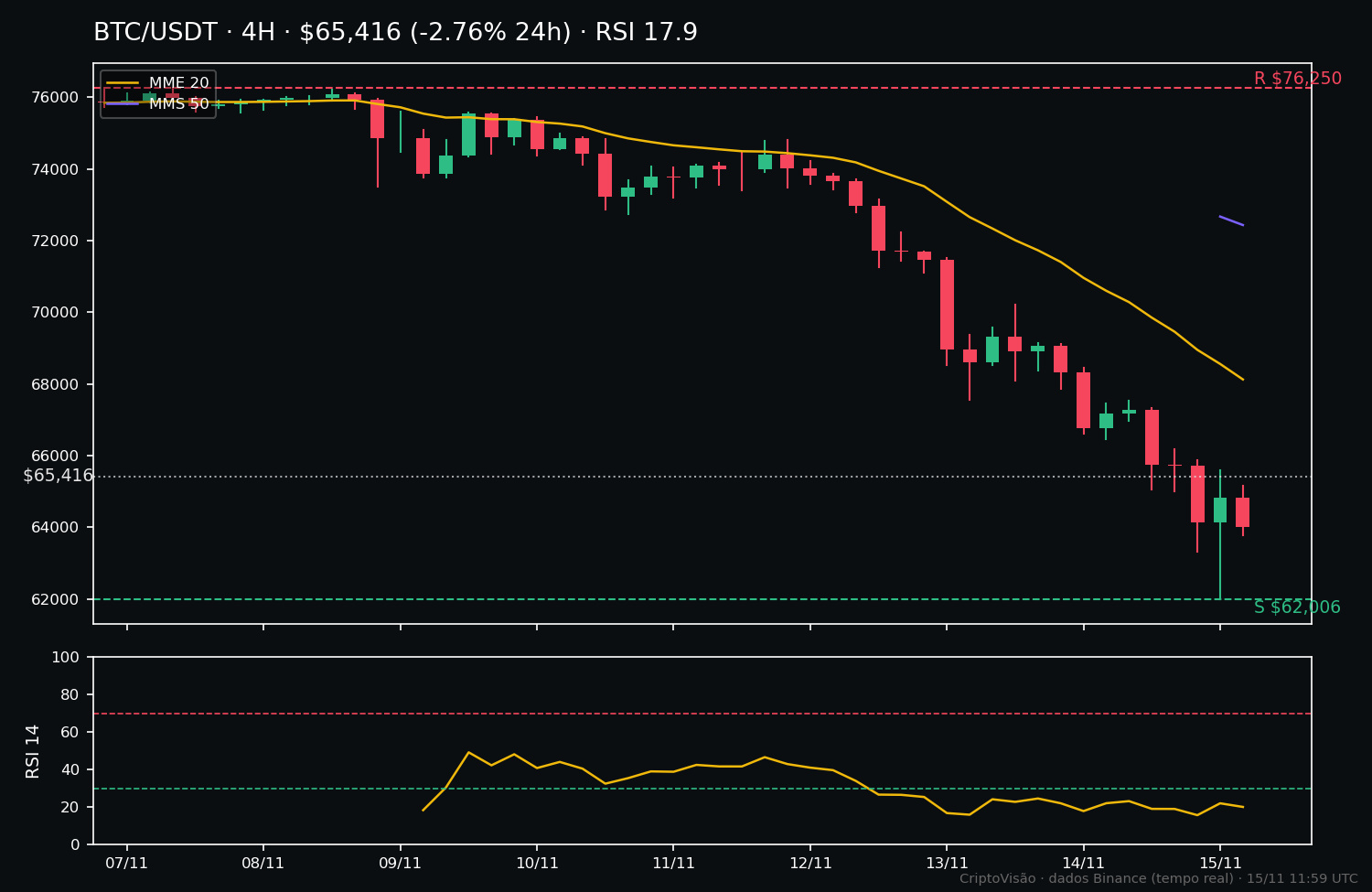
$BTC is up 5.5% from the low — and that’s when FOMO bites
$BTC fell as low as US$62,006 overnight — a new 7-day low — and is now at US$65,412. It’s up 5.5% from the bottom. And this is exactly when many people make the mistake of the day: buying the bounce out of FOMO, without confirmation.
The mistake: seeing the price rise quickly after a week of -15.6% and rushing in, afraid of “missing the turnaround.” The problem? The price is right up against resistance at US$66,456 — the 7-day floor it lost yesterday. Without a 4-hour close above that level, this may just be a breather within the downtrend, not a reversal. Anyone buying here is buying just below resistance, with the RSI-14 at 17.9 and the price still below the 4-hour moving averages (US$68,704 / US$72,433).
Why it costs money: if resistance holds and the price falls back to US$62,006, anyone who jumped in on the momentum loses ~5% in the blink of an eye — and, worse, gets stuck in a long position in a market that still hasn’t confirmed any bottom.
The simple rule: a bounce isn’t a reversal. Wait for a 4-hour close above US$66,456. If it doesn’t close above, there’s no entry — just patience. And if you do enter, set a stop below US$62,006 and risk a maximum of 1% of your account per trade.
Have you ever fallen for FOMO on a bounce that then crashed? Tell us in the comments 👇
$BTC
#Bitcoin #CriptoVisao #RiskManagement
41
·
--
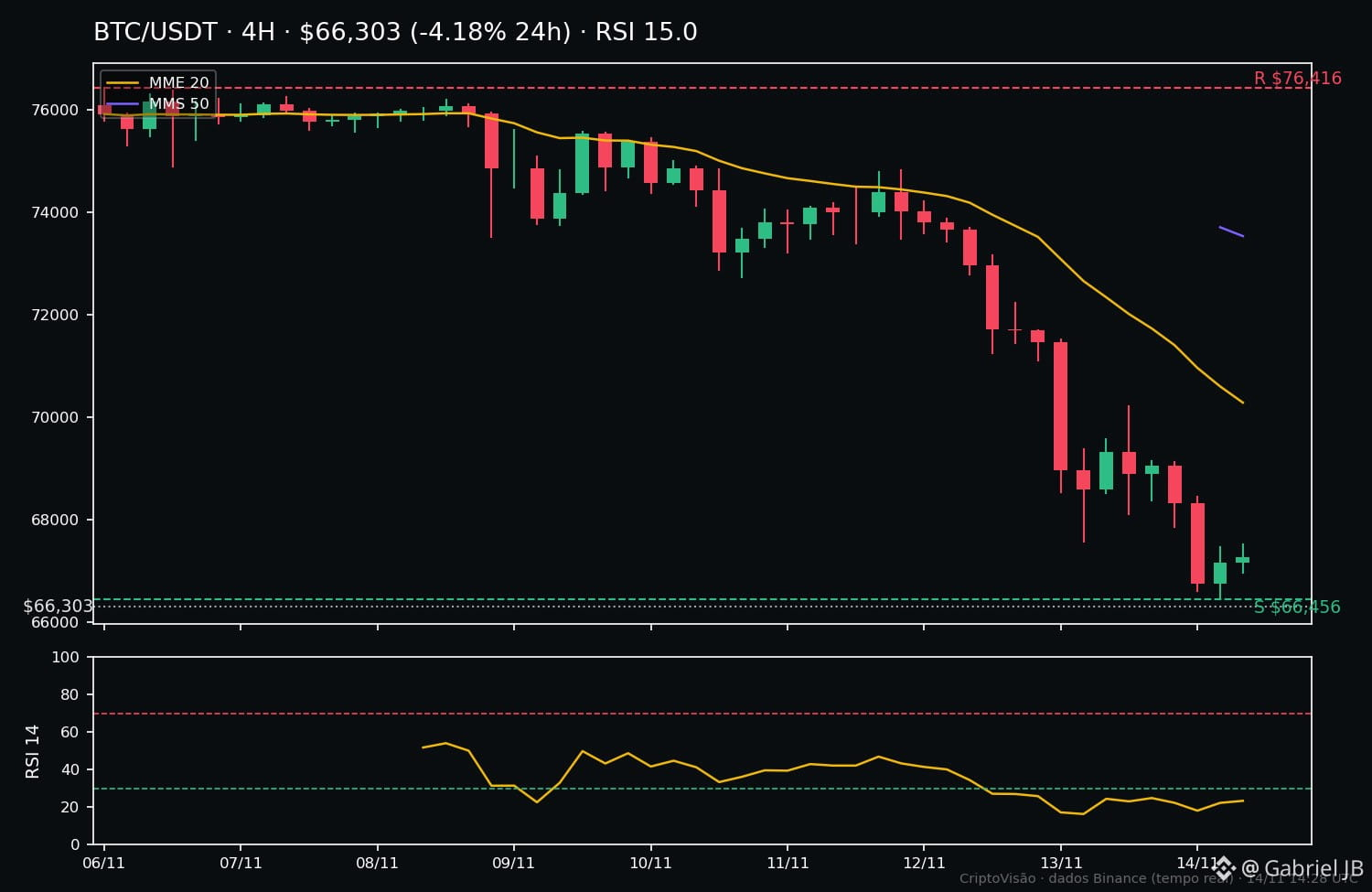
$BTC lost the weekly floor — and this is where the risk of ruin decides who stays in the game 📉
$BTC is currently at US$ 66,303, down 11.38% for the week, with an RSI-14 of 15.0 (extreme oversold). The 7-day floor of US$ 66,456 has been breached — the 24-hour low is US$ 65,962, and the nearest resistance is the 24-hour high at US$ 69,488.
Today’s lesson isn’t about getting the direction right. It’s about surviving a losing streak — the risk of ruin.
Example with a US$ 1,000 account:
• Risk 1% per trade = US$ 10. Ten consecutive losses: the account drops to ~US$ 904 (-9.6%). To recover, you only need +10.6%.
• Risk 5% per trade = US$ 50. Ten consecutive losses: the account drops to ~US$ 599 (-40.1%). To recover, you need +67%.
• Risk 10% per trade = US$ 100. Ten consecutive losses: the account drops to ~US$ 349 (-65.1%). To recover, you need +187%.
The math is unforgiving: the higher the risk per trade, the harder it is to get back. And in a week like this — with $BTC down 11% and the RSI at 15 — consecutive losses aren’t a hypothetical; they’re the normal scenario.
Rule of thumb: risk 1% per trade. With US$ 1,000, that’s US$ 10. If your stop is US$ 500 from your entry price, your position size is US$ 10 ÷ US$ 500 = 0.02 $BTC. The stop determines the size — never the other way around.
Preserving capital is strategy No. 1. Those who survive can trade tomorrow.
And you: have you calculated how many consecutive losses your account can withstand? 👇
#Bitcoin #GestaoDeRisco #CriptoVisao
$BTC lost the weekly floor — and this is where the risk of ruin decides who stays in the game 📉
$BTC is currently at US$ 66,303, down 11.38% for the week, with an RSI-14 of 15.0 (extreme oversold). The 7-day floor of US$ 66,456 has been breached — the 24-hour low is US$ 65,962, and the nearest resistance is the 24-hour high at US$ 69,488.
Today’s lesson isn’t about getting the direction right. It’s about surviving a losing streak — the risk of ruin.
Example with a US$ 1,000 account:
• Risk 1% per trade = US$ 10. Ten consecutive losses: the account drops to ~US$ 904 (-9.6%). To recover, you only need +10.6%.
• Risk 5% per trade = US$ 50. Ten consecutive losses: the account drops to ~US$ 599 (-40.1%). To recover, you need +67%.
• Risk 10% per trade = US$ 100. Ten consecutive losses: the account drops to ~US$ 349 (-65.1%). To recover, you need +187%.
The math is unforgiving: the higher the risk per trade, the harder it is to get back. And in a week like this — with $BTC down 11% and the RSI at 15 — consecutive losses aren’t a hypothetical; they’re the normal scenario.
Rule of thumb: risk 1% per trade. With US$ 1,000, that’s US$ 10. If your stop is US$ 500 from your entry price, your position size is US$ 10 ÷ US$ 500 = 0.02 $BTC . The stop determines the size — never the other way around.
Preserving capital is strategy No. 1. Those who survive can trade tomorrow.
And you: have you calculated how many consecutive losses your account can withstand? 👇
#Bitcoin #GestaoDeRisco #CriptoVisao
146
·
--
$BTC lost support — and this is where risk management decides who stays in the game 📉
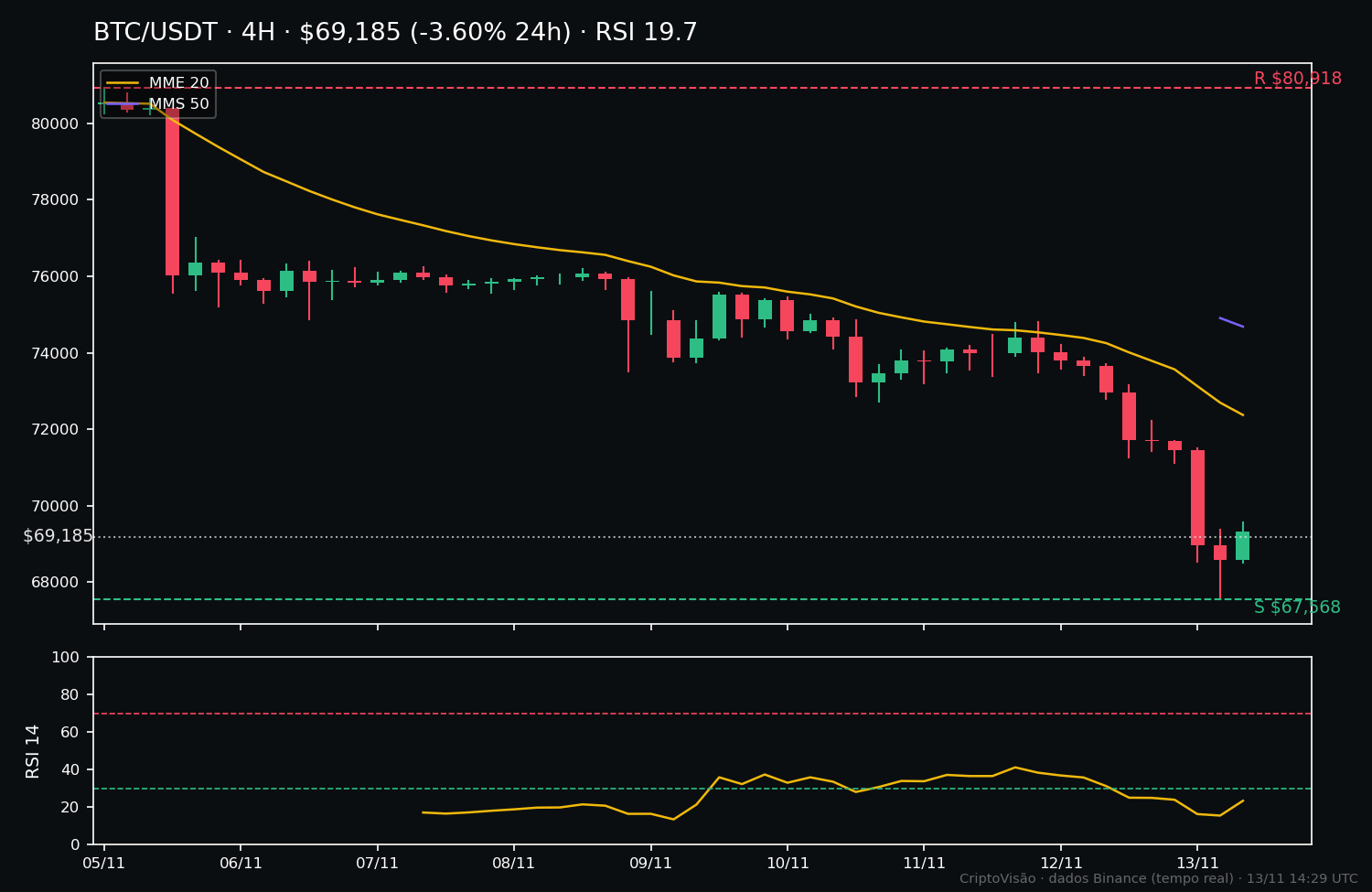
Bitcoin is at $69,195 today, down 13.94% for the week, with an RSI-14 of 19.7 (oversold). The $72,727 support level, which had held for days, broke yesterday. This week’s new support is the low of $67,568; the nearest resistance is the 24-hour high of $72,288.
Today’s lesson, using a $500 account as an example:
1. The 1% per-trade rule: the most you can lose on a trade is $5. That’s not the position value — it’s the amount you’d lose if the stop is triggered.
2. Place your stop at a structural level, not a round number: with support at $67,568, the stop goes below it, at $67,400. Entry at $69,195 → risk of $1,795 per BTC.
3. The stop determines your position size: $5 ÷ $1,795 = 0.0028 BTC (about $194). The stop determines the size — never the other way around.
4. Check the risk/reward ratio before entering: target at $72,288 → potential gain of $3,093 per BTC. Risk/reward ratio of 1.72:1. The minimum I recommend is 1:2. The result: this trade FAILS the test. The best trade today is no trade at all.
5. Ten small stop-outs are better than one all-in: 10 losses of 1% leave a $500 account with about $452 (-9.6%). One lost all-in trade leaves the account at $0. Preserving capital is strategy #1 — those who survive can trade again tomorrow.
What about you: do you calculate your position size based on your stop, or do you still trade by gut feeling? 👇
#Bitcoin #GestaoDeRisco #CriptoVisao
5
·
--
The $BTC broke the week's support. Now what? Your risk management is what decides.
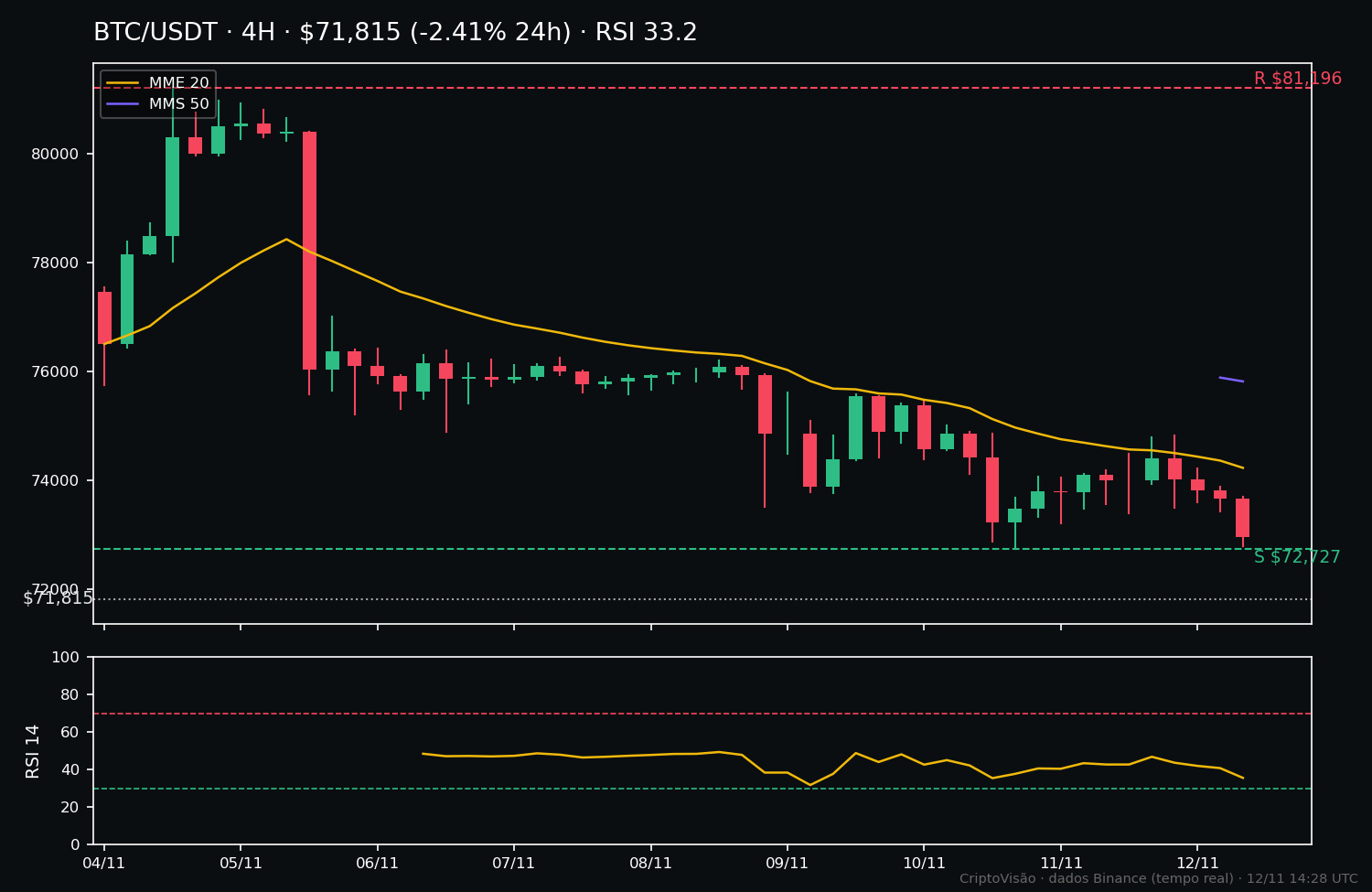
The $BTC is at $71,819 (-2.39% in 24h; -4.63% in 7 days), below the 20- and 50-period averages ($74,151 and $75,809), with the RSI-14 at 33.2. The low for the last 7 days was $72,727 — the price is already below it. Anyone whose stop was «below support» was stopped out. That's how the market works: yesterday's support doesn't protect today's trade.
Today's lesson, with real numbers — to repeat in any trade:
1️⃣ The 1% rule: with a $1,000 account, you risk a maximum of $10 per trade. That's not the position size — it's the maximum you're willing to lose if the stop is triggered.
2️⃣ The stop follows the structure, not a round number. The low for the last 24 hours is $71,777. A technical stop goes below it, with room for noise: $71,100. Distance from the current price: $719 per $BTC.
3️⃣ The stop determines the position size: $10 ÷ $719 = 0.0139 $BTC, worth around $999. The stop tells you how much to buy — never the other way around.
4️⃣ Risk/reward ratio before entering: the first obstacle above is the 20-period average, at $74,151. Potential gain: $2,332 per $BTC. Risk: $719. A ratio of 3.2 to 1 — above the minimum of 2 to 1. This test approves the entry; below 2 to 1, the best trade is no trade.
5️⃣ Why ten small stops are worth more than an all-in: ten 1% stops leave the account at $904 (-9.6%), and recovering requires +10.6%. An all-in that loses 50% requires +100% just to break even. Surviving is strategy No. 1 — profit comes later.
Preserving capital isn't fear. It's what keeps you in the game for the next setup. 📉
What's your risk rule per trade: 1%, 2%, or do you not have one yet?
#Bitcoin #GestaoDeRisco #CriptoVisao
The $BTC broke the week's support. Now what? Your risk management is what decides.
The $BTC is at $71,819 (-2.39% in 24h; -4.63% in 7 days), below the 20- and 50-period averages ($74,151 and $75,809), with the RSI-14 at 33.2. The low for the last 7 days was $72,727 — the price is already below it. Anyone whose stop was «below support» was stopped out. That's how the market works: yesterday's support doesn't protect today's trade.
Today's lesson, with real numbers — to repeat in any trade:
1️⃣ The 1% rule: with a $1,000 account, you risk a maximum of $10 per trade. That's not the position size — it's the maximum you're willing to lose if the stop is triggered.
2️⃣ The stop follows the structure, not a round number. The low for the last 24 hours is $71,777. A technical stop goes below it, with room for noise: $71,100. Distance from the current price: $719 per $BTC .
3️⃣ The stop determines the position size: $10 ÷ $719 = 0.0139 $BTC , worth around $999. The stop tells you how much to buy — never the other way around.
4️⃣ Risk/reward ratio before entering: the first obstacle above is the 20-period average, at $74,151. Potential gain: $2,332 per $BTC . Risk: $719. A ratio of 3.2 to 1 — above the minimum of 2 to 1. This test approves the entry; below 2 to 1, the best trade is no trade.
5️⃣ Why ten small stops are worth more than an all-in: ten 1% stops leave the account at $904 (-9.6%), and recovering requires +10.6%. An all-in that loses 50% requires +100% just to break even. Surviving is strategy No. 1 — profit comes later.
Preserving capital isn't fear. It's what keeps you in the game for the next setup. 📉
What's your risk rule per trade: 1%, 2%, or do you not have one yet?
#Bitcoin #GestaoDeRisco #CriptoVisao
30
·
--
The $BTC fell 10% in 7 days — and that’s where the costliest mistake lies 📉
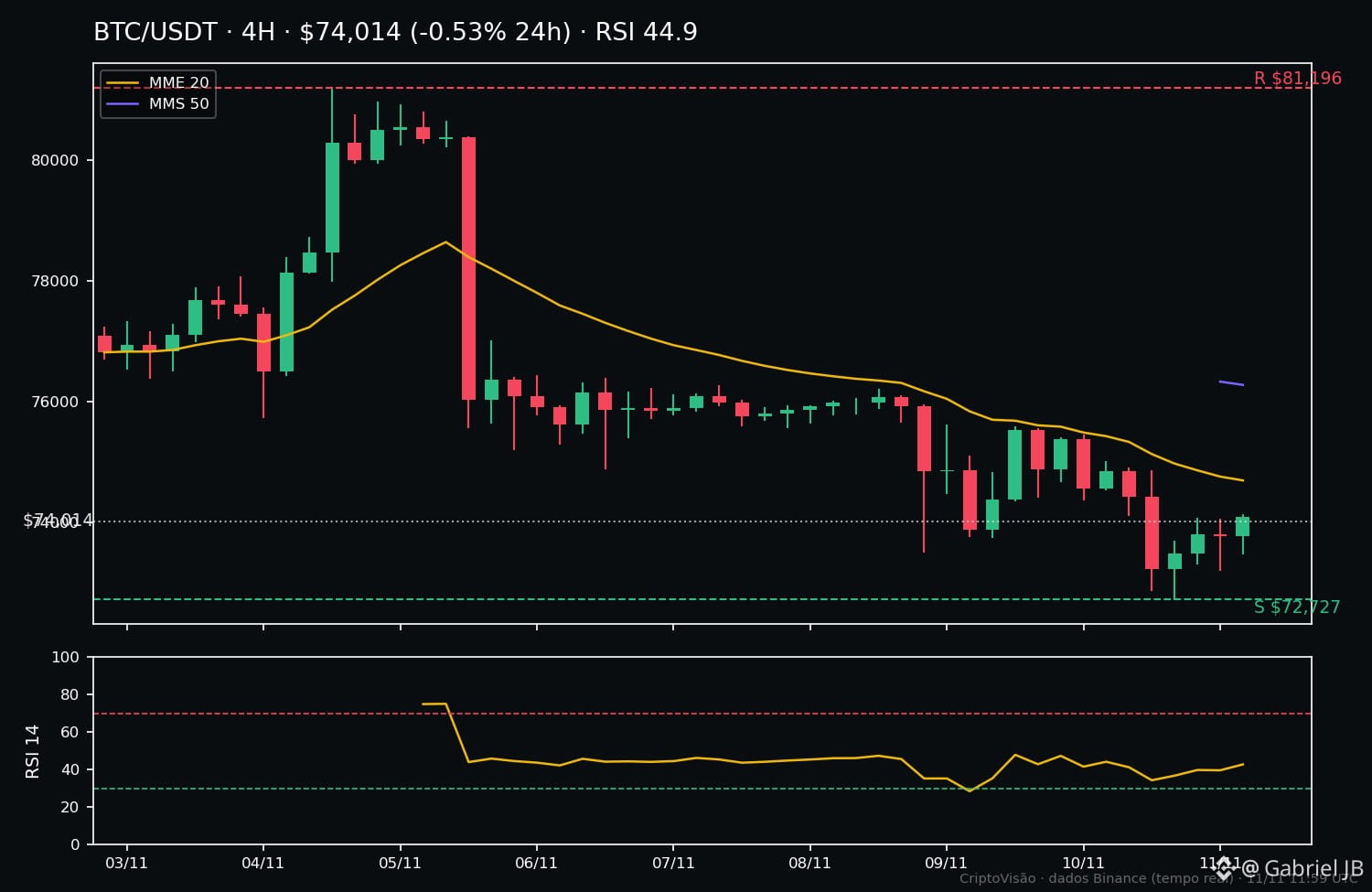
The $BTC fell from US$ 81.196 to US$ 72.727 in 7 days (-10.4%). Today it’s at US$ 74.014, still below the 20- and 50-period averages on the 4h chart (US$ 74.789 and US$ 76.276), with RSI-14 at 44.9 — neutral, with no sign of a reversal.
The mistake of the day: buying the dip just because “it’s already fallen a lot.” A falling price isn’t a cheap price. Without confirmation, every “discount” could just be the middle of the drop — and anyone who buys without a plan becomes hostage to the next candle.
The simple rule: wait for confirmation. A 4h close above the 20-period average (US$ 74.789) or a higher low shows that buyers have returned. Without that, it’s a bet, not analysis.
And if you enter: place a stop below the 7-day low (US$ 72.727). If that level is breached, the thesis is dead — exit and reassess. Anyone who doesn’t set a stop before entering ends up making decisions emotionally afterward.
Have you ever bought a dip that kept falling? Tell us in the comments 👇
$BTC
#Bitcoin #CriptoVisao #RiskManagement
50
·
--
The 1% rule that separates those who survive from those who go broke on $BTC 📊
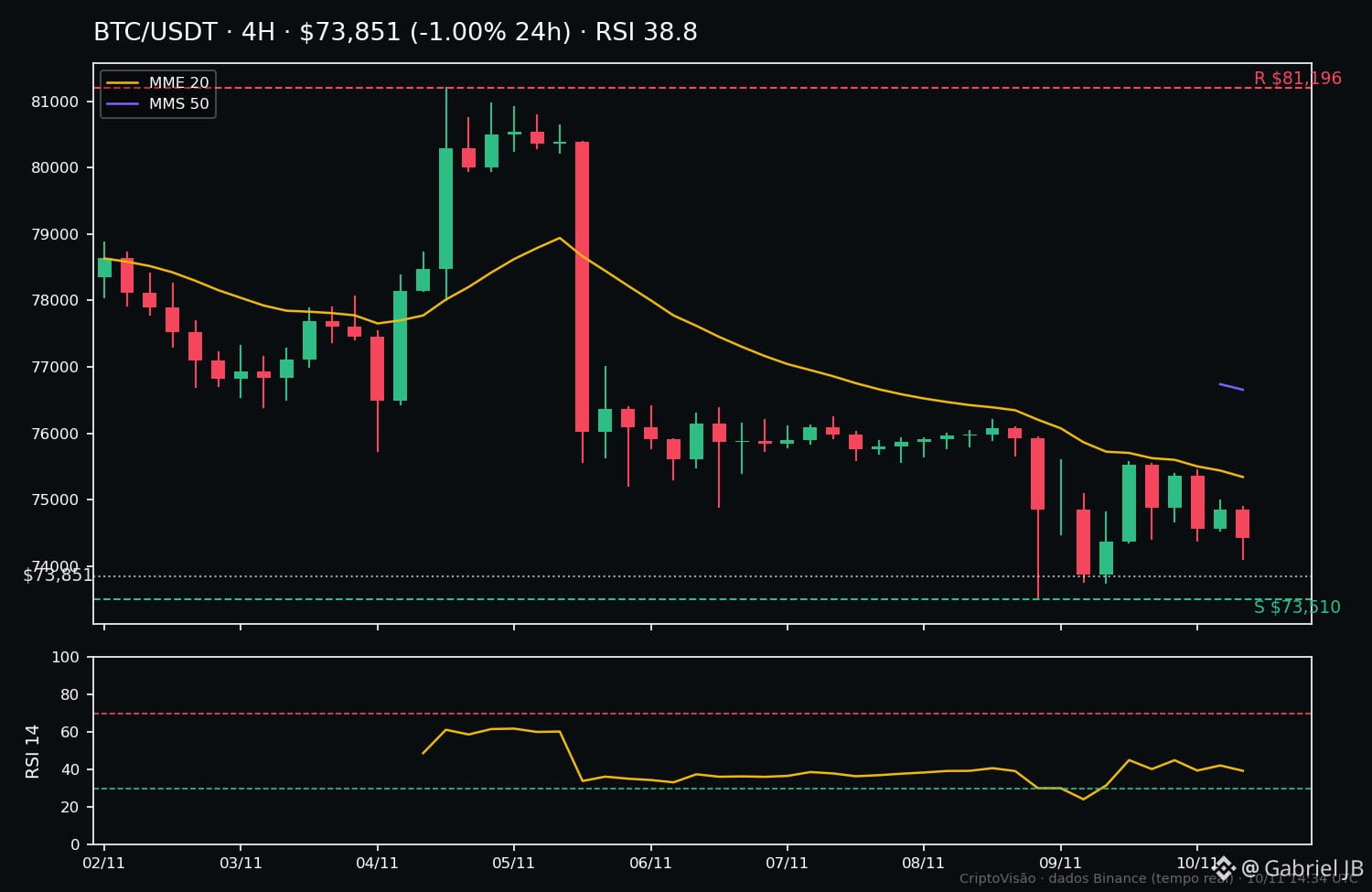
$BTC is trading at US$73,707 (-1.08% in 24h; -5.36% in 7 days), below the 20- and 50-period moving averages on the 4h chart, with the week's support at US$73,510 and resistance at US$81,196. It's the perfect scenario to practice the calculation that best protects an account — before thinking about profit.
Example account: US$1,000. The 1% rule = US$10 risk per trade. That's not the position size: it's the maximum you're willing to lose if the stop is triggered.
Step 1 — place the stop below actual support. Weekly support: US$73,510. Stop: US$72,950. It's not a round number: the chart structure dictates it. Risk per BTC: 73,707 − 72,950 = US$757.
Step 2 — the stop determines the position size. US$10 ÷ US$757 = 0.0132 BTC, about US$974. Notice: the position is large, but the risk is still only US$10.
Step 3 — the risk/reward test. First realistic target: US$75,347 (20-period moving average, 4h). Reward: 75,347 − 73,707 = US$1,640 per BTC. Risk/reward = 2.2:1 — above the 2:1 minimum. The entry passes the test. Below 2:1, the best decision is not to enter.
And why are several small stops worth more than an all-in? 10 consecutive 1% stops leave the account down 9.6% — you can recover with a 10.6% gain. A 50% loss on an all-in requires a 100% gain just to get back to zero. Preserving capital is strategy No. 1: those who survive stay in the game.
What's your risk limit per trade: 1% or 2%? Let us know in the comments. 👇
#Bitcoin #GestaoDeRisco #CryptoVision
4
·
--
Position size determines whether you survive — not being right 📐
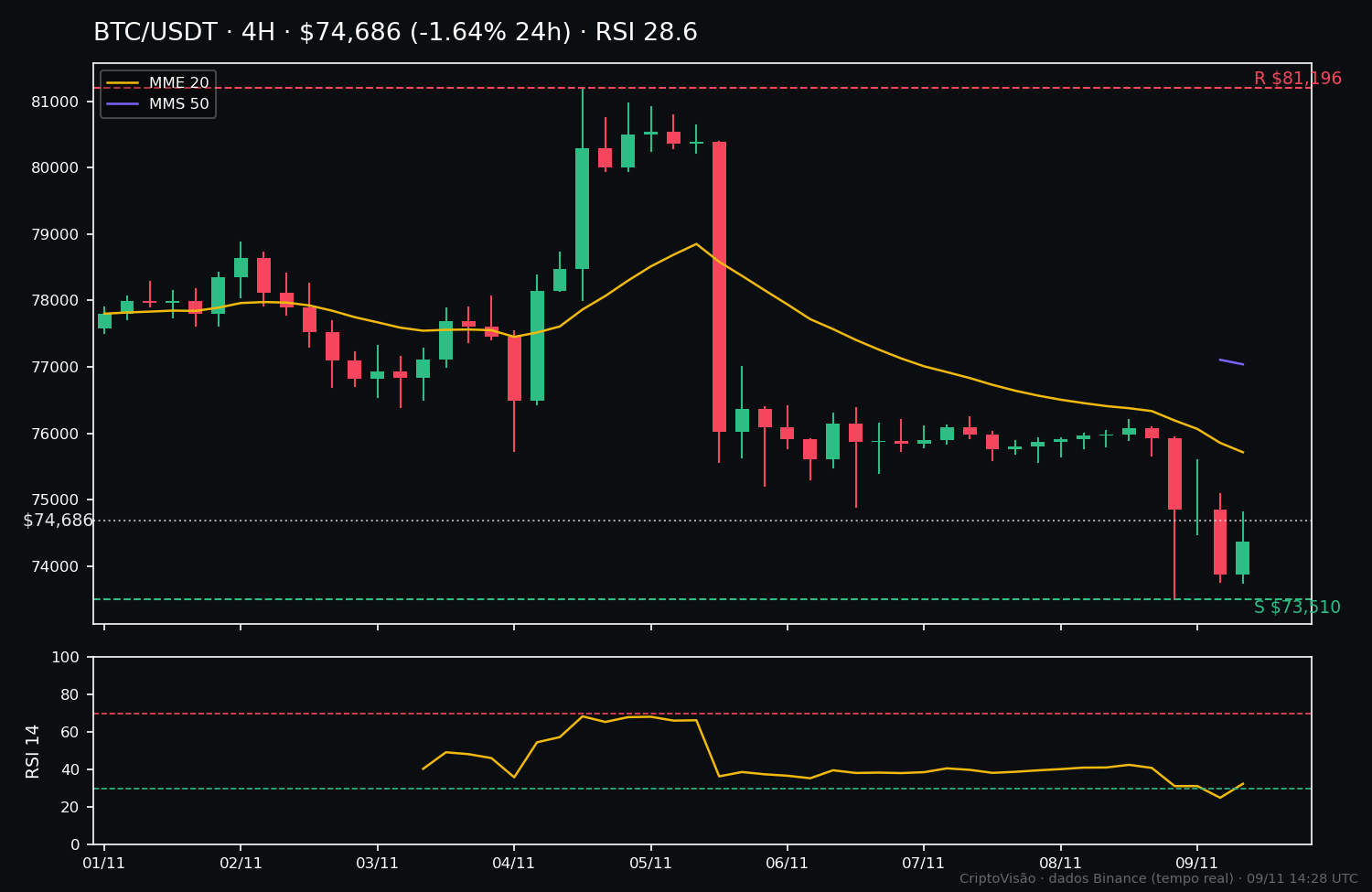
$BTC today: $74.696 (-1.6% in 24h). Weekly support: $73.510. Resistance: $81.196. RSI at 28.6, in oversold territory, and the price remains below the 20- and 50-period moving averages. Today’s calculation, step by step, using a $1,000 account as an example:
1️⃣ Define the risk: 1% of the account = $10 per trade. That’s the maximum you’re willing to lose if the stop is triggered.
2️⃣ Place the stop based on market structure: below actual support, at $73.100 — not at some arbitrary round number. Distance from entry: $74.696 − $73.100 = $1.596 per BTC.
3️⃣ The stop determines the position size: $10 ÷ $1.596 = 0,0063 BTC, about $468. It’s not the amount you “think” is right — it’s what the risk allows.
Risk/reward test: target at resistance, $81.196 − $74.696 = $6.500 in potential gains versus $1.596 in risk. A 4.1-to-1 ratio — above the minimum of 2-to-1, so the trade passes the test. Caveat: the short-term trend remains bearish, so the numbers give it the green light, but the context calls for caution.
Why does this matter? Ten 1% stop-outs cost about 9.6% of your account — you stay in the game. Ten 10% bets cost 65%. Preserving capital is strategy No. 1.
Do you already calculate your position size before entering, or do you decide by gut feeling? 👇
#Bitcoin #GestaoDeRisco #CryptoVision
8
·
--
The account that survives isn't the one that gets it right most often — it's the one that risks less per trade
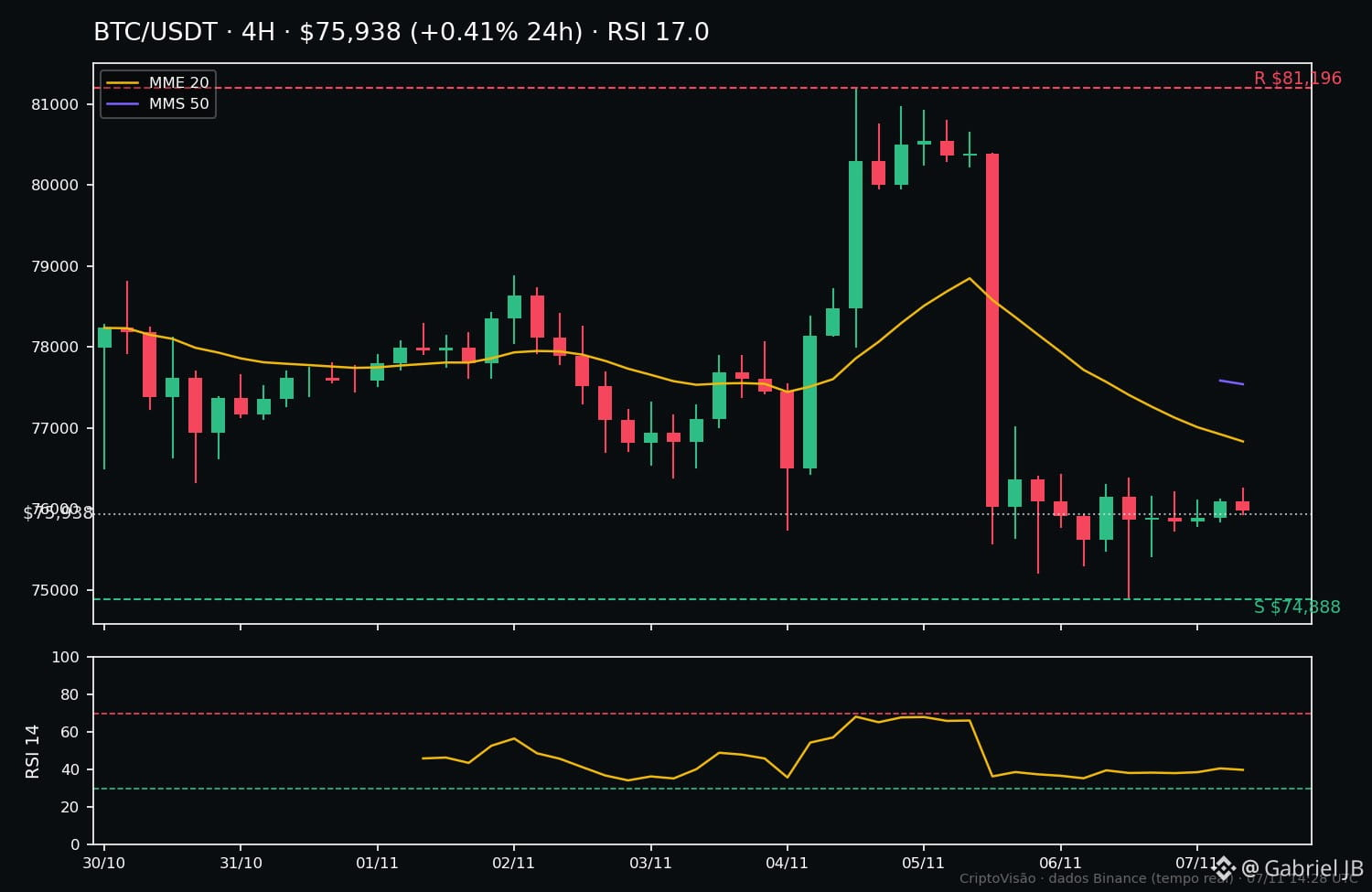
$BTC is currently at US$75,940.29, trading below the 20- and 50-period moving averages (4h), with the RSI-14 at 17, in oversold territory. This week's support: US$74,888. Resistance: US$81,196.
Today's lesson is simple: before thinking about profits, decide how much you can afford to lose.
1. The 1% rule: with a US$1,000 account, risk no more than US$10 per trade. It would take 100 consecutive losing trades to wipe out the account — and nobody loses 100 times in a row when following a method.
2. Place your stop below support, not at a round number: entry near US$75,940, stop at US$74,700, just below support at US$74,888. Risk per coin: US$1,240.
3. Position size is determined by risk, not by what you want: US$10 ÷ US$1,240 = 0.008 BTC (about US$612 in exposure). Risk determines position size — never the other way around.
4. Only enter if the reward makes it worthwhile: with a target at the US$81,196 resistance, the potential gain is US$5,256 — more than 4 times the risk. The minimum rule is 1 to 2. If it's below that, wait for the next opportunity.
Several small stop-outs keep you in the game. Going all-in takes you out of it for good. Preserving capital is strategy No. 1. 📉
What's your risk rule per trade — 1% or 2%? Tell us in the comments. 👇
#Bitcoin #GestaoDeRisco #CriptoVisao
18
·
--
The stop isn’t placed at a round number — it’s placed below support 🛡️
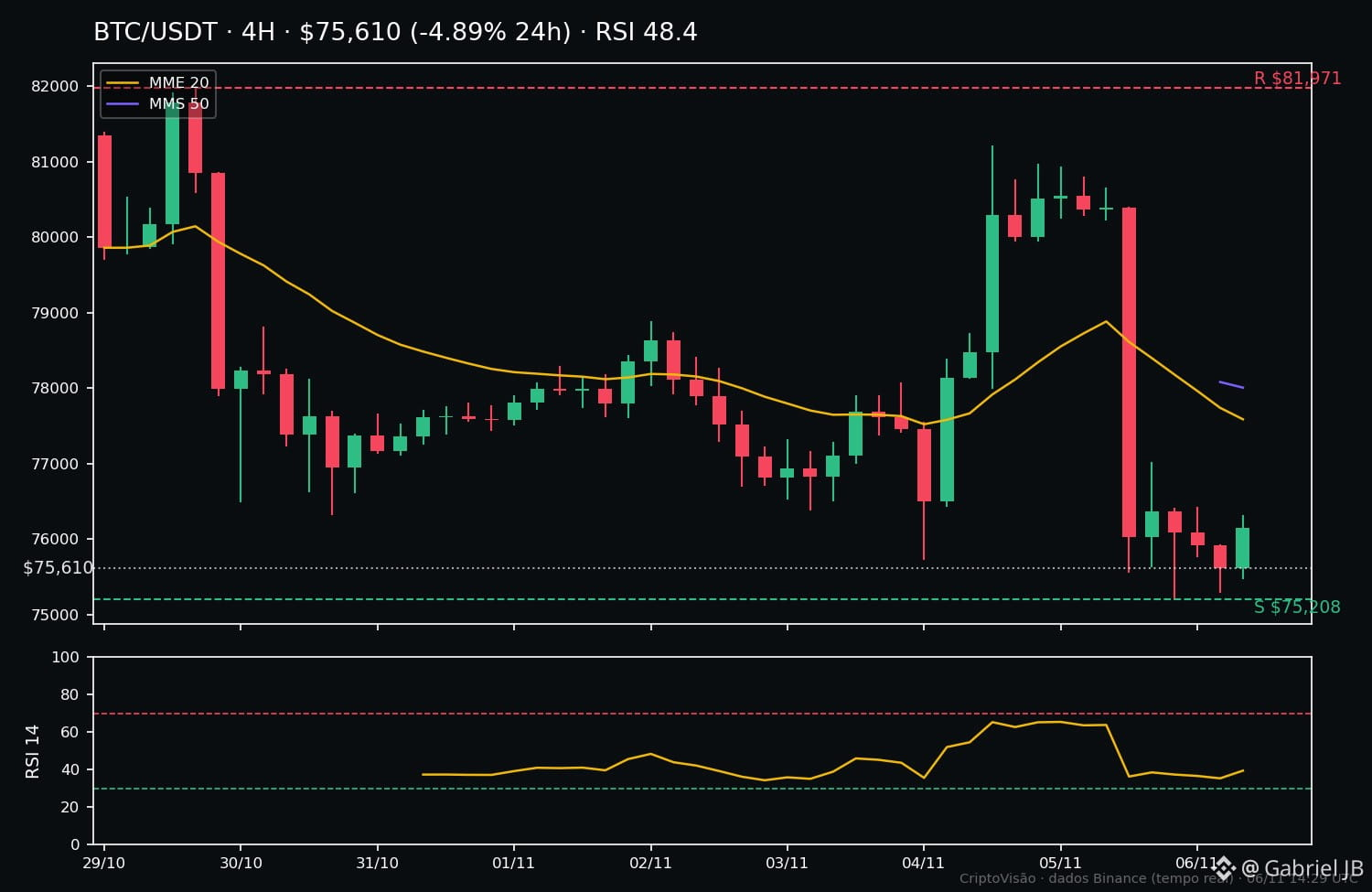
$BTC is trading at $75.641 today (-4,81% in 24h), right at the week’s support ($75.208) and below the 4h moving averages. Weekly resistance: $81.971. RSI 48,4 — neutral.
The calculation, step by step, for a $1.000 account:
1. The 1% rule: the maximum risk per trade is $10. Never more than that.
2. Stop based on structure: below actual support — $74.800, not the round number $75.000. Risk per BTC: $75.641 − $74.800 = $841.
3. The stop determines position size: $10 ÷ $841 = 0,0119 BTC (about $900). Stop first, position second — never the other way around.
4. Risk/reward test: target at resistance, $81.971 − $75.641 = $6.330 per BTC. 6.330 ÷ 841 ≈ 7,5:1 — comfortably above the 1:2 minimum.
But be careful: a high R:R isn’t a green light. The price is below the moving averages and the short-term trend is downward — the test says “worth a look,” not “get in now.”
And remember: 10 stops at 1% cost about 10% of your account. One bad all-in trade could cost you everything. Preserving capital is strategy #1.
What’s your risk limit per trade — 1% or 2%?
#Bitcoin #GestaoDeRisco #CriptoVisao
10
·
--
🛡️ The math that keeps you in the game (even when you make mistakes)
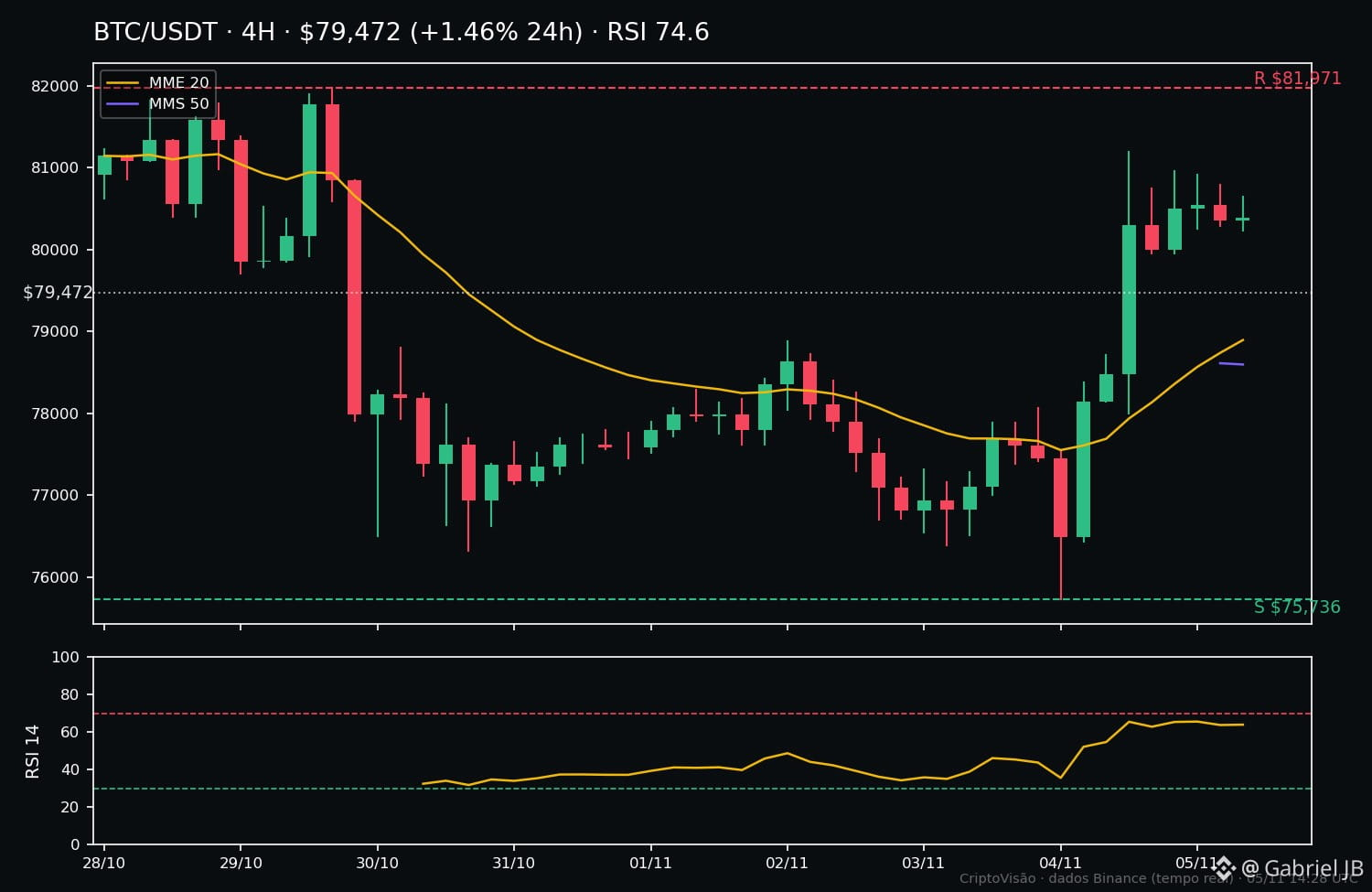
$BTC is at $79.466 today (+1.4% in 24h), between last week's support at $75.736 and resistance at $81.971. RSI at 74.6 — overbought territory. And this is where risk management decides everything.
Let's do the math together, step by step:
1️⃣ Define the risk: $2,000 account, 1% risk per trade = $20. Never more than that per trade.
2️⃣ Set the stop based on structure: below real support, at $75.150 — not just some round number.
3️⃣ Position size comes from the stop: risk per $BTC = $79.466 − $75.150 = $4.316. Position = $20 ÷ $4.316 = 0.0046 BTC (≈ $368). The stop determines the size — never a hunch.
4️⃣ Test the risk/reward: up to resistance, the potential gain is $81.971 − $79.466 = $2.505. R:R = 0.58:1. Below the minimum of 1.5:1 — this entry, at this price, FAILS. Waiting is also a decision.
And watch out for correlation: $BTC, $ETH and $SOL almost always move together. Three 1% positions in correlated coins aren't three 1% risks — they're ~3% in a single bet.
With 1% per trade, 10 consecutive stops cost ~10% of your account, and you stay in the game. Going all-in ends with the first mistake. Preserving capital is strategy No. 1 — the market will be here tomorrow.
What's your risk rule per trade: 1% or 2%? 👇
#Bitcoin #GestaoDeRisco #CryptoVision
🛡️ The math that keeps you in the game (even when you make mistakes)
$BTC is at $79.466 today (+1.4% in 24h), between last week's support at $75.736 and resistance at $81.971. RSI at 74.6 — overbought territory. And this is where risk management decides everything.
Let's do the math together, step by step:
1️⃣ Define the risk: $2,000 account, 1% risk per trade = $20. Never more than that per trade.
2️⃣ Set the stop based on structure: below real support, at $75.150 — not just some round number.
3️⃣ Position size comes from the stop: risk per $BTC = $79.466 − $75.150 = $4.316. Position = $20 ÷ $4.316 = 0.0046 BTC (≈ $368). The stop determines the size — never a hunch.
4️⃣ Test the risk/reward: up to resistance, the potential gain is $81.971 − $79.466 = $2.505. R:R = 0.58:1. Below the minimum of 1.5:1 — this entry, at this price, FAILS. Waiting is also a decision.
And watch out for correlation: $BTC , $ETH and $SOL almost always move together. Three 1% positions in correlated coins aren't three 1% risks — they're ~3% in a single bet.
With 1% per trade, 10 consecutive stops cost ~10% of your account, and you stay in the game. Going all-in ends with the first mistake. Preserving capital is strategy No. 1 — the market will be here tomorrow.
What's your risk rule per trade: 1% or 2%? 👇
#Bitcoin #GestaoDeRisco #CryptoVision
33
·
--
🛡️ A trade that fails the test is better left alone than lost
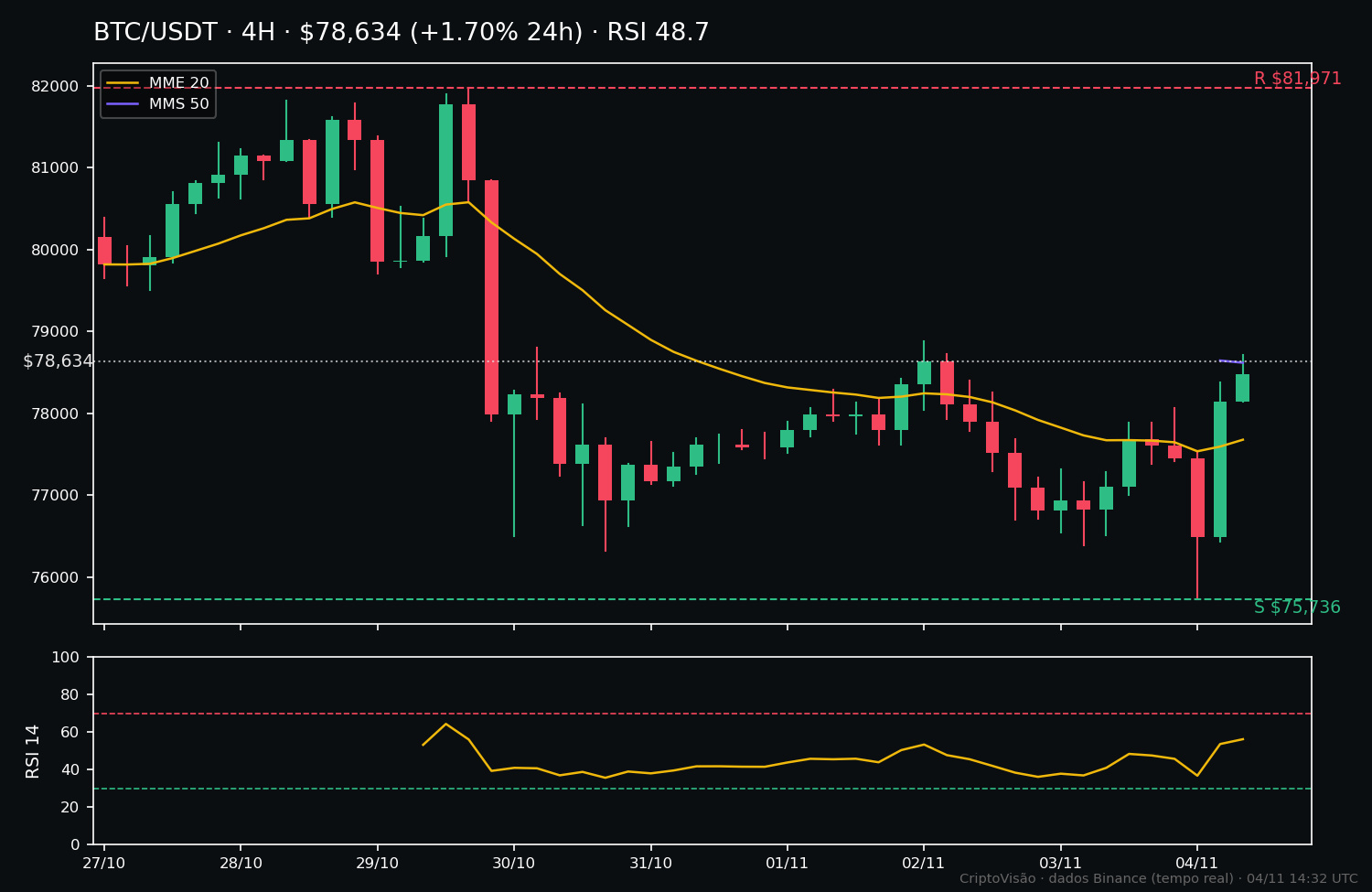
$BTC today (Nov 4): 78,638 USD (+1.7% in 24h). Weekly support: 75,736 USD. Resistance: 81,971 USD. RSI neutral (48.7), trend unclear — in this scenario, it’s not the price that decides the trade, it’s the plan.
The test to take before entering, in 3 steps:
1. Risk per trade: 1% of a 1,000 USD account = 10 USD. Never more than that.
2. Set the stop based on market structure, not a round number: below actual support, at 75,300 USD.
3. Position size is determined by the stop: 78,638 − 75,300 = 3,338 USD of risk per coin. 10 ÷ 3,338 = 0.0030 BTC (~236 USD). This is the position size that risks only 10 USD.
And the test that disqualifies the entry: a target at resistance gives 81,971 − 78,638 = 3,333 USD in potential profit against 3,338 USD in risk — a 1-to-1 ratio, below the minimum of 2 to 1. In this case, the best trade is no trade. Waiting for a better entry is also risk management.
What if the stop is triggered 10 times in a row? Losing 1% ten times leaves a 1,000 USD account at around 904 USD (−9.6%). A single lost “all-in” bet can cost half the account — and recovering 50% requires gaining 100%. Several small stops are worth more than one big bet.
Daily limit: 3 stops of 1% in a day = take a break. Preserving capital is strategy No. 1.
So, is the 1% rule already part of your plan, or do you still decide position size “by eye”? 👇
#Bitcoin #GestaoDeRisco #CriptoVisao
21
·
--
🛡️ Risk management: several small stops are worth more than going all-in
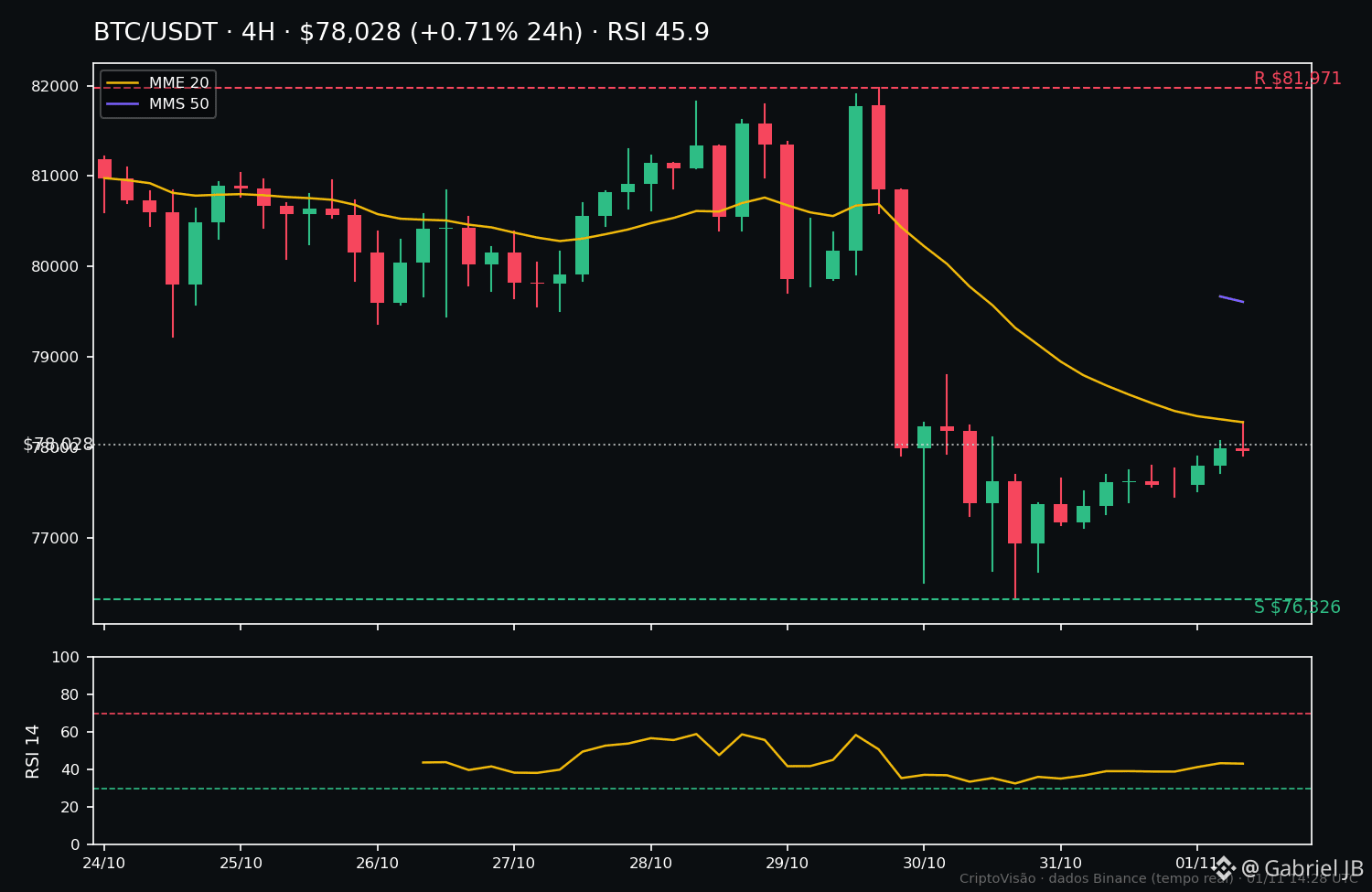
$BTC is currently at 78,028 USD, with weekly support at 76,326 USD and resistance at 81,971 USD. Let’s turn this into a lesson you can apply to any trade.
1️⃣ The 1% rule: in a sample account of 1,000 USD, you risk a maximum of 10 USD per trade. That’s not the position value—it’s the amount you’re willing to lose if your stop is triggered.
2️⃣ Place the stop below support, not at some random round number: entry at 78,028 USD, stop at 76,200 USD (just below 76,326 USD). Risk distance: 1,828 USD.
3️⃣ Calculate your position size; don’t guess: 10 USD ÷ 1,828 USD = 0.00547 BTC, or about 427 USD worth of position. That’s how you keep your risk at 1%, even with a position worth more than 10 USD.
4️⃣ Only enter trades with a risk/reward ratio of at least 1:2: with 1,828 USD at risk, the minimum target is 78,028 + 3,656 = 81,684 USD—just below weekly resistance. If the target doesn’t reach that level, don’t enter.
Why is this better than going all-in? With the same 1,000 USD fully invested, a drop to support would cost about 22 USD—more than double the risk under the 1% rule. Ten small stops cost 100 USD and keep you in the game; one poorly calculated all-in trade can knock you out in a single day.
Preserving capital is strategy number one. Without capital, there’s no next opportunity. Educational content, not financial advice.
#Bitcoin #GestaoDeRisco #CryptoVision
10
·
--
🛡️ Risk management: how many consecutive losses can your account withstand?
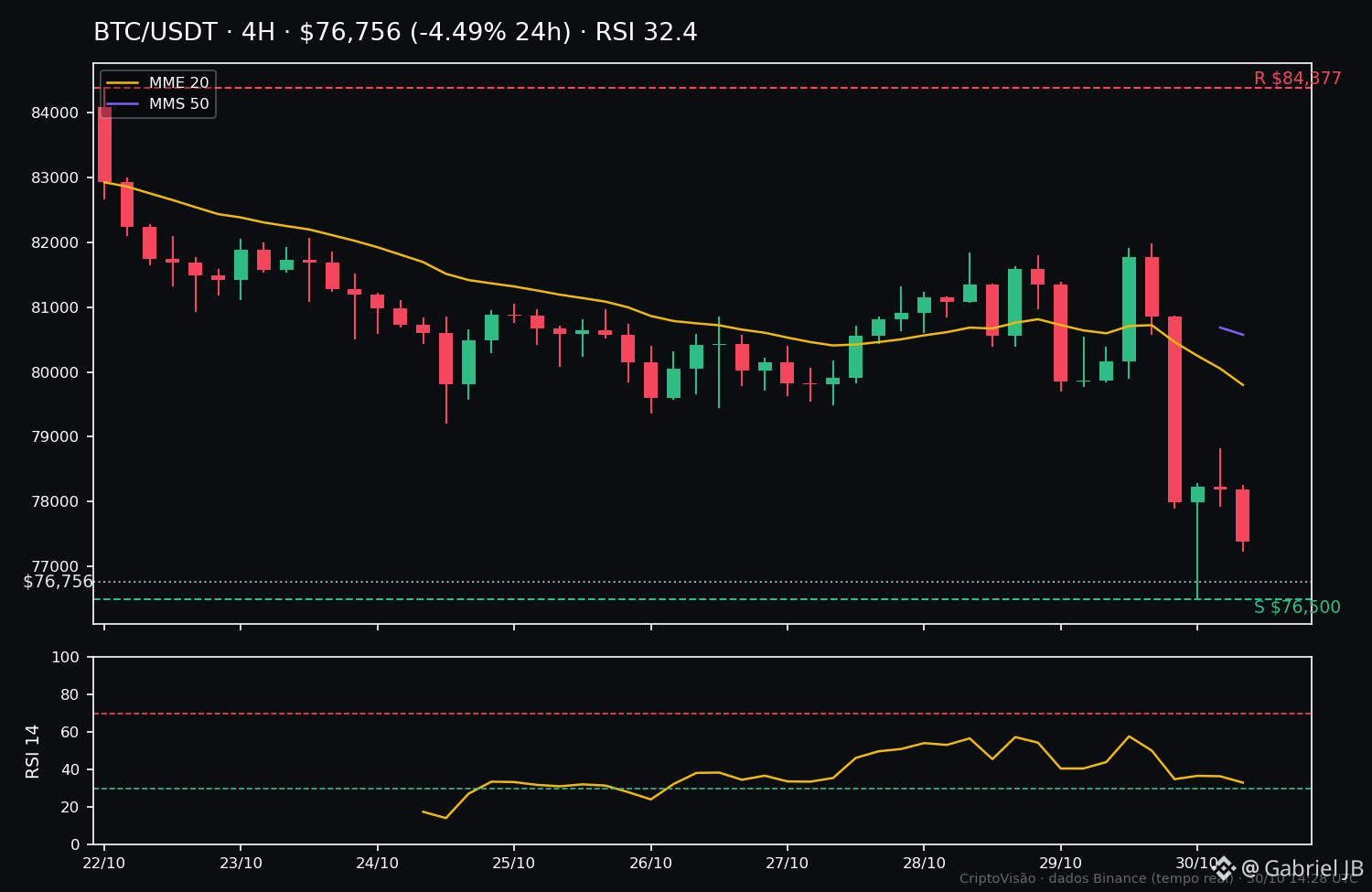
Real example with $BTC from today: current price 76,756 USD, weekly support at 76,500 USD, and resistance at 84,377 USD. The price is trading below the 4-hour moving averages, and the RSI-14 is at 32.4 — weakness, not certainty.
The example account has 1,000 USD and risks 1% per trade, or 10 USD.
Entry near 76,756 USD, with a stop below actual support, for example at 75,900 USD. Risk distance: 856 USD. Position size: 10 USD ÷ 856 USD = 0.0117 BTC. If the stop is hit, you lose 10 USD — no more, no less.
Minimum target of 1 to 2: 2 × 856 = 1,712 USD above the entry, near 78,468 USD — still below resistance.
Now for the part that determines who stays in the game: ten consecutive 10 USD stop-outs cost 100 USD (10% of the account), and recovering 10% requires a gain of 11.1%. Five losses of 10% of the account cost half the account — and recovering 50% requires doubling what remains.
Several small stop-outs keep you in the game; one badly placed “all-in” can end it all at once. Preserving capital is strategy No. 1.
This is educational content, not personalized financial advice. Study before trading, and never risk money you need.
#Bitcoin #GestaoDeRisco #CriptoVisao
28
·
--
🛡️ Risk management: preserving capital is the #1 strategy
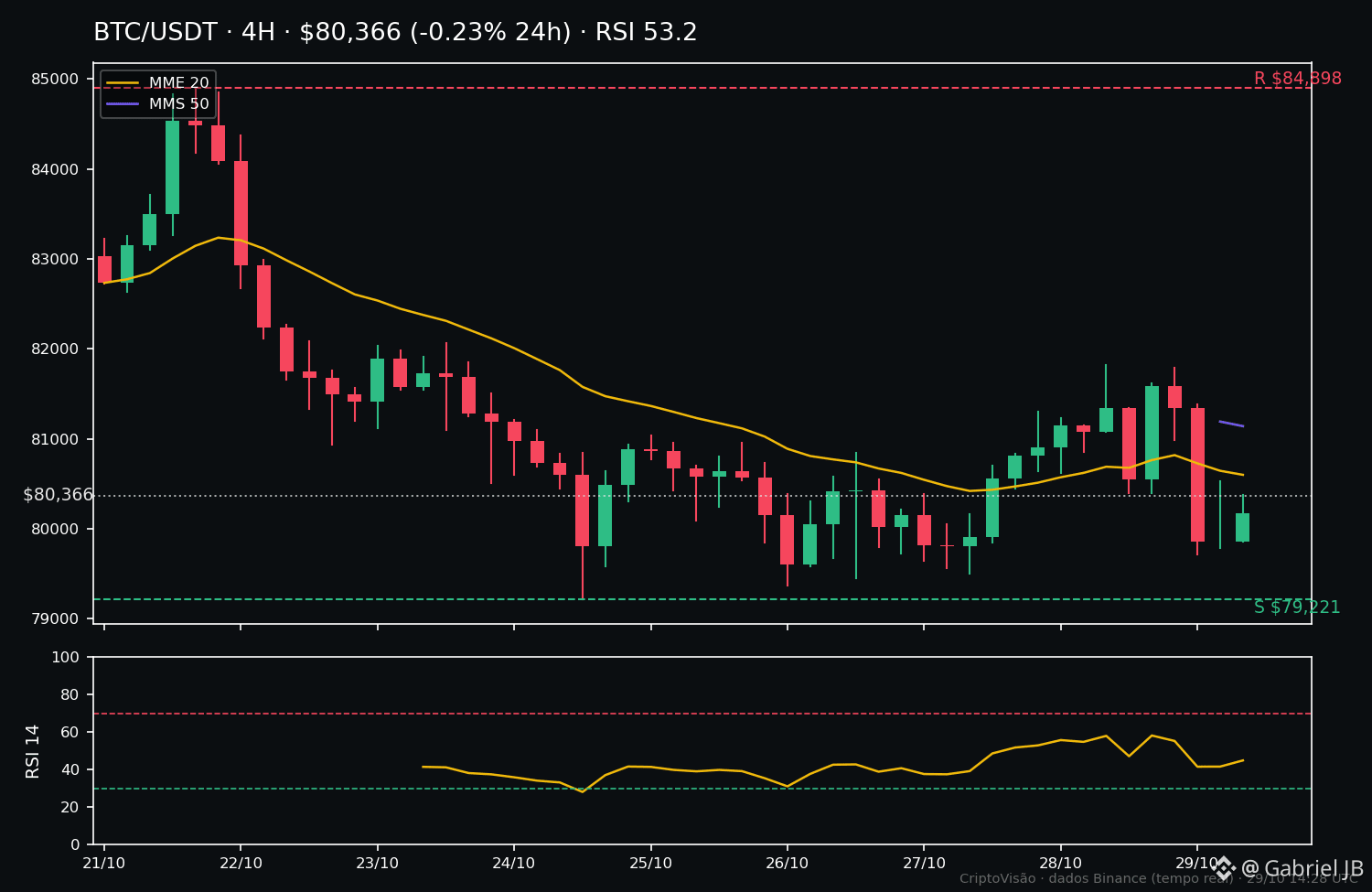
Practical example with $BTC de today: current price 80 366 USD, weekly support at 79 221 USD and resistance at 84 898 USD.
1️⃣ 1% rule per trade: in a sample account of 1 000 USD, the maximum risk per trade is 10 USD. It is not 1% of what you want to earn — it is 1% of what you accept to lose.
2️⃣ Stop based on structure, not a round number: if you enter near 80 366 USD, the stop is placed below the real support, for example at 79 000 USD. Risk distance: 1 366 USD.
3️⃣ Position size: divide the risk by the distance. 10 USD ÷ 1 366 USD = 0,0073 BTC per trade. That way, if the stop is hit, you lose 10 USD — no more, no less.
4️⃣ Minimum risk/reward of 1 to 2: with a risk of 1 366 USD, the target should be at least 2 732 USD above the entry, that is, near 83 098 USD — still below the resistance at 84 898 USD.
Why several small stops instead of one "all-in"? Ten stops of 10 USD cost 100 USD (10% of the account) and keep you in the game. A badly placed "all-in" can cost the entire account at once.
Formula to repeat every time: risk in USD ÷ distance to the stop = position size.
This is education, not personal financial advice. Study before trading and never risk money you need.
#Bitcoin #GestaoDeRisco #CriptoVisao
10
·
--
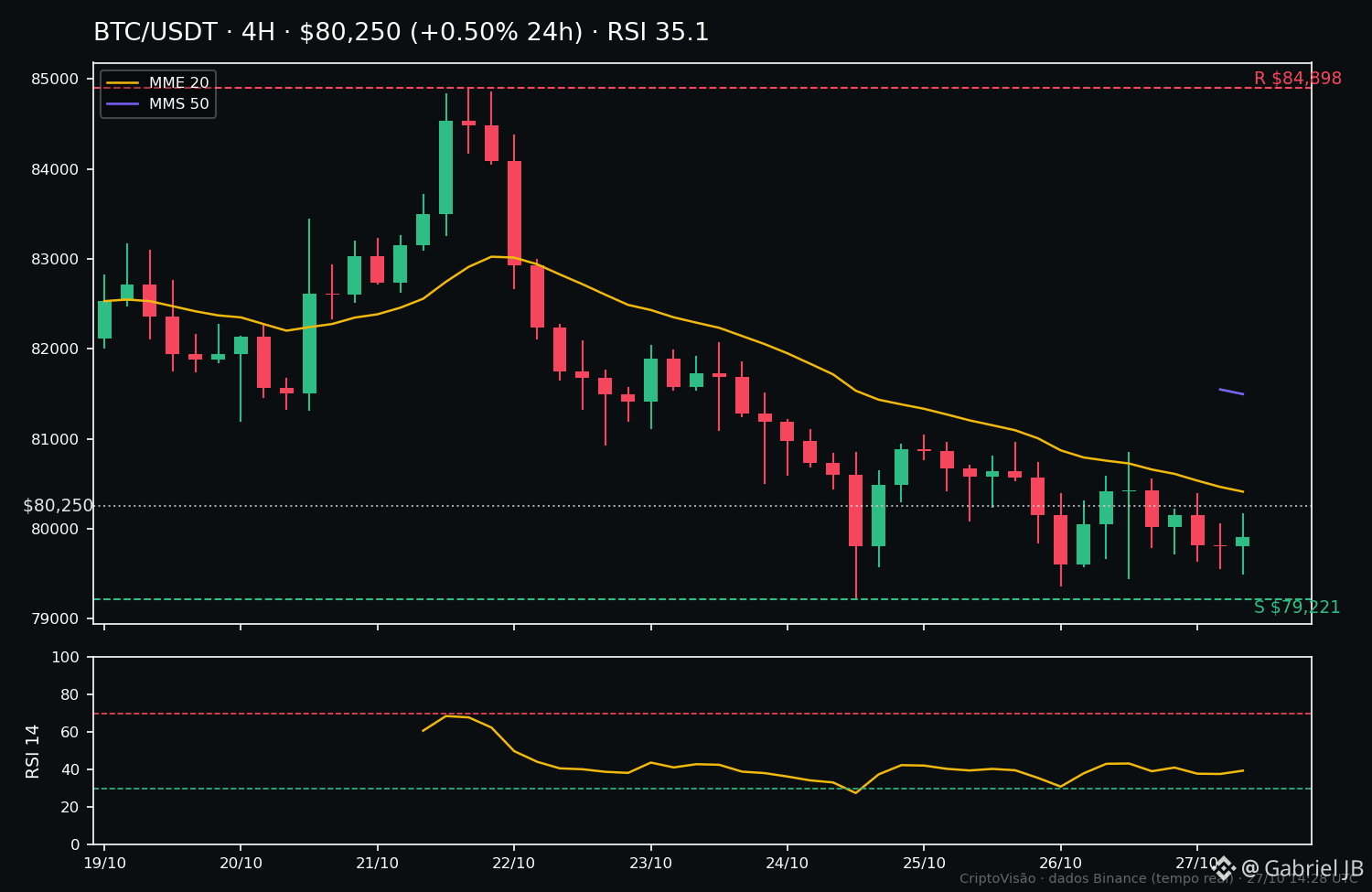
Risk management: the cost of recovering after a loss 🛡️
$BTC is trading near $80.167 today, with weekly support at $79.221 and resistance at $84.898. The question few people ask before entering: if things go wrong, how much will it cost to get back to where you started?
Let’s do the math with a $1,000 account as an example:
1. Small losses: you risk 1% per trade, or $10. After 10 consecutive stop-outs, your account is down to about $904. To recover, you only need a gain of ~10.6%. You’re still in the game.
2. An all-in that goes wrong: if you lose 50% of your account at once, you’re left with $500. To get back to $1,000, you need to double it—a 100% gain just to break even.
3. The stop determines the position size: entry at $80.167, stop below support at $79.000. Risk per coin: $1.167. Position = $10 ÷ $1.167 ≈ 0,0086 $BTC (about $687). The risk remains 1%, even with a position larger than $10.
4. Minimum target of 2:1: with a risk of $1.167, the target should be at least $82.501—before the $84.898 resistance, so it’s a realistic target. If the target can’t reach that level, don’t enter.
Losing a little many times is recoverable. Losing a lot at once can be the end of the game. Preserving capital is strategy no. 1. This is education, not financial advice.
#Bitcoin #RiskManagement
27
·
--
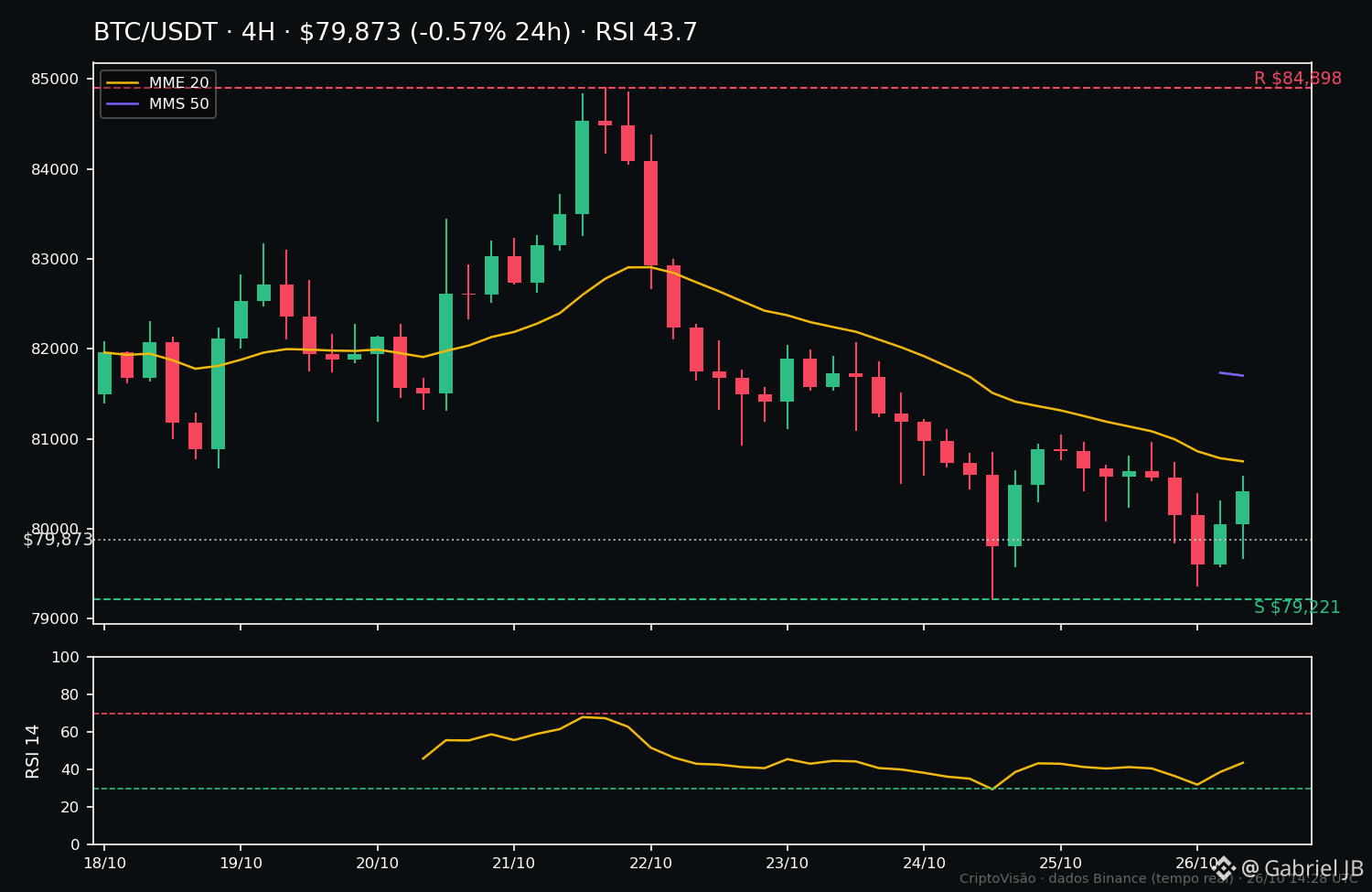
Risk management: the calculation that protects your account 🛡️
$BTC trading today near $79.852, with weekly support at $79.221 and resistance at $84.898. Before entering, do the math:
1. The 1% rule: in a $1,000 account, risk no more than $10 per trade. That’s not the position value—it’s the maximum you’re willing to lose if your stop is hit.
2. Set your stop based on the structure: below actual support, not some random round number. Example: entry at $79.852, stop at $79.000 (below $79.221). Risk per coin: $852.
3. Position size: $10 ÷ $852 ≈ 0.0117 $BTC (about $938). That’s how you keep risk at 1%, even with a position larger than $10.
4. Minimum risk/reward ratio of 2:1: with $852 of risk, the target should be at least $81.556 (entry + 2 × $852). If the target doesn’t reach that level, don’t enter.
5. Why use several small stops? 10 losing trades at 1% cost 10% of your account—you’re still in the game. One wrong “all-in” trade can wipe out your account in one go.
Preserving capital is strategy number one. Without capital, there’s no next opportunity. This is for educational purposes, not financial advice.
#Bitcoin #RiskManagement
18
·
--
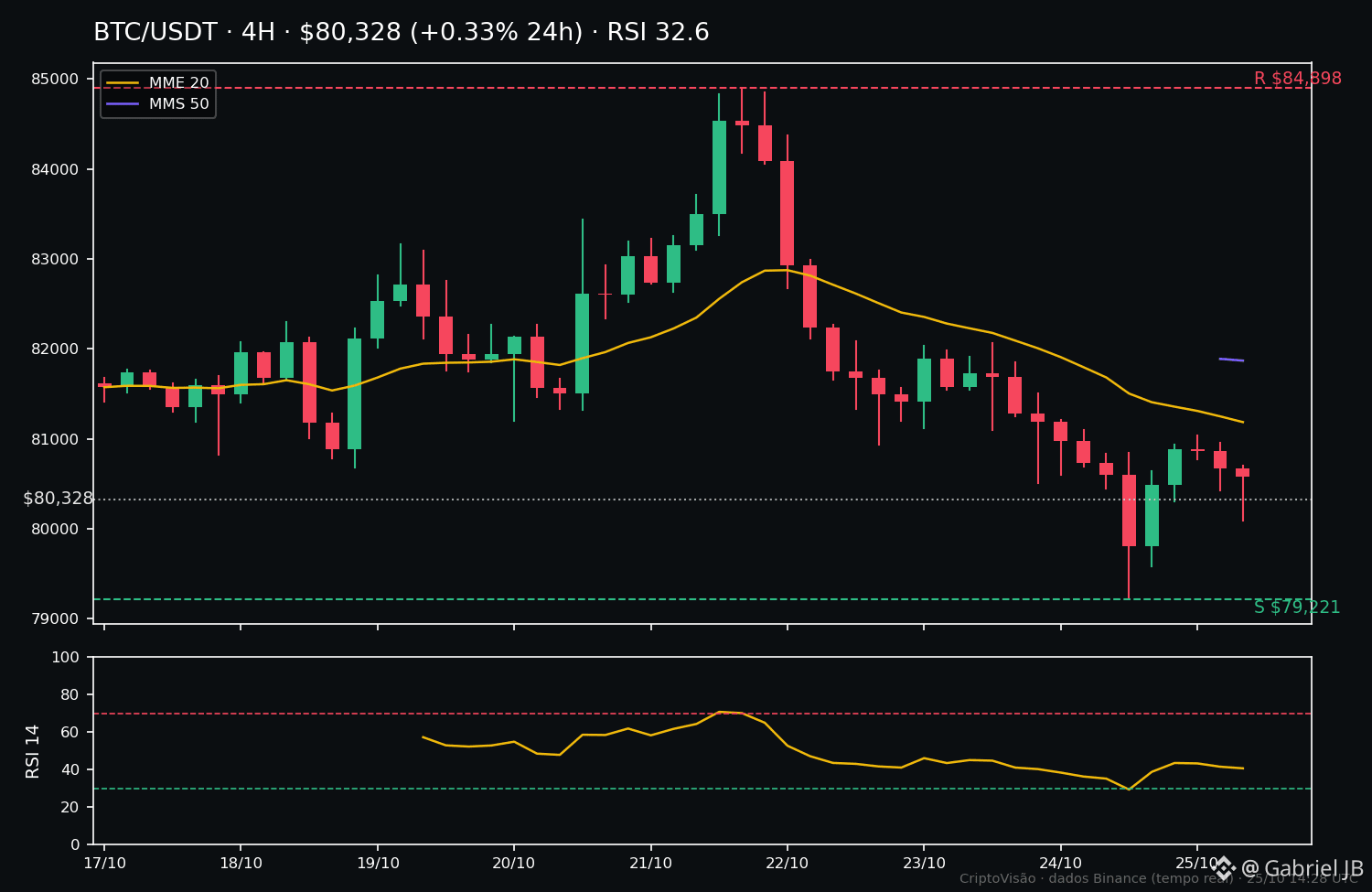
Risk management: several small stop-losses are worth more than going «all-in» 🛡️
$BTC is trading near $80.328 today, with the week's support at $79.221 and resistance at $84.898. These are the real numbers used for the calculation—not guesswork.
1️⃣ The 1–2% rule: in a sample $1,000 account, risking 1% per trade means just $10. Losing 10 trades in a row this way costs $100—the account survives. One losing «all-in» trade can wipe it out in a single shot.
2️⃣ Where to place the stop: below actual support, not at some random round number. Here, for example, at $78.900—slightly below $79.221. If the price breaks support, the trade idea has failed, and getting out is the right decision.
3️⃣ The full calculation: entry at $80.328, stop at $78.900 → risk of $1.428 per BTC. With $10 at risk, the position is about $562 (10 ÷ 1.428 × 80.328). For a minimum 2:1 risk/reward ratio, the target is $83.184—below the $84.898 resistance. You gain $20 when it goes well and lose $10 when it goes badly.
4️⃣ Why this matters: those who risk little per trade can be wrong several times and stay in the game long enough to get the good ones right. Those who go «all-in» need only one mistake to be out.
Preserving capital is strategy No. 1. Without capital, there is no next opportunity.
Educational example, not financial advice.
#Bitcoin #GestaoDeRisco #CriptoVisao
16
·
--
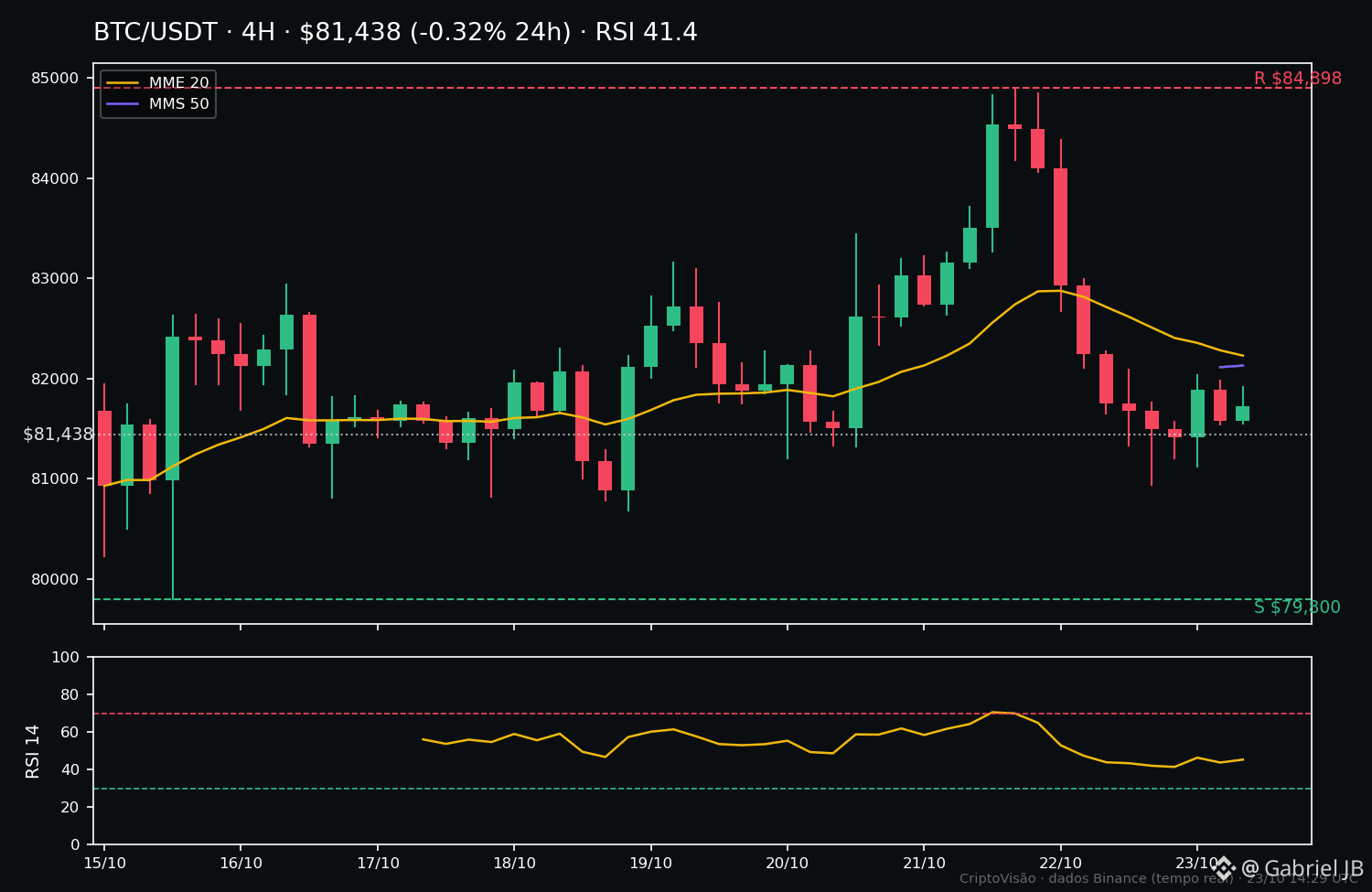
Risk management with today’s real numbers 📊
Example account: $1,000 → 1% risk = $10 per trade. This is the rule that separates those who survive from those who blow up.
$BTC a $81,438. Weekly support: $79,800. The stop goes BELOW support, with a buffer: $79,450 — not an arbitrary round number like $80,000.
The stop determines the position size: $10 ÷ ($81,438 − $79,450) = $10 ÷ $1,988 = 0.00503 BTC (~$410). The math decides the size, not enthusiasm.
Risk/reward test: target at resistance $84,898 → reward $3,460. R:R = 1:1.74 — below the 1:2 minimum. This entry fails the test. The best trade is no trade. ⛔
Why respect this: 10 consecutive 1% stops = −9.6% of the account (you need +10.6% to recover). One poorly managed all-in trade = −50%… and then you need +100% just to break even.
Preserving capital is strategy #1.
#Bitcoin #GestaoDeRisco
14
Log in to explore more content
Join global crypto users on Binance Square
⚡️ Get latest and useful information about crypto.
💬 Trusted by the world’s largest crypto exchange.
👍 Discover real insights from verified creators.
Email / Phone number
Trending Topics
1
#A Packed Week of Earnings and Data Tests Markets
41,870 views
301 Discussing
2
#AnthropicIPOTestsInvestorAppetiteForAI
55,286 views
962 Discussing
3
#BitcoinExtendsLosingStreakToSixWeeks
15,858 views
318 Discussing
4
#XRPFallsTo$0.89LowestSinceNovember2024
4,574 views
33 Discussing
5
#HuangReportedlyConsidersReturnToNvidia
77,853 views
976 Discussing
6
#SP500AndNasdaqFuturesHitQuarterlyLows
4,148 views
89 Discussing
7
#CaliforniaVotersBackProp42BarringNewCryptoTaxes
4,217 views
101 Discussing
8
#HKPlansDigitalAssetRegulatoryBillByYearEnd
3,822 views
80 Discussing
9
#MUFGSMFGMizuhoPlanYenBackedStablecoin
14,893 views
192 Discussing
10
#HKMAAndSwiftExploreTokenizedDepositInteroperability
713 views
14 Discussing