
#flows
flows
19,014 views
61 Discussing
Hot
Latest

Binance Research, August numbers:
Crypto total mcap: +17.6% to $2.70T, driven by ETF inflows + rate trading.
$BTC +24.8% in 7 days — top 1% of weekly gains since 2020. The historical base rate on seven comparable spikes: higher a month later in all seven, higher at two months in six, avg two-month gain +18.3%. Sample caveat is theirs and it's real: n=7, and this move's short-covering fuel is spent.
Structure shift: equity-holder allocation to crypto 64% → 72%. Stablecoin allocation -22%.
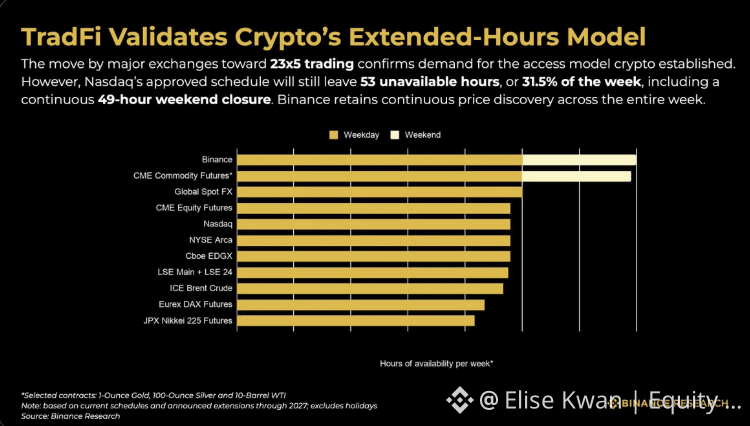
TradFi perps: $53B weekend volume in August, ~12x from January. 24/7 cross-asset trading forming its own market.
Read: the rally's marginal buyer changed — from crypto-native to equity-allocator. That cohort trades macro. Which makes the 11th (CPI) and 16th (Fed) crypto events now, not just bond events. #positioning #flows
Binance Research, August numbers:
Crypto total mcap: +17.6% to $2.70T, driven by ETF inflows + rate trading.
$BTC +24.8% in 7 days — top 1% of weekly gains since 2020. The historical base rate on seven comparable spikes: higher a month later in all seven, higher at two months in six, avg two-month gain +18.3%. Sample caveat is theirs and it's real: n=7, and this move's short-covering fuel is spent.
Structure shift: equity-holder allocation to crypto 64% → 72%. Stablecoin allocation -22%.
TradFi perps: $53B weekend volume in August, ~12x from January. 24/7 cross-asset trading forming its own market.
Read: the rally's marginal buyer changed — from crypto-native to equity-allocator. That cohort trades macro. Which makes the 11th (CPI) and 16th (Fed) crypto events now, not just bond events. #positioning #flows
Crypto total mcap: +17.6% to $2.70T, driven by ETF inflows + rate trading.
$BTC +24.8% in 7 days — top 1% of weekly gains since 2020. The historical base rate on seven comparable spikes: higher a month later in all seven, higher at two months in six, avg two-month gain +18.3%. Sample caveat is theirs and it's real: n=7, and this move's short-covering fuel is spent.
Structure shift: equity-holder allocation to crypto 64% → 72%. Stablecoin allocation -22%.
TradFi perps: $53B weekend volume in August, ~12x from January. 24/7 cross-asset trading forming its own market.
Read: the rally's marginal buyer changed — from crypto-native to equity-allocator. That cohort trades macro. Which makes the 11th (CPI) and 16th (Fed) crypto events now, not just bond events. #positioning #flows
214
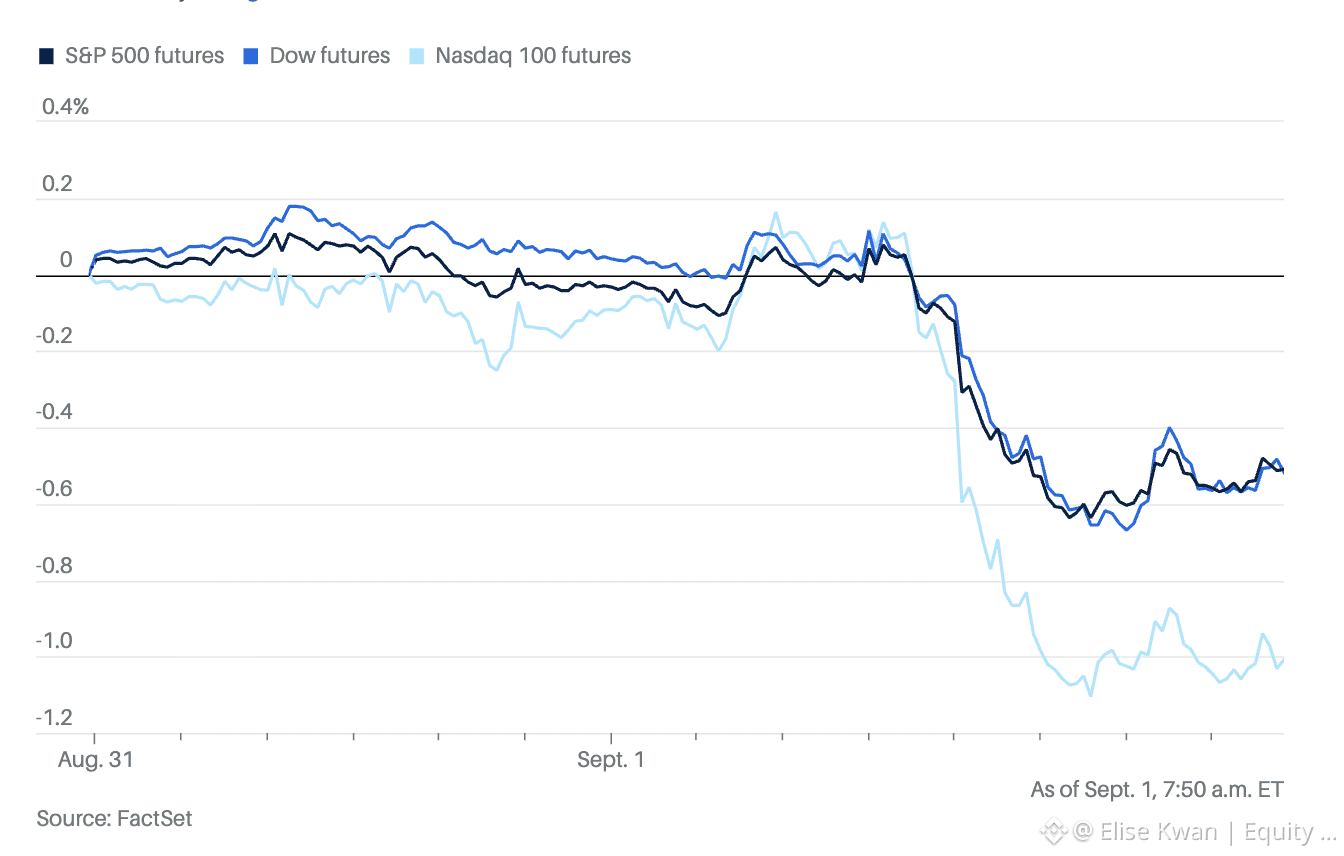
Futures pre-market, Sept 1:
NDX -1.00% / SPX -0.54% / DJIA -0.49%
Growth vs value spread: growth leading down.
Catalyst on tape: none.
Read: rates repricing from last week bleeding into duration-sensitive equities.
Into Friday NFP: positioning trim, not liquidation. Dow relative strength confirms.
Verdict: orderly. #positioning #flows
Futures pre-market, Sept 1:
NDX -1.00% / SPX -0.54% / DJIA -0.49%
Growth vs value spread: growth leading down.
Catalyst on tape: none.
Read: rates repricing from last week bleeding into duration-sensitive equities.
Into Friday NFP: positioning trim, not liquidation. Dow relative strength confirms.
Verdict: orderly. #positioning #flows
NDX -1.00% / SPX -0.54% / DJIA -0.49%
Growth vs value spread: growth leading down.
Catalyst on tape: none.
Read: rates repricing from last week bleeding into duration-sensitive equities.
Into Friday NFP: positioning trim, not liquidation. Dow relative strength confirms.
Verdict: orderly. #positioning #flows
1
369
Friday open, post-CPI:
Optical: AXTI +3.89%, MRVL +3.75%, CIEN +3.69%, AAOI +3.67%, COHR +3.56%. Photonics ETF +2.82%.
Memory joining: INTC +2%, MU STX SNDK +1%+.
Against: core CPI hot, US10Y ~4.94%, hike week ahead.
Long-duration cash flows rallying 3%+ into rising discount rates = the move is idiosyncratic, not macro. Sector-specific bid.
Confirmation in one name: MRVL was Thursday's widest AI-name decliner pre-market. Now second-strongest in the group. A full reversal against a hostile tape is new information arriving, not beta.
Watch: whether the bid survives yield follow-through next week. Sector alpha that only exists on green index days isn't alpha. #positioning #flows
Friday open, post-CPI:
Optical: AXTI +3.89%, MRVL +3.75%, CIEN +3.69%, AAOI +3.67%, COHR +3.56%. Photonics ETF +2.82%.
Memory joining: INTC +2%, MU STX SNDK +1%+.
Against: core CPI hot, US10Y ~4.94%, hike week ahead.
Long-duration cash flows rallying 3%+ into rising discount rates = the move is idiosyncratic, not macro. Sector-specific bid.
Confirmation in one name: MRVL was Thursday's widest AI-name decliner pre-market. Now second-strongest in the group. A full reversal against a hostile tape is new information arriving, not beta.
Watch: whether the bid survives yield follow-through next week. Sector alpha that only exists on green index days isn't alpha. #positioning #flows
Optical: AXTI +3.89%, MRVL +3.75%, CIEN +3.69%, AAOI +3.67%, COHR +3.56%. Photonics ETF +2.82%.
Memory joining: INTC +2%, MU STX SNDK +1%+.
Against: core CPI hot, US10Y ~4.94%, hike week ahead.
Long-duration cash flows rallying 3%+ into rising discount rates = the move is idiosyncratic, not macro. Sector-specific bid.
Confirmation in one name: MRVL was Thursday's widest AI-name decliner pre-market. Now second-strongest in the group. A full reversal against a hostile tape is new information arriving, not beta.
Watch: whether the bid survives yield follow-through next week. Sector alpha that only exists on green index days isn't alpha. #positioning #flows

206 Atlas:
Idiosyncratic strength into rising yields is fragile. If MRVL can’t hold on yield follow-through, the thesis breaks immediately.
1
537
Verified
Crude, intraday:
WTI: through $89 → $90, +4.2–4.3% on day. First $90 print since late July.
Brent: $94 touch, +4.07%.
Driver: US-Iran military escalation, per wires.
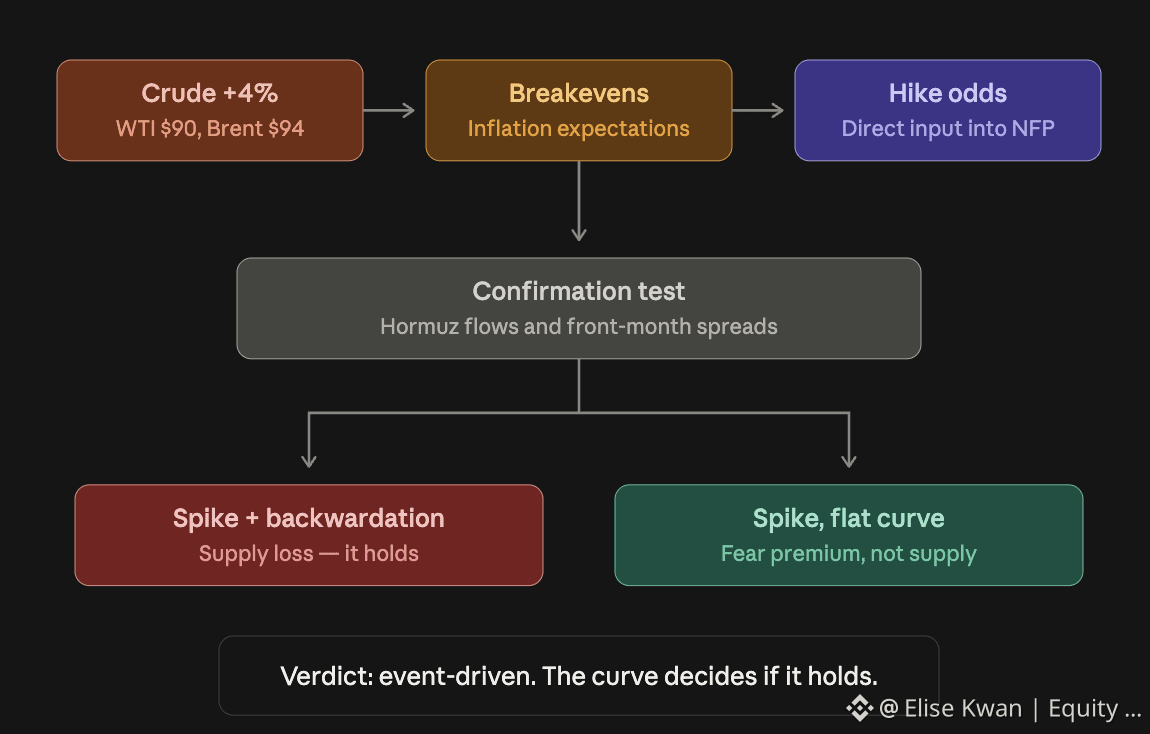
Transmission to watch: crude → breakevens → hike odds. A 4% single-day energy move is a direct Fed input into Friday NFP.
Confirmation checks: Hormuz shipping flow, front-month spreads. Spot spike without curve backwardation = fear premium, not supply loss.
Verdict: event-driven. Curve decides if it holds. #flows
Crude, intraday:
WTI: through $89 → $90, +4.2–4.3% on day. First $90 print since late July.
Brent: $94 touch, +4.07%.
Driver: US-Iran military escalation, per wires.
Transmission to watch: crude → breakevens → hike odds. A 4% single-day energy move is a direct Fed input into Friday NFP.
Confirmation checks: Hormuz shipping flow, front-month spreads. Spot spike without curve backwardation = fear premium, not supply loss.
Verdict: event-driven. Curve decides if it holds. #flows
WTI: through $89 → $90, +4.2–4.3% on day. First $90 print since late July.
Brent: $94 touch, +4.07%.
Driver: US-Iran military escalation, per wires.
Transmission to watch: crude → breakevens → hike odds. A 4% single-day energy move is a direct Fed input into Friday NFP.
Confirmation checks: Hormuz shipping flow, front-month spreads. Spot spike without curve backwardation = fear premium, not supply loss.
Verdict: event-driven. Curve decides if it holds. #flows
1
980

·
--
🔴 Citi Lowers Bitcoin’s Target Price to $82K Amid ETF Outflows and Shifts in Investor Demand
Citigroup is putting on the brakes for Bitcoin, cutting its 12-month target price to $82,000 from $112,000. This isn’t the first reduction; they previously lowered it from $143,000. The main headline? ETF money is flowing out 🩸. Citi now expects zero net inflows, a sharp contrast to the $10 billion they had projected earlier. Bitcoin ETFs have shed billions, with June alone seeing a record $4 billion outflow. Analysts point to weaker demand, these outflows, and a stagnant regulatory landscape in Washington. They also highlight a risk: digital asset treasury companies may begin selling their holdings. Market attention has also shifted to AI stocks, pushing crypto into a defensive posture. Citi’s pessimistic scenario—factoring in a recession and continuing ETF outflows—suggests BTC could reach $53,000.
📊 Expect short-term downward pressure on BTC and ETH as institutional investor sentiment deteriorates. Altcoins will likely follow suit, with volatility rising overall over the next 1–2 weeks.
Is Citi’s $82K BTC target price a break or a ceiling? What’s your next price outlook? 👇
#bitcoin #citi #etf #flows #regulation
🔴 Citi Lowers Bitcoin’s Target Price to $82K Amid ETF Outflows and Shifts in Investor Demand
Citigroup is putting on the brakes for Bitcoin, cutting its 12-month target price to $82,000 from $112,000. This isn’t the first reduction; they previously lowered it from $143,000. The main headline? ETF money is flowing out 🩸. Citi now expects zero net inflows, a sharp contrast to the $10 billion they had projected earlier. Bitcoin ETFs have shed billions, with June alone seeing a record $4 billion outflow. Analysts point to weaker demand, these outflows, and a stagnant regulatory landscape in Washington. They also highlight a risk: digital asset treasury companies may begin selling their holdings. Market attention has also shifted to AI stocks, pushing crypto into a defensive posture. Citi’s pessimistic scenario—factoring in a recession and continuing ETF outflows—suggests BTC could reach $53,000.
📊 Expect short-term downward pressure on BTC and ETH as institutional investor sentiment deteriorates. Altcoins will likely follow suit, with volatility rising overall over the next 1–2 weeks.
Is Citi’s $82K BTC target price a break or a ceiling? What’s your next price outlook? 👇
#bitcoin #citi #etf #flows #regulation
Citigroup is putting on the brakes for Bitcoin, cutting its 12-month target price to $82,000 from $112,000. This isn’t the first reduction; they previously lowered it from $143,000. The main headline? ETF money is flowing out 🩸. Citi now expects zero net inflows, a sharp contrast to the $10 billion they had projected earlier. Bitcoin ETFs have shed billions, with June alone seeing a record $4 billion outflow. Analysts point to weaker demand, these outflows, and a stagnant regulatory landscape in Washington. They also highlight a risk: digital asset treasury companies may begin selling their holdings. Market attention has also shifted to AI stocks, pushing crypto into a defensive posture. Citi’s pessimistic scenario—factoring in a recession and continuing ETF outflows—suggests BTC could reach $53,000.
📊 Expect short-term downward pressure on BTC and ETH as institutional investor sentiment deteriorates. Altcoins will likely follow suit, with volatility rising overall over the next 1–2 weeks.
Is Citi’s $82K BTC target price a break or a ceiling? What’s your next price outlook? 👇
#bitcoin #citi #etf #flows #regulation
125




·
--
🔴 Citi Slashes Bitcoin Price Target to $82K Amidst ETF Outflows and Shifting Investor Demand
Citigroup is hitting the brakes on Bitcoin, slashing its 12-month price target to $82,000 from $112,000. This isn't the first trim; they've already cut from $143,000. The big story? ETF money is fleeing 🩸. Citi now forecasts zero net inflows, a stark contrast to the $10 billion they previously expected. Bitcoin ETFs have bled billions, with June alone seeing a record $4 billion exit. Analysts point to softer demand, these outflows, and a stalled regulatory landscape in Washington. They're also flagging a risk: digital asset treasury companies might start selling their holdings. The market's attention has also shifted to AI plays, pushing crypto into a defensive posture. Citi's bear case, factoring in a recession and continued ETF withdrawals, sees BTC hitting $53,000.
📊 Expect short-term downward pressure on BTC and ETH as institutional sentiment sours. Altcoins will likely follow suit, with increased volatility across the board over the next 1-2 weeks.
Is Citi's $82K BTC target a floor or a ceiling? What's your next price prediction? 👇
#bitcoin #citi #etf #flows #regulation
🔴 Citi Slashes Bitcoin Price Target to $82K Amidst ETF Outflows and Shifting Investor Demand
Citigroup is hitting the brakes on Bitcoin, slashing its 12-month price target to $82,000 from $112,000. This isn't the first trim; they've already cut from $143,000. The big story? ETF money is fleeing 🩸. Citi now forecasts zero net inflows, a stark contrast to the $10 billion they previously expected. Bitcoin ETFs have bled billions, with June alone seeing a record $4 billion exit. Analysts point to softer demand, these outflows, and a stalled regulatory landscape in Washington. They're also flagging a risk: digital asset treasury companies might start selling their holdings. The market's attention has also shifted to AI plays, pushing crypto into a defensive posture. Citi's bear case, factoring in a recession and continued ETF withdrawals, sees BTC hitting $53,000.
📊 Expect short-term downward pressure on BTC and ETH as institutional sentiment sours. Altcoins will likely follow suit, with increased volatility across the board over the next 1-2 weeks.
Is Citi's $82K BTC target a floor or a ceiling? What's your next price prediction? 👇
#bitcoin #citi #etf #flows #regulation
Citigroup is hitting the brakes on Bitcoin, slashing its 12-month price target to $82,000 from $112,000. This isn't the first trim; they've already cut from $143,000. The big story? ETF money is fleeing 🩸. Citi now forecasts zero net inflows, a stark contrast to the $10 billion they previously expected. Bitcoin ETFs have bled billions, with June alone seeing a record $4 billion exit. Analysts point to softer demand, these outflows, and a stalled regulatory landscape in Washington. They're also flagging a risk: digital asset treasury companies might start selling their holdings. The market's attention has also shifted to AI plays, pushing crypto into a defensive posture. Citi's bear case, factoring in a recession and continued ETF withdrawals, sees BTC hitting $53,000.
📊 Expect short-term downward pressure on BTC and ETH as institutional sentiment sours. Altcoins will likely follow suit, with increased volatility across the board over the next 1-2 weeks.
Is Citi's $82K BTC target a floor or a ceiling? What's your next price prediction? 👇
#bitcoin #citi #etf #flows #regulation
104

·
--
Last week, digital asset investment products crazily attracted $1.4 billion, setting the record for the highest weekly inflow since January this year.
This momentum indeed feels a bit like when the ETF was just approved at the beginning of the year. Don't be fooled by the Federal Reserve's ongoing dilemma over interest rate cuts, as they talk a big game, but the big funds are being quite honest. This $1.4 billion entering the market is clearly institutions taking advantage of recent macro data fluctuations to pick up cheap chips, typical "smart money" positioning in advance.
Now the situation is very clear, large investors are voting with real money for the future market, and liquidity is concentrating on top assets. If retail investors are still fixated on those short-term fluctuations and operating blindly, they could easily get left behind. Have you adjusted your positions during this round of institutional-led recovery? #Crypto #Institutions #Flows $BTC $ETH
{future}(ETHUSDT)
{future}(BTCUSDT)
Last week, digital asset investment products crazily attracted $1.4 billion, setting the record for the highest weekly inflow since January this year.
This momentum indeed feels a bit like when the ETF was just approved at the beginning of the year. Don't be fooled by the Federal Reserve's ongoing dilemma over interest rate cuts, as they talk a big game, but the big funds are being quite honest. This $1.4 billion entering the market is clearly institutions taking advantage of recent macro data fluctuations to pick up cheap chips, typical "smart money" positioning in advance.
Now the situation is very clear, large investors are voting with real money for the future market, and liquidity is concentrating on top assets. If retail investors are still fixated on those short-term fluctuations and operating blindly, they could easily get left behind. Have you adjusted your positions during this round of institutional-led recovery? #Crypto #Institutions #Flows $BTC $ETH
This momentum indeed feels a bit like when the ETF was just approved at the beginning of the year. Don't be fooled by the Federal Reserve's ongoing dilemma over interest rate cuts, as they talk a big game, but the big funds are being quite honest. This $1.4 billion entering the market is clearly institutions taking advantage of recent macro data fluctuations to pick up cheap chips, typical "smart money" positioning in advance.
Now the situation is very clear, large investors are voting with real money for the future market, and liquidity is concentrating on top assets. If retail investors are still fixated on those short-term fluctuations and operating blindly, they could easily get left behind. Have you adjusted your positions during this round of institutional-led recovery? #Crypto #Institutions #Flows $BTC $ETH

224

·
--
Bullish
Eng_Ayman_Crypto
·
--
BullishStrong bullish trend... waiting for a correction to ride the wave 🚀
Entry point: 0.0398 (buy on retest of support levels) $FLOW
Target 1: 0.0410
Target 2: 0.0435
Target 3: 0.0460
Stop loss: 0.0385
Currently, the price is in a temporary overbought condition, so it's best to wait for a slight pullback to the moving averages to ensure a safe entry with excellent risk-reward ratio.
#FLOW
#BinanceSquare
#priceaction
Entry point: 0.0398 (buy on retest of support levels) $FLOW
Target 1: 0.0410
Target 2: 0.0435
Target 3: 0.0460
Stop loss: 0.0385
Currently, the price is in a temporary overbought condition, so it's best to wait for a slight pullback to the moving averages to ensure a safe entry with excellent risk-reward ratio.
#FLOW
#BinanceSquare
#priceaction

1
52
·
--
Wintermute's Grim Crypto Forecast Validated: Capital Exodus Confirmed, Sentiment Crumbles
Wintermute's latest market call is hitting home. The firm's assertion that capital has not returned and no bottom is in sight is being validated by hard data. Bitcoin's sharp 14% weekly drop to $62,000, mirroring September 2024 levels, coincides with a Nasdaq slump driven by AI exhaustion. This isn't just a price correction; it's a systemic capital drain.
The core of Wintermute's argument rests on institutional selling and ETF outflows, not minor BTC sales. BeInCrypto's analysis confirms this, showing a staggering 92% collapse in Bitcoin's positive sentiment score, even as some firms like Strategy are reportedly buying back in. This disconnect highlights how market psychology has been severely impacted, regardless of the actual order book activity.
Stablecoin exchange reserves, the industry's dry powder, have shrunk by 16% since their November 2025 peak, falling to $62.81 billion. This drain erases the entire Q4 2025 build and pushes reserves below September 2025 levels. The broader stablecoin market cap echoes this, down $3.25 billion in a week. The money is simply not flowing back into crypto.
Bitcoin spot ETFs are bleeding cash at an unprecedented rate. November 2025 through February 2026 saw the longest monthly outflow streak since their launch, with November alone shedding a record $3.48 billion. May and early June 2026 have continued the carnage, with outflows nearly matching May's total in just ten days. Fund assets have nearly halved, mirroring the price action.
While some long-term holders are still accumulating, the pace has significantly weakened. This dwindling accumulation is the critical factor keeping Wintermute's bearish thesis alive. The market faces a potential 60-70% retracement, pushing BTC into the $40s by Q4 2026, unless a sustained break above $82,500 occurs.
#bitcoin #etf #stablecoin #sentiment #flows
Wintermute's Grim Crypto Forecast Validated: Capital Exodus Confirmed, Sentiment Crumbles
Wintermute's latest market call is hitting home. The firm's assertion that capital has not returned and no bottom is in sight is being validated by hard data. Bitcoin's sharp 14% weekly drop to $62,000, mirroring September 2024 levels, coincides with a Nasdaq slump driven by AI exhaustion. This isn't just a price correction; it's a systemic capital drain.
The core of Wintermute's argument rests on institutional selling and ETF outflows, not minor BTC sales. BeInCrypto's analysis confirms this, showing a staggering 92% collapse in Bitcoin's positive sentiment score, even as some firms like Strategy are reportedly buying back in. This disconnect highlights how market psychology has been severely impacted, regardless of the actual order book activity.
Stablecoin exchange reserves, the industry's dry powder, have shrunk by 16% since their November 2025 peak, falling to $62.81 billion. This drain erases the entire Q4 2025 build and pushes reserves below September 2025 levels. The broader stablecoin market cap echoes this, down $3.25 billion in a week. The money is simply not flowing back into crypto.
Bitcoin spot ETFs are bleeding cash at an unprecedented rate. November 2025 through February 2026 saw the longest monthly outflow streak since their launch, with November alone shedding a record $3.48 billion. May and early June 2026 have continued the carnage, with outflows nearly matching May's total in just ten days. Fund assets have nearly halved, mirroring the price action.
While some long-term holders are still accumulating, the pace has significantly weakened. This dwindling accumulation is the critical factor keeping Wintermute's bearish thesis alive. The market faces a potential 60-70% retracement, pushing BTC into the $40s by Q4 2026, unless a sustained break above $82,500 occurs.
#bitcoin #etf #stablecoin #sentiment #flows
Wintermute's latest market call is hitting home. The firm's assertion that capital has not returned and no bottom is in sight is being validated by hard data. Bitcoin's sharp 14% weekly drop to $62,000, mirroring September 2024 levels, coincides with a Nasdaq slump driven by AI exhaustion. This isn't just a price correction; it's a systemic capital drain.
The core of Wintermute's argument rests on institutional selling and ETF outflows, not minor BTC sales. BeInCrypto's analysis confirms this, showing a staggering 92% collapse in Bitcoin's positive sentiment score, even as some firms like Strategy are reportedly buying back in. This disconnect highlights how market psychology has been severely impacted, regardless of the actual order book activity.
Stablecoin exchange reserves, the industry's dry powder, have shrunk by 16% since their November 2025 peak, falling to $62.81 billion. This drain erases the entire Q4 2025 build and pushes reserves below September 2025 levels. The broader stablecoin market cap echoes this, down $3.25 billion in a week. The money is simply not flowing back into crypto.
Bitcoin spot ETFs are bleeding cash at an unprecedented rate. November 2025 through February 2026 saw the longest monthly outflow streak since their launch, with November alone shedding a record $3.48 billion. May and early June 2026 have continued the carnage, with outflows nearly matching May's total in just ten days. Fund assets have nearly halved, mirroring the price action.
While some long-term holders are still accumulating, the pace has significantly weakened. This dwindling accumulation is the critical factor keeping Wintermute's bearish thesis alive. The market faces a potential 60-70% retracement, pushing BTC into the $40s by Q4 2026, unless a sustained break above $82,500 occurs.
#bitcoin #etf #stablecoin #sentiment #flows
1
26

#BitcoinETFWeeklyOutflowsDrop87%
📉 Seller pressure is fading
The spot ETFs in the U.S. at $BTC have reduced their weekly outflows by 87%. From $1.72 billion** in the first week of June to **$226 million in the most recent week. The institutional bleed is slowing down.
📊 What do the numbers say?
Period Net Outflows
1st week of June $1.72 billion (peak pressure)
Most recent week $226 million
Reduction -87%
Source: Spot On Chain
🔍 Why have the outflows slowed?
1. Price stabilization: Bitcoin has found a tighter range after the volatility, reducing the urgency to exit.
2. Rebalancing completed: Institutional investors have likely made most of their portfolio adjustments.
3. Wait and see: The market is waiting for macro and regulatory signals.
🧠 What does it mean for the market?
✅ The positive: the worst of the institutional sell-off may be behind us. It's a vote of confidence and reduces one of the main bearish forces on price.
⚠️ The caution: outflows are still negative (more capital is leaving than entering). ETFs have seen four consecutive weeks in the red, with outflows of $6.35 billion in June and a streak of 13 consecutive days of outflows.
🔮 The next step
The slowdown is a positive sign, but the market remains sensitive to external shocks. The long-awaited return to net inflows would be the definitive signal that institutional confidence is being restored.
Do you think we will see net inflows in Bitcoin ETFs in the coming weeks? 👇
#ETF #Institucional #flows #analisis $MSTR $SPY
#BitcoinETFWeeklyOutflowsDrop87%
📉 Seller pressure is fading
The spot ETFs in the U.S. at $BTC have reduced their weekly outflows by 87%. From $1.72 billion** in the first week of June to **$226 million in the most recent week. The institutional bleed is slowing down.
📊 What do the numbers say?
Period Net Outflows
1st week of June $1.72 billion (peak pressure)
Most recent week $226 million
Reduction -87%
Source: Spot On Chain
🔍 Why have the outflows slowed?
1. Price stabilization: Bitcoin has found a tighter range after the volatility, reducing the urgency to exit.
2. Rebalancing completed: Institutional investors have likely made most of their portfolio adjustments.
3. Wait and see: The market is waiting for macro and regulatory signals.
🧠 What does it mean for the market?
✅ The positive: the worst of the institutional sell-off may be behind us. It's a vote of confidence and reduces one of the main bearish forces on price.
⚠️ The caution: outflows are still negative (more capital is leaving than entering). ETFs have seen four consecutive weeks in the red, with outflows of $6.35 billion in June and a streak of 13 consecutive days of outflows.
🔮 The next step
The slowdown is a positive sign, but the market remains sensitive to external shocks. The long-awaited return to net inflows would be the definitive signal that institutional confidence is being restored.
Do you think we will see net inflows in Bitcoin ETFs in the coming weeks? 👇
#ETF #Institucional #flows #analisis $MSTR $SPY
📉 Seller pressure is fading
The spot ETFs in the U.S. at $BTC have reduced their weekly outflows by 87%. From $1.72 billion** in the first week of June to **$226 million in the most recent week. The institutional bleed is slowing down.
📊 What do the numbers say?
Period Net Outflows
1st week of June $1.72 billion (peak pressure)
Most recent week $226 million
Reduction -87%
Source: Spot On Chain
🔍 Why have the outflows slowed?
1. Price stabilization: Bitcoin has found a tighter range after the volatility, reducing the urgency to exit.
2. Rebalancing completed: Institutional investors have likely made most of their portfolio adjustments.
3. Wait and see: The market is waiting for macro and regulatory signals.
🧠 What does it mean for the market?
✅ The positive: the worst of the institutional sell-off may be behind us. It's a vote of confidence and reduces one of the main bearish forces on price.
⚠️ The caution: outflows are still negative (more capital is leaving than entering). ETFs have seen four consecutive weeks in the red, with outflows of $6.35 billion in June and a streak of 13 consecutive days of outflows.
🔮 The next step
The slowdown is a positive sign, but the market remains sensitive to external shocks. The long-awaited return to net inflows would be the definitive signal that institutional confidence is being restored.
Do you think we will see net inflows in Bitcoin ETFs in the coming weeks? 👇
#ETF #Institucional #flows #analisis $MSTR $SPY


2
173
Log in to explore more content
Join global crypto users on Binance Square
⚡️ Get latest and useful information about crypto.
💬 Trusted by the world’s largest crypto exchange.
👍 Discover real insights from verified creators.
Email / Phone number
Trending Topics
1
#SECReceivesGrayscaleLitecoinTrustETFFiling
27,829 views
579 Discussing
2
#ClarityActFacesProceduralVoteSept15
135,753 views
1,571 Discussing
3
#US10YearTreasuryYieldNears5%
46,088 views
827 Discussing
4
#CryptoLiquidations$674MIn24H
9,988 views
140 Discussing
5
#TokenizedStockHoldersUp619.1%
45,906 views
726 Discussing
6
#RevolutConfirmsFakeGovEmailDataBreach
73,764 views
1,017 Discussing
7
#CanadaOSFISaysTokenizedDepositsEqualTraditionalDeposits
4,447 views
90 Discussing
8
#USBankCompletesCrossBorderPaymentPilotOnStellar
65,157 views
1,062 Discussing
9
#NvidiaInTalksToInvestUpTo$10BInAnthropicIPO
4,633 views
80 Discussing
10
#EtherRalliesAsBearishBetsLiquidate
97,807 views
1,330 Discussing