
#anza
anza
1,782 views
14 Discussing
Hot
Latest

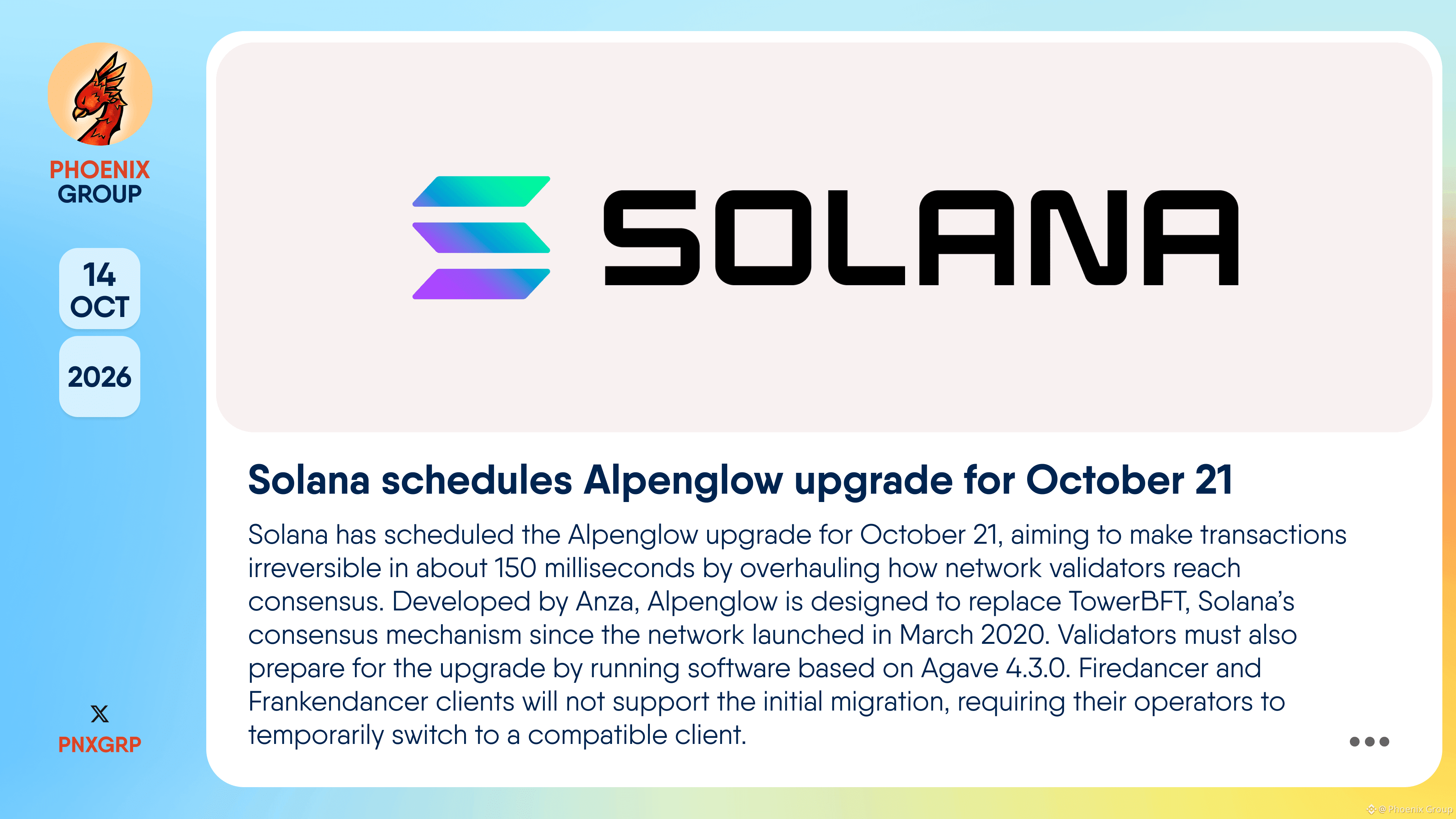
Solana schedules Alpenglow upgrade for October 21
#Solana has scheduled the Alpenglow upgrade for October 21, aiming to make transactions irreversible in about 150 milliseconds by overhauling how network validators reach consensus. Developed by #Anza , Alpenglow is designed to replace TowerBFT, Solana’s consensus mechanism since the network launched in March 2020. Validators must also prepare for the upgrade by running software based on Agave 4.3.0. Firedancer and Frankendancer clients will not support the initial migration, requiring their operators to temporarily switch to a compatible client.
With vote transactions removed, validators will no longer pay roughly 1 SOL per epoch in voting fees. Instead, they will pay a one-time admission fee of 0.8 SOL. The migration is scheduled for epoch 1064, expected to start around 15:00 UTC on October 21. Solana will retain its existing voting system for the first 5,000 slots before transitioning to Alpenglow approximately 18 minutes later.
👉 coindesk.com/tech/2026/10/14/solana-sets-oct-21-for-alpenglow-upgrade-targeting-150-millisecond-finality
225

·
--
Verified
Solana has laid out its vision for 2027, with computing capacity set to double.
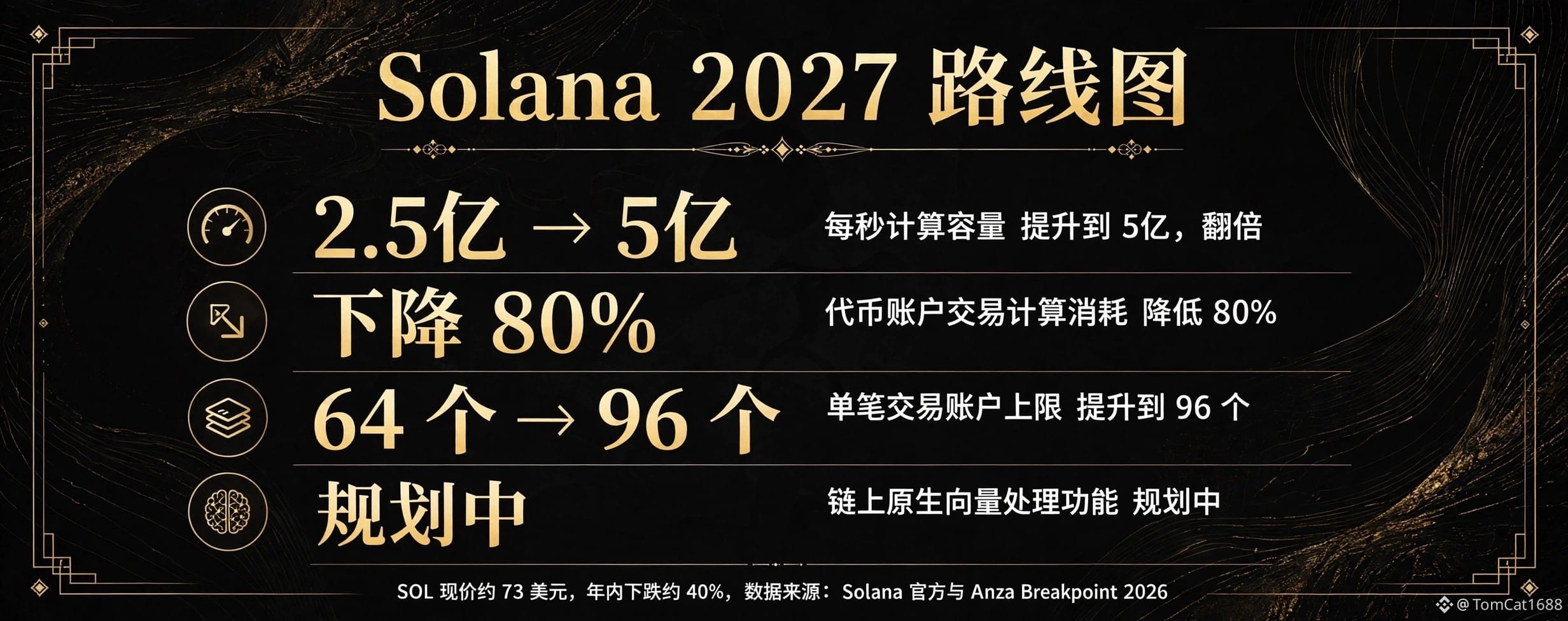
On November 19, core development team Anza unveiled Solana’s 2027 technical roadmap at Breakpoint 2026. Anza CEO Brennan Watt presented it in person, with one clear goal: by the end of 2027, Solana should be able to handle twice as much activity.
Here are the numbers. Computing capacity per second will rise from 250 million CUs to 500 million—double the current amount. Compute costs for token account transactions will be cut by 80%, so the same transfer will use just one-fifth of the computing power it does today. The number of accounts a single transaction can access will increase from 64 to 96, meaning complex transactions won’t need to be split up.
The bigger ambition is on-chain AI. The roadmap calls for native vector processing, allowing AI models to run entirely on-chain. Other planned upgrades include Rotor replacing Turbine for block propagation, and Constellation embedding transaction-ordering rules in the protocol to foster more competition among validators.
These are all goals, not live features. Anza hasn’t set firm timelines for most of the projects either. The nearest commitment is to reduce storage rent by another factor of seven within two weeks.
The market hasn’t been impressed so far. SOL is currently trading around $73, down about 40% this year, after hitting a low of $69.93 this week. The price barely moved after the roadmap was announced.
For comparison, Alpenglow went live on October 21, cutting finality from 12.8 seconds to 150 milliseconds. That was an upgrade that actually shipped. This roadmap is about next year, and delivery will depend on development progress.
In the long term, this is Solana’s declaration of intent to evolve from a fast blockchain into high-performance financial infrastructure. In the short term, it won’t change the flow of funds. The Fear & Greed Index is currently just 11, signaling extreme fear.
The roadmap is for 2027; the market is happening today. Don’t confuse the two.
#Solana2027路线图拟将网络计算容量翻倍 #Solana #SOL #Anza #On-chain AI
5
2.2k

Anza: The company behind Solana’s biggest Alpenglow upgrade
- Solana is attracting attention with its Alpenglow upgrade, which aims to reduce transaction finality time to 150 milliseconds.
- Anza is the engineering company responsible for building this upgrade.
- CoinGape’s article discusses Anza’s story, but the RSS summary doesn’t provide any further details.
#Solana #Alpenglow #Anza #CryptoNews #BinanceSquare
$sol
vlikevn Titanbot
Source: CoinGape
47

📰 Why are miners calling it quits? Solana’s first-ever drop in hash rate comes as AI competes for electricity
After the Alpenglow upgrade to the Solana network, transaction finality time fell from 12.8 seconds to 150 milliseconds. At the same time, however, the network’s total hash rate recorded its first-ever decline. Behind this is a surge in electricity costs, driving miners to cheaper platforms. In particular, the enormous electricity demand from AI training is beginning to squeeze the space available for cryptocurrency mining.
Why does this news matter?
Solana’s upgrade was an industry milestone, dramatically reducing Tendermint BFT’s 12.8-second finality time to a human-perceptible 150 milliseconds. But the drop in hash rate exposes a deeper problem: as demand for AI computing power surges (the cost of computing power has already surpassed that of the entire cryptocurrency industry), electricity is becoming a key resource in the competition. Miners are finding that training a large language model consumes as much electricity as mining 100 bitcoins, while mining revenues on public blockchains such as Solana are no longer enough to cover local electricity prices. This means the race for computing power will shift from capital to control over electricity resources—a major test for public blockchains that depend on miners for security.
Market impact
This is a short-term positive for SOL, but a long-term risk. In the short term, an increase in hash rate would strengthen network resilience (if miners are in it for the long haul). But in the long run, if electricity costs aren’t addressed, the SOL ecosystem could suffer the same fate as some sidechains. The takeaway for BTC/ETH is that computing efficiency will no longer be the only dimension of competition: electricity costs will become a matter of survival for underlying public blockchains. In particular, if electricity prices remain higher than block rewards, ETH’s merged mining model could see miners leave, as Solana is now experiencing.
💡 Solana’s improved computing efficiency is worth recognizing, but if electricity costs aren’t addressed, this advantage could be wiped out. If California’s electricity policies continue to tighten over the next few months (commercial electricity prices are already above $0.35/kWh), SOL could face the risk of further miner exits. This means the $80–85 range could be a key resistance level for SOL.
This article was not sponsored by any project, and the author does not hold any of the assets mentioned.
$BTC $ETH #BTC #ETH
⚠️ This does not constitute investment advice. Forecasts are for reference only.
#Anza’sAlpenglowgoesliveonSolana,cuttingfinalityto150milliseconds
$SOL
6

·
--
📰 Why has Solana suddenly accelerated? Alpenglow launches at 150 ms—so why did SOL still fall?
We talked about this just two days ago, and now there’s a new development. Solana’s mainnet has launched a new version, Alpenglow, cutting transaction finality from 12.8 seconds to just 150 milliseconds—faster than lightning. This is a major boost for the Solana ecosystem, so why has the coin price instead hit a new low? This unusual phenomenon reveals two things.
Why does this news matter? The fundamental reason is that Solana is working hard to fix an old problem: finality has been too slow, directly hurting the user experience. Transfers that once took more than ten seconds to confirm are now almost as fast as local transfers. This means Solana is polishing its “high performance” reputation to a shine, which could make it exponentially more attractive to DeFi and GameFi. If computing power can’t keep up with this speed boost, that would pose an even greater risk.
As for the market impact, SOL may continue to diverge in the short term. 150 ms is just a number; whether it can translate into more users depends on ecosystem projects getting on board. If NFT and GameFi projects don’t actively build on Solana, this speed advantage will be little more than an illusion. In the medium term, SOL may stabilize in the $107.12–110 range, provided Bitcoin holds above $107.12K. If BTC falls below that level, this positive development could be overwhelmed by risk aversion.
💡 If exchanges impose widespread restrictions on Solana deposits, this 150 ms speed advantage will be meaningless, and this assessment will no longer hold.
This article is not sponsored by any project, and the author does not hold any of the assets mentioned.
⚠️ This is not investment advice. Predictions are for reference only.
#Anza’sAlpenglowgoesliveonSolana,cuttingfinalityto150milliseconds
$SOL $BTC
1
310

·
--
Bearish
Verified
#solanatransactionv1goesliveonmainnet
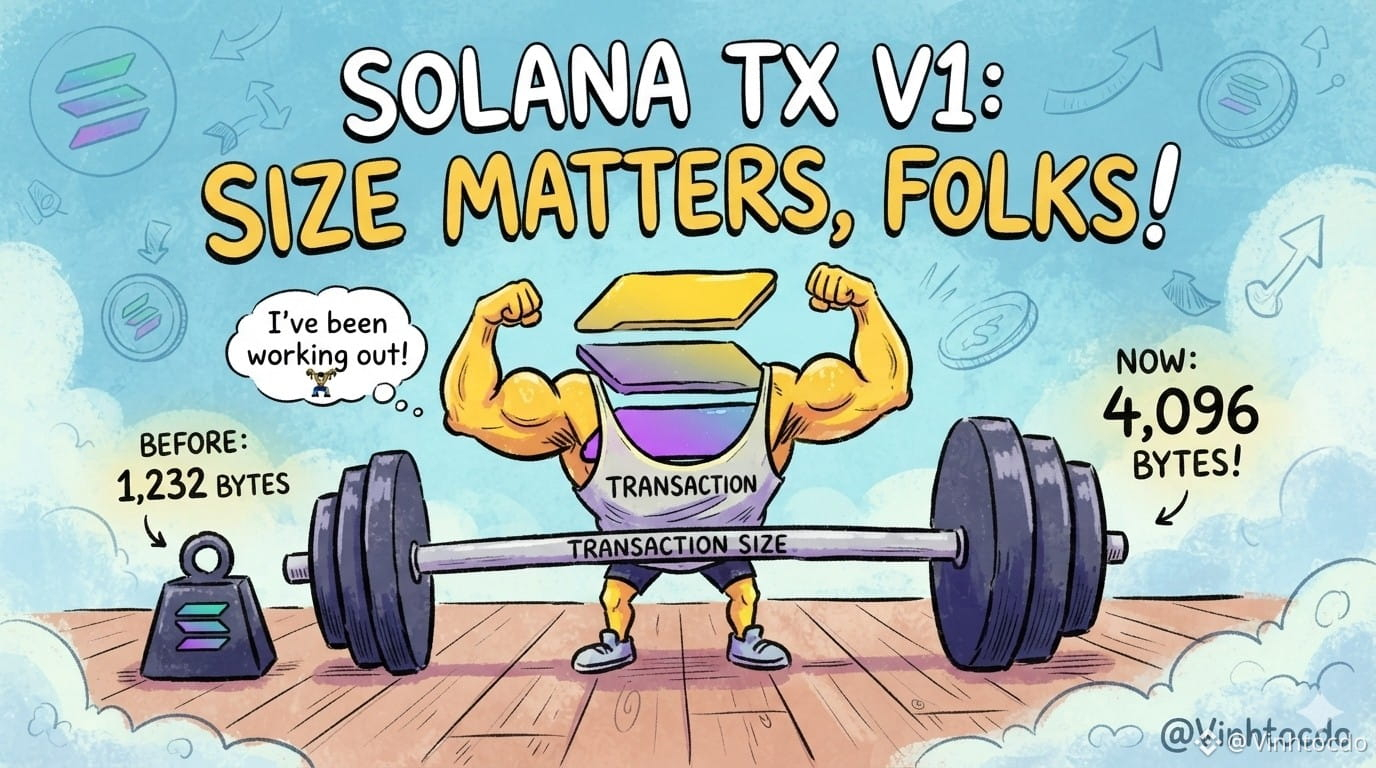
🚀 Solana TX V1 is LIVE: Size Matters, Folks!
Breaking news! Solana’s Transaction V1 (SIMD-0385) just hit the mainnet. What does this upgrade mean? Solana basically went to the gym and pumped its maximum transaction size from a tiny 1,232 bytes to a massive 4,096 bytes! 🏋️♂️
What should traders do now?
1️⃣ Stop panicking: The network isn't congested (yet).
2️⃣ Enjoy the gains: Massive multi-sigs and ZK-proofs can now fit into a single atomic transaction. No more multi-step nightmares!
⚠️ Reminder: This is NOT financial advice. Do your own research!
Want to join the future of crypto? Sign up on Binance now using my referral link or code!
🔗 Link: [binance.com](https://www.binance.com/register?ref=VINHTOCDO)🆔 Code: VINHTOCDO
👇 Click and trade the tokens below to support my content!
#Solana #SOL #Anza #VINHTOCDO
$SOL
{future}(SOLUSDT)
$BTC
{future}(BTCUSDT)
$ETH
{future}(ETHUSDT)
#solanatransactionv1goesliveonmainnet
🚀 Solana TX V1 is LIVE: Size Matters, Folks!
Breaking news! Solana’s Transaction V1 (SIMD-0385) just hit the mainnet. What does this upgrade mean? Solana basically went to the gym and pumped its maximum transaction size from a tiny 1,232 bytes to a massive 4,096 bytes! 🏋️♂️
What should traders do now?
1️⃣ Stop panicking: The network isn't congested (yet).
2️⃣ Enjoy the gains: Massive multi-sigs and ZK-proofs can now fit into a single atomic transaction. No more multi-step nightmares!
⚠️ Reminder: This is NOT financial advice. Do your own research!
Want to join the future of crypto? Sign up on Binance now using my referral link or code!
🔗 Link: binance.com🆔 Code: VINHTOCDO
👇 Click and trade the tokens below to support my content!
#Solana #SOL #Anza #VINHTOCDO
$SOL
$BTC
$ETH
1
128
Log in to explore more content
Join global crypto users on Binance Square
⚡️ Get latest and useful information about crypto.
💬 Trusted by the world’s largest crypto exchange.
👍 Discover real insights from verified creators.
Email / Phone number
Trending Topics
1
#CanBTCReboundAfterFallingBelow60K?
133,121 views
538 Discussing
2
#GlobalStocksFaceLongestLosingStreakSince2023
56,489 views
518 Discussing
3
#AnthropicPlungesTowardIPOPriceonDay2
19,979 views
215 Discussing
4
#BNBDropsBelow540USDTWith8.46%DailyDecline
0 views
3 Discussing
5
#MorganStanleyEndsAnthropicStockSupportAfterOneDay
0 views
1 Discussing
6
#CryptoBilisAttackerMoves25000ETHToTornadoCash
0 views
1 Discussing
7
#GaoTengBitcoinETFListsOnHKEX
38,582 views
392 Discussing
8
#TradFiForBeginners
1M views
5,845 Discussing
9
#NvidiaBoardReportedlySplitOverHuang’sReturn
407,525 views
2,585 Discussing
10
#TetherBurns8BillionUSDTInPast20Days
48,091 views
164 Discussing