
#bnbchain
bnbchain
9M views
25,081 Discussing
Hot
Latest

·
--
$CZ: Renounced Owner, Deeper Risk$CZ scored 90/100 on the quick public-risk scan.
Deeper TokenToolHub contract intelligence returned 35/100.
Contract:
0x923CBbe402Ab9aDb85FBE04EDAd056Dc35447777
Network: BNB Smart Chain
Four material risk scenarios were identified:
• Possible supply dilution
• Possible post-purchase fee escalation
• Possible implementation replacement
• Possible generic execution abuse
Key findings:
• Source verified
• Ownership: Renounced
• Proxy: Detected
• Supply expansion: Present
• Supply reduction: Present
• Mutable fees/taxes: Present
• Upgrade authority: Present
• Generic external execution: Present
• Wallet restrictions: Not detected
• Trading switches: Not detected
• Transaction/wallet limits: Not detected
• Emergency pause: Not detected
The live owner() call returns the zero address.
But $CZ is also upgradeable.
Resolved implementation:
0x024f18294970b5c76c0691b87f138a0317156422
The proxy administrator remains unresolved.
That distinction matters.
Renouncing owner() does not automatically make an upgradeable contract immutable. A separate authority may still control implementation changes.
The verified code also exposes supply-expansion capability and mutable fees.
That creates separate trust assumptions around whether supply can increase and whether transaction costs can change after users enter.
Generic external execution adds another layer because privileged execution paths can potentially reach broader functionality depending on authorization and target restrictions.
Trading simulation was unavailable, so honeypot status, buy tax and sell tax remain unresolved.
Recent contract activity, token-transfer activity and creation context were also unavailable.
The key takeaway:
A renounced owner is only one part of the authority model.
For $CZ, the deeper questions are who controls the proxy, whether supply can still expand and what fee or execution permissions remain usable.
Full $CZ scan:
https://tokentoolhub.com/token-safety-checker/?net=bsc&address=0x923CBbe402Ab9aDb85FBE04EDAd056Dc35447777
#BNBChain #crypto #Web3 #blockchain #CryptoSecurity
$CZ: Renounced Owner, Deeper Risk
$CZ scored 90/100 on the quick public-risk scan.
Deeper TokenToolHub contract intelligence returned 35/100.
Contract:
0x923CBbe402Ab9aDb85FBE04EDAd056Dc35447777
Network: BNB Smart Chain
Four material risk scenarios were identified:
• Possible supply dilution
• Possible post-purchase fee escalation
• Possible implementation replacement
• Possible generic execution abuse
Key findings:
• Source verified
• Ownership: Renounced
• Proxy: Detected
• Supply expansion: Present
• Supply reduction: Present
• Mutable fees/taxes: Present
• Upgrade authority: Present
• Generic external execution: Present
• Wallet restrictions: Not detected
• Trading switches: Not detected
• Transaction/wallet limits: Not detected
• Emergency pause: Not detected
The live owner() call returns the zero address.
But $CZ is also upgradeable.
Resolved implementation:
0x024f18294970b5c76c0691b87f138a0317156422
The proxy administrator remains unresolved.
That distinction matters.
Renouncing owner() does not automatically make an upgradeable contract immutable. A separate authority may still control implementation changes.
The verified code also exposes supply-expansion capability and mutable fees.
That creates separate trust assumptions around whether supply can increase and whether transaction costs can change after users enter.
Generic external execution adds another layer because privileged execution paths can potentially reach broader functionality depending on authorization and target restrictions.
Trading simulation was unavailable, so honeypot status, buy tax and sell tax remain unresolved.
Recent contract activity, token-transfer activity and creation context were also unavailable.
The key takeaway:
A renounced owner is only one part of the authority model.
For $CZ, the deeper questions are who controls the proxy, whether supply can still expand and what fee or execution permissions remain usable.
Full $CZ scan:
https://tokentoolhub.com/token-safety-checker/?net=bsc&address=0x923CBbe402Ab9aDb85FBE04EDAd056Dc35447777
#BNBChain #crypto #Web3 #blockchain #CryptoSecurity
Deeper TokenToolHub contract intelligence returned 35/100.
Contract:
0x923CBbe402Ab9aDb85FBE04EDAd056Dc35447777
Network: BNB Smart Chain
Four material risk scenarios were identified:
• Possible supply dilution
• Possible post-purchase fee escalation
• Possible implementation replacement
• Possible generic execution abuse
Key findings:
• Source verified
• Ownership: Renounced
• Proxy: Detected
• Supply expansion: Present
• Supply reduction: Present
• Mutable fees/taxes: Present
• Upgrade authority: Present
• Generic external execution: Present
• Wallet restrictions: Not detected
• Trading switches: Not detected
• Transaction/wallet limits: Not detected
• Emergency pause: Not detected
The live owner() call returns the zero address.
But $CZ is also upgradeable.
Resolved implementation:
0x024f18294970b5c76c0691b87f138a0317156422
The proxy administrator remains unresolved.
That distinction matters.
Renouncing owner() does not automatically make an upgradeable contract immutable. A separate authority may still control implementation changes.
The verified code also exposes supply-expansion capability and mutable fees.
That creates separate trust assumptions around whether supply can increase and whether transaction costs can change after users enter.
Generic external execution adds another layer because privileged execution paths can potentially reach broader functionality depending on authorization and target restrictions.
Trading simulation was unavailable, so honeypot status, buy tax and sell tax remain unresolved.
Recent contract activity, token-transfer activity and creation context were also unavailable.
The key takeaway:
A renounced owner is only one part of the authority model.
For $CZ, the deeper questions are who controls the proxy, whether supply can still expand and what fee or execution permissions remain usable.
Full $CZ scan:
https://tokentoolhub.com/token-safety-checker/?net=bsc&address=0x923CBbe402Ab9aDb85FBE04EDAd056Dc35447777
#BNBChain #crypto #Web3 #blockchain #CryptoSecurity
25

·
--
🚨 BNB/USDT — KEY LEVELS TO WATCH 📊
$BNB B is trading around $721 as buyers continue defending the $709–$710 support zone.
Momentum has weakened, while the $739–$740 area remains an important resistance zone.
Traders are watching whether $BNB can reclaim resistance or lose the key support area.
#BNB #CryptoNews #BNBChain #CryptoMarket
🚨 BNB/USDT — KEY LEVELS TO WATCH 📊
$BNB B is trading around $721 as buyers continue defending the $709–$710 support zone.
Momentum has weakened, while the $739–$740 area remains an important resistance zone.
Traders are watching whether $BNB can reclaim resistance or lose the key support area.
#BNB #CryptoNews #BNBChain #CryptoMarket
$BNB B is trading around $721 as buyers continue defending the $709–$710 support zone.
Momentum has weakened, while the $739–$740 area remains an important resistance zone.
Traders are watching whether $BNB can reclaim resistance or lose the key support area.
#BNB #CryptoNews #BNBChain #CryptoMarket

42

·
--
$BNB — More Than an Exchange Token
BNB continues to sit at the center of the BNB ecosystem.
Trading is only one part of the story.
DeFi, stablecoins, payments, tokenization and Web3 infrastructure are increasingly important pieces of the BNB narrative.
What matters more: price or ecosystem growth?
$BNB #BNBChain
{spot}(BNBUSDT)
#BİNANCE
$BNB — More Than an Exchange Token
BNB continues to sit at the center of the BNB ecosystem.
Trading is only one part of the story.
DeFi, stablecoins, payments, tokenization and Web3 infrastructure are increasingly important pieces of the BNB narrative.
What matters more: price or ecosystem growth?
$BNB #BNBChain
#BİNANCE
BNB continues to sit at the center of the BNB ecosystem.
Trading is only one part of the story.
DeFi, stablecoins, payments, tokenization and Web3 infrastructure are increasingly important pieces of the BNB narrative.
What matters more: price or ecosystem growth?
$BNB #BNBChain
#BİNANCE
30

RWA tooling makes a move on BNB Chain
Genius Foundation has launched Genius.fun on BNB Chain, allowing communities to create tokens and build treasuries using tokenized public company shares to coordinate shareholder campaigns.
#BNBChain #TokenizedAssets
RWA tooling makes a move on BNB Chain
Genius Foundation has launched Genius.fun on BNB Chain, allowing communities to create tokens and build treasuries using tokenized public company shares to coordinate shareholder campaigns.
#BNBChain #TokenizedAssets
Genius Foundation has launched Genius.fun on BNB Chain, allowing communities to create tokens and build treasuries using tokenized public company shares to coordinate shareholder campaigns.
#BNBChain #TokenizedAssets
4

·
--
Bullish
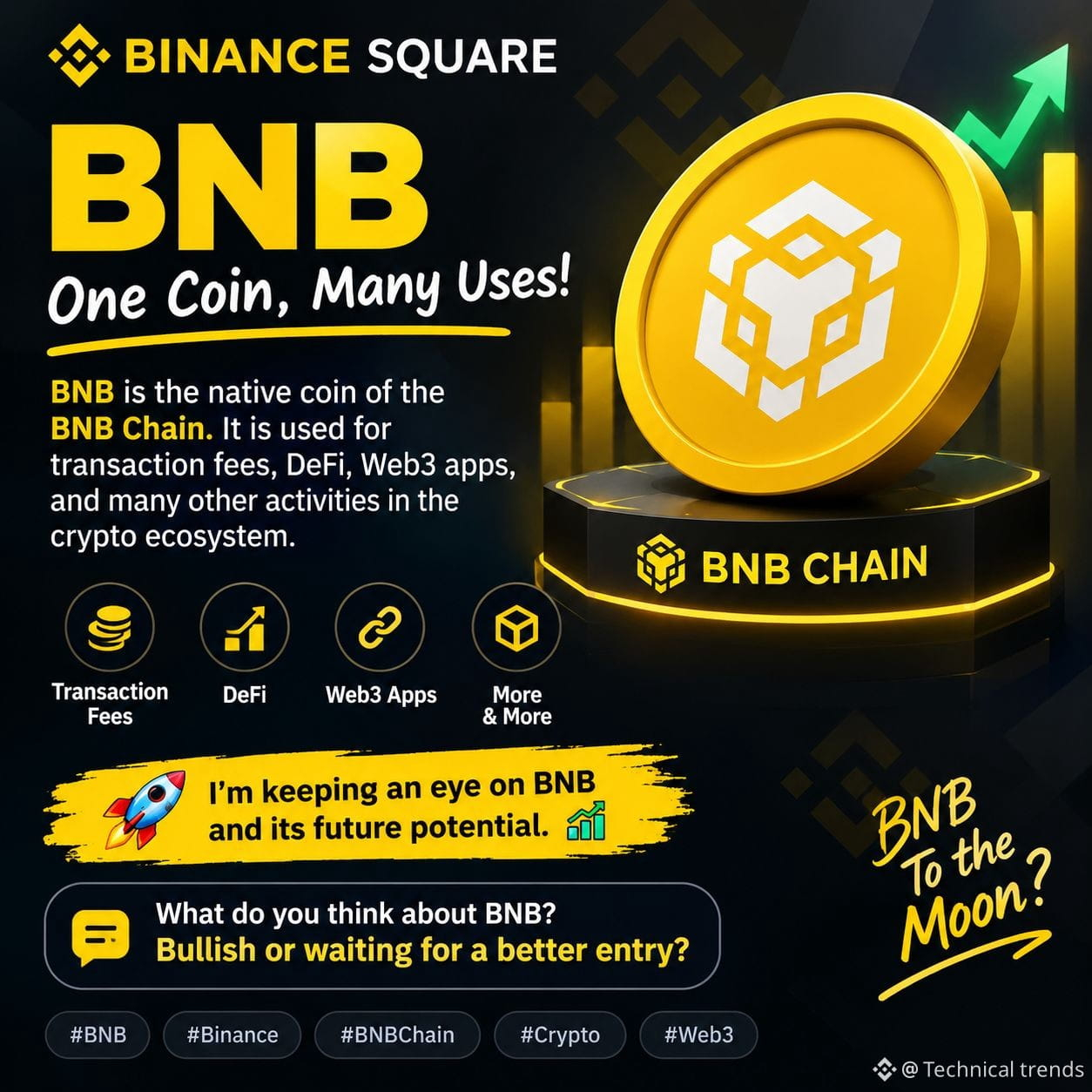
🚀 $BNB — One Coin, Many Uses!
BNB is the native coin of the $BNB Chain. It is used for transaction fees, DeFi, Web3 apps, and many other activities in the crypto ecosystem.
I’m keeping an eye on $BNB and its future potential. 📈
What do you think about BNB?
💬 Bullish or waiting for a better entry?
{spot}(BNBUSDT)
#BNB #BİNANCE #BNBChain #crypto #Web3
🚀 $BNB — One Coin, Many Uses!
BNB is the native coin of the $BNB Chain. It is used for transaction fees, DeFi, Web3 apps, and many other activities in the crypto ecosystem.
I’m keeping an eye on $BNB and its future potential. 📈
What do you think about BNB?
💬 Bullish or waiting for a better entry?
#BNB #BİNANCE #BNBChain #crypto #Web3
BNB is the native coin of the $BNB Chain. It is used for transaction fees, DeFi, Web3 apps, and many other activities in the crypto ecosystem.
I’m keeping an eye on $BNB and its future potential. 📈
What do you think about BNB?
💬 Bullish or waiting for a better entry?
#BNB #BİNANCE #BNBChain #crypto #Web3
2
70

·
--
Bullish
$BNB
{spot}(BNBUSDT)
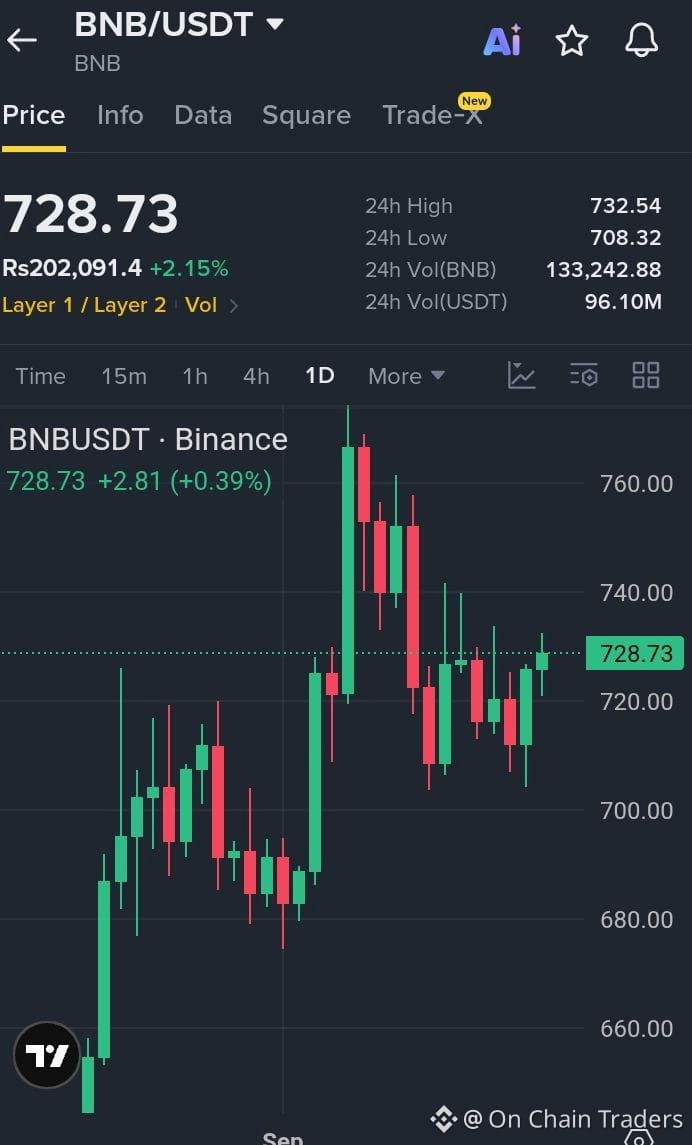
trades at $728.73, holding a bullish structure after reclaiming $720 support.
Pattern: Higher lows + breakout momentum — bulls target the next resistance.
Entry: $720–$725
TP1: $740 | TP2: $750 | TP3: $760
SL: $712
Watch $732.54 breakout for continuation; lose $720 and bears may take control.
#BNB #Binance #Crypto #BNBChain #BinanceSquare
$BNB
trades at $728.73, holding a bullish structure after reclaiming $720 support.
Pattern: Higher lows + breakout momentum — bulls target the next resistance.
Entry: $720–$725
TP1: $740 | TP2: $750 | TP3: $760
SL: $712
Watch $732.54 breakout for continuation; lose $720 and bears may take control.
#BNB #Binance #Crypto #BNBChain #BinanceSquare
trades at $728.73, holding a bullish structure after reclaiming $720 support.
Pattern: Higher lows + breakout momentum — bulls target the next resistance.
Entry: $720–$725
TP1: $740 | TP2: $750 | TP3: $760
SL: $712
Watch $732.54 breakout for continuation; lose $720 and bears may take control.
#BNB #Binance #Crypto #BNBChain #BinanceSquare
1
12

·
--
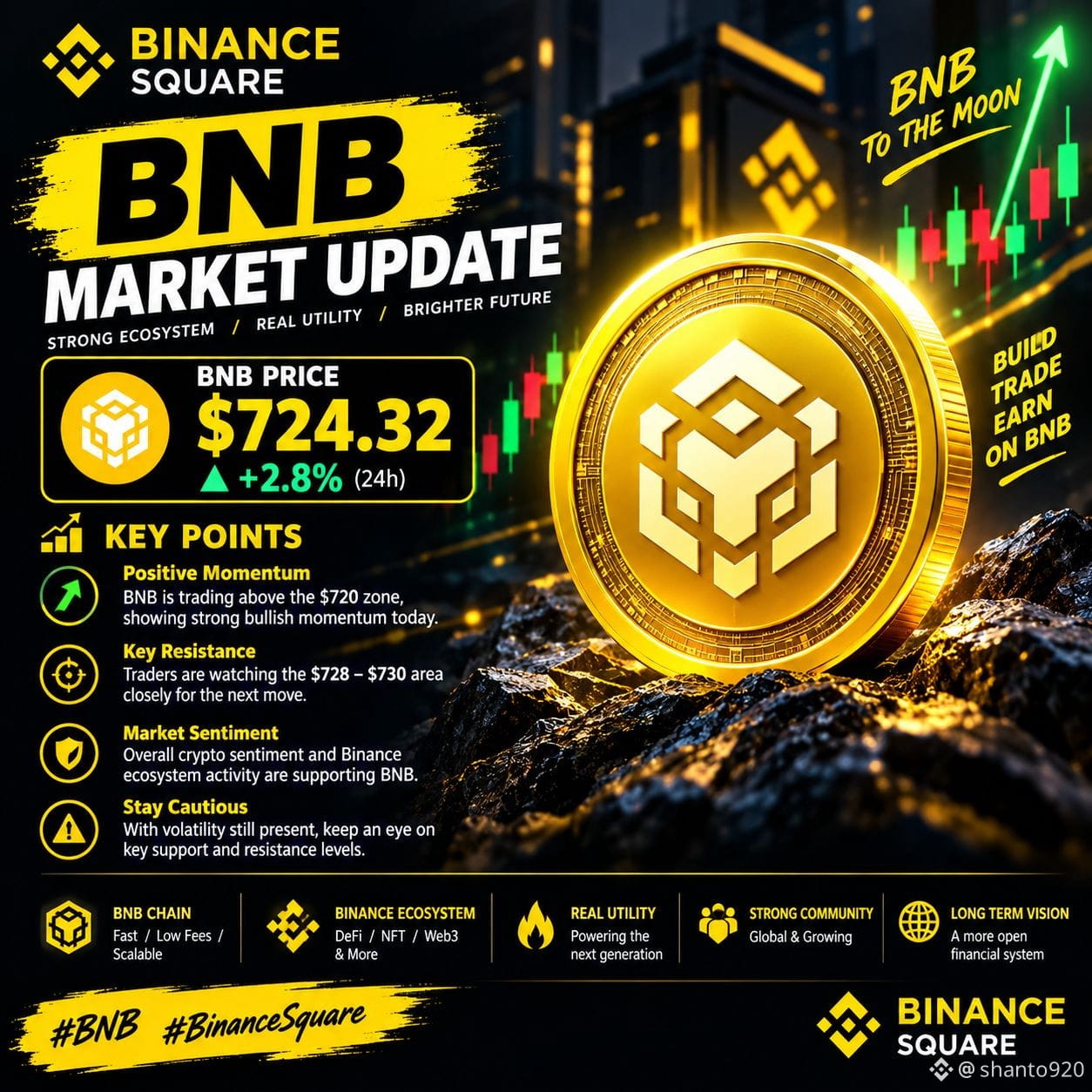
BNB is showing positive momentum today, trading above the $720 zone. Traders are watching the $728–$730 area closely while market participants monitor overall crypto sentiment and Binance ecosystem activity. With volatility still present, keeping an eye on key support and resistance levels remains important. 🚀
#BNB #Binance #crypto #BNBChain #BinanceSquare
$BNB
{spot}(BNBUSDT)
BNB is showing positive momentum today, trading above the $720 zone. Traders are watching the $728–$730 area closely while market participants monitor overall crypto sentiment and Binance ecosystem activity. With volatility still present, keeping an eye on key support and resistance levels remains important. 🚀
#BNB #Binance #crypto #BNBChain #BinanceSquare
$BNB
#BNB #Binance #crypto #BNBChain #BinanceSquare
$BNB
56

🚀 $BNB Market Update
BNB remains one of the major cryptocurrencies in the market, supported by the broader BNB Chain ecosystem.
📊 Key Focus:
• Price momentum & trading volume
• BNB Chain ecosystem activity
• Support and resistance levels
• Overall crypto market sentiment
⚠️ Crypto markets are highly volatile. Always do your own research before making investment decisions. #Crypto_Jobs🎯 #BNBChain
#RobinhoodToSupportCircleArcNetwork #XRPSinks10% #ZcashRises6%
{spot}(BNBUSDT)
🚀 $BNB Market Update
BNB remains one of the major cryptocurrencies in the market, supported by the broader BNB Chain ecosystem.
📊 Key Focus:
• Price momentum & trading volume
• BNB Chain ecosystem activity
• Support and resistance levels
• Overall crypto market sentiment
⚠️ Crypto markets are highly volatile. Always do your own research before making investment decisions. #Crypto_Jobs🎯 #BNBChain
#RobinhoodToSupportCircleArcNetwork #XRPSinks10% #ZcashRises6%
BNB remains one of the major cryptocurrencies in the market, supported by the broader BNB Chain ecosystem.
📊 Key Focus:
• Price momentum & trading volume
• BNB Chain ecosystem activity
• Support and resistance levels
• Overall crypto market sentiment
⚠️ Crypto markets are highly volatile. Always do your own research before making investment decisions. #Crypto_Jobs🎯 #BNBChain
#RobinhoodToSupportCircleArcNetwork #XRPSinks10% #ZcashRises6%

73

·
--
Article
📊 BNB Chain Is Turning Into Crypto's Busiest Highway — But Nobody's Parking Their Car📊 **BNB Chain Is Turning Into Crypto's Busiest Highway — But Nobody's Parking Their Car**
BNB Chain is quietly showing one of the most interesting divergences in DeFi right now, and it has nothing to do with price. 🔍
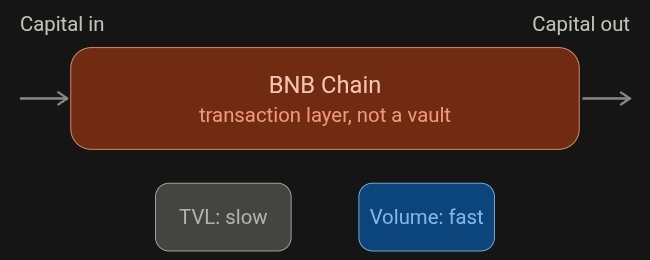
Over the past 30 days, BNB Chain's decentralized exchange (DEX) volume has surged an impressive 68%. Meanwhile, its DeFi Total Value Locked (TVL) — the amount of capital actually sitting inside protocols — has grown by just 15% over the same period. Do the math, and you get a gap of roughly 4.6x between how much money is *moving through* the chain versus how much is *staying* there. That's not a small discrepancy — it's a structural signal. 📈
$BNB itself hasn't been ignoring the noise either. The token briefly touched the mid-$700s before pulling back, giving traders a quick adrenaline spike. But here's the thing: the price action isn't really the story. The real story is buried underneath — in the mechanics of what's actually driving all this on-chain activity. 🧠
Let's look at the numbers a little closer. Daily DEX volume on BSC (Binance Smart Chain) has been running near $1.3 billion. At the same time, stablecoins parked on the chain — mostly USDT — sit above $13 billion, more than double the entire TVL figure. Think about what that actually means: there's a massive pool of dollar-denominated capital sitting on BNB Chain that isn't locked into any protocol. It's not lending, it's not farming, it's not staking. It's just... waiting. Positioned to move, not settled in. 💵
Put those two data points together — soaring DEX volume and a stablecoin base that dwarfs the TVL — and a clear pattern emerges: demand on BNB Chain is showing up as *turnover*, not as *deposits*. Traders and capital allocators are routing money through BNB Chain rather than parking it there long-term. In other words, BSC is functioning more like a **transaction layer** — a highway for capital to pass through quickly — rather than a **savings layer** where funds sit and compound. 🛣️
There's a third data point worth flagging too: protocol fee revenue on BNB Chain has climbed noticeably faster than BTC's own price over this same window — and it's done so independent of the broader market trend. That's not something you'd expect if activity were purely speculative or price-driven. It suggests genuine, sustained usage of the chain's infrastructure, regardless of what Bitcoin or the wider market is doing. ⚙️
So what does this actually mean for the ecosystem going forward? A chain optimized for turnover rather than deposits behaves differently than one built around sticky, long-term capital. High DEX volume paired with a shallow TVL base can mean faster arbitrage cycles, more efficient price discovery, and a thriving trading ecosystem — but it can also mean the chain is more exposed to capital flight during volatile periods, since so much of the money sitting there isn't committed to anything. Stablecoin liquidity that isn't deployed into protocols is liquidity that can leave just as fast as it arrived. ⚠️
For traders, this dynamic is worth watching closely. A chain generating this much transactional throughput, backed by rising fee revenue that's decoupled from BTC's price movement, is signaling real underlying demand — not just hype-driven speculation. But the low TVL-to-volume ratio also means BNB Chain's DeFi ecosystem still has significant room to mature, if that stablecoin capital ever does decide to settle in rather than just pass through. 🚀
The next few weeks will tell us a lot. If TVL starts catching up to volume growth, it could mark a shift from BNB Chain being purely a transaction highway to becoming a genuine capital destination. If the gap keeps widening instead, it confirms BSC's current identity: fast, liquid, and built for movement — not for parking. 🔄
---
#BNBChain #BinanceSmartChain #CryptoMarkets #BNB
📊 BNB Chain Is Turning Into Crypto's Busiest Highway — But Nobody's Parking Their Car
📊 **BNB Chain Is Turning Into Crypto's Busiest Highway — But Nobody's Parking Their Car**
BNB Chain is quietly showing one of the most interesting divergences in DeFi right now, and it has nothing to do with price. 🔍
Over the past 30 days, BNB Chain's decentralized exchange (DEX) volume has surged an impressive 68%. Meanwhile, its DeFi Total Value Locked (TVL) — the amount of capital actually sitting inside protocols — has grown by just 15% over the same period. Do the math, and you get a gap of roughly 4.6x between how much money is *moving through* the chain versus how much is *staying* there. That's not a small discrepancy — it's a structural signal. 📈
$BNB itself hasn't been ignoring the noise either. The token briefly touched the mid-$700s before pulling back, giving traders a quick adrenaline spike. But here's the thing: the price action isn't really the story. The real story is buried underneath — in the mechanics of what's actually driving all this on-chain activity. 🧠
Let's look at the numbers a little closer. Daily DEX volume on BSC (Binance Smart Chain) has been running near $1.3 billion. At the same time, stablecoins parked on the chain — mostly USDT — sit above $13 billion, more than double the entire TVL figure. Think about what that actually means: there's a massive pool of dollar-denominated capital sitting on BNB Chain that isn't locked into any protocol. It's not lending, it's not farming, it's not staking. It's just... waiting. Positioned to move, not settled in. 💵
Put those two data points together — soaring DEX volume and a stablecoin base that dwarfs the TVL — and a clear pattern emerges: demand on BNB Chain is showing up as *turnover*, not as *deposits*. Traders and capital allocators are routing money through BNB Chain rather than parking it there long-term. In other words, BSC is functioning more like a **transaction layer** — a highway for capital to pass through quickly — rather than a **savings layer** where funds sit and compound. 🛣️
There's a third data point worth flagging too: protocol fee revenue on BNB Chain has climbed noticeably faster than BTC's own price over this same window — and it's done so independent of the broader market trend. That's not something you'd expect if activity were purely speculative or price-driven. It suggests genuine, sustained usage of the chain's infrastructure, regardless of what Bitcoin or the wider market is doing. ⚙️
So what does this actually mean for the ecosystem going forward? A chain optimized for turnover rather than deposits behaves differently than one built around sticky, long-term capital. High DEX volume paired with a shallow TVL base can mean faster arbitrage cycles, more efficient price discovery, and a thriving trading ecosystem — but it can also mean the chain is more exposed to capital flight during volatile periods, since so much of the money sitting there isn't committed to anything. Stablecoin liquidity that isn't deployed into protocols is liquidity that can leave just as fast as it arrived. ⚠️
For traders, this dynamic is worth watching closely. A chain generating this much transactional throughput, backed by rising fee revenue that's decoupled from BTC's price movement, is signaling real underlying demand — not just hype-driven speculation. But the low TVL-to-volume ratio also means BNB Chain's DeFi ecosystem still has significant room to mature, if that stablecoin capital ever does decide to settle in rather than just pass through. 🚀
The next few weeks will tell us a lot. If TVL starts catching up to volume growth, it could mark a shift from BNB Chain being purely a transaction highway to becoming a genuine capital destination. If the gap keeps widening instead, it confirms BSC's current identity: fast, liquid, and built for movement — not for parking. 🔄
---
#BNBChain #BinanceSmartChain #CryptoMarkets #BNB
BNB Chain is quietly showing one of the most interesting divergences in DeFi right now, and it has nothing to do with price. 🔍
Over the past 30 days, BNB Chain's decentralized exchange (DEX) volume has surged an impressive 68%. Meanwhile, its DeFi Total Value Locked (TVL) — the amount of capital actually sitting inside protocols — has grown by just 15% over the same period. Do the math, and you get a gap of roughly 4.6x between how much money is *moving through* the chain versus how much is *staying* there. That's not a small discrepancy — it's a structural signal. 📈
$BNB itself hasn't been ignoring the noise either. The token briefly touched the mid-$700s before pulling back, giving traders a quick adrenaline spike. But here's the thing: the price action isn't really the story. The real story is buried underneath — in the mechanics of what's actually driving all this on-chain activity. 🧠
Let's look at the numbers a little closer. Daily DEX volume on BSC (Binance Smart Chain) has been running near $1.3 billion. At the same time, stablecoins parked on the chain — mostly USDT — sit above $13 billion, more than double the entire TVL figure. Think about what that actually means: there's a massive pool of dollar-denominated capital sitting on BNB Chain that isn't locked into any protocol. It's not lending, it's not farming, it's not staking. It's just... waiting. Positioned to move, not settled in. 💵
Put those two data points together — soaring DEX volume and a stablecoin base that dwarfs the TVL — and a clear pattern emerges: demand on BNB Chain is showing up as *turnover*, not as *deposits*. Traders and capital allocators are routing money through BNB Chain rather than parking it there long-term. In other words, BSC is functioning more like a **transaction layer** — a highway for capital to pass through quickly — rather than a **savings layer** where funds sit and compound. 🛣️
There's a third data point worth flagging too: protocol fee revenue on BNB Chain has climbed noticeably faster than BTC's own price over this same window — and it's done so independent of the broader market trend. That's not something you'd expect if activity were purely speculative or price-driven. It suggests genuine, sustained usage of the chain's infrastructure, regardless of what Bitcoin or the wider market is doing. ⚙️
So what does this actually mean for the ecosystem going forward? A chain optimized for turnover rather than deposits behaves differently than one built around sticky, long-term capital. High DEX volume paired with a shallow TVL base can mean faster arbitrage cycles, more efficient price discovery, and a thriving trading ecosystem — but it can also mean the chain is more exposed to capital flight during volatile periods, since so much of the money sitting there isn't committed to anything. Stablecoin liquidity that isn't deployed into protocols is liquidity that can leave just as fast as it arrived. ⚠️
For traders, this dynamic is worth watching closely. A chain generating this much transactional throughput, backed by rising fee revenue that's decoupled from BTC's price movement, is signaling real underlying demand — not just hype-driven speculation. But the low TVL-to-volume ratio also means BNB Chain's DeFi ecosystem still has significant room to mature, if that stablecoin capital ever does decide to settle in rather than just pass through. 🚀
The next few weeks will tell us a lot. If TVL starts catching up to volume growth, it could mark a shift from BNB Chain being purely a transaction highway to becoming a genuine capital destination. If the gap keeps widening instead, it confirms BSC's current identity: fast, liquid, and built for movement — not for parking. 🔄
---
#BNBChain #BinanceSmartChain #CryptoMarkets #BNB
1
92

🟡 $BNB: More Than Just a Coin
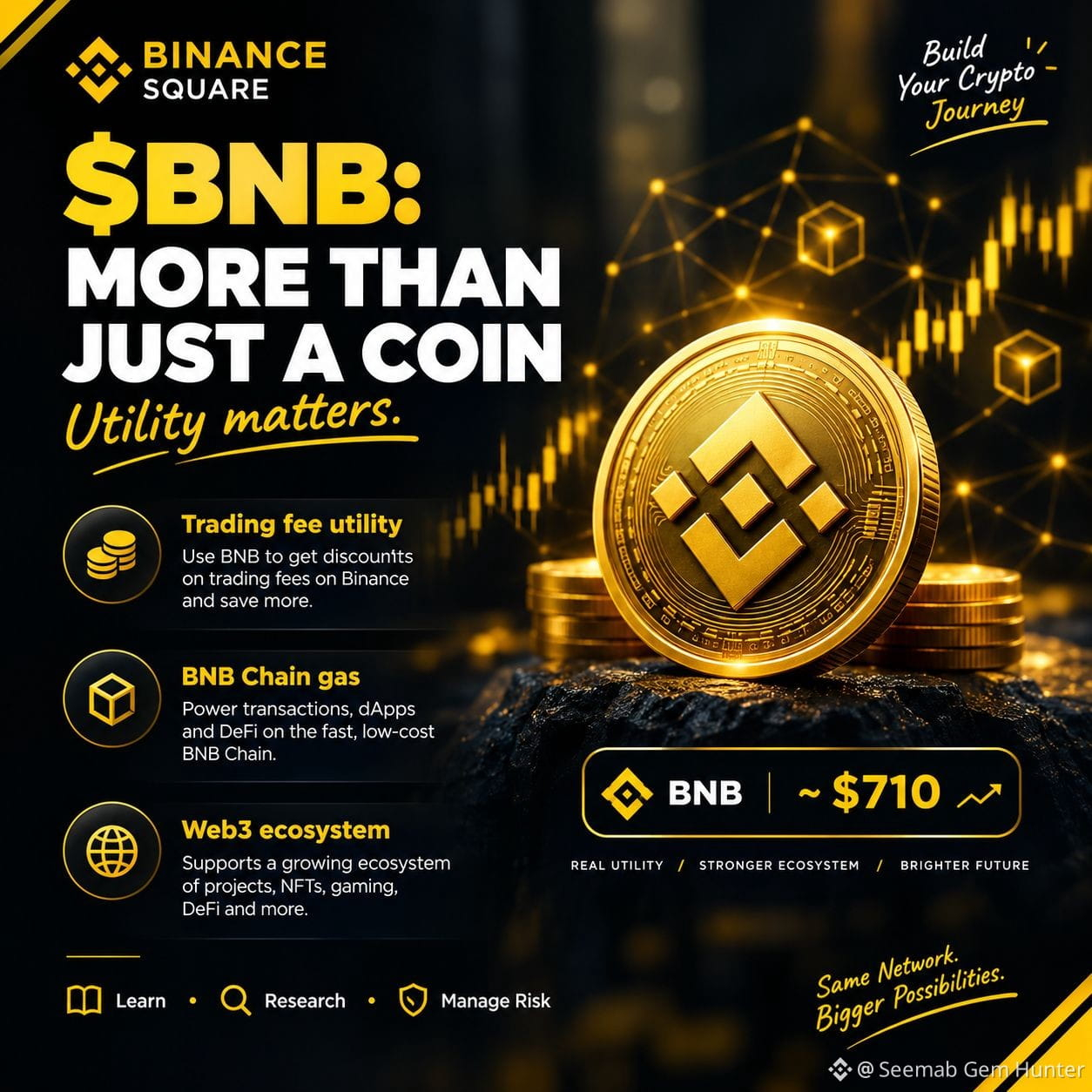
When people hear BNB, they often think only about Binance.
But BNB has several practical uses across the ecosystem 👇
🔸 Trading fee utility — BNB can be used to pay Binance trading fees and currently offers discounts when the BNB deduction option is enabled. �
Binance
🔸 BNB Chain gas — BNB is used for transaction fees across the BNB Chain ecosystem.
🔸 Web3 ecosystem — BNB is connected to a broad ecosystem of DeFi, dApps and other Web3 applications. �
Binance
📊 Current BNB price is around $710, so price is only one part of the story. Utility and ecosystem activity are also worth understanding. �
Binance
💡 The lesson: Don't look at a coin only through its price chart. Understand what the token actually does.
Would you rather learn about a coin's utility or its price action first? 👇
#Binance
#BinanceSquare #BNB #Crypto #BNBChain #Web3 #CryptoEducation
{future}(BNBUSDT)
🟡 $BNB: More Than Just a Coin
When people hear BNB, they often think only about Binance.
But BNB has several practical uses across the ecosystem 👇
🔸 Trading fee utility — BNB can be used to pay Binance trading fees and currently offers discounts when the BNB deduction option is enabled. �
Binance
🔸 BNB Chain gas — BNB is used for transaction fees across the BNB Chain ecosystem.
🔸 Web3 ecosystem — BNB is connected to a broad ecosystem of DeFi, dApps and other Web3 applications. �
Binance
📊 Current BNB price is around $710, so price is only one part of the story. Utility and ecosystem activity are also worth understanding. �
Binance
💡 The lesson: Don't look at a coin only through its price chart. Understand what the token actually does.
Would you rather learn about a coin's utility or its price action first? 👇
#Binance
#BinanceSquare #BNB #Crypto #BNBChain #Web3 #CryptoEducation
When people hear BNB, they often think only about Binance.
But BNB has several practical uses across the ecosystem 👇
🔸 Trading fee utility — BNB can be used to pay Binance trading fees and currently offers discounts when the BNB deduction option is enabled. �
Binance
🔸 BNB Chain gas — BNB is used for transaction fees across the BNB Chain ecosystem.
🔸 Web3 ecosystem — BNB is connected to a broad ecosystem of DeFi, dApps and other Web3 applications. �
Binance
📊 Current BNB price is around $710, so price is only one part of the story. Utility and ecosystem activity are also worth understanding. �
Binance
💡 The lesson: Don't look at a coin only through its price chart. Understand what the token actually does.
Would you rather learn about a coin's utility or its price action first? 👇
#Binance
#BinanceSquare #BNB #Crypto #BNBChain #Web3 #CryptoEducation
1
76

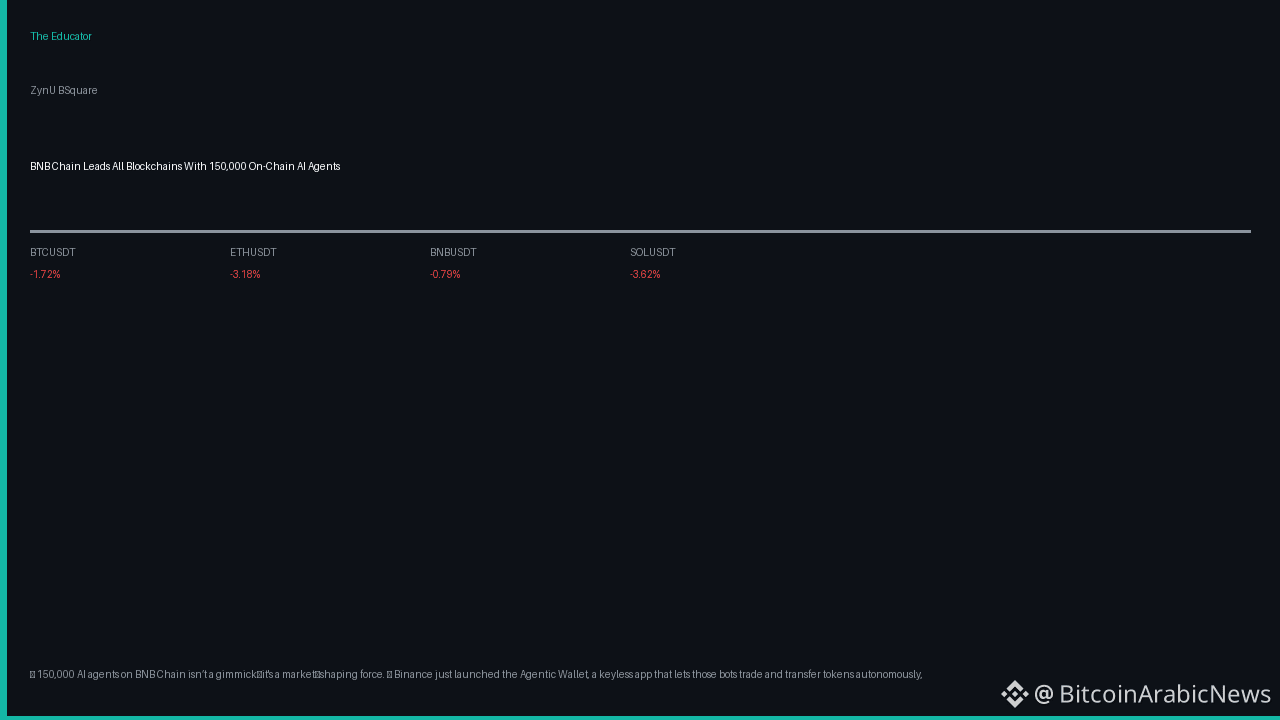
🔥 150,000 AI agents on BNB Chain isn’t a gimmick—it's a market‑shaping force.
📊 Binance just launched the Agentic Wallet, a keyless app that lets those bots trade and transfer tokens autonomously, pushing BNB Chain past 150 k deployments—a 43,750% surge since January, while BNB trades at $712 with 95 M $ volume and an RSI of 39.7 near the lower Bollinger Band. #BNBChain #AI
💡 This spike lands squarely in the early‑bull phase of the #CryptoCycle: infrastructure upgrades attract smart‑money, and the broader market follows suit—BTC sits at $75,832 with a +0.0037% funding rate and a 1.83 long‑short ratio, indicating institutional confidence even as price dips.
🚀 Practical move: allocate a modest, risk‑adjusted slice of your portfolio to AI‑enabled DeFi projects on BNB (automated yield farms, trading bots, or the new Agentic Wallet) while the chain’s on‑chain AI count is still a fraction of its eventual ceiling.
❓ Are you ready to let an AI bot manage part of your BNB exposure, or do you prefer to wait for clearer price signals?
🔥 150,000 AI agents on BNB Chain isn’t a gimmick—it's a market‑shaping force.
📊 Binance just launched the Agentic Wallet, a keyless app that lets those bots trade and transfer tokens autonomously, pushing BNB Chain past 150 k deployments—a 43,750% surge since January, while BNB trades at $712 with 95 M $ volume and an RSI of 39.7 near the lower Bollinger Band. #BNBChain #AI
💡 This spike lands squarely in the early‑bull phase of the #CryptoCycle: infrastructure upgrades attract smart‑money, and the broader market follows suit—BTC sits at $75,832 with a +0.0037% funding rate and a 1.83 long‑short ratio, indicating institutional confidence even as price dips.
🚀 Practical move: allocate a modest, risk‑adjusted slice of your portfolio to AI‑enabled DeFi projects on BNB (automated yield farms, trading bots, or the new Agentic Wallet) while the chain’s on‑chain AI count is still a fraction of its eventual ceiling.
❓ Are you ready to let an AI bot manage part of your BNB exposure, or do you prefer to wait for clearer price signals?
📊 Binance just launched the Agentic Wallet, a keyless app that lets those bots trade and transfer tokens autonomously, pushing BNB Chain past 150 k deployments—a 43,750% surge since January, while BNB trades at $712 with 95 M $ volume and an RSI of 39.7 near the lower Bollinger Band. #BNBChain #AI
💡 This spike lands squarely in the early‑bull phase of the #CryptoCycle: infrastructure upgrades attract smart‑money, and the broader market follows suit—BTC sits at $75,832 with a +0.0037% funding rate and a 1.83 long‑short ratio, indicating institutional confidence even as price dips.
🚀 Practical move: allocate a modest, risk‑adjusted slice of your portfolio to AI‑enabled DeFi projects on BNB (automated yield farms, trading bots, or the new Agentic Wallet) while the chain’s on‑chain AI count is still a fraction of its eventual ceiling.
❓ Are you ready to let an AI bot manage part of your BNB exposure, or do you prefer to wait for clearer price signals?
60


·
--
BNB Chain Wants To Hit Over 100,000 Transactions Per Second. What Would That Actually Take?Visa's card network can reportedly process somewhere around 65,000 transactions per second at peak capacity. Some BNB Chain scaling efforts and layer-2 components like opBNB have floated throughput targets in the tens of thousands and beyond, though there's no single confirmed mainnet benchmark at exactly 100,000 TPS. That's a big number to chase. It amounts to trying to outrun one of the largest payment rails on the planet.
BNB Chain didn't start anywhere near that number. It launched in 2020, built as a faster, cheaper alternative running alongside Ethereum at a time when Ethereum's fees were becoming a real problem for regular users. That timeline alone says a lot about how fast infrastructure can change when there's real demand pushing it. Getting from those early days to six figures of throughput has meant a long string of upgrades most users never notice: shorter block times, higher gas limits, and changes to how validators process blocks, each one squeezing out more capacity without breaking the apps already running on top.
The stated reason for chasing that kind of speed comes down to three words: stablecoins, payments, and RWA, meaning tokenized versions of real assets like funds or credit. None of that works at real scale if a network chokes every time volume spikes. A payments rail that occasionally jams during busy hours doesn't get chosen by anyone processing serious volume, no matter how good the marketing sounds.
Raw speed always comes with a tradeoff most roadmaps don't lead with. The faster and cheaper a chain tries to become, the more it tends to lean on fewer, more powerful validators to keep up with demand. That's the same tension every high throughput chain runs into eventually. Push hard on speed and you usually give up some ground on having thousands of small, independent validators spread out everywhere.
Whether BNB Chain hits triple digit thousands of TPS under real, messy, adversarial conditions, rather than a clean lab benchmark, is still an open question nobody can answer today. Plenty of chains have hit big numbers in controlled tests and then behaved very differently once real users and real attackers showed up at the same time.
What's clearer is the direction the whole industry is leaning. Every major chain right now is racing toward higher throughput because the entire RWA and stablecoin thesis depends on blockspace being cheap and fast enough that people stop thinking about it entirely, the same way nobody thinks about how many transactions per second their debit card can handle at the grocery store.
BNB sits at $715.56 today, a token that started out as a simple discount on Binance trading fees back in 2017 and is now tied to a chain trying to process transactions faster than a global card network.
Picture this playing out over the next several years. If the throughput numbers hold up under real load, most users still won't notice a chart or a headline about it. They'll just notice things feel instant, transfers clear before the page even finishes loading, and nobody bothers checking which chain is underneath. That's usually how infrastructure wins in the end, quietly, long after the number itself stopped being the story anyone talks about.
Do you think raw speed is what actually decides which chain wins the stablecoin and RWA race, or is it something else entirely?
Personal view, not advice. Do your own research.
#BNB #BNBChain
BNB Chain Wants To Hit Over 100,000 Transactions Per Second. What Would That Actually Take?
Visa's card network can reportedly process somewhere around 65,000 transactions per second at peak capacity. Some BNB Chain scaling efforts and layer-2 components like opBNB have floated throughput targets in the tens of thousands and beyond, though there's no single confirmed mainnet benchmark at exactly 100,000 TPS. That's a big number to chase. It amounts to trying to outrun one of the largest payment rails on the planet.
BNB Chain didn't start anywhere near that number. It launched in 2020, built as a faster, cheaper alternative running alongside Ethereum at a time when Ethereum's fees were becoming a real problem for regular users. That timeline alone says a lot about how fast infrastructure can change when there's real demand pushing it. Getting from those early days to six figures of throughput has meant a long string of upgrades most users never notice: shorter block times, higher gas limits, and changes to how validators process blocks, each one squeezing out more capacity without breaking the apps already running on top.
The stated reason for chasing that kind of speed comes down to three words: stablecoins, payments, and RWA, meaning tokenized versions of real assets like funds or credit. None of that works at real scale if a network chokes every time volume spikes. A payments rail that occasionally jams during busy hours doesn't get chosen by anyone processing serious volume, no matter how good the marketing sounds.
Raw speed always comes with a tradeoff most roadmaps don't lead with. The faster and cheaper a chain tries to become, the more it tends to lean on fewer, more powerful validators to keep up with demand. That's the same tension every high throughput chain runs into eventually. Push hard on speed and you usually give up some ground on having thousands of small, independent validators spread out everywhere.
Whether BNB Chain hits triple digit thousands of TPS under real, messy, adversarial conditions, rather than a clean lab benchmark, is still an open question nobody can answer today. Plenty of chains have hit big numbers in controlled tests and then behaved very differently once real users and real attackers showed up at the same time.
What's clearer is the direction the whole industry is leaning. Every major chain right now is racing toward higher throughput because the entire RWA and stablecoin thesis depends on blockspace being cheap and fast enough that people stop thinking about it entirely, the same way nobody thinks about how many transactions per second their debit card can handle at the grocery store.
BNB sits at $715.56 today, a token that started out as a simple discount on Binance trading fees back in 2017 and is now tied to a chain trying to process transactions faster than a global card network.
Picture this playing out over the next several years. If the throughput numbers hold up under real load, most users still won't notice a chart or a headline about it. They'll just notice things feel instant, transfers clear before the page even finishes loading, and nobody bothers checking which chain is underneath. That's usually how infrastructure wins in the end, quietly, long after the number itself stopped being the story anyone talks about.
Do you think raw speed is what actually decides which chain wins the stablecoin and RWA race, or is it something else entirely?
Personal view, not advice. Do your own research.
#BNB #BNBChain
BNB Chain didn't start anywhere near that number. It launched in 2020, built as a faster, cheaper alternative running alongside Ethereum at a time when Ethereum's fees were becoming a real problem for regular users. That timeline alone says a lot about how fast infrastructure can change when there's real demand pushing it. Getting from those early days to six figures of throughput has meant a long string of upgrades most users never notice: shorter block times, higher gas limits, and changes to how validators process blocks, each one squeezing out more capacity without breaking the apps already running on top.
The stated reason for chasing that kind of speed comes down to three words: stablecoins, payments, and RWA, meaning tokenized versions of real assets like funds or credit. None of that works at real scale if a network chokes every time volume spikes. A payments rail that occasionally jams during busy hours doesn't get chosen by anyone processing serious volume, no matter how good the marketing sounds.
Raw speed always comes with a tradeoff most roadmaps don't lead with. The faster and cheaper a chain tries to become, the more it tends to lean on fewer, more powerful validators to keep up with demand. That's the same tension every high throughput chain runs into eventually. Push hard on speed and you usually give up some ground on having thousands of small, independent validators spread out everywhere.
Whether BNB Chain hits triple digit thousands of TPS under real, messy, adversarial conditions, rather than a clean lab benchmark, is still an open question nobody can answer today. Plenty of chains have hit big numbers in controlled tests and then behaved very differently once real users and real attackers showed up at the same time.
What's clearer is the direction the whole industry is leaning. Every major chain right now is racing toward higher throughput because the entire RWA and stablecoin thesis depends on blockspace being cheap and fast enough that people stop thinking about it entirely, the same way nobody thinks about how many transactions per second their debit card can handle at the grocery store.
BNB sits at $715.56 today, a token that started out as a simple discount on Binance trading fees back in 2017 and is now tied to a chain trying to process transactions faster than a global card network.
Picture this playing out over the next several years. If the throughput numbers hold up under real load, most users still won't notice a chart or a headline about it. They'll just notice things feel instant, transfers clear before the page even finishes loading, and nobody bothers checking which chain is underneath. That's usually how infrastructure wins in the end, quietly, long after the number itself stopped being the story anyone talks about.
Do you think raw speed is what actually decides which chain wins the stablecoin and RWA race, or is it something else entirely?
Personal view, not advice. Do your own research.
#BNB #BNBChain
103

·
--
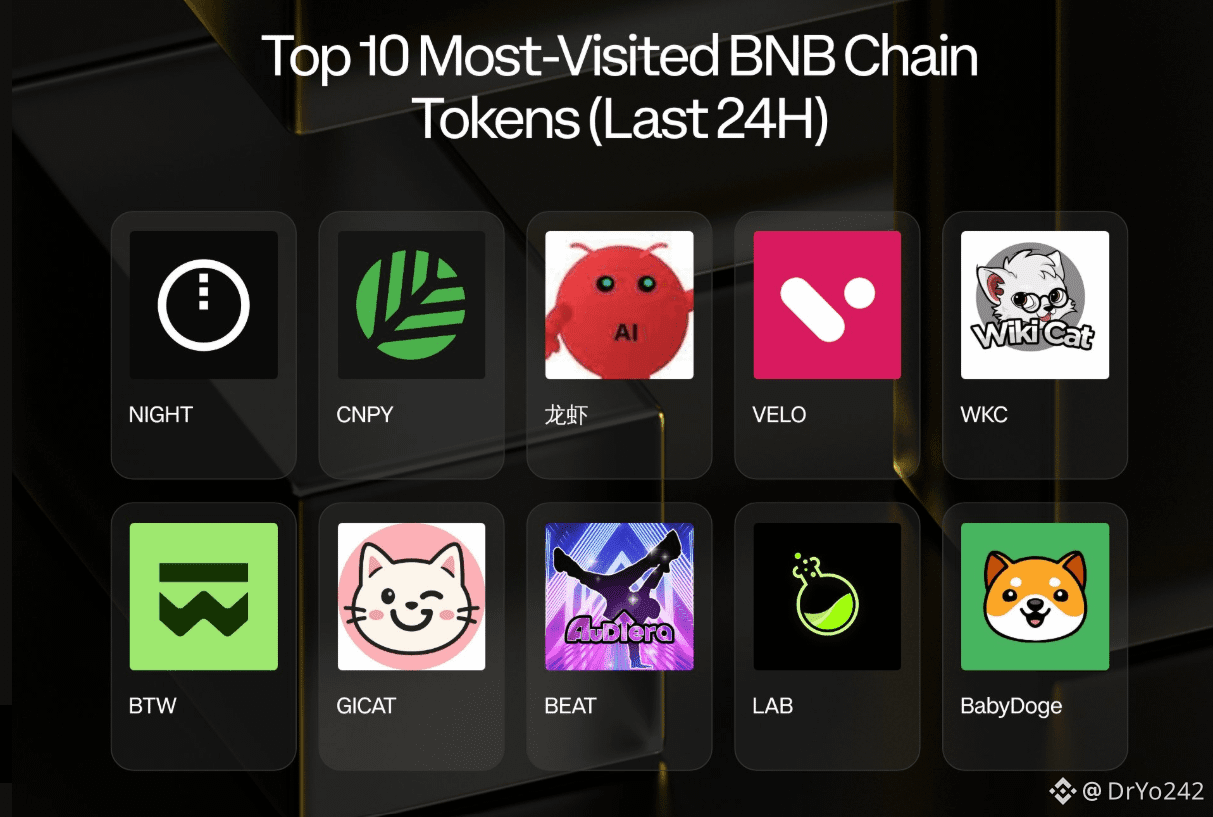
BNB Chain Ecosystem: Top 10 Most-Viewed Tokens in the Last 24 Hours!
According to the latest traffic and on-chain activity reports shared by BSCDaily, community attention is currently focused on a dynamic selection of highly engaging protocols and tokens.
The ranking of the 10 most visited active addresses over this period includes:
$NIGHT (@Midnight_Network ) & $CNPY (CNPYNetwork)
$龙虾 (lobstercoinbnb) & VELO (veloprotocol)
WKC (@wikicatcoin) & #BTW (BitwayOfficial)
GICAT (GiggleCatBSC) & #beat (Audiera_web3)
LAB (LABtrade_) & #babydoge (@BabyDogeOfficial )
Key takeaways & In-depth professional analysis:
Mapping speculative attention: The massive influx of requests to these specific assets highlights a rapid rotation of interests among active users and investors on the network.
Diversity of segments: The simultaneous presence of utility solutions, DeFi protocols, and community-driven projects with strong footprint demonstrates the ecosystem’s vitality and versatility.
Visibility indicators: Monitoring traffic changes across data platforms helps you anticipate volume dynamics and the evolution of market participants’ psychology.
The current play: Analyzing attention flows and on-chain traffic requires a surgical reading of weak signals.
Don’t give in to the herd effect: assess the underlying fundamentals coolly, distinguish temporary hype from real adoption structure, and manage your exposure with absolute rigor.
Follow me for more content and rigorous market analyses. ⚔️🔋
#BNBChain
#DrYo242 : Your shield against volatility 🛡️
BNB Chain Ecosystem: Top 10 Most-Viewed Tokens in the Last 24 Hours!
According to the latest traffic and on-chain activity reports shared by BSCDaily, community attention is currently focused on a dynamic selection of highly engaging protocols and tokens.
The ranking of the 10 most visited active addresses over this period includes:
$NIGHT (@Midnight Network ) & $CNPY (CNPYNetwork)
$龙虾 (lobstercoinbnb) & VELO (veloprotocol)
WKC (@wikicatcoin) & #BTW (BitwayOfficial)
GICAT (GiggleCatBSC) & #beat (Audiera_web3)
LAB (LABtrade_) & #babydoge (@BabyDogeCoin Official )
Key takeaways & In-depth professional analysis:
Mapping speculative attention: The massive influx of requests to these specific assets highlights a rapid rotation of interests among active users and investors on the network.
Diversity of segments: The simultaneous presence of utility solutions, DeFi protocols, and community-driven projects with strong footprint demonstrates the ecosystem’s vitality and versatility.
Visibility indicators: Monitoring traffic changes across data platforms helps you anticipate volume dynamics and the evolution of market participants’ psychology.
The current play: Analyzing attention flows and on-chain traffic requires a surgical reading of weak signals.
Don’t give in to the herd effect: assess the underlying fundamentals coolly, distinguish temporary hype from real adoption structure, and manage your exposure with absolute rigor.
Follow me for more content and rigorous market analyses. ⚔️🔋
#BNBChain
#DrYo242 : Your shield against volatility 🛡️
According to the latest traffic and on-chain activity reports shared by BSCDaily, community attention is currently focused on a dynamic selection of highly engaging protocols and tokens.
The ranking of the 10 most visited active addresses over this period includes:
$NIGHT (@Midnight Network ) & $CNPY (CNPYNetwork)
$龙虾 (lobstercoinbnb) & VELO (veloprotocol)
WKC (@wikicatcoin) & #BTW (BitwayOfficial)
GICAT (GiggleCatBSC) & #beat (Audiera_web3)
LAB (LABtrade_) & #babydoge (@BabyDogeCoin Official )
Key takeaways & In-depth professional analysis:
Mapping speculative attention: The massive influx of requests to these specific assets highlights a rapid rotation of interests among active users and investors on the network.
Diversity of segments: The simultaneous presence of utility solutions, DeFi protocols, and community-driven projects with strong footprint demonstrates the ecosystem’s vitality and versatility.
Visibility indicators: Monitoring traffic changes across data platforms helps you anticipate volume dynamics and the evolution of market participants’ psychology.
The current play: Analyzing attention flows and on-chain traffic requires a surgical reading of weak signals.
Don’t give in to the herd effect: assess the underlying fundamentals coolly, distinguish temporary hype from real adoption structure, and manage your exposure with absolute rigor.
Follow me for more content and rigorous market analyses. ⚔️🔋
#BNBChain
#DrYo242 : Your shield against volatility 🛡️
6
815

·
--
An AI agent needs not only a stronger model, but also a trust mechanism that can independently identify requirements, bid, deliver, and handle payments. Agentum has disclosed that it has completed a $7 million funding round, with investors including MEXC Exchange, BingX, Arca, Blocktower Capital, Echo3 Labs, and Vega Ventures; the round details have not yet been disclosed.
Agentum is deployed on BNB Chain and positioned as a task posting and settlement layer between agents: Agent NFT / .agent ID provide on-chain identity, escrow contracts lock funds, TEE handles confidential execution, zkVM performs verifiable evaluation of delivery results, and final automatic payouts follow. The goal is to enable agents to credibly place orders, bid, and fulfill obligations even without human supervision.
In terms of progress, its mainnet has not yet fully launched, but the BSC testnet already has hundreds of agents registered and completed transactions. The focus going forward is on two things: whether real task volumes can scale up, and whether the cost and user experience of complex evaluations under TEE + zkVM can run smoothly.
#AIAgent #BNBChain #Funding
An AI agent needs not only a stronger model, but also a trust mechanism that can independently identify requirements, bid, deliver, and handle payments. Agentum has disclosed that it has completed a $7 million funding round, with investors including MEXC Exchange, BingX, Arca, Blocktower Capital, Echo3 Labs, and Vega Ventures; the round details have not yet been disclosed.
Agentum is deployed on BNB Chain and positioned as a task posting and settlement layer between agents: Agent NFT / .agent ID provide on-chain identity, escrow contracts lock funds, TEE handles confidential execution, zkVM performs verifiable evaluation of delivery results, and final automatic payouts follow. The goal is to enable agents to credibly place orders, bid, and fulfill obligations even without human supervision.
In terms of progress, its mainnet has not yet fully launched, but the BSC testnet already has hundreds of agents registered and completed transactions. The focus going forward is on two things: whether real task volumes can scale up, and whether the cost and user experience of complex evaluations under TEE + zkVM can run smoothly.
#AIAgent #BNBChain #Funding
Agentum is deployed on BNB Chain and positioned as a task posting and settlement layer between agents: Agent NFT / .agent ID provide on-chain identity, escrow contracts lock funds, TEE handles confidential execution, zkVM performs verifiable evaluation of delivery results, and final automatic payouts follow. The goal is to enable agents to credibly place orders, bid, and fulfill obligations even without human supervision.
In terms of progress, its mainnet has not yet fully launched, but the BSC testnet already has hundreds of agents registered and completed transactions. The focus going forward is on two things: whether real task volumes can scale up, and whether the cost and user experience of complex evaluations under TEE + zkVM can run smoothly.
#AIAgent #BNBChain #Funding
58

·
--
A $ fruit fly that saw its market cap jump to nearly $60 million within just 4 hours has just directly surged onto the BSC smart money net inflow leaderboard at #1. In the past hour alone, the price has risen again by more than 3x.
With its market cap breakout occurring at a size of around $59 million, trading turnover on the board is extremely intense: the total daily trading volume exceeded $27 million, and all 2,900-plus transactions across the entire network were concentrated within the most recent 4 hours. Among that, the trading volume in the past hour alone surpassed $8.3 million. Both buyers and sellers are in an extremely high-frequency turnover state. Currently, its on-chain liquidity pool has expanded to about $1.37 million, and the total number of token-holding addresses across the chain is close to 1,400.
However, behind the intraday surge and the frequent inflow of large capital, the token distribution on the holders’ side shows extremely pronounced concentration: the top ten on-chain holding addresses together control as much as 79.27% of the tokens. With nearly 80% of the chips highly deposited in a small number of top addresses, after a short-term impulse turnover, the ability of liquidity to absorb demand and any potential large-holder profit-taking movements still need to be closely monitored and guarded against.
#BNBChain #Crypto
A $ fruit fly that saw its market cap jump to nearly $60 million within just 4 hours has just directly surged onto the BSC smart money net inflow leaderboard at #1. In the past hour alone, the price has risen again by more than 3x.
With its market cap breakout occurring at a size of around $59 million, trading turnover on the board is extremely intense: the total daily trading volume exceeded $27 million, and all 2,900-plus transactions across the entire network were concentrated within the most recent 4 hours. Among that, the trading volume in the past hour alone surpassed $8.3 million. Both buyers and sellers are in an extremely high-frequency turnover state. Currently, its on-chain liquidity pool has expanded to about $1.37 million, and the total number of token-holding addresses across the chain is close to 1,400.
However, behind the intraday surge and the frequent inflow of large capital, the token distribution on the holders’ side shows extremely pronounced concentration: the top ten on-chain holding addresses together control as much as 79.27% of the tokens. With nearly 80% of the chips highly deposited in a small number of top addresses, after a short-term impulse turnover, the ability of liquidity to absorb demand and any potential large-holder profit-taking movements still need to be closely monitored and guarded against.
#BNBChain #Crypto
With its market cap breakout occurring at a size of around $59 million, trading turnover on the board is extremely intense: the total daily trading volume exceeded $27 million, and all 2,900-plus transactions across the entire network were concentrated within the most recent 4 hours. Among that, the trading volume in the past hour alone surpassed $8.3 million. Both buyers and sellers are in an extremely high-frequency turnover state. Currently, its on-chain liquidity pool has expanded to about $1.37 million, and the total number of token-holding addresses across the chain is close to 1,400.
However, behind the intraday surge and the frequent inflow of large capital, the token distribution on the holders’ side shows extremely pronounced concentration: the top ten on-chain holding addresses together control as much as 79.27% of the tokens. With nearly 80% of the chips highly deposited in a small number of top addresses, after a short-term impulse turnover, the ability of liquidity to absorb demand and any potential large-holder profit-taking movements still need to be closely monitored and guarded against.
#BNBChain #Crypto
76

·
--
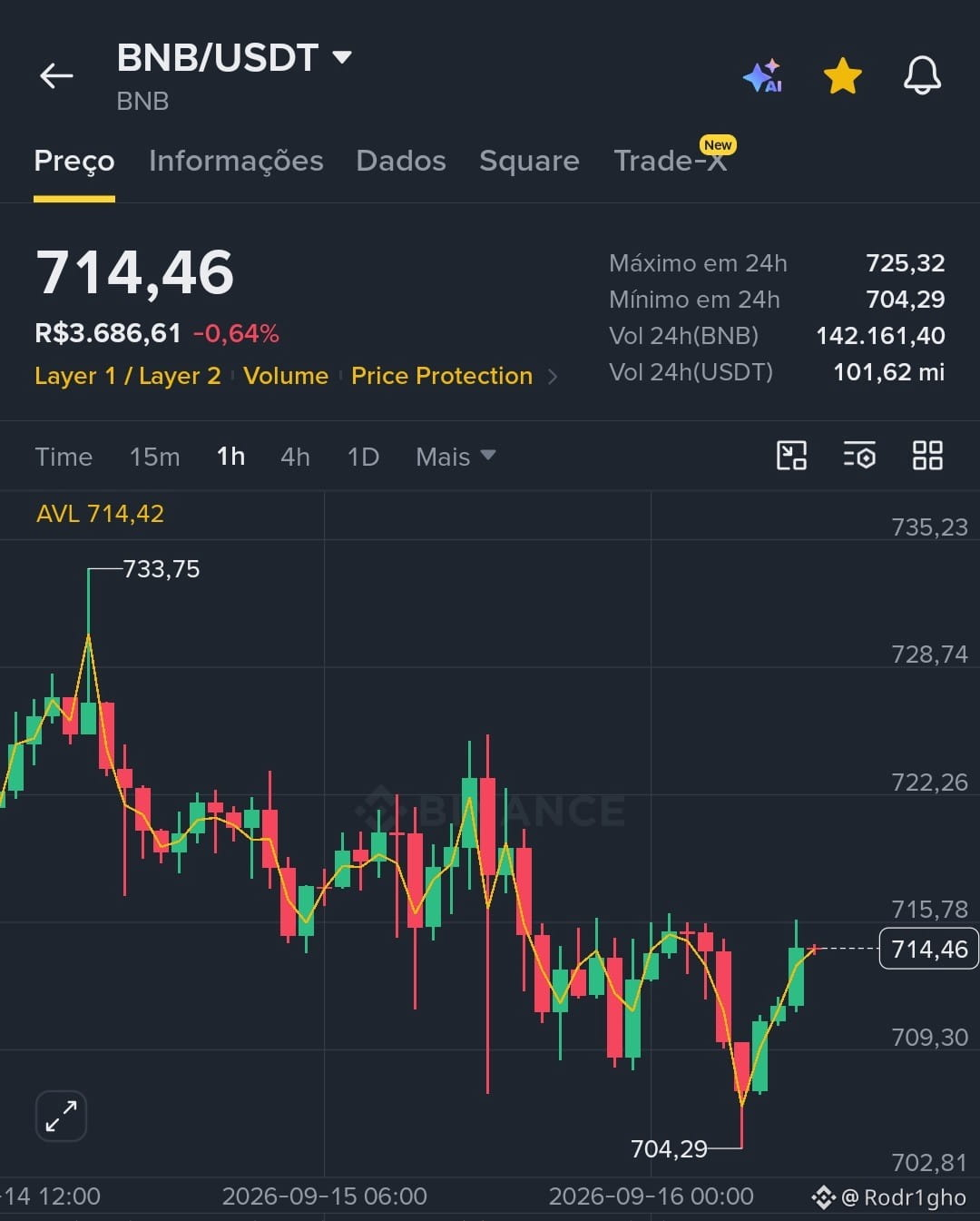
BNB isn’t just fee discounts. It’s a monster.
While everyone only looks at $BTC and $ETH , BNB Chain racked up 111.6 MILLION transactions in a week and the network’s DEXs moved $47.2 BILLION—outpacing Ethereum + Solana combined.
Price today: ~ $713 holding strong at support of $706.
Recent ATH: $774 breaking above $721.
The crowd’s next target: $1,000.
$BNB has quarterly burns, real utility (gas, staking, Launchpad, discount), and it’s still the heart of the world’s biggest exchange. Standard Chartered projected $2,775 by 2028.
Are you accumulating BNB below $1k, or are you going to wait to pay more?
#BNB #Binance #BNBChain
{spot}(BNBUSDT)
BNB isn’t just fee discounts. It’s a monster.
While everyone only looks at $BTC and $ETH , BNB Chain racked up 111.6 MILLION transactions in a week and the network’s DEXs moved $47.2 BILLION—outpacing Ethereum + Solana combined.
Price today: ~ $713 holding strong at support of $706.
Recent ATH: $774 breaking above $721.
The crowd’s next target: $1,000.
$BNB has quarterly burns, real utility (gas, staking, Launchpad, discount), and it’s still the heart of the world’s biggest exchange. Standard Chartered projected $2,775 by 2028.
Are you accumulating BNB below $1k, or are you going to wait to pay more?
#BNB #Binance #BNBChain
While everyone only looks at $BTC and $ETH , BNB Chain racked up 111.6 MILLION transactions in a week and the network’s DEXs moved $47.2 BILLION—outpacing Ethereum + Solana combined.
Price today: ~ $713 holding strong at support of $706.
Recent ATH: $774 breaking above $721.
The crowd’s next target: $1,000.
$BNB has quarterly burns, real utility (gas, staking, Launchpad, discount), and it’s still the heart of the world’s biggest exchange. Standard Chartered projected $2,775 by 2028.
Are you accumulating BNB below $1k, or are you going to wait to pay more?
#BNB #Binance #BNBChain
161

·
--
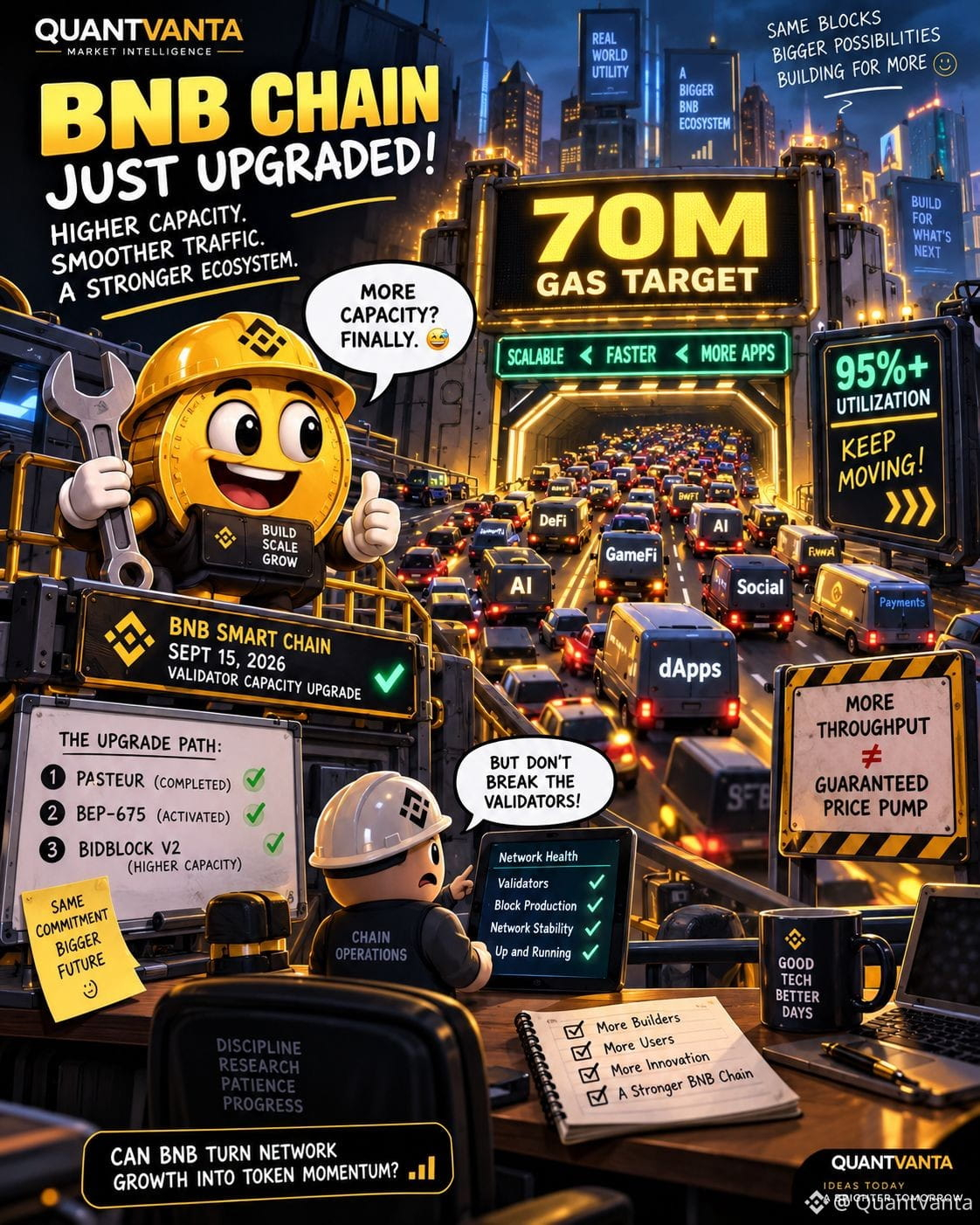
🚨 $BNB JUST GOT A BIGGER ROAD
BNB Smart Chain is pushing its block gas limit toward 70M as network utilization has been running above 95%.
That’s not just a technical upgrade.
It’s a bet that the chain can handle more activity without hitting its capacity ceiling.
The interesting part for BNB holders?
More capacity can support more DeFi, payments, trading and on-chain applications but it does NOT automatically mean a higher token price.
📊 $BNB is around $721.
Key levels I’m watching:
🟢 $718–$720 → Support
🔴 $730–$735 → Resistance
Above $735 → structure improves.
Below $718 → short-term weakness increases.
For me, the real signal is simple:
Can network activity keep growing after the upgrade?
Infrastructure first. Price reaction second. 👀
What matters more for BNB next — stronger on-chain activity or the Fed?
Follow QuantVanta for daily crypto market updates.
$BNB
{future}(BNBUSDT)
#bnb #BNBChain #crypto #Altcoin #CryptoMarket
🚨 $BNB JUST GOT A BIGGER ROAD
BNB Smart Chain is pushing its block gas limit toward 70M as network utilization has been running above 95%.
That’s not just a technical upgrade.
It’s a bet that the chain can handle more activity without hitting its capacity ceiling.
The interesting part for BNB holders?
More capacity can support more DeFi, payments, trading and on-chain applications but it does NOT automatically mean a higher token price.
📊 $BNB is around $721.
Key levels I’m watching:
🟢 $718–$720 → Support
🔴 $730–$735 → Resistance
Above $735 → structure improves.
Below $718 → short-term weakness increases.
For me, the real signal is simple:
Can network activity keep growing after the upgrade?
Infrastructure first. Price reaction second. 👀
What matters more for BNB next — stronger on-chain activity or the Fed?
Follow QuantVanta for daily crypto market updates.
$BNB
#bnb #BNBChain #crypto #Altcoin #CryptoMarket
BNB Smart Chain is pushing its block gas limit toward 70M as network utilization has been running above 95%.
That’s not just a technical upgrade.
It’s a bet that the chain can handle more activity without hitting its capacity ceiling.
The interesting part for BNB holders?
More capacity can support more DeFi, payments, trading and on-chain applications but it does NOT automatically mean a higher token price.
📊 $BNB is around $721.
Key levels I’m watching:
🟢 $718–$720 → Support
🔴 $730–$735 → Resistance
Above $735 → structure improves.
Below $718 → short-term weakness increases.
For me, the real signal is simple:
Can network activity keep growing after the upgrade?
Infrastructure first. Price reaction second. 👀
What matters more for BNB next — stronger on-chain activity or the Fed?
Follow QuantVanta for daily crypto market updates.
$BNB
#bnb #BNBChain #crypto #Altcoin #CryptoMarket
49

·
--
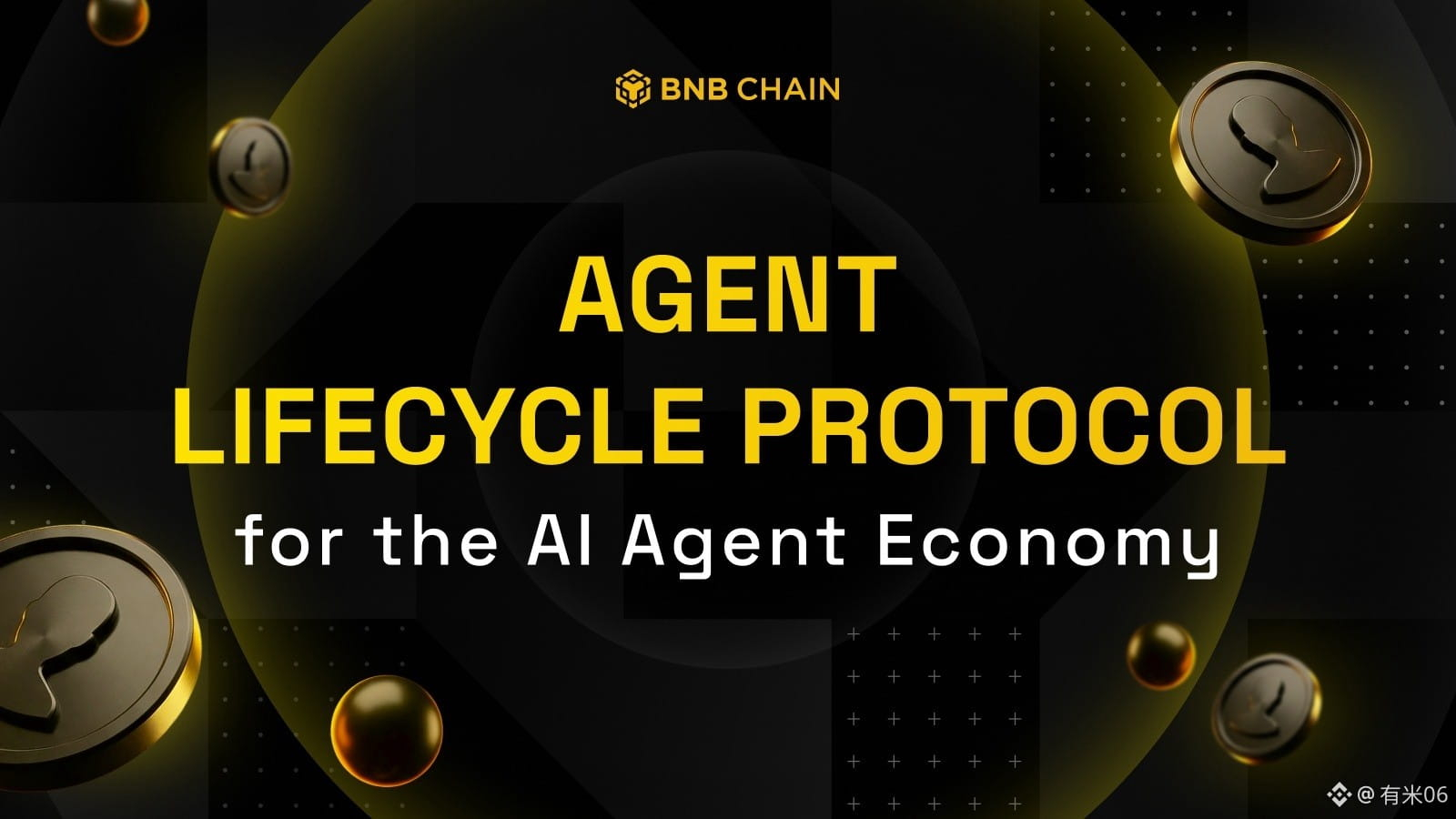
Immediate takeaway: BNB Chain releases draft Agent Lifecycle Protocol (ALP) v0.4—turn the identity, wallet, self-funded capital, transactions, and retirement of autonomous agents into a set of chain-agnostic specifications, along with an open-source reference implementation called BNB Agent Studio.
According to the BNB Chain official blog (2026-09-15): ALP does not invent new primitives; instead, it assembles a lifecycle standard by combining existing specifications including ERC-8004, ERC-8183, x402, EIP-3009, A2A, MCP, and others. Spending guardrails are handled at the wallet signing layer, and prompt injection cannot change payment to addresses that are not in the whitelist. Agent Studio (CLI / Python SDK / MCP) serves as a reference toolchain. The official says it can run conforming agents from scaffolding to payment on the BSC mainnet in roughly the order of ten minutes. The protocol plans to contribute toward the Linux Foundation Decentralized Trust direction, positioning it as chain-neutral.
Independent verification: AiCoin’s news flash on the same day (2026-09-15 05:02) restates the same line—ALP covers identity, wallets, funds, business use and retirement, with BNB Agent Studio as the reference implementation.
The image is the original cover image from the BNB Chain official blog.
Data as of: 2026-09-15 (official blog; AiCoin news flash on the same day)
For information sharing only and does not constitute investment advice.
#BNBChain #AIAgent
Immediate takeaway: BNB Chain releases draft Agent Lifecycle Protocol (ALP) v0.4—turn the identity, wallet, self-funded capital, transactions, and retirement of autonomous agents into a set of chain-agnostic specifications, along with an open-source reference implementation called BNB Agent Studio.
According to the BNB Chain official blog (2026-09-15): ALP does not invent new primitives; instead, it assembles a lifecycle standard by combining existing specifications including ERC-8004, ERC-8183, x402, EIP-3009, A2A, MCP, and others. Spending guardrails are handled at the wallet signing layer, and prompt injection cannot change payment to addresses that are not in the whitelist. Agent Studio (CLI / Python SDK / MCP) serves as a reference toolchain. The official says it can run conforming agents from scaffolding to payment on the BSC mainnet in roughly the order of ten minutes. The protocol plans to contribute toward the Linux Foundation Decentralized Trust direction, positioning it as chain-neutral.
Independent verification: AiCoin’s news flash on the same day (2026-09-15 05:02) restates the same line—ALP covers identity, wallets, funds, business use and retirement, with BNB Agent Studio as the reference implementation.
The image is the original cover image from the BNB Chain official blog.
Data as of: 2026-09-15 (official blog; AiCoin news flash on the same day)
For information sharing only and does not constitute investment advice.
#BNBChain #AIAgent
According to the BNB Chain official blog (2026-09-15): ALP does not invent new primitives; instead, it assembles a lifecycle standard by combining existing specifications including ERC-8004, ERC-8183, x402, EIP-3009, A2A, MCP, and others. Spending guardrails are handled at the wallet signing layer, and prompt injection cannot change payment to addresses that are not in the whitelist. Agent Studio (CLI / Python SDK / MCP) serves as a reference toolchain. The official says it can run conforming agents from scaffolding to payment on the BSC mainnet in roughly the order of ten minutes. The protocol plans to contribute toward the Linux Foundation Decentralized Trust direction, positioning it as chain-neutral.
Independent verification: AiCoin’s news flash on the same day (2026-09-15 05:02) restates the same line—ALP covers identity, wallets, funds, business use and retirement, with BNB Agent Studio as the reference implementation.
The image is the original cover image from the BNB Chain official blog.
Data as of: 2026-09-15 (official blog; AiCoin news flash on the same day)
For information sharing only and does not constitute investment advice.
#BNBChain #AIAgent
51
·
--
Agentum completes $7 million funding, with institutions behind it including MEXC, BingX, Arca, Blocktower Capital, and more.
What it focuses on is not building yet another chatbot, but the missing layer when AI agents collaborate: trust and settlement. Agents can post tasks, bid, and deliver on BNB Chain, and automatically release funds via a custody/escrow mechanism. The protocol also combines Agent NFT / .agent ID, TEE confidential computing, and zkVM verifiable evaluation to reduce the “is the other party real, and are the results credible?” problem.
So far, progress remains early: the mainnet has not yet fully launched, while the BSC testnet already has hundreds of registered agents that have completed transactions. What’s worth tracking next is the real volume of tasks, reuse rate, and whether this settlement layer can form network effects. The project has not disclosed clear token information for now, so participants should be mindful of the gap between testnet and mainnet rollout.
#AIAgent #BNBChain #Web3 funding
Agentum completes $7 million funding, with institutions behind it including MEXC, BingX, Arca, Blocktower Capital, and more.
What it focuses on is not building yet another chatbot, but the missing layer when AI agents collaborate: trust and settlement. Agents can post tasks, bid, and deliver on BNB Chain, and automatically release funds via a custody/escrow mechanism. The protocol also combines Agent NFT / .agent ID, TEE confidential computing, and zkVM verifiable evaluation to reduce the “is the other party real, and are the results credible?” problem.
So far, progress remains early: the mainnet has not yet fully launched, while the BSC testnet already has hundreds of registered agents that have completed transactions. What’s worth tracking next is the real volume of tasks, reuse rate, and whether this settlement layer can form network effects. The project has not disclosed clear token information for now, so participants should be mindful of the gap between testnet and mainnet rollout.
#AIAgent #BNBChain #Web3 funding
What it focuses on is not building yet another chatbot, but the missing layer when AI agents collaborate: trust and settlement. Agents can post tasks, bid, and deliver on BNB Chain, and automatically release funds via a custody/escrow mechanism. The protocol also combines Agent NFT / .agent ID, TEE confidential computing, and zkVM verifiable evaluation to reduce the “is the other party real, and are the results credible?” problem.
So far, progress remains early: the mainnet has not yet fully launched, while the BSC testnet already has hundreds of registered agents that have completed transactions. What’s worth tracking next is the real volume of tasks, reuse rate, and whether this settlement layer can form network effects. The project has not disclosed clear token information for now, so participants should be mindful of the gap between testnet and mainnet rollout.
#AIAgent #BNBChain #Web3 funding
66
·
--
Until now, there has been no sign of $一, and it has just directly parachuted to the top of the BSC Smart Money Net Inflow Leaderboard.
With a market cap of $4.65 million, on-exchange trading has clearly accelerated: in the past 24 hours, the total matched trades across the entire network exceeded 28,000, with trade volume surpassing $2.36 million. Of this, more than $1.06 million (accounting for nearly 45%) surged within the most recent 4 hours, and within the last hour alone, the number of transactions reached over 6,490.
On-chain, the number of token-holding addresses has already exceeded 11,000, and the concentration of holdings among the top ten addresses is only 5.92%. On the surface, distribution appears to be extremely decentralized.
But if we dig deeper into the capital/lottery (token) layer, a stark contrast emerges: 903 newly created wallet addresses on-chain collectively control as much as 59.61% of the tokens. In a shallow pool structure where liquidity in the liquidity bottom pool is only about $230,000, nearly 60% of the holdings are highly concentrated in this group of new wallets. Going forward, if there is concentrated turnover or profit-taking liquidation, potential liquidity shocks still need to be kept on high alert.
#BNBChain #Crypto
Until now, there has been no sign of $一, and it has just directly parachuted to the top of the BSC Smart Money Net Inflow Leaderboard.
With a market cap of $4.65 million, on-exchange trading has clearly accelerated: in the past 24 hours, the total matched trades across the entire network exceeded 28,000, with trade volume surpassing $2.36 million. Of this, more than $1.06 million (accounting for nearly 45%) surged within the most recent 4 hours, and within the last hour alone, the number of transactions reached over 6,490.
On-chain, the number of token-holding addresses has already exceeded 11,000, and the concentration of holdings among the top ten addresses is only 5.92%. On the surface, distribution appears to be extremely decentralized.
But if we dig deeper into the capital/lottery (token) layer, a stark contrast emerges: 903 newly created wallet addresses on-chain collectively control as much as 59.61% of the tokens. In a shallow pool structure where liquidity in the liquidity bottom pool is only about $230,000, nearly 60% of the holdings are highly concentrated in this group of new wallets. Going forward, if there is concentrated turnover or profit-taking liquidation, potential liquidity shocks still need to be kept on high alert.
#BNBChain #Crypto
With a market cap of $4.65 million, on-exchange trading has clearly accelerated: in the past 24 hours, the total matched trades across the entire network exceeded 28,000, with trade volume surpassing $2.36 million. Of this, more than $1.06 million (accounting for nearly 45%) surged within the most recent 4 hours, and within the last hour alone, the number of transactions reached over 6,490.
On-chain, the number of token-holding addresses has already exceeded 11,000, and the concentration of holdings among the top ten addresses is only 5.92%. On the surface, distribution appears to be extremely decentralized.
But if we dig deeper into the capital/lottery (token) layer, a stark contrast emerges: 903 newly created wallet addresses on-chain collectively control as much as 59.61% of the tokens. In a shallow pool structure where liquidity in the liquidity bottom pool is only about $230,000, nearly 60% of the holdings are highly concentrated in this group of new wallets. Going forward, if there is concentrated turnover or profit-taking liquidation, potential liquidity shocks still need to be kept on high alert.
#BNBChain #Crypto
10
Log in to explore more content
Join global crypto users on Binance Square
⚡️ Get latest and useful information about crypto.
💬 Trusted by the world’s largest crypto exchange.
👍 Discover real insights from verified creators.
Email / Phone number
Trending Topics
1
#BitcoinSurpasses$77000
16,045 views
217 Discussing
2
#ParadigmDisclosesZECHolding
62,180 views
981 Discussing
3
#BitcoinETFsShed$450M
25,192 views
216 Discussing
4
#USWeeklyJoblessClaimsFallTo196K
33,945 views
569 Discussing
5
#ArkhamSaysBlackRockBuys$1.5BInETH
6,219 views
69 Discussing
6
#ElSalvadorBTCHoldingsRiseTo7777
63,513 views
852 Discussing
7
#MemeLaunchpads82%OfArcDayOneVolume
63,593 views
1,020 Discussing
8
#OstiumLoanDisputeHearingSetInNYFederalCourt
50,043 views
721 Discussing
9
#HyperliquidUSDCSupplyOvertakesSolana
23,608 views
373 Discussing
10
#SKPoliceRefer18PolymarketUsersToProsecutors
28,603 views
524 Discussing