
#11699
11699
36 views
3 Discussing
Hot
Latest

·
--
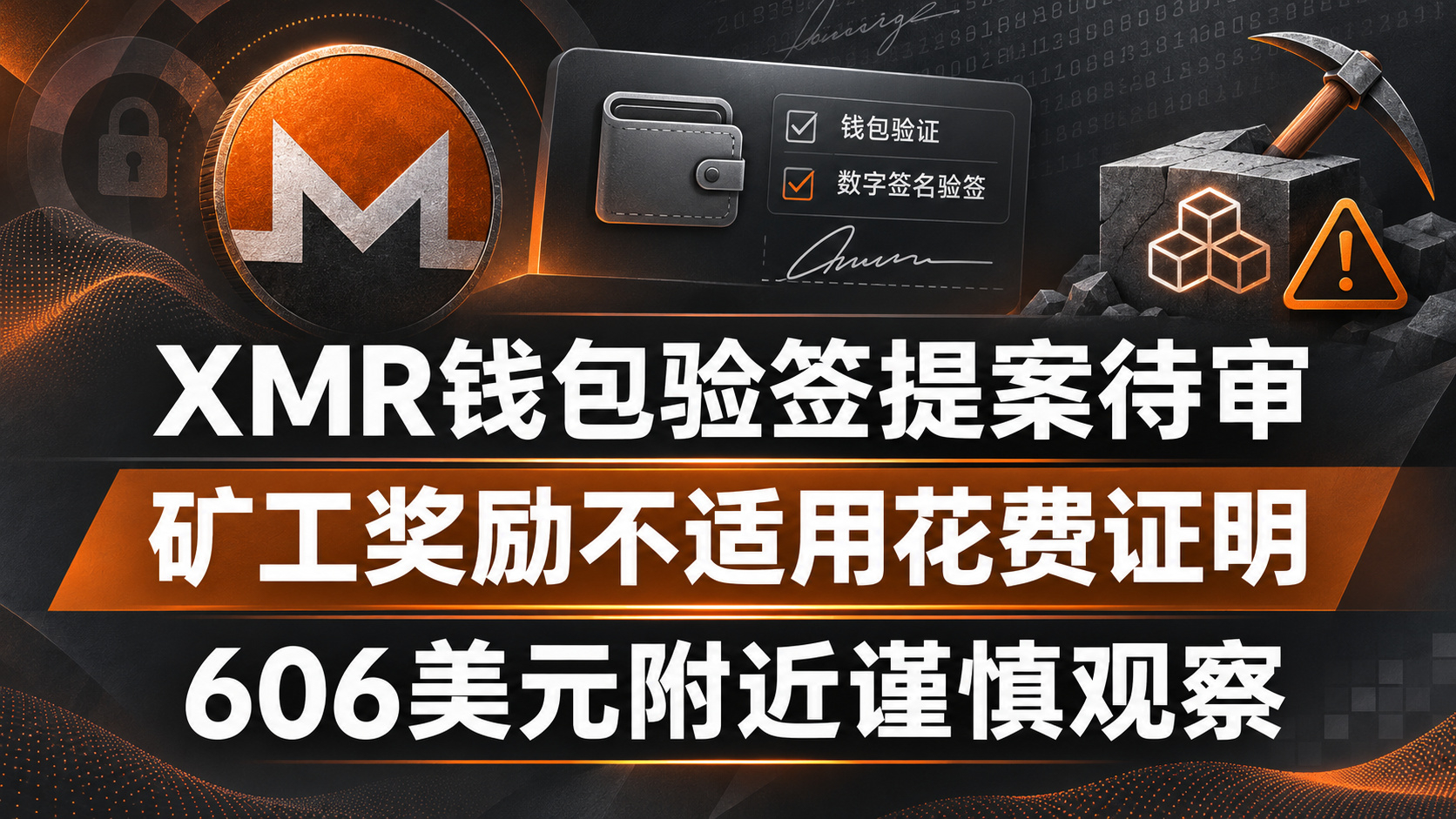
XMR wallet signature-verification proposal under review|Miner reward transactions are not applicable to spend proofs|Watching key levels near $606
My view is that wallet verification details matter, but code changes should not be hyped as bullish. On November 8, a PR titled #11699 appeared in the official Monero code repository. It concerns wallet2’s check_spend_proof: the proposal requires an immediate error if the transaction being checked is a miner reward transaction; it also returns a clear error when the transaction has no key inputs. I checked the PR page and the specific file diff: the changes are limited to the wallet signature-verification path, and the PR is still Open and has not been merged. The latest official release currently listed on the Monero website is still version 0.18.5.4, released on October 16. So this is not a new feature already in effect for all users, much less a change to mainnet consensus or mining rules.
Why is this worth watching? Monero’s privacy transaction verification works differently from that of public blockchains. The official wallet documentation describes check_spend_proof as using a signature to prove that a spend occurred. Merchants or reconciliation systems may rely on this kind of result to assess payment evidence. Miner reward transactions do not have the input structure of ordinary spending transactions, so they should be explicitly rejected by the spend-proof verification process. If this small change passes review and is released, its value would be to reduce misuse of the interface and ambiguous errors; it would not increase on-chain usage, nor would it justify claiming that an exploited vulnerability exists, funds have been stolen, or payments are broadly failing. The purposes of different proof types should also be kept distinct: a transaction proof does not automatically mean the received funds are immediately spendable.
The market is not assigning this PR any obvious standalone price impact at the moment. XMR/USD on Kraken is around $606.39, with today’s open at $600.02, high at $606.88, and low at $594.44; the rolling 24-hour high is $614.74 and the low is $593.66. The current price is about 1% above today’s open, but there is no evidence that the gain was caused by the wallet PR. Binance Square’s Trending Topics currently focus on resumed withdrawals, exchange regulation, and Keplr social-login wallet security; XMR does not appear among Most Searched. I would not claim the Keplr incident affected Monero, nor would I borrow unrelated hashtags. ETF, macroeconomic, and exchange-security news will continue to influence overall risk appetite; a single engineering proposal cannot outweigh those factors.
I’m watching to see whether $606.88 holds, then looking toward the rolling high at $614.74. To the downside, $594.44 is today’s low; a break below it would invalidate the short-term recovery. The project thesis would be invalidated if the PR is closed, changes to a different verification approach, or reviewers conclude that it does not improve the targeted error handling. The price view, meanwhile, needs confirmation from trading activity and a successful retest. If there is only a sudden spike without follow-through, discipline matters more than the story.
If I were trading this myself: I would stay out for now, remain directionally neutral, and hold 0% of my portfolio in the position. Only if spot XMR breaks above $606.88 and holds that level on a retest, while overall risk conditions have not deteriorated significantly, would I consider a small long position of no more than 0.25% of total capital, without leverage. The first target is $614.74, where I would sell half; I’d hold the remainder toward $622 and move the stop loss to around breakeven. If the price falls back below $602 after entry, I’d reduce the position; if it breaks below $594.44, I’d close the entire position at a stop loss. I’d also close any remaining position if there is no continuation in volume within a day, or if the PR receives a negative review. If the conditions are not met, this remains just a plan—not a recorded trade or profit.
Sources: Official Monero PR #11699 and file diff, official wallet RPC documentation, official release announcement, Kraken XMR/USD market data, and Binance Square trending topics.
#XMR
This is only my personal market commentary and is not investment advice.
10
·
--
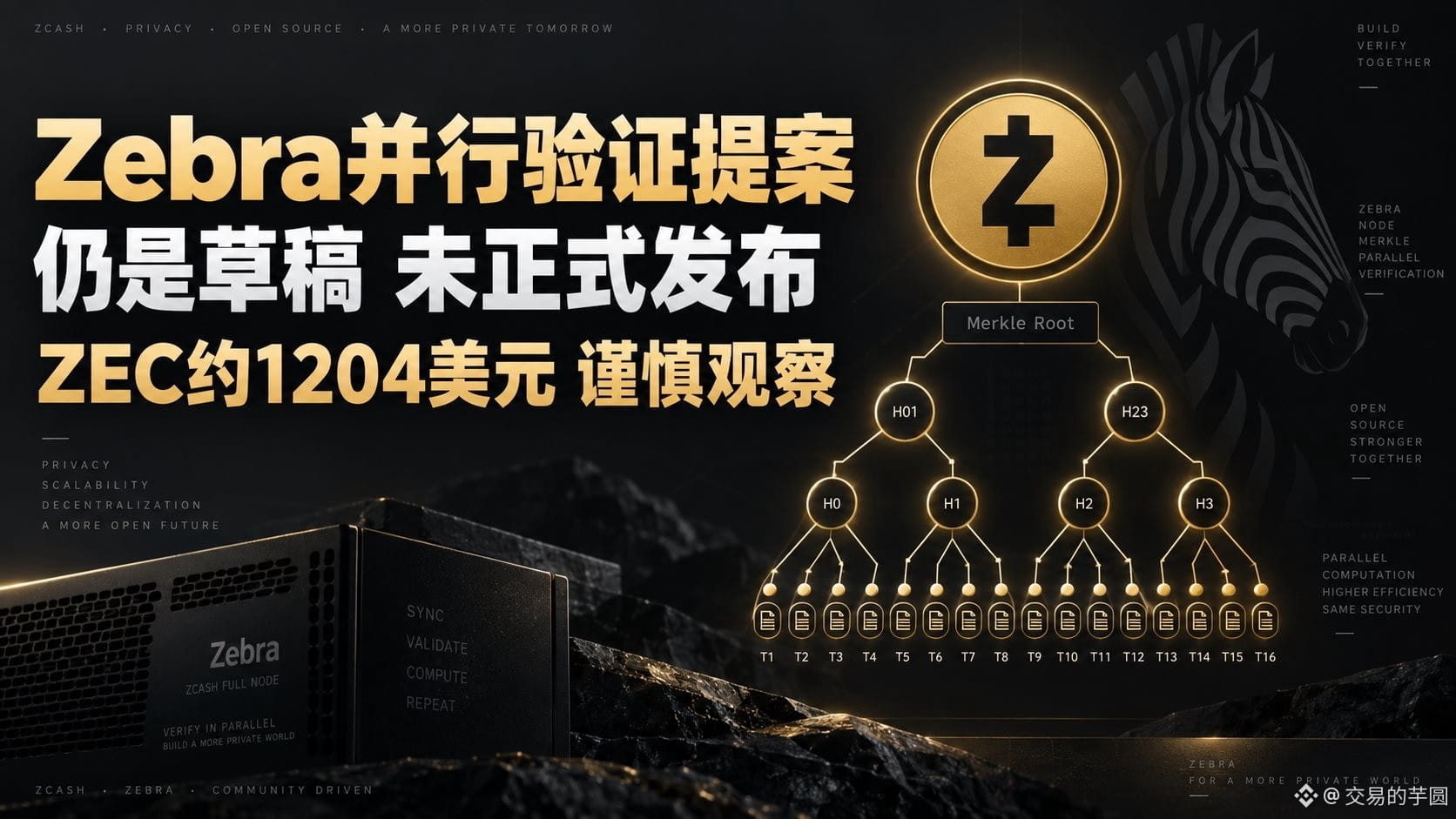
Zebra parallel verification proposal is still a draft | ZEC around $1,204 | I only look at measured results, not bullish code news
Let me make my position clear upfront: performance optimizations in Zcash node software are worth tracking, but they are not an immediate bullish catalyst for spot ZEC. On October 12, PR #11699 appeared in the Zcash Foundation’s Zebra repository, and the page is marked Draft. The proposal parallelizes part of the hashing used to calculate the block authorization data root: for blocks with at least 16 transactions, it first calculates each transaction’s digest in parallel, then forms the Merkle root in the original order; smaller blocks continue to use the serial path. On the developer’s 32-thread machine, the 1,024-transaction example went from 7.57 milliseconds to 611 microseconds, and the 16-transaction example went from 119 microseconds to 39 microseconds. Note that these are localized benchmarks provided by the PR’s author—not network-wide transactions per second, nor guaranteed performance improvements already released in an official version.
Why does this matter for ZEC? A full node has to verify blocks it receives, so reducing CPU time for one task could theoretically ease the burden of syncing or processing. But real-world node performance is also constrained by network propagation, disk writes, proof verification, and hardware configuration. Even if this particular calculation gets faster, that does not directly imply higher block capacity, lower fees, or increased demand for shielded transactions. More importantly, the parallel path must produce exactly the same root as the old path across different transaction counts, versions, and edge cases; the PR description lists tests comparing parallel and serial results. Only after review, merging, an official release, and further measurements in real-world environments can we discuss its actual contribution to lowering the barrier to running a node. As of today, the status is still Draft, so saying “the Zcash performance upgrade is live” would be an overinterpretation.
The market does not automatically price in a code draft. Kraken’s ZEC/USD quote was around $1,203.88 at the time of writing, with an intraday open of $1,275.69, a high of $1,348.03, and a low of $1,186.08; the price was well below the open and near the intraday low. These quotes alone cannot confirm which news caused the decline, but at least there is no evidence of strong buying driven by the performance proposal. My risk reference points are the low near $1,186 and the $1,200 round-number level. For a rebound, I’d look first at $1,240, then at the $1,276 opening reference. If the price breaks below $1,186 and cannot quickly recover, my short-term stabilization thesis is invalidated. If it gets above $1,240 but remains capped by $1,276, that would be a recovery, not a trend reversal.
If I were trading it myself, I would stay out for now—not catch a falling knife because of a draft PR, and definitely not use leverage. Only if ZEC regains and holds $1,240, then retests and confirms that level, would I consider a test long using a spot position of no more than 0.8% of my total capital. Entry: around $1,240–$1,250; first target: $1,276, where I’d take half off; the rest would target $1,310. If the rebound fades and the price falls below $1,220, I’d stop out and close the position immediately. If it first breaks below $1,186, I’d scrap the original long plan and stay out until a new price structure forms. If the PR is ultimately not merged or the test results cannot be reproduced, I’d also withdraw the assumption that node efficiency will improve. If the plan’s conditions are not met, there is no trade or profit. Sources: Zcash Foundation Zebra repository PR #11699 and Kraken ZEC/USD live quotes. #ZEC
This is only my personal market observation and does not constitute investment advice.
39
Log in to explore more content
Join global crypto users on Binance Square
⚡️ Get latest and useful information about crypto.
💬 Trusted by the world’s largest crypto exchange.
👍 Discover real insights from verified creators.
Email / Phone number
Trending Topics
1
#NvidiaInvestigatesAfterHuang’sAffairApology
23,251 views
310 Discussing
2
#BitcoinFiveWeeklyLosses
38,223 views
747 Discussing
3
#AIChipSlumpNasdaq
22,293 views
419 Discussing
4
#SouthKoreaSupremeCourtClarifiesVirtualAssetSeizureRules
0 views
1 Discussing
5
#EthereumSpotETFsPost$365MWeeklyOutflow
970 views
27 Discussing
6
#GalxeToIntegrateIntoGravityGraduallyCloseQuest
25 views
7 Discussing
7
#TradFiForBeginners
261,026 views
2,325 Discussing
8
#KeplrAdvisesSocialLoginUsersToTransferAssets
89,355 views
671 Discussing
9
#TetherPlans€28.8MForJuventusCapitalIncrease
60,571 views
491 Discussing
10
#JobsReportRaisesHikeOdds
1M views
4,678 Discussing