
Interface News reporter | Song Jianan
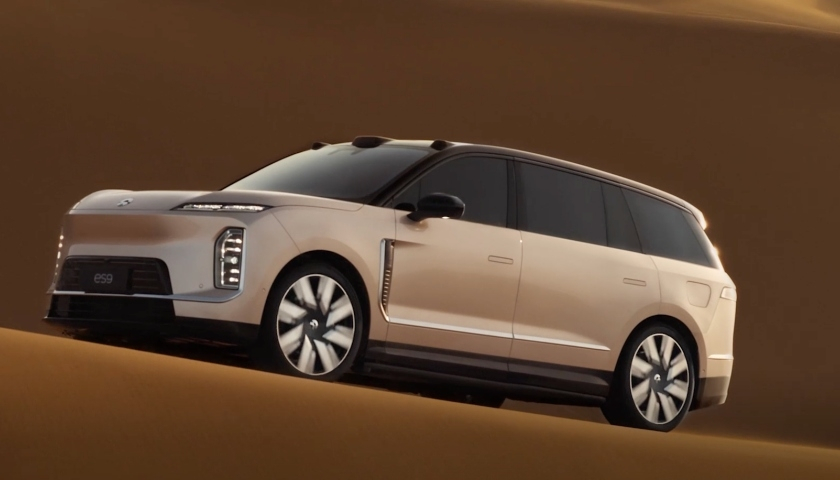
Recently, some owners of the NIO ES9 have reported that after using a commercial high-pressure water gun to rinse off grime on the front bumper at close range, the vehicle’s outer surface paint peeled off in sheets, exposing the underlying base material; the painted layers separated and peeled off, which sparked widespread public questioning about whether this model’s coating process has defects.
On June 29, NIO’s official account @NIO Xiao La Ba posted on Weibo (a small reminder about using a high-pressure water gun to wash cars). It said that in response to feedback from owners regarding the vehicle paint issues on the NIO ES9 caused by the high-pressure water gun being used too close during cleaning, the company attaches great importance to the matter. It has already contacted the owner in question, conducted extensive communication, and provided a comprehensive, professional on-site Q&A and explanation regarding the situation.
NIO stated that the upper injection-molded part on the front bumper of the NIO ES9 is produced by a leading supplier in the industry. This manufacturer supplies to multiple luxury brands during the same period and follows a unified, very high standard quality system, ensuring stable and reliable component quality.
Regarding paint thickness, NIO says it has developed stricter internal corporate implementation requirements based on the ISO 2808 international standard. For paint film adhesion, it conducts rigorous testing according to ISO 16925:2021. In the coating development process, it also references international standards such as ISO 16925 and SAE J400-2002 to fully verify the coating’s scratch resistance and performance under physical impact.
NIO also states that during production, each month the company performs 100% scribing inspections and high-pressure water rinsing tests for each model and each color to ensure stable mass-production quality. Each year, it also conducts comprehensive type tests on all models, such as aging tests, to verify the coating’s long-term weather resistance and reliability.
NIO emphasizes that when high-pressure cleaning equipment operates outside the factory-specified limits, its jetting force is strong enough to cause irreversible damage to the vehicle’s paint. Take a common commercial high-pressure water gun, for example: when the distance from the nozzle is reduced to within 200 mm, the actual impact force can increase by several times compared with the 500 mm distance. The localized pressure is very likely to exceed 100 bar, and the shearing force at the edge of the water stream is comparable to the force of a hard scraper.
Under such extreme conditions, the high-pressure water jets force their way into the microscopic interfaces between the paint film and the plastic substrate, breaking the chemical bonding between the primer and the substrate. At the same time, if the water stream’s instantaneous turbulence carries tiny sand particles, it can also cause “sandblasting”-type abrasion to the clearcoat layer, leading to a sharp drop in gloss level.
The specific damage types include paint film peeling off in sheets, micro-cracks in the clearcoat, delamination at the coating interface, and secondary swelling caused by water ingress at the edges of trim pieces. These damages are not due to material quality defects, but are physical damages resulting from operating outside the designed operating conditions. The related car-washing safety precautions mentioned above are already widely accepted consensus in the industry.
The NIO ES9 (owner’s manual) states that it is recommended to keep the spraying distance above 500 mm, control the pressure below 100 bar, set the maximum temperature to 60°C, and keep the nozzle as perpendicular as possible to the car surface during rinsing. If operation exceeds the specified conditions, it may cause damage to components or allow water to enter the vehicle interior.
“As a warm reminder to all car owners: when washing your car, please follow maintenance standards, use a wide-angle misting nozzle, maintain a sufficient spraying distance, and avoid directly blasting plastic exterior parts such as bumpers from close range to better protect your car’s paint surface.” NIO said.
ES9 is the core model in NIO’s current product matrix that carries both the sales-volume task and the brand-upward mission. It is positioned as a six-seat technology executive flagship pure-electric SUV, officially launching for delivery on May 27, 2026. The vehicle uses a full-domain 900V high-voltage platform, a Tianxing fully active suspension, and self-developed technologies such as the NX9031 five-nanometer automotive intelligent driving chip.
Judging by NIO’s overall product layout logic, the ET9 sedan is responsible for showcasing the brand’s technical ceiling, with a flagship, high-end image as its main goal; the ES9, meanwhile, plays a strategic role in technology implementation and driving volume sales and revenue. The ES9 is offered in an Executive Luxury Edition, an Executive Signature Edition, and a Horizon Special Edition. Its starting purchase price for the whole vehicle is RMB 498,000. It uses a BaaS battery leasing model for purchase, with a starting price of RMB 390,000. It directly competes with flagship models priced similarly, such as Ideal L9 and AITO M9.
Worth noting is that executives from Ideal and NIO previously exchanged remarks about suspension technology issues for the L9 and ES9 models in a sort of face-off from a distance. At the NIO ES9 launch event at the end of May, NIO CEO Li Bin focused on explaining the 48V integrated fully active suspension, saying that this architecture is a generation ahead of a separate 800V suspension. Although he did not name competitors, the industry generally points to Ideal’s L9 suspension solution.
On June 5, a video released by Ideal Auto comparing the real-world test performance of the Ideal new L9 Livis against the NIO ES9 on a wavy road sparked widespread discussion. In the video, the Ideal L9 maintains a steady driving posture, while the ES9’s body pitch and bounce are much more pronounced. But hours after the video was uploaded, it was taken down.
That day, NIO’s Vice President Ma Lin responded on a social platform, writing: “In the video released by Ideal Auto’s official mini program, NIO ES9 in standard mode and in the ultra-soft mode with very weak working intensity of the fully active suspension shake at the same speed or even faster. This does not match our product settings. We expect Ideal’s official company to verify the authenticity of the video, clarify the source of the video, and explain the environment and suspension settings during the test.”
Soon after, Tang Jingfa, the first product line president of Ideal Auto responsible for the L9 Livis model, posted a message saying: “Regarding the L9 Livis and a certain car’s chassis comparison video that everyone has been discussing, it’s something we internally want to learn seriously—why did Ge (Li Bin) talk at the launch event about how 48V is more advanced than 800V?”
In fact, competition among the “9-series” models has already entered an intense phase. Previously, Li Bin said publicly: “This year’s market competition is indeed very fierce, but NIO will not change its pricing strategy because of that.” According to Li Bin, ES9 order performance exceeded expectations, especially the share of orders for the Signature Edition and the Horizon Special Edition, which was “far beyond internal expectations.”
NIO’s overall deliveries are currently on an upward trend. Data released by the company earlier this month shows that in May, NIO delivered 37,705 new vehicles, up 62.3% year over year and up 28.4% month over month. Of these, the NIO brand delivered 20,013 new vehicles, up 50.8%; the 乐道 (LeDuo) brand delivered 12,029 new vehicles, up 91.5%; and the Firefly (Xiaoyinghuo/Firefly) brand delivered 5,663 new vehicles, up 53.9%. In the first five months of this year, NIO delivered a total of 150,526 new vehicles, up 68.7% year over year.