


#7 🟡 Humans are inherently social. As social beings, we need to communicate, share, and collaborate with each other to thrive. Our ability to work together through communities is largely responsible for our civilization as we know it today.
Community plays an important role in the growth and development of an individual, from family units to religious affiliations, social clubs, and organizations.
Communities foster a sense of belonging and unity, the kind that allows us to bring together our unique ability to achieve a shared goal.
For communities to function, there is a need for structure and some sort of governance to drive consensus, communication, and decision-making.
As a society, we have created different forms and approaches to building and sustaining communities. In most cases, these structures operate in a top-down authority model; somebody has to oversee everyone else.
The consequences of too much power in the hands of a few questions trust and transparency. These issues become heated conversations.
But, what if we don’t need a boss to get things done? What if we can collaborate and build lasting solutions without layers of authority?
Meet, DAOs. This is a new form of structuring communities through technology that facilitates collaboration on equal footing. No bosses, just contributors.
In this article, we will explore how this form of organization works and why you should care.
Community and governance are at the heart of human interactions. Community fosters a sense of belonging, whereas governance promotes order in decision-making.
The prevalence of blockchain technology and mainstream adoption of blockchain solutions is creating a paradigm shift in the structure and functioning of communities, traditional organizations, and firms through DAOs.
DAOs — Decentralized Autonomous Organizations are redefining community and networking, governance, and equity ownership through decentralization and tokenomics.
The concept and actualization of DAOs provide a solution to the bottleneck framework of decision-making in traditional organizations through community governance.
By creating better models for this, DAOs are fast becoming mainstream. There is a belief that in the nearest future, all organizations, firms, and institutions will transform into DAOs and have their operations and functions carried out and documented on the blockchain.
The fundamental ethos of blockchain technology and every other innovation founded on blockchain technology is distributed control, permissionless participation, and equity ownership.
It is based on fostering peer-to-peer interactions online without the need for intermediaries and ceding full ownership and control of data to the creators while incentivizing contributions and efforts on a merited basis through financial and social recognition.
At the core of decentralized solutions using blockchain are communities.
Moses Samuel.
DAOs allow the possibility of distributed control and permissionless participation through communities. It connects individuals with common interests and goals and rewards creators for their contribution to the growth of the DAO.
What is this buzzword all about? Why are DAOs becoming mainstream? Do we need to adopt the mechanism and governance structure of DAOs? Let’s talk about it.
To understand the meaning of this acronym, we must dissect and explain the individual letters;
D- Decentralized. This simply means distributed control and authority. There is no central authority to create rules or regulate the activities of the participants.
However, the system is built with a feedback loop model that incentivizes participants for their positive contributions. This feedback loop enforces moral conduct and pro-community behavior, which leads to economic and financial growth, as well as utility value.
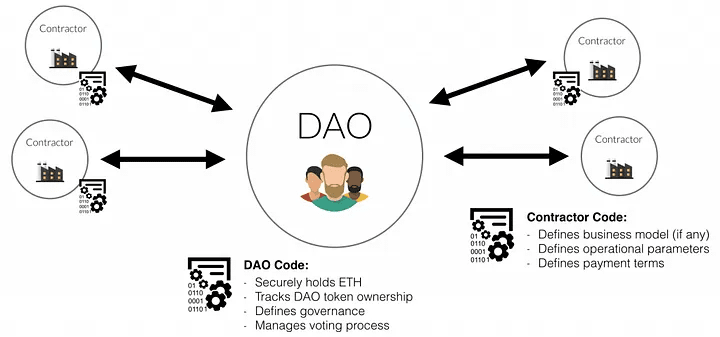
A- Autonomous. This means having the freedom to control itself. With DAOs, community governance comes into play. Members of the DAO govern the organization via agreed rules coded in smart contracts.
O- Organization. An entity of people connected by a common interest, purpose, or goal. Individuals join DAOs because the goals of the DAO align with their personal interests.
What keeps them is their desire to participate in something that aligns with their interest, with or without financial benefits in the interim.
In traditional organizations, the presence of a centralized authority ensures a hierarchical, organized structure. Having decentralized authority and distributed control questions the structure of a DAO.
This brings us to the big question: How is the structure of a DAO maintained?
Deep Dives - DAO structure: Governance, Tokenomics, Smart Contracts.
Smart Contracts
The smart contract itself is self-executing. It automates workflow and triggers succeeding actions when predetermined conditions are met. The smart contract contains the rules that govern the activities of the DAO participants. It is stored on the blockchain.
By encoding these rules in a smart contract and storing them on a blockchain, they become transparent, trustworthy, and insusceptible to third-party manipulation for personal interest.
Participants of the DAO agree on the rules that govern the DAO. They do this by voting through a consensus. The eligibility of their voting rights and the power thereof are proven by tokenomics.
DAO Governance and Tokenomics
Governance is needed for orderliness in decision-making. For every group of individuals connected by a common interest or goal, governance structures must be put in place to check the behavior of each participant, generate profit for the organization, and regulate and manage the activities of the organization.
Being a community-led entity, DAOs implore community governance strategies. Every participant of the DAO partakes in decision-making.
Each proposal or decision directly affects each participant (socially, economically, or financially), hence, they will be inclined to make pro-community choices.
Final decisions are made through voting processes. Voting is done with tokens to influence rules, make new decisions, adopt new profit-based strategies or refine existing ones.
Each participant of a DAO must hold a certain amount of the native token of the DAO. The higher the number of tokens a participant holds, the higher the voting power.
The distribution and utility of the native token of a DAO is mentioned and regulated by its tokenomics.
Tokenomics
Tokenomics is a combination of two English words, “token” and “economy”. This simply means the economy of tokens- total supply of tokens, creation of demand of these tokens, and their utility.
Tokenomics also addresses the allocation of these tokens and oversees treasury activities.
However, most tokens function as governance tokens. They are mainly used for the voting process. Only token holders have the right to participate in voting and decision-making.
However, the whole concept of tokenomics questions the decentralization of DAOs. What happens when an individual or a particular group of people hold higher amounts than necessary?
In such cases, it is easier for such people to manipulate decision-making for personal interest. Are there rules or measures put in place to limit the number of tokens one can acquire?
One necessary factor is to ensure the circulation of tokens. To retain a truly decentralized structure, certain measures must be implemented to ensure that there are limits to the amount of tokens an individual or group of persons can hold and that tokens are in constant circulation.
This can be achieved by creating a flywheel of network expansion and growth. A limited supply of tokens enforces its scarcity. The utility value creates the demand for these tokens. Increased demand of scarce tokens and great utility value attached to growth and network expansion improve the circulation of these tokens.
Increased regulation of token circulation ensures that tokens are not only bought from decentralized exchanges and held by angel investors, but are utilized by the participants of the DAO to create economic, social, and financial value..