
Just My Real Life
7 Beiträge

Just My Real Life
Melden
Nutzer blockieren
30/06/1990
Trade eröffnen
Hochfrequenz-Trader
2.2 Jahre
3 Following
254 Follower
971 Like gegeben
Beiträge
Portfolio
·
--
Bullisch
Übersetzung ansehen
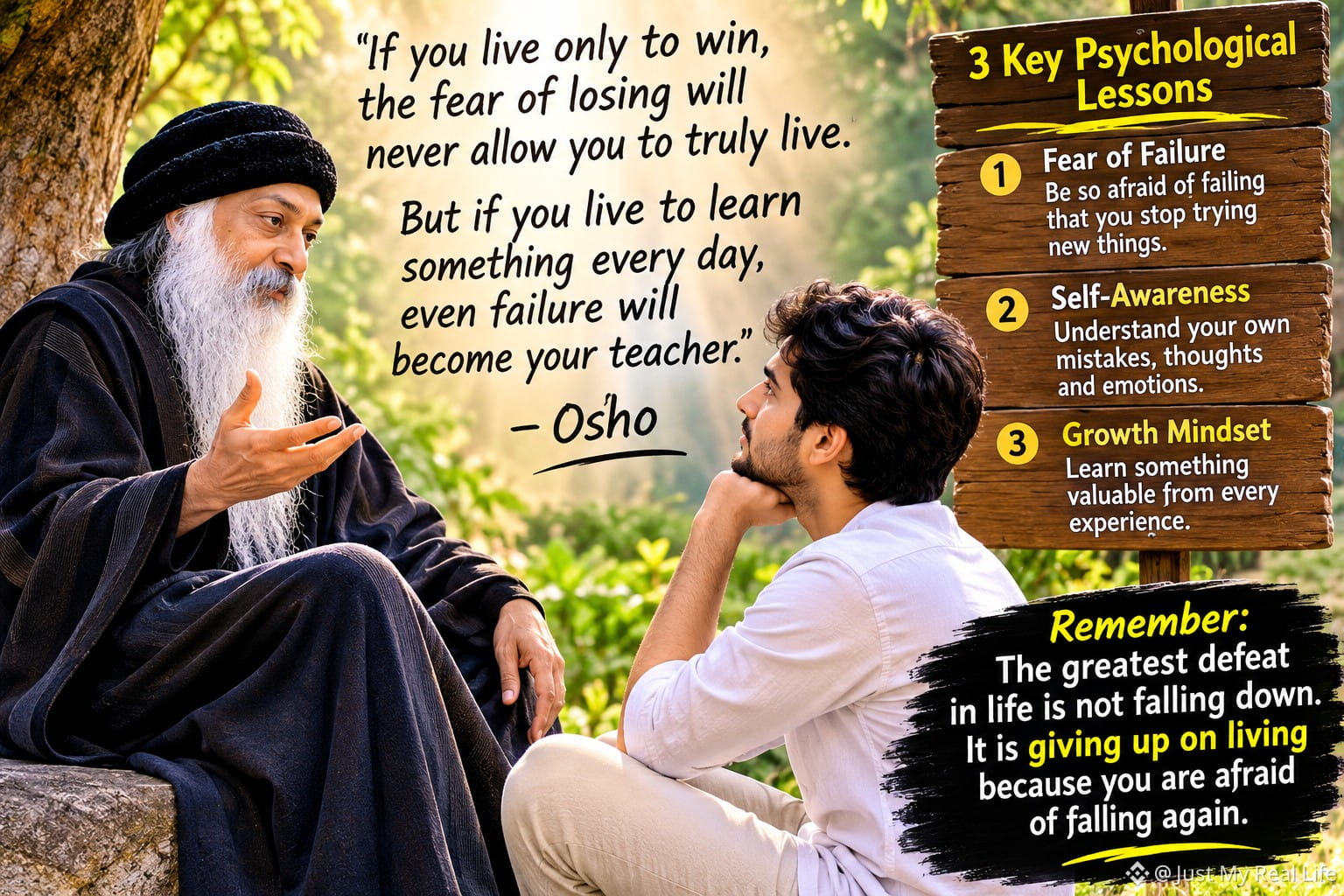
🧘 From Osho’s Perspective – The Fear of Failure and the True Meaning of Life
Psychology of Failure – An Osho-Inspired Story
One day, a young man came to Osho and asked:
"Osho, I have failed many times in life. Every time I start something new, a fear enters my mind: What if I fail again? Now I am even afraid to try. What should I do?"
Osho smiled and said:
"Your problem is not that you fail. Your problem is that you have made your failure your identity."
The young man asked, "But when someone fails again and again, their confidence breaks. How can they move forward?"
Osho replied:
"When a small child learns to walk, how many times does he fall? Does he stop walking because he thinks he was born to fall?
No! He gets up again because he enjoys learning to walk more than he fears falling.
But as you grow older, you connect everything with winning and losing. You no longer do things to learn; you do them to prove your success to others."
The young man became silent.
Osho continued:
"Life is not a competition. You are not behind anyone. Your journey belongs to you.
Do not be afraid of failure. But do not keep repeating the same mistakes without understanding them.
Let go of what has already happened. Live what is in front of you with complete awareness."
🧠 Three Psychological Lessons
1. Fear of Failure: Being so afraid of failing that you stop trying new things.
2. Self-Awareness: Understanding your own mistakes, thoughts, and emotions.
3. Growth Mindset: Learning something valuable from every experience.
❤️ The Final Message
"If you live only to win, the fear of losing will never allow you to truly live.
But if you live to learn something every day, even failure will become your teacher."
Remember: The greatest defeat in life is not falling down. It is giving up on living because you are afraid of falling again.
An inspirational fictional story inspired by Osho's philosophy, not an actual quotation from his teachings.
$AGT
{future}(AGTUSDT)
$JCT
{future}(JCTUSDT)
$INIT
{spot}(INITUSDT)
🧘 From Osho’s Perspective – The Fear of Failure and the True Meaning of Life
Psychology of Failure – An Osho-Inspired Story
One day, a young man came to Osho and asked:
"Osho, I have failed many times in life. Every time I start something new, a fear enters my mind: What if I fail again? Now I am even afraid to try. What should I do?"
Osho smiled and said:
"Your problem is not that you fail. Your problem is that you have made your failure your identity."
The young man asked, "But when someone fails again and again, their confidence breaks. How can they move forward?"
Osho replied:
"When a small child learns to walk, how many times does he fall? Does he stop walking because he thinks he was born to fall?
No! He gets up again because he enjoys learning to walk more than he fears falling.
But as you grow older, you connect everything with winning and losing. You no longer do things to learn; you do them to prove your success to others."
The young man became silent.
Osho continued:
"Life is not a competition. You are not behind anyone. Your journey belongs to you.
Do not be afraid of failure. But do not keep repeating the same mistakes without understanding them.
Let go of what has already happened. Live what is in front of you with complete awareness."
🧠 Three Psychological Lessons
1. Fear of Failure: Being so afraid of failing that you stop trying new things.
2. Self-Awareness: Understanding your own mistakes, thoughts, and emotions.
3. Growth Mindset: Learning something valuable from every experience.
❤️ The Final Message
"If you live only to win, the fear of losing will never allow you to truly live.
But if you live to learn something every day, even failure will become your teacher."
Remember: The greatest defeat in life is not falling down. It is giving up on living because you are afraid of falling again.
An inspirational fictional story inspired by Osho's philosophy, not an actual quotation from his teachings.
$AGT
$JCT
$INIT
52
Übersetzung ansehen
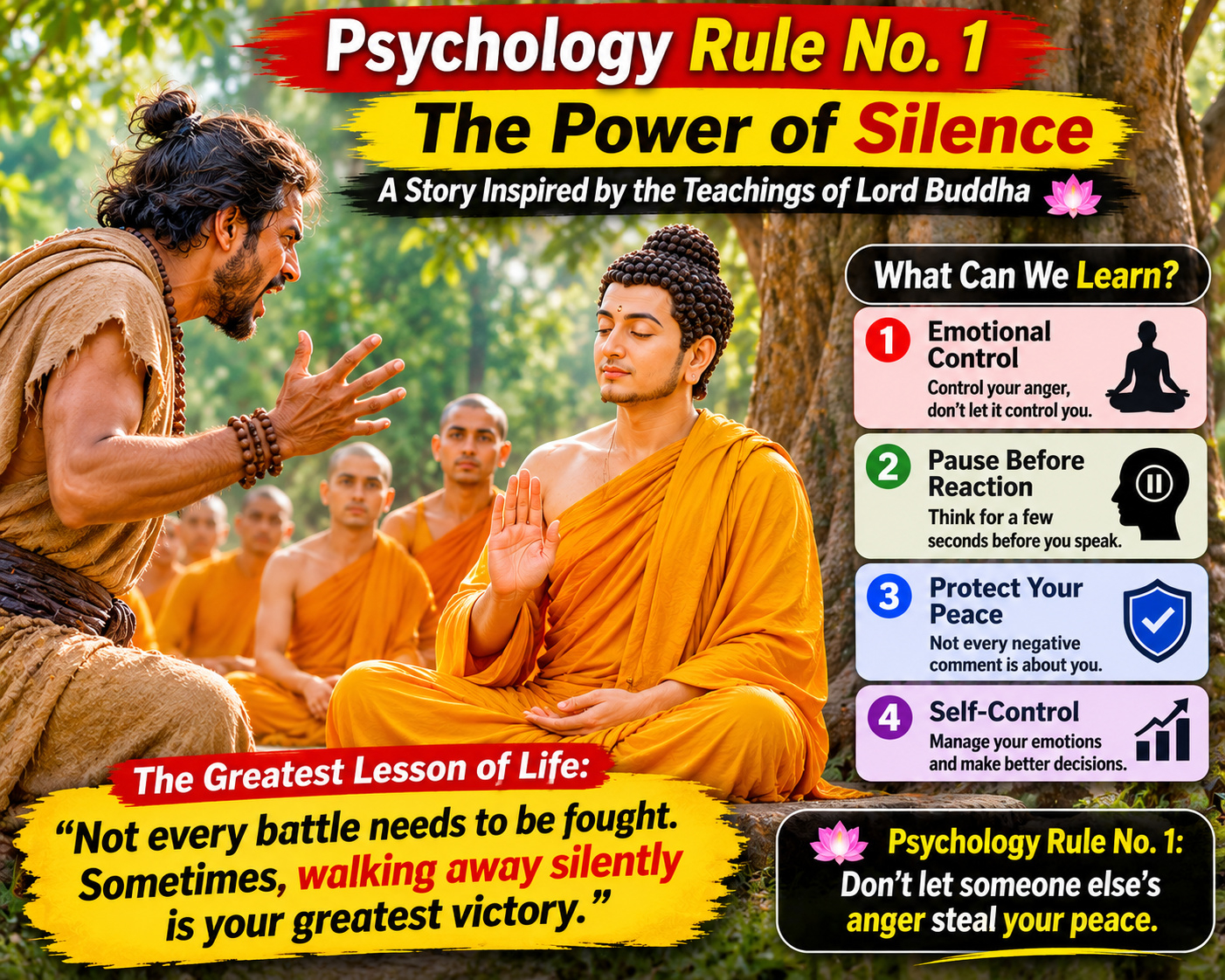
🧠 Psychology Rule No. 1 – The Power of Silence
A Story Inspired by the Teachings of Lord Buddha 🪷
One day, Lord Buddha was sitting under a tree with his disciples. Suddenly, a man approached him. He was extremely angry.
He said to Buddha, "You go around teaching people about wisdom, but I don't think you know anything yourself."
The man continued insulting Buddha, but Buddha remained completely calm. He neither became angry nor responded.
After some time, the man became tired and asked, "Why are you still silent even after I have insulted you so much? Don't you feel angry?"
Lord Buddha smiled and replied:
"If someone gives you fire and you hold it in your hands, whose hands will burn first? Yours. In the same way, if you accept someone else's anger and keep it inside your mind, the first thing you will lose is your own peace."
Then Buddha explained:
"Other people's words can hurt you deeply only when you allow them to control your mind."
🧠 Psychology Explanation – What Can We Learn?
This story teaches us four important psychological lessons.
1. Emotional Control: Learn to control your anger instead of letting your anger control you.
2. Pause Before Reaction: Don't respond immediately to everything. Take a few seconds to think before speaking.
3. Protect Your Peace: You don't have to take every negative comment personally.
4. Self-Control: A person who can manage their emotions can make better decisions in difficult situations.
❤️ The Greatest Lesson of Life
"Not every battle needs to be fought. Sometimes, walking away silently is your greatest victory."
🪷 Psychology Rule No. 1: Don't let someone else's anger steal your peace.
This is an inspirational story based on the teachings of Lord Buddha, not a verified historical event.
$JCT
{future}(JCTUSDT)
$ON
{future}(ONUSDT)
🧠 Psychology Rule No. 1 – The Power of Silence
A Story Inspired by the Teachings of Lord Buddha 🪷
One day, Lord Buddha was sitting under a tree with his disciples. Suddenly, a man approached him. He was extremely angry.
He said to Buddha, "You go around teaching people about wisdom, but I don't think you know anything yourself."
The man continued insulting Buddha, but Buddha remained completely calm. He neither became angry nor responded.
After some time, the man became tired and asked, "Why are you still silent even after I have insulted you so much? Don't you feel angry?"
Lord Buddha smiled and replied:
"If someone gives you fire and you hold it in your hands, whose hands will burn first? Yours. In the same way, if you accept someone else's anger and keep it inside your mind, the first thing you will lose is your own peace."
Then Buddha explained:
"Other people's words can hurt you deeply only when you allow them to control your mind."
🧠 Psychology Explanation – What Can We Learn?
This story teaches us four important psychological lessons.
1. Emotional Control: Learn to control your anger instead of letting your anger control you.
2. Pause Before Reaction: Don't respond immediately to everything. Take a few seconds to think before speaking.
3. Protect Your Peace: You don't have to take every negative comment personally.
4. Self-Control: A person who can manage their emotions can make better decisions in difficult situations.
❤️ The Greatest Lesson of Life
"Not every battle needs to be fought. Sometimes, walking away silently is your greatest victory."
🪷 Psychology Rule No. 1: Don't let someone else's anger steal your peace.
This is an inspirational story based on the teachings of Lord Buddha, not a verified historical event.
$JCT
$ON
11
·
--
Bullisch
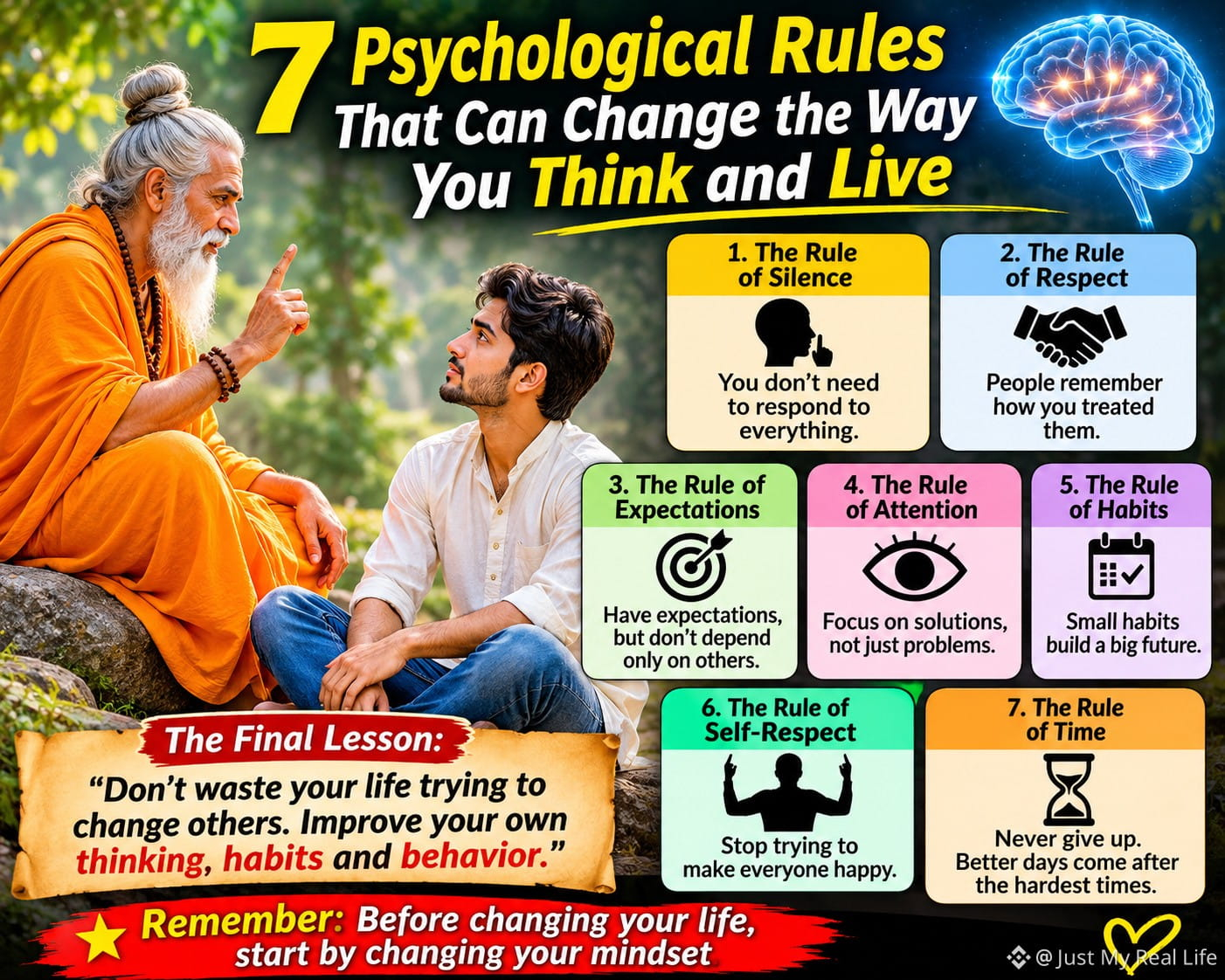
🧠 7 psychologische Regeln, die deine Denk- und Lebensweise verändern können
Es war einmal ein Schüler, der seinen Lehrer fragte: „Wie kann ich Menschen verstehen und im Leben stärker werden?“
Der Lehrer lächelte und sagte: „Wenn du Menschen verstehen willst, musst du zuerst lernen, den menschlichen Geist zu verstehen. Denn dein Geist kann zu deinem größten Feind oder zu deiner größten Stärke werden.“
Dann erklärte er 7 wichtige psychologische Lektionen.
1. Die Regel des Schweigens 🤫
Du musst nicht auf alles reagieren. Manchmal kann dein Schweigen mehr sagen als tausend Worte.
2. Die Regel des Respekts ❤️
Menschen vergessen vielleicht, wie viel Geld du hast, aber sie vergessen selten, wie du sie behandelt hast.
3. Die Regel der Erwartungen
Je mehr Erwartungen du an jemanden hast, desto enttäuschter kannst du sein. Habe Erwartungen, aber lege dein Glück niemals vollständig in die Hände eines anderen.
4. Die Regel der Aufmerksamkeit 👀
Dein Geist schenkt allem Bedeutung, worauf du dich konzentrierst. Statt dich nur auf Probleme zu konzentrieren, bring dir bei, nach Lösungen zu suchen.
5. Die Regel der Gewohnheiten
Dein Leben verändert sich nicht an einem einzigen Tag. Deine kleinen täglichen Gewohnheiten gestalten nach und nach deine Zukunft.
6. Die Regel der Selbstachtung
Hör auf, es allen recht machen zu wollen. Wenn du lernst, dich selbst zu respektieren, lernst du auch, Respektlosigkeit von anderen nicht hinzunehmen.
7. Die Regel der Zeit ⏳
Menschen und Umstände können sich in schwierigen Zeiten verändern. Gib niemals auf, wenn das Leben herausfordernd wird. Manchmal beginnt das beste Kapitel deines Lebens nach der schwersten Zeit.
Der Lehrer schloss mit einer letzten Lektion:
„Verschwende nicht dein ganzes Leben damit, andere ändern zu wollen. Verbessere dein eigenes Denken, deine Gewohnheiten und dein Verhalten. An dem Tag, an dem du lernst, deinen Geist zu verstehen und zu kontrollieren, hast du den halben Kampf des Lebens gewonnen.“
❤️ Denk daran: Bevor du dein Leben veränderst, beginne damit, deine Denkweise zu ändern.
Dies sind vom Fachgebiet der Psychologie inspirierte Lebenslektionen und keine sieben offiziell anerkannten wissenschaftlichen Gesetze.
$JCT
{future}(JCTUSDT)
$ON
{future}(ONUSDT)
$INIT
{spot}(INITUSDT)
🧠 7 psychologische Regeln, die deine Denk- und Lebensweise verändern können
Es war einmal ein Schüler, der seinen Lehrer fragte: „Wie kann ich Menschen verstehen und im Leben stärker werden?“
Der Lehrer lächelte und sagte: „Wenn du Menschen verstehen willst, musst du zuerst lernen, den menschlichen Geist zu verstehen. Denn dein Geist kann zu deinem größten Feind oder zu deiner größten Stärke werden.“
Dann erklärte er 7 wichtige psychologische Lektionen.
1. Die Regel des Schweigens 🤫
Du musst nicht auf alles reagieren. Manchmal kann dein Schweigen mehr sagen als tausend Worte.
2. Die Regel des Respekts ❤️
Menschen vergessen vielleicht, wie viel Geld du hast, aber sie vergessen selten, wie du sie behandelt hast.
3. Die Regel der Erwartungen
Je mehr Erwartungen du an jemanden hast, desto enttäuschter kannst du sein. Habe Erwartungen, aber lege dein Glück niemals vollständig in die Hände eines anderen.
4. Die Regel der Aufmerksamkeit 👀
Dein Geist schenkt allem Bedeutung, worauf du dich konzentrierst. Statt dich nur auf Probleme zu konzentrieren, bring dir bei, nach Lösungen zu suchen.
5. Die Regel der Gewohnheiten
Dein Leben verändert sich nicht an einem einzigen Tag. Deine kleinen täglichen Gewohnheiten gestalten nach und nach deine Zukunft.
6. Die Regel der Selbstachtung
Hör auf, es allen recht machen zu wollen. Wenn du lernst, dich selbst zu respektieren, lernst du auch, Respektlosigkeit von anderen nicht hinzunehmen.
7. Die Regel der Zeit ⏳
Menschen und Umstände können sich in schwierigen Zeiten verändern. Gib niemals auf, wenn das Leben herausfordernd wird. Manchmal beginnt das beste Kapitel deines Lebens nach der schwersten Zeit.
Der Lehrer schloss mit einer letzten Lektion:
„Verschwende nicht dein ganzes Leben damit, andere ändern zu wollen. Verbessere dein eigenes Denken, deine Gewohnheiten und dein Verhalten. An dem Tag, an dem du lernst, deinen Geist zu verstehen und zu kontrollieren, hast du den halben Kampf des Lebens gewonnen.“
❤️ Denk daran: Bevor du dein Leben veränderst, beginne damit, deine Denkweise zu ändern.
Dies sind vom Fachgebiet der Psychologie inspirierte Lebenslektionen und keine sieben offiziell anerkannten wissenschaftlichen Gesetze.
$JCT
$ON
$INIT
11
Anmelden und weiter Inhalte entdecken
Krypto-Nutzer weltweit auf Binance Square kennenlernen
⚡️ Bleib in Sachen Krypto stets am Puls.
💬 Die weltgrößte Kryptobörse vertraut darauf.
👍 Erhalte verlässliche Einblicke von verifizierten Creators.
E-Mail-Adresse/Telefonnummer
Trendthemen
HotCPIDecemberHikePriced
226,912 Aufrufe
2,385 Kommentare
CPI-Marktüberblick | US-Verbraucherpreise steigen im Oktober um 0,4 % und liegen damit über der Prognose von 0,3 %
Binance News
·31 Likes
·44.2k Aufrufe
StrategyFaces$2.8BSelloffRiskFromMSCIRemoval
8,054 Aufrufe
94 Kommentare
AnthropicRejectsIPODelayValuationinQuestion
309,543 Aufrufe
2,642 Kommentare