

#opecreportedlykeepsoilquotasunchangedforq1
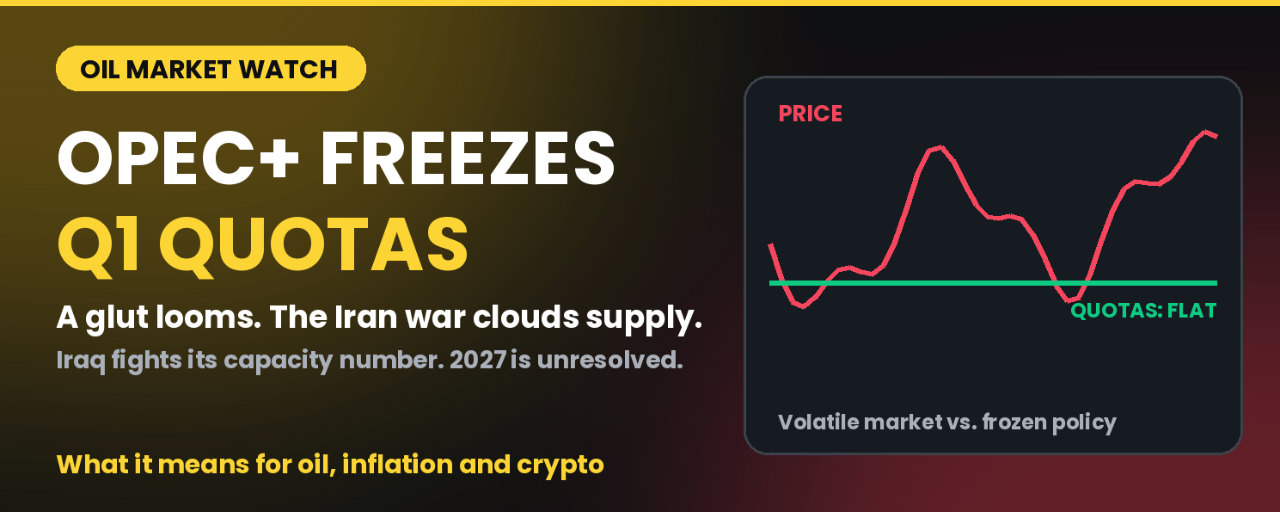
OPEC+ has reportedly agreed in principle to leave first-quarter 2027 oil output quotas unchanged. On paper it's a non-event, but the decision comes with a war, a glut forecast and a quota dispute attached.
What was reported
Two delegates told Bloomberg that OPEC+ has an agreement in principle to keep quotas flat for the first quarter. Saudi Arabia and its partners were due to ratify the plan at online meetings on Sunday. Reuters sources said the same earlier in the week. I couldn't find confirmation of the final outcome yet, so treat this as reported, not final.
Why they are standing still
1. The audit broke down. OPEC+ commissioned its first-ever review of each member's maximum sustainable capacity to set 2027 baselines. Sources told Reuters that Iraq and Kazakhstan challenged their assessments as too low. One report says Iraq objects to a preliminary figure of 4.9 million barrels a day and wants a 2027 baseline of 6 million. With no agreed baselines, freezing Q1 is the easy way out.
2. The Iran war makes supply impossible to model. Gulf exports remain disrupted. Analysts at Rapidan Energy Group argue that nobody knows how long the war will last or how much crude it will keep off the market, so changing targets now would be guesswork.
3. A glut is waiting. Rystad Energy forecasts a global surplus of about 5 million barrels a day next year, roughly 5% of world demand, even if Gulf supply recovers only partially. The IEA expects a fourth-quarter surplus of 1.7 million barrels a day. If barrels return faster than expected, the group faces a very hard call.
The cracks underneath
A frozen quota hides a group under strain. The UAE left OPEC and OPEC+ earlier this year after years of arguing its quota was too low. Iraq has warned it may leave if its quota isn't raised. The cartel's usual tool is discipline, and discipline is harder to enforce when members are openly fighting over their numbers.
Why crypto traders should care
Oil is an input to inflation, and inflation drives interest-rate expectations. Rate expectations drive risk appetite, and crypto is one of the most rate-sensitive risk assets there is. A few ways this could play out:
Supply shock from the war: higher oil, higher inflation worries, tighter financial conditions.
Surplus wins: weaker oil, easier inflation pressure, which is generally friendlier to risk assets.
Quota dispute escalates: a member exit or a price war would mean sharp volatility across commodities, and spillover into markets like crypto is possible.
None of these is a prediction. They are the scenarios worth watching.
The bottom line
"Unchanged" is a holding pattern, not a solution. The real decisions on 2027 baselines, Iraq's demands and how to handle a possible glut are still ahead. Until then, oil's direction depends on the Iran war and the audit dispute more than on this quota freeze.
What to watch next: the final OPEC+ statement, any update on the capacity assessment, and news on Iraq's position.
💬 Do you think OPEC+ can hold together through 2027? Tell me below. 👇
#OPEC #Oil #Crypto #Macro $BTC $BNB